Take a little trip with us through the park. It’s forty-five minutes of Dino-mite conversation Here is a link to a previous post on the first film.

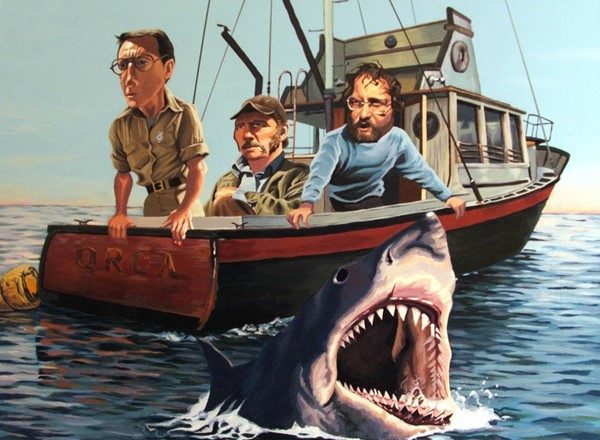
Take a little trip with us through the park. It’s forty-five minutes of Dino-mite conversation Here is a link to a previous post on the first film.
 Don’t let the title fool you, it is not just an obligation it is a pleasure to see and write about the greatest adventure movie of the second half of the last century [and so far, the first Sixteen years of the current one.]
No film has been covered as in depth on this blog site as the original Steven Spielberg classic. If you go back a year to the 40th anniversary, you will see that I saw the movie on the big screen four times in 10 days and did a different post on each one of those visits. You will also be able to find an extensive collection of posts at the following: Jaws Week.
It is late however, and I have some obligations in the next few hours so I will keep this years comments short.
First, I think this may be the first time I saw the movie at the Egyptian Theater, a spot that has become my go to cinema for classic films, including several events each year at the TCM Classic Movie Film Festival. The popcorn is good, the butter flavor rich and they have Coke Zero. Oh yeah, they also have the coolest old school design on the Boulevard.
In introducing the program and telling everyone the rules of conduct, our host tonight asked how many people were seeing the movie for the first time. I was flabbergasted to see nearly a third of the packed house raise their hands. While it surprised this veteran of at least a hundred trips to Amity over the years, it also created a great expectation on my part. I had to ask myself if the film would still work on a fresh audience that is jaded by the speed and CGI of today’s films. I can safely report that when Ben Gardner makes his final appearance in the movie, the screams were loud and people again levitated out of their seats.
When the shark first shows up in profile, there is another jump, and everyone still nervously laughs at Roy Scheider’s ad-libbed classic line. There are two more great scares, a dozen moments of levity that all break the tension in glorious ways and you can tell they were all working tonight. Finally, there was a loud outburst of cheers and applause when the hero solves the problem of the shark in a most satisfying conclusion.
As always, I picked up a couple more tidbits of information during the screening. In the hundred times I’ve seen the movie, this was the first time I noticed the timeline continuity error in the police report for Chrissy’s death and the date of the attack on Alex Kitner. Why I had not worried about it before is beyond me, but I think I’d go crazy if I worried about all those kinds of things. A movie is made up of a million moving parts and sometimes the cog in one section is out of synch with the gears in another section.
Something that bothers me a little more because it seems like it should be obvious. At dinner, when Quint is telling the story of the Indianapolis, I suddenly realize that he and Hooper have finished their meals and that Brody hasn’t even touched his food. It may be the framing on the big screen that makes this more noticeable, or maybe because Shaw is so compelling when he does the monologue, you don’t really take tour eyes off him much. So the Chief has a queasy stomach on the ocean with the more experienced sailors. That’s one more small detail that is so brilliant in making these characters real and representative of their types in the story.
I also think that different prints or sound systems may emphasize some parts of the music or the dialogue a bit more from one screening location to another. After forty years, it’s great to say the movie still succeeds and there are still small moments to discover.
It’s been an amazing ten years that AMC Theaters have put on the Best picture Showcase. In 2007, there were only five films nominated, continuing a long tradition since the 1940s of only including five films in the top category. In 2009 there was a change in the nomination process and up to 10 films would be honored as Best Picture Nominees. That’s when the Showcase evolved into a two day affair spread over two weekends. Since then we have had two years of ten nominations, two years of nine nominations and two years of eight nominations. While it is nice when extra films are included, the four a day weekends are a little easier to get through than the two five a day weekends they had when the rules first changed. Someday though, I hope to tackle the 24 hour marathon when they have eight to ten films play back to back in a single 24 hour period.

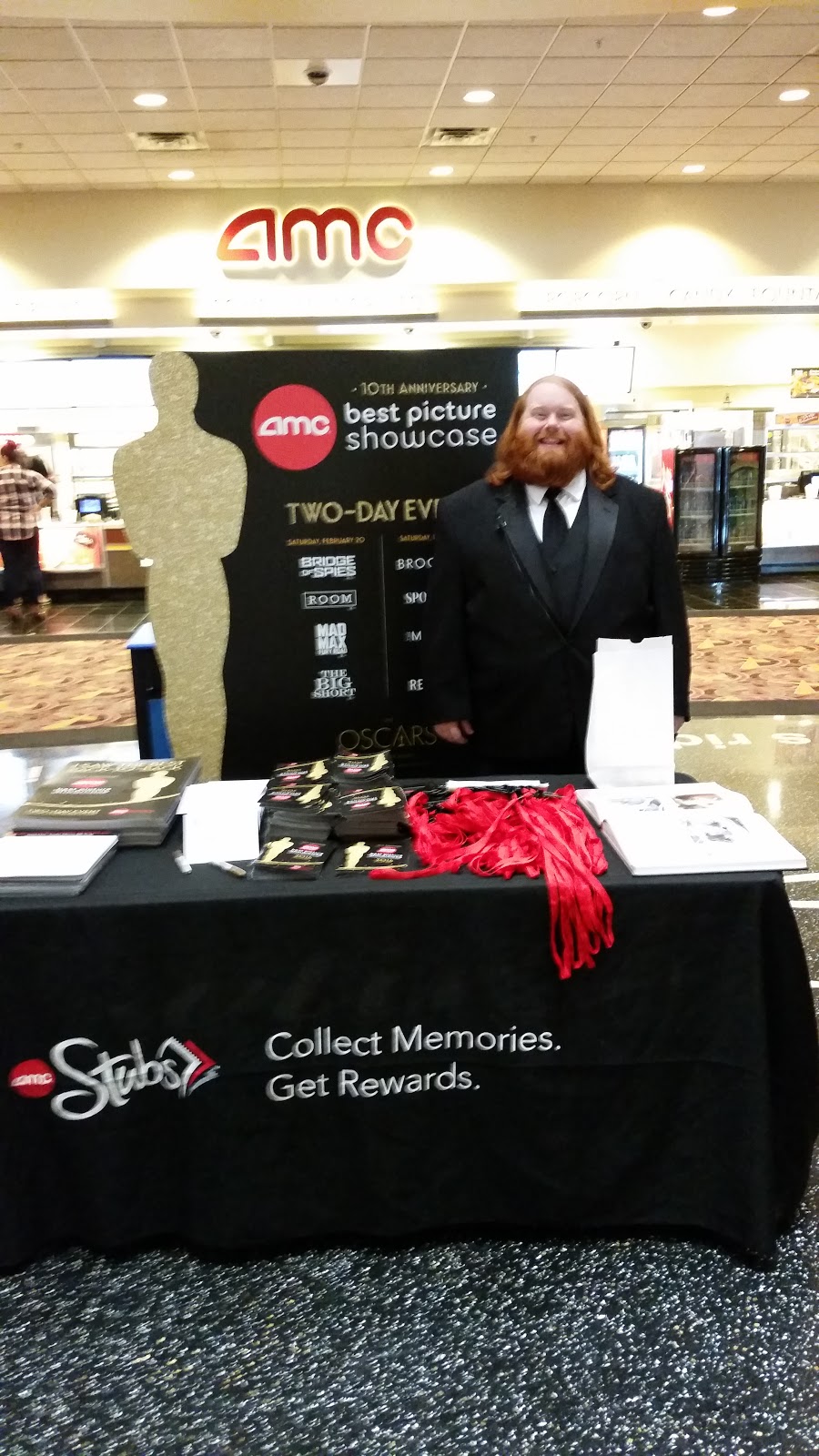 |
| Shane, the AMC host for the event at Santa Anita |
So this year, for some reason, I’ve not seen as many of the nominees as usual. That means I don’t have a lot of reviews to link back to. I will try yo make my comments extensive enough to give you a sense of the film, without necessarily giving you a full review.

How it is that I missed a Steven Spielberg film, starring Tom Hanks and featuring Cold War spy intrigue is a mystery to me. I think that Mr. Spielberg has reached the point where everyone seems to take for granted that his films are going to be good. A bit like Meryl Streep, his movies get nominated a lot but don’t usually end up taking the prose. This is his third nominated film in the last five years, he has had eleven Best Picture Nominations in his career, but only one has taken home the top prize. It gets to the point where we just expect great work from him and then don’t need to confirm it with an award. As an artist with a high degree of consistency, Spielberg is hard to match and he has another excellent film with this movie.
 The production design of this film is meticulous. The late fifties and early sixties are evoked in the subway rides and the vistas they reveal. Sometimes we are moving through an elevated train in Brooklyn, and other times crossing the border between East and West Berlin. The data that was being gathered by the Soviet agent is never described or explained, only the context of his arrest and the times. Tom Hanks Manhattan attorney works in the sort of firm you imagine would be found at the time, with big oak desks and solid doors with engraved nameplates to indicate the partner who’s office we are in. The bleak apartments and prisons of the Communist dominated sections of Germany are contrasted with lush Western hotels and meeting rooms. Only the Soviet courtroom where Francis Gary Powers is convicted, has the grandeur of the western locations.
Working without John Williams for the first time in forever, the music of Thomas Newman is dramatic without having a signature touch. Hanks is as usual excellent, but the stand out in a not quite wordless but certainly an economized set of lines is British Theater star Mark Rylance, playing a Soviet agent who remains unperturbed by his predicament. The impenetrable web of lies that the east Germans, Soviets and Americans share with one another, has to be translated by the boy scout of an attorney played by Hanks, and there are national security issues in every step. It plays out effectively with the usual Spielberg professionalism and eye for details. The parallel images of boys jumping over neighbors back fences in New York and families being machine gunned as they try to cross the new wall in Berlin, is just one mark of that eye that Spielberg has for connecting the visual with the emotional.
I’m not sure I have recovered from seeing this movie yet. A dark story that will horrify and inspire simultaneously, “Room” may be the best acted film nominated this year. Young Brie Larson is almost certainly going to be the winner of the Best Actress award. Her portrayal of a wounded lioness trying to raise her cub while at the same time learning to live with the damage done to her was remarkable. She works with a child actor equally gifted at this stage, Jacob Tremblay. The two of them are the focus of the film almost entirely, even in scenes with other actors, including accomplished veterans, they form the kind of symbiotic performance that makes your heart melt in one moment and freeze in the next.
 The story is told effectively in the first half, with limited camera movement in a claustrophobic space that induces hopelessness. Even after the two emerge from the location of the first five years of young Jack’s life, they seem to still be trapped in that space. It is surprising that Jack, who has known nothing but “room” his whole life is the one who exits the cocoon with the least amount of difficulty. His mother Joy seems at first to be ready to be back in the world but the trauma of her experience is more likely to haunt her for a much longer time than her tough little kid. The scene where her parents and step father sit and confront the elephant in the room will show you how everyone was traumatized by the experience and also give you hope that Joy can recover. Her philosophy toward her son and his existence is humane and righteous, and the fact that her father can’t really deal with it crushes her despite her new won status.
The story is never exploitative, which says a lot for the screenplay and the director. It could have been a horror film or a melodrama, instead it is an opportunity to consider the reality that all sorts of crime perpetrate on our psyches. You may recoil at the suggestion of the media that Joy may have missed an opportunity at one point to spare her child, unfortunately you will also recognize the brutal nature of the news to find any point of controversy to exploit for interest sake. She is a young woman who survived a horrible tragedy, finds a way to rescue herself and her child and then gets second guessed by someone who can’t see that her life is still coming apart in spite of the fact that she is restored to her family. Anyone who doesn’t love animals may not get it, but the healing power of both real and imaginary dogs will cover you with a final warm message.
My third favorite film of the last year, Mad Max Fury Road is the kind of movie that I loved as a kid and would never expect to be nominated for Best Picture. Action films are often seen as mere entertainment and despite the fact that they have been put together in polished and inventive ways, they are mostly neglected at awards season. This is the fourth film in a series that has not been active for thirty years. As a reboot it expands the vision of the director and takes the real. in camera effects that make us movie fans, and puts them on the screen like they did in the days of Ben Hur.
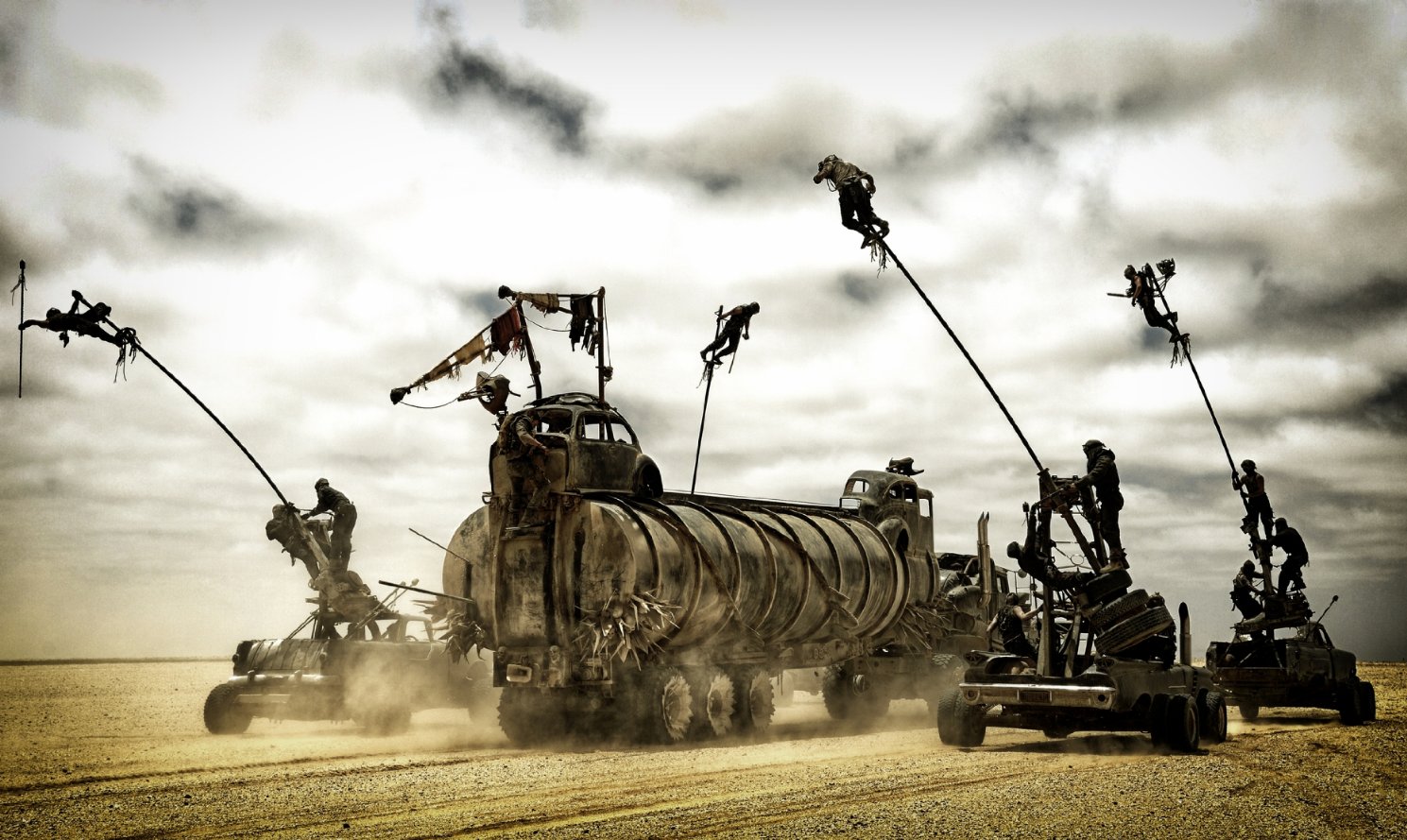
There is also much more of story here than you may at first believe. While the whole movie is a chase film, it is also a film that empowers it’s female characters and pushes back against the brutish domination of women that is often seen in action films. Charlize Theron and Nicholas Hoult are the real lead characters They play wounded souls who are aided reluctantly by the titular hero.
I am clearly not as smart as I’d wish to be. Even with Margot Robbie in a bathtub and Anthony Bourdain making metaphors in the kitchen. a lot of the financial hocus pocus this film was trying to show us was invisible to me. I have a vague understanding of the concepts but an unclear vision of how it was carried out. In an interesting way, none of the groups pictured in this story are the bad guys. They saw what was coming and did make a killing on it, but they simply screwed the real bad guys, whop were the incompetent and indifferent Wall Street types everyone worries about.

Written and directed as if it were a thriller. “The Big Short introduces us to a variety of characters that deserve admiration for their acumen and criticism for their scruples. It was put together from a non-fiction work that tried to explain how the economic meltdown of 2008 came about. According to the screenplay, avarice and stupidity combined with circumstances to bring about a situation where the housing market collapsed on itself. A combination of economic gurus, hedge fund analysts and up and comers anticipated the collapse and created a way to short the market that greedy banks and investment houses were all too willing to try to take advantage of.
The hit and run nature of the story does not give us much chance to care about the characters. We learn that Steve Carrell’s character has a tragedy, that Christian Bale’s character is a genius with no ability to connect to people, and that the character of Ryan Gosling is a weasel who simply cares about getting richer. Most of the action consists of people talking and screaming. Sometimes they are doing so in a humorous way, and every time they prove how stupid someone from an investment company. a government agency or a newspaper is, we get more depressed. After seeing “The Wolf of Wall Street” a couple of years ago, the director and screenwriter Adam McKay seems to have followed the director’s crib sheet and he tells the story through narration, comic freezes, and outrageous moments of human foibles. It’s a good film but I was not as impressed with it as I thought I might be. At least we skipped most of the drug use and sex parties of the Scorsese film.
Next week, the other four films, two of which I have seen and look forward to seeing again.
The world is a different place than it was twenty two years ago when the original “Jurassic Park” stormed onto screens, made CGI the standard by which special effects would be measured from then on, and crowned the king of Hollywood with his greatest commercial success the same year he achieved his greatest artistic success with “Schindler’s List”. Spielberg’s dinosaur movie was the start of freeing our imaginations with digital images and the story was fresh. Here we are all those years later, and everyone knows that the dinosaurs are going to be spectacular, and the setting is going to be lush and the action intense. Even if it is the first time you see any of the Jurassic Park films, “Jurassic World” can never repeat the magic of that 1993 event picture.
 Having said that, and giving anybody with bloated expectations a way to let a little air out of the bubble, “Jurassic World” is a terrific summer film that should fill the pockets of everyone involved because it does exactly what the times call for. It entertains us with spectacle, danger and action. There is one important element missing from this film that was much more abundant in it’s three precursors, humor. Other than that, you will have a great time at the movies as long as you are not really expecting a science lesson.
The park has been open for a while now. It is still unclear to me after the events of “The Lost World: Jurassic Park”, how “i-gen”, the company founded by John Hammond can still exist. They must have had their assets sold off to pay for the lawsuits that would have followed the company after the T-Rex eats half of San Diego. They could not even afford security to keep people off of site B in the third Jurassic Park film. That is all just nit picking however, the point of this movie is to give us something to marvel at and be frightened of. The real monsters continue to be the scientists who play with genetic power and don’t consider the consequences. These films must have inspired a lot of the Monsanto hate out there, because the researchers come across as indifferent to the work they are doing and it’s consequence, they simply see it as something to exploit. B.D. Wong as Dr. Henry Wu is older but not wiser, making all new mistakes with the current endeavor. Vincent D’Onofrio has the Paul Reiser role as a corporate hack who has visions of defense contracts dancing through his head. It’s Bryce Dallas-Howard who ultimately has to redeem herself as a cold fish of an executive, looking at marketing before she considers the ethical and responsible things to do. She does get to the point where we do root for her, but in the beginning, she is as guilty as anyone for what happens.
If you were worried that the velociraptors of the early films had turned into trained house pets, be assured that is not the case. Chris Pratt, channeling Harrison Ford, is working with the deadly pack hunters, but the story is much more realistic than the trailer would lead you to believe. He needed to have more of “Star Lords” one liners and facial ticks, to make the movie sing more. The fault is not in the performance but the script. Jeff Goldblum owned the first two movies with his sardonic sense of humor and his well timed jabs at the corporation and scientific processes. Pratt only gets one or two moments to show off his comic chops, and then once the story takes off, there are no moments of levity at all.
There are several thrill moments in the film, but nothing to match that T-Rex attack from “Jurassic Park”. The sequence with the gyroglobes is meant to stand in for the attack on the jeep in the first film, and it does have a few great elements to it, but it is not as sustained as that first brilliant sequence that Spielberg used all of his skills to put together. Director Colin Trevorrow copies the master but can’t quite match the terror achieved in that sequence. His strongest effort is in the final fight sequence which does manage to use the characters , both real and digital, to their best effect. Composer Michael Giacchino has done a good job in building a soundtrack for the movie but his work will always be overshadowed here by the theme from the first film, composed by John Williams. That motif is repeated in several sections and at the end of the picture it is as if Williams himself did the score for this. It may be an unfair thing for me to say, but it was the way I felt about it.
 The movie succeeds in creating a monster to chase the characters that really is scary. The park looks fantastic and reasonably crowed, at least until the climax. I would want to do several of the rides and attractions we saw in the build up. Kayaking with dinosaurs, riding a Triceratops, or traveling by monorail through a forest are all attractions that would made me want to go through the turnstile. Some times the themes get a little big for the movie. Asset management and investment are certainly important, but a guy who manages to make it to being the eighth richest man on the planet can surely see that losing a $26 million project is small potatoes next to the disaster staring him in the face. Of course if people did not make some stupid choices, there would be no movie for us to thrill to, so ignore some of the improbable s, and sit back for what will surely be the thrill ride of the summer.

This is my entry into the 31 days of Oscar Blogathon hosted by Paula’s Cinema Club, Outspoken and Freckled and Once Upon a Screen. This week focuses on Oscar Snubs. For forty years I have been stewing on this injustice and I am thankful to have an opportunity to vent. Please be sure to check out the other posts on this project at the sites listed above. I have also included links to relevant posts of my own in this entry.
I have always maintained that 1975 was one of the great years in American movie history. Along with 1939 and 1982, this year from the middle of the last golden age of cinema had a plethora of worthy films. I would never denigrate “One Flew Over the Cuckoo’s Nest”, or “Dog Day Afternoon”. “Barry Lyndon” is lovely but I despise “Nashville”. The picture that deserved to win the big award is featured on the masthead of this blog so it is no secret that I harbor an admiration for Steven Spielberg’s “Jaws“. It was an oversight to neglect that movie but it was understandable given the fine work done by all in the eventual winner.
What I do find unforgivable however is the negligence of the Academy’s Actor’s branch to include two performances from that year in the supporting actor category. Not only were the two performances I want to highlight for you ignored, they were far more deserving than any of the roles that did receive nominations. Just to refresh your memory, in case you don’t carry that sort of trivia around in your head for just such a discussion, the nominees in the Best Supporting Actor category were, Brad Dourif as Billy Bibbit in “One Flew Over the Cuckoo’s Nest, Burgess Meredith as Harry Greener in “Day of the Locust”, Chris Sarandon as Leon in “Dog Day Afternoon” and Jack Warden as Lester Karpf in “Shampoo”. The eventual winner was sentimental favorite, comedian, vaudevillian, and TV personality George Burns, as Al Lewis in “the Sunshine Boys”. All of these men did fine work, and no one should be embarrassed to have been included, but the five selected did not include career defining work from two other well known and worthy actors.
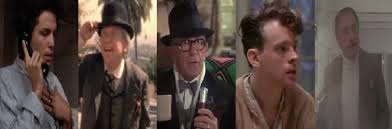 Let me start with the performance that is least likely to be remembered by today’s movie goers. Brian Keith was maybe best known as a Television actor. He starred in two separate successful series, one in the 1960s, “Family Affair” where he played Uncle Bill, the bachelor guardian to his brother’s orphaned children. In the 80’s he costarred in Hardcastle and McCormick, he had two or three other series that did not last more than a season or two as well. He made an appearance in many films since he started in the business but worked most consistently in TV. In 1975 he showed up and off in the John Milius written and directed “The Wind and the Lion“.
Keith played President Theodore Roosevelt, perhaps the most accomplished man we ever had in the job of President of the U.S.. It is also a role that is parodied in films, depicting Roosevelt as a reckless headstrong cowboy, whose bellicose manner was defined as the “Big Stick” policy. What may not be said as frequently is the first part of the policy, “speak Softly”. Keith manages to to convey this dual nature of Roosevelt in this adventure film inspired by a real historic incident.
In the story, Sean Connery is a Berber brigand who has taken an American woman hostage for political purposes in Morocco. As he is preparing to run for the office he inherited, Roosevelt seizes upon the event as a potential campaign issue. Keith never raises his voice or shouts. His whole performance is level but with a lot of vocal nuance. Keith had a naturally gruff voice that fits with our image of the Rough Rider Teddy. He uses tone and pacing to emphasize some deep philosophical ideas well at the same time laughing at himself for taking things so seriously.
Keith has a bit of an advantage in his performance by playing opposite Director/Actor John Huston who plays Secretary of State John Hay. Huston had another one of those great voices and the two of them crossing swords in the White House or out on the shooting range made for some wonderful scenes in the movie that contrasted nicely with the action adventure scenes set in Northern Africa. Keith gets some nice moments of power conveying the certainty of his foreign policy. Roosevelt was know as a man of action and that’s exactly how he is represented here. Not by having him run around in circles crying Bully every five minutes but by speaking forcefully and decisively. His actions are not shown to be short sighted or politically motivated but rather, that he understood the political advantage his manner and policies provided him.
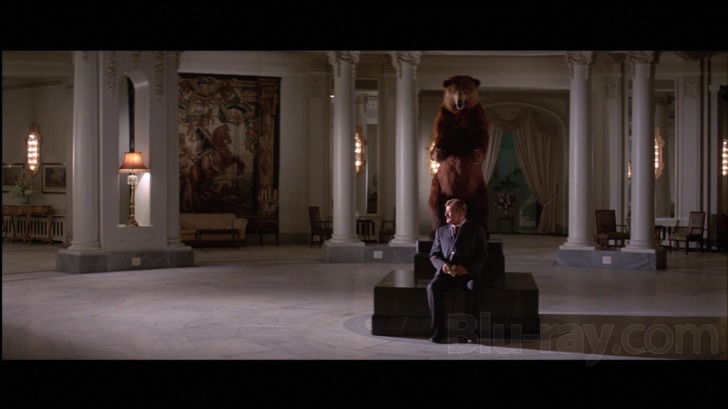
The closest the film comes to mocking Roosevelt is in a scene where he tries to  describe to a man from the Smithsonian, how he wants the grizzly bear he shot to be displayed. He poses with hands up and growls, and encouraged by his daughter, repeats the pose and growl on a table. Part of it is political theater, but mostly it comes across as the enthusiasm of a man who knows what he wants. Keith’s jovial nature in the scene contrasts effectively with an earlier scene in the wilderness with an entourage in tow as he speaks about the taking of the bear with a magnificent vista behind him. He is proud of the accomplishment but also sad. He expresses an admiration for the grizzly that seems heart felt and warm, again mostly because of the vocal variety he uses. He smiles with his voice and speaks wistfully about America’s place in the world.

Connery and Keith never shared any scenes in this film. Their characters are an ocean apart but very similar in nature. In the closing of the movie is the closest we come to an interaction as Roosevelt, suffering from blindness in one eye, sits at the foot of his bear and reads a note from the Rasuli, describing their places in the world. The two actors would share the screen a few years later in the execrable “Meteor” but nothing there matches the power of Connery’s voice over narration as Keith sits in silence and acts with just his shoulders and hands in the scene.
While Brian Keith being ignored is a disappointment since he never had another part equal to that role, the second actor ignored is a crime beyond my comprehension. If you were to ask almost anybody in the movie business, what are the most culturally influential films of the 1970s, there are really two main answers. “Star Wars” is a juggernaut that turned the geek audience into the main driving force of popular culture today. All the comic book movies that dominate the screen these days are descended from that George Lucas film in 1977. Yet it was two years earlier that the ground began to shift, the blockbuster mentality began to rule, and the talent of Steven Spielberg was recognized by the world. The failure to nominate Steven Spielberg for the best film he ever made is probably a result of jealousy by other Academy members and hubris by Spielberg himself. The failure of the actors branch to mention Robert Shaw is inexplicable.
“Jaws” is a film that everyone who watches movies knows about, and anyone who loves movies cherishes. The story behind the making of the film has been told before. So has the story of the impact of the film. This is not the first time I have complained about the neglect of Robert Shaw either. As a vocal advocate of this movie I will freely admit that this is not an unbiased opinion. I consider it a duty to remind the world on a regular basis of the greatness of this film, and this post gives me the opportunity to do so through the means of promoting a great screen performance.

I only hope that this fan made poster is right and we get an anniversary release this coming summer.
I have done maybe a dozen posts over the years on some aspect of this film. It is a film I know I can say I have literally seen at least a hundred times because every year since it has been available to rent or or buy on VHS, watch on cable or on laser disc or DVD, or Blu ray, I have done so approximately four times a year. It is downloaded on my Kindle right now, waiting for an opportunity during a long wait in line or a medical appointment that is taking too long to get to. One of the reasons that it is so repeatable is the performance of the aforementioned Mr. Shaw. It is a part that is fascinating every time I watch it and there is always something new and amazing to discover.
To begin with, 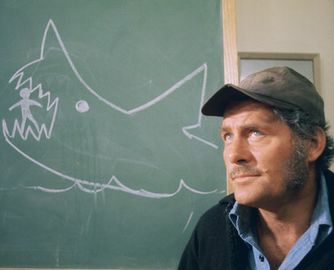 the character of “Quint”, although introduced in the first act of the film, doesn’t reappear in the story until halfway though the movie. That first introduction is incredibly memorable, with Shaw scraping the chalkboard and chewing his food during the town council meeting. He condescends to everyone in attendance and then walks out of the scene. The force of his personality lingers over the meeting and the rest of the film. We know this smug, superior fisherman in the ancient sweater jacket and muttonchops is going to return and be a pivotal player in the story.
While he does pop up in one brief moment, chuckling to himself over the amateurs who think they can bring in the shark, his return to the story takes place on his ground. The business he runs is filled with stewing cauldrons of shark cartilage and homemade liquor. His self assurance is spat out at the way he mocks Richard Dreyfuss’s characters attempt to provide some credentials by mentioning the America’s Cup. Shaw’s English background helped make the flinty New England accent more realistic. His devil may care costuming impresses us with his working class manner of thinking. He is a man who knows his place in the world and is completely confident in it up to the end. Look at the body language as he surveys the equipment that Hooper is bringing aboard, he might just as well have spit. 
The on set legend is that Shaw disliked Dreyfuss and that dislike carried over to his performance. Shaw was also an alcoholic who needed just one drink to turn mean. It sounds like he was the perfect fit for the role. I recently saw “The Godfather” and Sterling Hayden who played Captain McClusky in that film was originally supposed to take the role of Quint, but tax complications kept him out and fortuitously put Shaw in. I can imagine Hayden fitting the part with his haggard look and somewhat raspy voice, but the character would have played very differently. I think he would have come off as an old man set in his ways and believing in them. Shaw provides some of that, but he also manages to suggest that he is just a little off hinged.
For example, the Limerick he recites as Mrs. Brody is dropping off her city slicker husband to go on the shark hunt, sounds so much more snarky and odd coming from a younger man and one who is taking such glee in sharing it out of nowhere. Quint projects it across the sounds of the Orca being loaded and he smiles knowingly as he gets to the somewhat dirty payoff. Shaw almost puts a chuckle in his voice but stops just short of being cloying. Shaw plays Quint as if he is tickled at the chance to show up all these land lubbers. Of course he is also the master of his own boat and while Brody does complain back at one point, Shaw makes it clear in near silhouette and with a frozen posture, that he is having none of it.
 Carl Gottlieb, the credited screenwriter along with book author Peter Benchley, largely gives credit to Shaw for the most famous monologue since Shakespeare. The story he shares is a ghost story about the demons who have haunted him and turned him into the character he is. The fact that Shaw sells the story makes it all the more jaw dropping. This one scene would have won the award for any number of actors. The five minutes in this scene trump the whole five minute performance of Beatrice Straight in “Network”. Of course the role was not limited to that one scene and just about everywhere else, he burns up the screen with his stare, his grin or his hat. The by-play with Roy Scheider as Chief Brody, exists in a friendly but condescending universe.
The three leads are all well cast and well played, but it is the prickly off-kilter Quint who gets the best scene and makes the most memorable impression. Robert Shaw played a series of tough guy roles over the years. Some of them steely like Red Grant in “From Russia With Love“, or Doyle Lonnegan in “The Sting“. Others were playful and heroic like the pirate in “Swashbuckler“. “Quint encapsulates both spirits and puts a haunting backstory in the mouth of a master actor. It’s nice that George Burns got an Oscar and a new career from his role in “The Sunshine Boys”, but history shows that the Academy can make a mistake in the interests of sentimentality. It is my opinion that they did so in 1975.

OK, this is a good way to start the New Year on a movie blog. Last night I had the chance to see the three films from Robert Zemekis that cemented his position as the most commercial director of the 1980s outside of Steven Spielberg, who of course was a producer on all three films himself. This was a digital presentation at the Egyptian Theater and the house was packed. I saw several attendees wearing down vests and one guy with Griff’s hat on from the second movie. It is now 2015 and that was the year in the future that Marty and Doc went to to try and straighten out Marty’s kids. Unfortunately we don’t have the Hoverboards, Flying cars and self tying shoes predicted in the film, but we do have skype, flatscreen TVs, Google Glass, and more channel choices that someone could watch at the same time than anyone should find necessary.
 This will not be a full review on each film but rather just a quick recap and a few comments. These movies are pretty well known and are beloved by millions. The first in the series is one of the great pop entertainment surprises ever. While the follow ups struggle to achieve the same kind of magic as the original, they manage to do the one thing that every consumer of films wants, entertain us.
 The original film roared out of no where in 1985 to incredible popular success and made Michael J. Fox an entertainment icon rather than simply a good character on a successful TV show. The cleverness of the concept and it’s execution are hard to match. This film is funny, exciting and it manages to raise our awareness of family history and it’s significance along the way. While Fox is clearly the star, the secret weapon in this film is Christopher Lloyd, who got laughs from an intake of breath and a bug eyed scream. He manages to make some of the slapstick work where so often it does not in modern films. I will also mention that Lea Thompson is best used in this film and she does the “good girl with a bad side” 50s character just perfectly. She is also strikingly attractive in the film.
 Four years later, the second film was released at the Thanksgiving holidays. It was a success but came nowhere close to matching the original box office draw of it’s predecessor. Maybe too much time had elapsed or maybe it is the sour tone of the movie. Fox is still great, but the complicated movement between time periods and the inconsistency of some of the rules make it a little sloppy. Having to invent a character fault in Marty, in order to justify the story line is also a bit frustrating. Thomas Wilson as Biff/Griff does a great job in building his malignant character, but because the movie uses him in such cartoony ways and so frequently, the movie feels shrill. Doc Brown gets short shrift in this chapter of the story and Elizabeth Shue, as the new Jennifer, is put to sleep a third of the way into the movie and does not return until the coda of the third film. When I first saw this thirty years ago, it was a bit of a letdown. Last night however, it was pure joy. The future sequences play even more effectively now that we are in 2015 and the suspense bits still work. While I feel as if this is the weakest of the three films, that does not mean it is not a success. There is plenty here to enjoy.
 The third chapter was awkwardly set up in the second film, but once it gets started it works just fine and it feels seamless rather than forced. The historical context is fun and the western tropes that are lampooned were amusing. Marty adopts the “Man with No Name” persona, and gives him a name, Clint Eastwood. The fact that Clint was a big star at the time but also the only star who tried to keep Westerns alive during the 80s was a big whoop for film fans. Familiar Western character actors are sprinkled through the film and the gulf between the real west and the movie west is explored just a bit. The addition of Mary Steenburgen to the cast was a nice touch and gives Doc a great conclusion to his story. Watch Wilson copy Lee Marvin from “The Man Who Shot Liberty Vallance” in his portrayal of “Mad Dog Tannen”. He gets the walk, swagger and body movement just right, and in case you missed it, he carries a riding crop in his non-shooting hand. This was a simpler version of the time travel story and it effectively wrapped up the story lines they had created in the second movie. The fact that the two sequels were shot simultaneously saved some money and allowed this film to be released just seven months after the second installment.
 A pleasant evening was had by all and I am much more ready to come back to these films than I have been for a while. They really were terrific entertainment even when there are some issues in the time story sequences.
 Kirkham A Movie A Day