Over the years I’ve become a fan of Wes Anderson films, “Bottle Rocket” was his first film, but it was not the first one that I saw. I’m pretty sure that “Rushmore” was my Gateway into Wiss Anderson filmography. It was after that film that I went and rented “Bottle Rocket” and watched it at home. I had virtually no memory of seeing it other than the memory of going to Blockbuster, putting it in the VCR, and being done with it later and thinking that was a nice bit of nothing.
30 years later I’m pretty much in the same place. “Bottle Rocket” is a shaggy dog story, with the two brothers Owen and Luke Wilson playing off of one another as dimbulb characters whose lofty goal is to become master thieves. Or maybe that’s just the goal of Dignan, the delusional character played by Owen Wilson in full stoner mode. For some reason he’s the character who hasn’t been in a mental institution but clearly should have been. Anthony is the friend who has been self-committed for a time, played by Luke Wilson, as a character who’s only guile is fooling his friend and indulging his delusions. Otherwise he’s a pretty stand-up fellow.
The ridiculous 75-year plan to become Master criminals and live a life of ease is Dignan’s fantasy. It is however clear from the very beginning that these two guys, along with their friend Bob, are too inept to be successful as criminals. At best they would be small timers forever at worst they might get killed pulling off a job that would hardly be worth it. What pleasure is found in the movie is in seeing Anthony trying to make a connection with the maid at the hotel that they’re staying at, in spite of his inability to speak a language she understands.
The sincerity of this Romance is put as a backdrop to Dignan’s plan to connect with Mr Henry, his former boss at Landscaping Company, who also happens to be a low-level criminal. If crime were all in the planning, then Dignan and Anthony would be at the top of the game. For them the problem is that crime is really in the execution, and they are frankly not capable of executing anything more complicated than opening a can of beer.
The story here is not deep, we kind of want the best for these idiots, but we also recognize that they deserve to go to jail for the activities that they are engaged in. At the same time we want Anthony and Inez to work it out. I did think there was one clever twist along the way concerning their plot, but it’s not one that benefits them at all. Mr Henry is the one who’s capable of planning and executing a crime, not these three dimwits.
The offbeat humor and the thickness of the main characters are the traits that mark this as a Wes Anderson film. He will continue to mine these tropes for all of his future movies, but he will add a plot and additional characters to make those a little bit more absorbing. Meanwhile “Bottle Rocket” is a pleasant enough couple of hours, that you won’t mind having spent some time watching. You may however have trouble remembering why I was so pleasant.
Like a lot of film fans, if you ask me on any given day what my favorite movie is from a given director or actor, my opinion is likely to be influenced by the most recent film I’ve seen of theirs. For me I don’t think that’s the case with the Coen brothers. I really enjoy and love most of their films, but “Fargo” has always been my favorite. It features one of the greatest characters that they ever created in Marge Gunderson, the police chief of Brainerd, MN, who heroically pursues malfeasance in her community. Frances McDormand has been a fixture in the Academy Awards process ever since Mississippi Burning, but this is the film that cemented her as the leading actress of our era.
“Fargo” starts off with a lie, one that most people don’t even realize has been passed off on them. An opening card says that the movie is based on true events. No it is not. The mischief that is created by this line is continued in the ongoing Fargo TV series which uses the same conceit, and tagline about how only the names have been changed in respect to the dead and to protect the living. Joel and Ethan Cohen created a mythos with that line which works to make the film that follows more epic than it really is
Francis McDormand is not the only outstanding performance in the film. There are two other actors whose contributions to Fargo make it one of the great dark comedies of all time, while simultaneously being a grim crime story. William H Macy plays Jerry Lundergaard, the hapless car salesman who has taken out a loan against the inventory on his Father-In-Laws car lot, in order to invest in a piece of property he thinks is going to turn a tidy profit down the road. Of course the problem is he needs more money than he can get, and his solution is to kidnap his own wife and to ransom her using his father-in-law’s money. Macy presents a guileless persona in Jerry, he’s a character so conniving and reprehensible, while at the same time being a simpleton and a pushover. You get a good example of his feckless success in the scene where he passively aggressively bullies a customer into paying for an undercoat for the new car he is buying. We get a chance to see how capable Jerry is of lying while still trying to look like a powerless fool. The fact that he is a powerless fool doesn’t hurt.
The third Ace in this hand is Steve Buscemi’s Carl Shoalwalter, a professional criminal nearly as feckless as Jerry is. His frustration with his lot in life builds up to a crescendo of violence rather than a shrug of powerlessness. Buscemi is smarmy and belligerent, dangerously so when he confronts his own partner. No one in the story is reliable, but we can count on Buscemi to always make the worst choice possible and act as if he is the victim instead of the victimizer. Along with Mr Pink, his character and “Reservoir Dogs”, ShowWalter, establishes Buscemi as the weaseliest character actor of the 90s.
Just like Tarantino does, the Coen’s turned violence into grim humor, but unlike Tarantino, whose joke usually depends on the visual explosion of a handgun in someone’s face, the Coen’s make the situation the source of the humor. The violence is just the consequence of a particular situation. We don’t need to see Buscemi shoot the face off of an innocent ticket clerk in a parking structure, his frustration has already been set up, all we need is to see the consequence.
Chief Gunderson, has a couple of great scenes where her real sincerity is contrasted with the deceptiveness of the people she’s interacting with. Her kindness in regard to a former classmate, who clearly has emotional problems, and seems incapable of telling the truth, makes us see Marge as the decent woman she is in a tough job. In the two times she confronts the duplicitous Jerry Lundergaard, she is authoritative and polite up to the point, where Lundergaard’s rudeness demands that she step up. Her voiceless confrontation with Peter Stormare’s character, as he is disposing of his partner in the wood chipper, shows that she is also fearless, under that veneer of Minnesota nice.
Even though the film plays out as a tragedy, with several senseless deaths, which occur under uncomfortably amusing circumstances, there’s still some hope. As Marge and her adoring husband lay in bed contemplating the future and their soon to be born child, we get a sense that the normal people in the world still have a chance. That’s about as hopeful as it gets.
I’ve said it in the past and I’ll say it again now, for a period of 20 years Brian DePalma was my favorite film director. I saw all of his movies and thought they were great, even the ones that flopped at the box office. If you were ever in the mood you can visit my post on the 1984 film “Body Double” and see how I’m willing to commit to DePalma, even at his most lured and financially disappointing point.
“Snake Eyes” probably marks the beginning of the end of my DePalma era. The films that came after hardly seemed interesting, and never drew my attention in the same way. This 1998 film, with an over-the-top Nicolas Cage, and a fabulously understated Gary Sinise, shows the director’s talents at staging, framing, and editing a film in a way that few others have managed to succeed at. Structurally the screenplay starts well past the real start of the story, nowadays that’s fairly typical, but in 1998 it was pure DePalma.
The vast majority of the film takes place on a single night at a prize fight in Atlantic City. The former Resort town transitioned into a casino based economy, which struggles to survive while also trying to mimic Vegas. Nick Cage plays Rick Santoro, a corrupt local detective who’s old friend is a naval Commander in charge of security for the visiting Secretary of Defense. Of course the string of unrelated events creates a confluence of narrative around the assassination of the secretary. The heavyweight fighter, a mysterious blonde, a local newscaster, and some low-life bookies, all are connected to Santoro and the investigation of this crime. Everyone in attendance at the prize fight is a suspect so they are all contained inside of the Arena and the adjoining Casino. This sets up a cat and mouse scenario with Santoro trying to figure out what happened, who to trust, and of course most importantly, whether to take a payoff.
The film is full of long single shot takes, a well-known characteristic of Brian DePalma films. There are also interesting angles, shot from above, clearly inspired by the Alfred Hitchcock films that DePalma has always mined for ideas. The movie feels kinetic without ever losing its coherence. It’s terrific to watch, with 90s style, and an indie attitude, in spite of its big budget and stars. It’s a different kind of dirt then you’d find under the fingernails of a Tarantino film, but the styles are very similar and equally compelling on the screen.
As always, there’s a conspiracy, and the principles have difficulty containing the situation when Detective Santoro becomes the fly in the ointment. Whether or not Rick is supposed to be high on cocaine, he certainly conveys such a personality. Cage has the ebullient voice, grandiose hand and arm gestures, and bug-eyed smirks, which characterize some of his most memorable characters. Gary Sinise looks great in his Naval dress uniform, but it doesn’t take long for us to suss out that there is something not quite right there.
After this film was originally released it showed up regularly on pay channels that we subscribed to on our Dish TV satellite. It felt like it was on a regular rotation at the house, and my kids who were still too young to really be seeing this kind of stuff, watched it anyways, and fell in love with both Gary Sinise and Nicholas Cage. So when a chance to see this film on the big screen showed up, inevitably we were going to go and I’m so glad we did.
This movie is wild, well shot, and a little complex. It is also vastly entertaining. I probably haven’t seen it for 15 years, and I can’t really understand why. The truth is I’ll probably be watching it again in the next few days, because it’s just that addicting. It reminds me in every shot why I loved De Palma of the 70s, 80s and 90s.
For a large number of years now I’ve had an affinity for the films of Guy Ritchie. His English gangster films are the most intriguing with clever plots and hard-nosed dialogue written in a style that is amusing enough to keep me entertained even when I’m not quite familiar with the British vernacular. I’ve even enjoyed his Sherlock Holmes movies and the remake of Aladdin. In the last few years however his output has been a little less consistent. I was not a big fan of “Operation Fortune”, and I had my suspicions about this film, given its apparently turbulent distribution problems. (Although Guy Richie’s The Covenant” was my favorite film two years ago)
I can say off the bat that this is not my favorite of his films but it is also not the worst of those movies that he’s made. The major flaw in this film is the first 45 minutes, where we get the kind of narrative provided in voiceover that tells you that this might have been an intriguing novel but was maybe a little too intricate to show cinematically. Usually Richie gets around that by narrating things that have already happened and then going back and showing us what it all meant. The structure of this film’s narration however seems to be contiguous with the events that are taking place. So we get an omnipresent voice explaining what’s happening on the screen, almost continuously for the first half of the film. I found it quite irritating. Yeah it helps clear up what’s going on on screen, but it was pissing me off having to listen to this voice keep telling me what should be clear from watching the events on screen. The narration is needed to clarify things but it just doesn’t work the way it has worked in previous Richie films.
Now that said, once the action part of the movie kicks into gear, the film works really well. We have a very clear idea of what’s coming because elaborate plans were laid out in the first half of the film. Richie has always played with the timeline of his plots, but this film seems to have done the most surprising of things, stuck to a chronological narrative, and followed through on things that were set up in the first half of the film.
The two biggest stars in the movie are Henry Cavill and Jake Gyllenhaal, both of whom usually have enough charisma to carry a film on their own. The problem with this movie is that they are not really the stars of the film, they’re the secondary characters who carry out the plans of the main lead. Eiza González plays a high powered Financial fixer/lawyer who’s trying to reclaim a billion dollar loan given to a shady South American who is either a drug lord or a dictator, we don’t really know for sure. All we know is that he is scurrilously unwilling to pay back his debt, and has already killed people in the process of protecting himself. Most of the film consists of a high stakes set of financial traps, being perpetrated by González’s character with the assistance of Cavill and Gyllenhaal. They seem to be equally ruthless, but we are clearly on their side from the beginning. Rosamund Pike appears as the financier, who contracts with González s character, but who may be trying to short her in the payoff.
Sid and Bronco are the two tough guys played by Cavill and Gyllenhaal, and their loyalty to González is explained partially on screen, but mostly it’s assumed because of the way the dialogue flows. I don’t want to seem sexist , but I think it may be possible that another one of the faults of the film is that it puts so much of Richie’s Macho based banter into the mouth of the main female character. Rachel, the character played by González, is supposed to be incredibly bright, accomplished and ruthless. All of that comes out in her demeanor, but when the dialogue tries to reinforce it, it doesn’t quite sound as true. Jason Statham, Matthew McConaughey, Hugh Grant and a dozen other British actors have made Richie’s dialogue crackle over the years, González just makes it sound like exotic conversation, not like petulant threats or braggadocious chastisements. To me the thing that doesn’t work in this film is using her point of view to tell the story.
We know how well prepared the team is to carry out their plan when they originally visit the island of their nefarious counterpart. We were shown step by step the plans that were being made to protect Rachel and to extract themselves from anything that might have gone wrong. When Rachel and her team accomplished their objective, you might think that all of that setup was for naught. Of course it’s there for a reason. Eventually all of the three Escape Routes that were elaborately laid out for us , get used in some way because of the usual last minute double cross.
Bronco and Sid are the stereotypically competent to the extreme accessories to what would be a heist film, if the main objective here wasn’t just blackmail in Leverage. Once the chase starts everyone is cool, calm and deliberate. Even when a sacrifice is being made, it is done in a very professional way, reinforcing the old saying it’s not personal it’s just business.
I never saw much marketing on this film and I’m not exactly sure how they would sell it anyway. The heist is not really a heist but more a series of stings designed to create leverage to get somebody in a contract to comply with the terms of their loan. I suppose they could lean heavily on the action scenes and half of the film, but it takes a while to get there and the humor that is usually strung throughout a Guy Richie film seems to be much less frequent than usual. Cool shots of the composed team are all we have to keep us going until the guns start coming out.
Don’t get me wrong I enjoyed the film, I just found it to be less of what I wanted and more of something else . There were probably ways to fix this movie, so that it would more closely resemble some of the earlier gangster films that Richie is responsible for, it just seems like everybody was a little lazy and wanted to do it in shorthand. And then they realize that nobody reads shorthand.
I will tell you up front, especially if you are new to this site, I love musicals. The form is not as popular as it once was, but the ones that manage to make it to the screen are usually going to get some attention from me, even if I have reservations about the subject or director. Hell, if Ari Aster or Robert Eggers did a musical, I’d bother to see it. Fortunately, I don’t have those reservations about this particular film. I generally trust Bill Condon as a director and, although I never read the original novel, I am a big fan of the 1985 film that was based on it. William Hurt won the Academy Award for his performance as Luis Molina, and the film played the story straight as a political drama, with tragic outcomes.
When the story was converted to a Broadway Musical, I was frankly confused. I could not quite imagine how this bleak story of two prisoners in a South American hellhole, would work as fodder for tourists visiting New York City. Even with the fantasy sequences extended, it seemed like a longshot at best. I never saw the musical version, which was quite successful, until now. It works really well as a film, and I would be interested in seeing a stage production so I could compare the way they transition between the two worlds presented in the story.
There will be some comparisons here to the 1985 film, since that is my original experience. I actually purchased a Laser Disc copy in the last year because I did not own it in any other form, and the cover art is really nice. I rewatched the film and confirmed my impression from 1985, this was one of the best films of the year. So now it comes time to see the musical version in a screen format, and I have to say I was nicely impressed. The tone is a little old fashioned, but that’s ok, so am I.
There are three things that are important to talk about here, the music sequences, the original story premise and the performances. The thing that I liked the most about the musical sequences is that they remind me of the dance numbers and songs from the 30s and 40s era films that inspired them. The camerawork is not ostentatious, it is just clever enough to give us some interesting views of the action taking place. For the most part, the scenes are shown in full screen shots with very limited edits. I’m not an expert, but I would be willing to believe that some of them were done in single takes from start to finish 9if not, then a nod to the editors who made it appear seamless). The settings are often elaborate in the way a musical from bygone times would be. There are extravagant costumes, interesting backgrounds, and colors that pop every time we go to the musical fantasies. Unlike some contemporary music, you could actually follow a melody in most of the songs. This was not a Sondheim tonal fest, but a throwback to films like “Cabaret” or “Chicago”. I wasn’t humming the tunes as I left the theater, but I could if I listened to them a little more.
Bill Condon has stayed true to the political story, but there is one significant change. Molina, the persecuted homosexual that is cellmates with Valentin, the political prisoner, is revealed much earlier in the story as an informer for the warden. That limited my ability to build the requisite sympathy for the character for a lot longer time than in the 1985 film. The prison sequences are fairly grueling, and I was happy there there was no dance number to accompany the food poisoning diarrhea scene. The story is also set more clearly in the Argentina of the 1970s. The timing of events in Argentina are closely tied to the ending of the musical, where they were not as important in the 85 film.
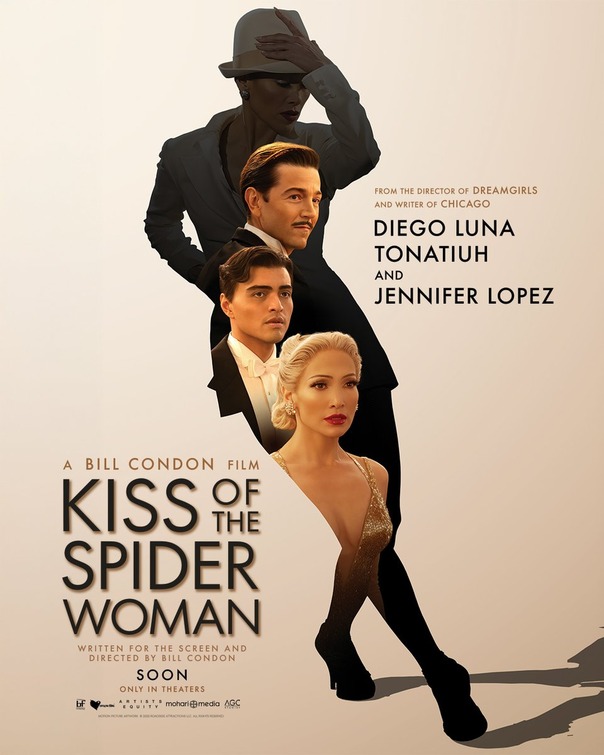
A Crappy Movie Poster Does Not Help
There are several changes in the story of the old film that Molina is recounting from his memory. Those allow the fantasy character played by Jennifer Lopez, much more of a role than Sonia Braga got. Lopez continues to be beautiful on screen and her singing performance is very good, with eight or so songs to perform, including the climax title song. She has the most impressive of the musical elements in the film. Her two costars, get something that the two stars of the 1985 movie don’t get, they have dual roles not only as the prisoners but as characters in the fantasy of the movie “Kiss of the Spider Woman” as Molina is telling it. Diego Luna has the heavier role in the musical sequences as the romantic interest of the star Ingrid Luna (Lopez). Tonatiuh, the actor playing Molina, has the stronger role in the prison scenes. Both of the men are quite good in the jail set scenes. Tonatiuh plays Molina with less obvious femininity than Hurt did, and the more subdued reading of the character might be better for the story, but it will probably not sustain the attention that Hurt’s performance did. This may be a case where the authentic casting works against the need for the audience to suspend it’s disbelief.
So, the movie is old fashioned, put together professionally, does right by it’s socially important political story and the music scenes all work. So why is this film going nowhere fast with audiences? I guess it is just a different world. This movie could have been platform released thirty years ago, starting in prestige locations and then getting a wider release as interest grew. That is not the world we live in anymore, and the success of the movie suffers for it. If you can find it on the big screen, go for it, but my guess is that it will be PPV this week and streaming on a service next month. Too bad, because it would bring back some old fashioned glamour to a movie going experience.
One of the greatest films of the 1970s is also one that is largely forgotten. The reasons for this are complex but include the fact that this film came out in the wake of Star Wars, replaced that film on the Chinese Theater screen for only a week, and then was replaced itself by Star Wars. This was the film that no one knew what to do with, it’s an action adventure film with protagonists who are all loathsome in some way. Their heroic actions are always mitigated by the fact that they are criminals, terrorists, fraudsters, and murderers. When your rooting interest is someone that you would avoid if you cross paths with them on the street, it’s not hard to imagine that a film is going to struggle to find an audience.
“Sorcerer”, may be William Friedkin’s best film, and he made “The Exorcist” and “The French Connection”. This sweat-laden, rain soaked, mud encrusted thriller, will not leave you with a warm feeling, but it will leave you with deep admiration for the director’s skill at building tension and following characters through their true natures.
This was my first time seeing the film on the big screen. I only caught up with it on cable years later, and then finally when the remastered Blu-ray came out about a decade ago, I Revisited it andI appreciated the story. Seeing it in a theater however, is truly a great experience. There are sequences in this film that are so fraught with tension that I felt like sweating myself. Those of you not familiar, the main part of the story focuses on four displaced men, struggling in a poverty stricken Village in the nameless South American country, who take on the job of transporting volatile explosives 200 miles across the jungle.
The first half hour of the movie however, has nothing to do with the main adventure, it simply details what these four men were like before they came together in this anonymous part of the world. Each of their stories has a degree of vibrancy to it that makes their subsequent activities feel more important. Roy Scheider plays the displaced American, a gangster who is wanted by other gangsters for a crime back in the States. There is also a Palestinian terrorist, a French financier, guilty of a massive fraud, and a professional assassin as part of this team of drivers taking on this hellish task because they are desperate.
Perhaps the most amazing part of this film is that it was shot without CGI, or in a studio. The road that this group has to travel is filled with dangerous sinkholes, impossible to pass barriers, and a raging river with a rickety bridge that will give you nightmares. All of it is on screen and all of it is real to some degree. Of course some of the biggest threats come not from nature but from other men. There is revolution in the air, and there are criminal elements who take advantage of the Revolutionary impulses of others, to steal and kill.
Although we got backstories for all four of the drivers, Scheider remains our main protagonist, and our link to the civilization that seems largely out of reach In this jungle locale. As is typical in 1970s films, the ending of the story is downbeat, but not at all in a manner in which you expect. The inevitability of our guilt catching up with us is one of the main themes of the story. I’m not sure if that’s a part of the original film this movie is based on. I have seen that movie, but it has been a long time and I didn’t have the context of this film to compare it to at the time.
So if you want to feel your sphincter tighten, and have your sympathies be conflicted, then you should make it a point to see this film. And of course if you get a chance to see it on the big screen you need to put your money down and go.
Monday Night we returned to our summer house, the Paramount Theater in Austin Texas, to enjoy a 35mm screening of “Sunset Blvd”, from writer/director Billy Wilder. This poison pen love letter to Hollywood is suspenseful and reflective of the cutthroat nature of the film business. The industry has changed a lot since 1950, but some things remain the same. Writers are neglected by audiences as part of the film making process, in spite of the fact they are essential. Older stars are abandoned with indifferent cruelty, after all, who wants to see the elderly in a romantic clinch? And finally, the grasping secondary people will sell off their self respect to make it in the world.
Norma Desmond is a rich but washed up silent movie star, who clings to a dream of being relevant and being adored by an audience. Gloria Swanson does a magnificent job of conveying her delusional self image while also grasping at the desperate attempts she makes at holding onto the dream. William Holden is cynical and callous enough as the down on his luck screenwriter, who allows himself to be snagged like a fly in Norma’s web. He is not guilt free, but we can empathize with every character in the movie, and he is our main protagonist.
The black and white photography, the dark themes and a femme fatale all qualify “Sunset Blvd” as a Noir film. The floating body of the protagonist at the start of the film does the same in spades. The behind the scenes views of Hollywood in the golden age also make this film, unlike any other movie of the era. The below the line talent hangs out at Schwab’s drugstore, they part like normal people on New Years Eve and they are malleable to circumstances like everyone else. Betty Schaffer may be an innocent run over by the system in pursuit of stepping up in class, but she was also willing to abandon her love interest for a more promising prospect, at least until she found out who he really was.
When my daughter was still in school at USC with a minor in film, we took in a screening of “Sunset Blvd” at the Arclight Theater in Hollywood. Just to show her how steeped in film the whole town was and is, I drove straight up the street that we turned out of the parking garage on, and drove four blocks up to Joe Gillis apartment. It is still there, exactly where he said it was in the opening of the film. That is a pleasant memory of Hollywood, “Sunset Blvd” reminds us all, that the fantasy comes at a price.
Our third day of the TCM Film Festival started off with a science fiction classic from the 1950s featuring Special Effects by the great Ray Harryhausen. I don’t think I’ve ever seen this film before “Earth vs. the Flying Saucers”. The morning’s presentation was introduced by Joe Dante a director that I’ve admired for almost 50 years. Just as a side note that behind him at the screening of the Bruce Willis film “Sunset” in the Cinerama Dome.
Earth versus the flying saucers is a straightforward fifties sci-fi film, which means that it features military types who are hysterical about contact with new species, and weapons that we have not encountered before which will require a sudden development of Technology that we haven’t used before. Many times the aliens in these movies are standings for communism, the idea that a totalitarian race wants to dominate us and control our resources and lives sounds like it’s a pretty straightforward interpretation of the Soviet Union, only with cool space suits.
I’m sure I’ve seen actor Hugh Marlow in something else but at the moment I can’t remember what it would be. Many of the actors portraying generals looked quite familiar, I suspect they probably worked regularly in the 1950s playing military types. The highlight of these films is usually the special effects and in this particular case it’s the flying saucers and the Damage they cause Washington DC. Ray Harryhausen he’s always been one of my favorite producers, who’s specialty is stop motion animation, that he did mostly on his own. The effects look really cool on the screen, although in this particular film they were a little repetitive until we got to the attack on DC.
Colossus: The Forbin Project
Our second film of the day was one that I was looking forward to from the moment I first saw the schedule. In the decade Plus that I have attended the TCM Film Festival, I’ve made sure to see the presentations from Craig Barron and Ben Burtt. These two gentlemen have extensive background in sound and special effects, receiving multiple Academy Awards, and having a clear knowledge of the history of their own disciplines. The very first film I saw at one of these festivals was my favorite, “The Adventures of Robin Hood” with Errol Flynn. Barron and Burtt were the presenters for that screening and they had such interesting detail and background history on the movie that I resolved never to miss an opportunity when they were speaking again.
The film they were working on this day, was “Colossus: The Forbin Project”, from 1970. While not the most well-known science fiction film of its ilk, Colossus is a forerunner of some of the most prescient films of the last 50 years. James Cameron was clearly influenced by exposure to this movie because the whole concept of Skynet is stolen from this film. The premise of the film is simple, we have created an artificial intelligence to run our defense systems, and the worst things that can happen do.
I was a little surprised that this was the film that these two gentlemen were working on for the festival, because I didn’t remember that there were extensive effect shots. Of course I forget sometimes that matte paintings and sound design are a big part of how a movie like this manage to impress. The opening shots of Dr Forbin, walking through the Colossus computer as it is being booted up, require some difficult matte paintings that were done by the great Albert Whitlock. The descriptions that the speakers provided impressively explained why we should take note of this subtle work.
I also found it quite interesting, that the sound of colossus’s voice in the television interface that originated at the World’s Fair in 1939, was classified during World War II. The sound technology was used for the direct communication line between Franklin Delano Roosevelt in Winston Churchill. It was a nice simulation of what their call would have sounded like using the encryption sound technology that was later used for this movie. Once again one of my favorite things at the TCM Film Festival was a presentation by Craig Barron and Ben Bert. As an added bonus the star of the film Eric Braeden made an appearance. He did a brief introduction before the movie, and then participated in a little Q&A
Brigadoon
The third film for the day had us returning to the Egyptian Theater for the first time since last year. Although I love the Chinese IMAX I have to say that the Egyptian is my favorite venue for the festival. When I lived in Southern California I was a member of the American Cinematique, who operated the Egyptian. It is since traded hands and is now a Netflix venue, and while that may not be something I think is great, they have done a fantastic job updating the theater while still maintaining it’s historical ambience. Such ambience seemed particularly important for this film, a 1950s Musical that I have never seen before Brigadoon.
I’m a fan of musicals and of Gene Kelly, so it’s a little surprising that I hadn’t seen this for myself at some point in the past. I don’t know that it has the best reputation in the world of musicals, after all I’m not sure there’s a song in it that was a hit. The film however it does have a number of charms, and it’s a good reminder of how the studio system of the golden age of Hollywood could produce a film on sound stages that made you feel like you were in Scotland. In case you are not aware Brigadoon is a village that is either cursed or blessed depending upon your point of view. It’s residents appear to be living nearly forever, because the village is only active for a few days every hundred years. Of course when Gene Kelly and Van Johnson stumble upon the village, complications ensue, but so do some wonderful dance sequences. I was not aware that Van Johnson danced in any films, but he did a pretty credible job with one number in this movie.
The real dancers in the film however were represented at the screening today by two of their own, Barrie Chase and George Chakiris. Both of these actors/dancers are well into their 80s, and they occasionally scratch their heads trying to remember some details about the particular film. They certainly gave us some insight into the way that dancers in those days found jobs or auditioned. I got the definite impression that Barry Chase lost a few opportunities because she would not submit to Arthur Freed . The casting couch was alive and well in those days.
While most of the film looked pretty good there were some sequences that probably needed to be remastered. I was happy to catch up on this classic and enjoy the look of the film even if the story is a little slight, and inconsistent on its own world building. After all it’s really a musical not a science fiction fantasy film interested in creating its own universe.
JAWS
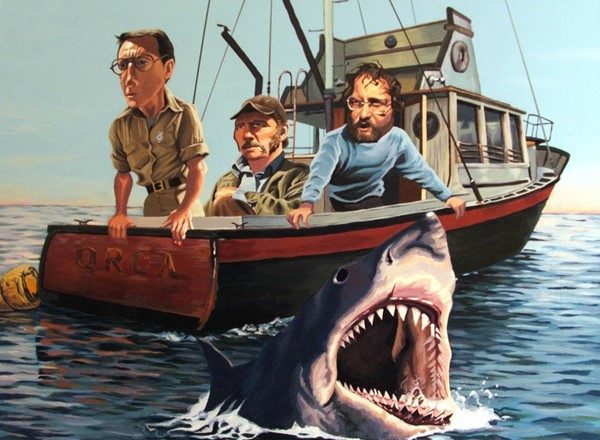
When we left the theater after Brigadoon we immediately got a new cue card and got in line to get back into the Egyptian for the most important film of our at TCM. This year is the 50th anniversary of the greatest film of the second half of the 20th century. Jaws is influential, groundbreaking, and once again in my opinion the best film that Steven Spielberg has ever made.
I am not sure that there is another movie that I have seen in a theater as often as I have Jaws. It made me very nostalgic to be seeing it here at TCM in the Egyptian Theater, since at least a half dozen of my earlier screenings also took place at this iconic venue. Anybody reading this can find more than a dozen posts about the movie Jaws on this blog site. I’m not going to recap the story or the significance of the movie on this day. Instead, main thing I want to talk about is the guest Lorraine Gary, who played Ellen Brody in the film.
She was married to Sid Steinberg, who at the time was the chief at Universal Studios and Steven Spielberg’s mentor. This is the part that she will be remembered for, all of her other roles were primarily supporting TV characters. Frankly she’s terrific in the movie, although she disappears from the film entirely in the third Act. Advanced age of 88 she had No Reservations about being honest concerning her co-workers. She was dismissive of Richard Dreyfuss, without giving any details of why she didn’t care for him. She also expressed the opinion that Roy Scheider was it somewhat mean co-star, and she didn’t have any warm memories of working with him. She did however confess to having a crush on Robert Shaw, which I find completely Charming and ironic given their parts in the film.
The print of the film that was screened for us came from the British Film Institute, and had been preserved since a 1981 presentation on the BBC. The color dyes in this print are probably as close to the original version of the film from 1975, as we are likely to ever see. The film looked magnificent. It was surprising when Ben Mankowitz ask for a show of hands of people who had never seen the movie, that there were dozens of hands in the air. Listening to the audience during the film I had no trouble believing that those people were being honest, because you could hear the intake of breath, the shots of surprise, and the Applause of delight for all those little things that make Jaws the quintessential Blockbuster in one of my favorite films.
Blade Runner
We repeated the process at the end of this film walking out of the theater getting in line immediately to get a new cue card to go back in and see our final film for the evening. Although it was not a financial success in 1982 when it was first released, Blade Runner has been a critical success and a cult favorite for more than 40 years.
One of the first Criterion Collection laserdiscs that I purchased was Blade Runner, back in the 1990s. That version does not include the director’s cut in the Final Cut, but there is discussion of some of the things that would later be included in revised editions of the film. The version we saw appears to have been the Final Cut, so there is no narration in the ending is slightly different, although to be honest we only stayed through the first hour of the film. As I’ve already mentioned we were staying at the house in Glendora so we had a 45 minute ride home, if we stayed for the whole film we would not have been in bed until 1: 30, and we needed to get up at 5: 30 to make Sunday.
The special guests for this film was the female co-star Sean Young, who was only 19 when the film was made and who was making her debut as a film actress with this movie. Miss Young has always been known as an outspoken and opinionated actress and nothing has changed even if she is aged the way I have. She spoke about working with Harrison Ford, the rigors of the makeup chair, and generally working in Hollywood. Her talk was not limited to Blade Runner though, as she made brief comments about several films and actors that she had worked with. She seemed fond of the late Gene Hackman when she worked with in no way out, but never seem to get very close to Kevin Costner who was her leading man. She did say that Blade Runner was the favorite film that she made, but the bigger reaction from the audience was to her second favorite film which was Ace Ventura.
Watching Blade Runner at home on Blu-ray, streaming, or even my beloved LaserDisc, cannot do it justice. Seeing it on the big screen and listening to the score and the sound design of the film in the theater like the Egyptian is one of those things that everybody should experience. We only stayed through the scene where James Hong meets his demise, but I can tell you everything up to that point looked and sounded spectacular on the big screen.
At one time it had been my hope to make a couple of the midnight movies, and “Wild at Heart” would have been another film at the Egyptian had we not been so tired. So we ended our day with the fun talk from Sean Young and the brilliant vision of Ridley Scott.
We got a chance to see this fun little horror film, a little early, as it was being presented in a promotional screening that included streaming Q&A from two of the Stars who also happen to be the writers and directors of the film. Finn Wolfhard and Billy Bryk, are our young actors who have come up with a script and somehow got the green light to make the movie. Wolfhard would be familiar to most of you as Mike from “Stranger Things”. The youngsters have been watching their ’80s horror movies and they have a pretty good grasp of the tropes that they want to take advantage of in their little concoction.
The movie is set at a summer camp, had a remote location, with the camp counselors arriving early in preparation for this season’s Camp session. One of the counselors is returning for the 6th time as a counselor, at the age of 24 is a little old be working this as a summer job, but it appears to be his dream, and he loves what he’s doing. The character is Jason, as if that is not a tribute to earlier horror films, and he is a nebbish but sincere guy who just wants to have the best summer ever. The younger counselors, come from a slightly different generation, and they have a hard time understanding Jason and his enthusiasm for outdoor activities.
The film is a comedy, but it takes the murders fairly seriously. The only time one of the deaths has a cartoon quality to it is in the opening scene, when a guitar is used as a grizzly marker for murder. Other than that tuneful moment, the deaths themselves, even as they pile up, are treated as real murders and not as the punchline to an elaborate joke where the death of a teenager is supposed to be laughed at. So the film is very much in keeping with the tone of the early Friday the 13th or Halloween movies.
Most of the humor occurs when the counselors panic about how to respond to all of the death, and they false the accused Jason of being the murderer. They’re attempted solution to the problem offers lots of opportunities for us to laugh at the callousness and the cluelessness of this new generation of campers. The two step brothers, who also happen to be the writers and directors of the film, also offer us a lot of humorous moments as they bicker like siblings might, over little things such as who gets to sit in the front seat of the car. They did a pretty good job letting us know something about the characters in the film, so that we care a bit about the outcome. There are one or two small Clues as to who is responsible for the killings, those come early on and if you are not paying attention it would be easy to miss them and have to wait for the reveal when it shows up. I’m perfectly willing to say that I miss them the first time around, but I appreciate it that the screenwriters made an effort to give us a chance to honestly solve the puzzle before they do.
In addition to the humor, the main draw of the film will be the Practical effects that are used to present the deaths. There is solid work done by the makeup team, but they don’t go overboard and try to make things so gross that we are reacting to just the physical image more than the concept of what’s been done to these poor kids. The character of Jason is also a rich source of humor in the film, since he wants to be at the camp at all, and eventually wants to take on the role of hero, in spite of being accused by and tied up by the other counselors.
Maybe it takes a while to get things started after we had those initial kills, but I just thought that that was good storytelling. I have no objection to a slow burn as long as it pays off, and I think hell of a summer paid off pretty well. It’s a solid first part of the Apple for the two aspiring filmmakers, and it should satisfy people who have a love for horror movies rooted in the 1980s.
This is a rare film that actually did better at the box office it’s second week rather than the first week of release. There is only one reason for that, the tie in to Valentine’s Day. In fact February 14th was the highest grossing day for the film, almost double the take from the Friday before. People must be desperate for a film that they can share on Valentine’s Day, if this is the thing they committed their romantic holiday to. It is not very good. The level of stupidity can be offset just a little bit by attractive casting.
“Heart Eyes” is a romantic comedy that morphs into a slasher film, in spite of the fact that it starts with a couple of gruesome murders. That is because the murders are so disconnected from anything that we know about this world. The initial couple that we see killed are trying to produce the perfect tick tock video proposal, and you will dislike them immediately. They are self absorbed and controlling, but that doesn’t mean they should be murdered or that we should care that they are. The real story starts with a young ad executive who has miscalculated how to promote romance and engagement jewelry, at the wrong time and in the wrong way. We are supposed to see immediately that she is a darling who has just made a mistake and is uncomfortable with her tasks. I see a stereotypical female romantic lead, who is portrayed as clever but makes every silly mistake you can imagine in the first two acts. The meet cute with her rom-com counterpart is actually a nice play on the trope and he is attractively packaged.
The problem is that the psycho killer is stalking couples and they accidentally become one that the killer is focusing on. Because we know nothing about the killer, other than their costume, we have no idea what the motive is or how the killer thinks. We are getting less than half of the usual slasher film here and the romantic comedy stuff gets run over by the repeated attempts on the lives of our two “non-lovers”. Once in a while that pays off with a funny bit of business but not consistently.
If the reveal of the killer feels like an anticlimax, that’s because it is. There is more to it and we get a stapled on ending in the third act. If you don’t feel cheated by the preposterous new reveal, then all I can say to you is I have an extremely rare copy of “Speed” on Laserdisc that I will let go for $200. Look, I’m a horror fan and I forgive a lot of bad storytelling to allow a fright film room to operate in, but this film expects too much of us simply because it centers around a holiday.
The best “kills” are revealed in the trailer, so save yourself some time, watch that and get your gore fix. Now put on your LED lit goggles and go out and find somebody to share a real movie with.