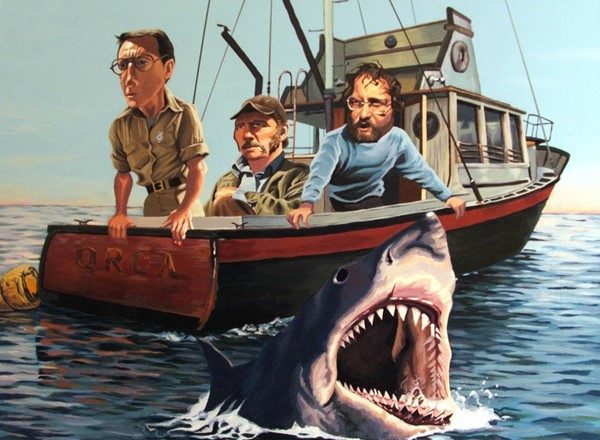
I’m going to let the podcast do the talking for this one for now.
Daily Archives: August 8, 2026
Snake Eyes (1998)
I’ve said it in the past and I’ll say it again now, for a period of 20 years Brian DePalma was my favorite film director. I saw all of his movies and thought they were great, even the ones that flopped at the box office. If you were ever in the mood you can visit my post on the 1984 film “Body Double” and see how I’m willing to commit to DePalma, even at his most lured and financially disappointing point.
“Snake Eyes” probably marks the beginning of the end of my DePalma era. The films that came after hardly seemed interesting, and never drew my attention in the same way. This 1998 film, with an over-the-top Nicolas Cage, and a fabulously understated Gary Sinise, shows the director’s talents at staging, framing, and editing a film in a way that few others have managed to succeed at. Structurally the screenplay starts well past the real start of the story, nowadays that’s fairly typical, but in 1998 it was pure DePalma.
The vast majority of the film takes place on a single night at a prize fight in Atlantic City. The former Resort town transitioned into a casino based economy, which struggles to survive while also trying to mimic Vegas. Nick Cage plays Rick Santoro, a corrupt local detective who’s old friend is a naval Commander in charge of security for the visiting Secretary of Defense. Of course the string of unrelated events creates a confluence of narrative around the assassination of the secretary. The heavyweight fighter, a mysterious blonde, a local newscaster, and some low-life bookies, all are connected to Santoro and the investigation of this crime. Everyone in attendance at the prize fight is a suspect so they are all contained inside of the Arena and the adjoining Casino. This sets up a cat and mouse scenario with Santoro trying to figure out what happened, who to trust, and of course most importantly, whether to take a payoff.
The film is full of long single shot takes, a well-known characteristic of Brian DePalma films. There are also interesting angles, shot from above, clearly inspired by the Alfred Hitchcock films that DePalma has always mined for ideas. The movie feels kinetic without ever losing its coherence. It’s terrific to watch, with 90s style, and an indie attitude, in spite of its big budget and stars. It’s a different kind of dirt then you’d find under the fingernails of a Tarantino film, but the styles are very similar and equally compelling on the screen.

As always, there’s a conspiracy, and the principles have difficulty containing the situation when Detective Santoro becomes the fly in the ointment. Whether or not Rick is supposed to be high on cocaine, he certainly conveys such a personality. Cage has the ebullient voice, grandiose hand and arm gestures, and bug-eyed smirks, which characterize some of his most memorable characters. Gary Sinise looks great in his Naval dress uniform, but it doesn’t take long for us to suss out that there is something not quite right there.
After this film was originally released it showed up regularly on pay channels that we subscribed to on our Dish TV satellite. It felt like it was on a regular rotation at the house, and my kids who were still too young to really be seeing this kind of stuff, watched it anyways, and fell in love with both Gary Sinise and Nicholas Cage. So when a chance to see this film on the big screen showed up, inevitably we were going to go and I’m so glad we did.
This movie is wild, well shot, and a little complex. It is also vastly entertaining. I probably haven’t seen it for 15 years, and I can’t really understand why. The truth is I’ll probably be watching it again in the next few days, because it’s just that addicting. It reminds me in every shot why I loved De Palma of the 70s, 80s and 90s.
Strangers on a Train (1951)
Years ago I said it but I don’t remember exactly who I said it to. Steven Spielberg learned all he knows about building an action scene by watching Hitchcock’s “Strangers on a Train”. The movie is a slow burn with a lot of exposition but the climax is filled with the dramatic carousel chase that ends up being both humorous and truly frightening simultaneously. Hitchcock mixes close-ups with master shots and movement, along with editing to make the scene really sing. It’s exactly the kind of thing that Spielberg has done in Jaws, Raiders of the Lost Ark, Jurassic Park, and the Lost World.
This 1951 Thriller begins Hitchcock’s most epic period of filmmaking. The black and white cinematography was nominated for an Academy Award and it’s almost impossible for me to believe but the truly psychotic Bruno played by Robert Walker was not nominated. Those of you not familiar with the story, it involves a chance meeting between a privileged, spoiled sociopath, and a tennis star that he admires. Bruno has an interesting theory, that the perfect way to commit a murder would be by trading murders with somebody else. That way you could establish an alibi and there would be no way to trace back who the killer of your victim who would have no motive..
Farley Granger plays Guy Haynes. who has a deep resentment to the wife that he thinks he’s about to divorce, but who turns out to be manipulating him simply to keep him paying for her lifestyle in spite of her infidelities. He does lash out at her in one scene but it’s not murderous, it’s simply frustration. Bruno however insists on carrying out his part of the plan, and once he has committed an atrocity, expects Guy to reciprocate. Guy, who is afraid of being implicated in the murder of his wife, tries to avoid Bruno and stay out of his way. But like a gracious Terminator, Walker keeps coming back into the scene. At times convivial, at other times psychotically out of control.
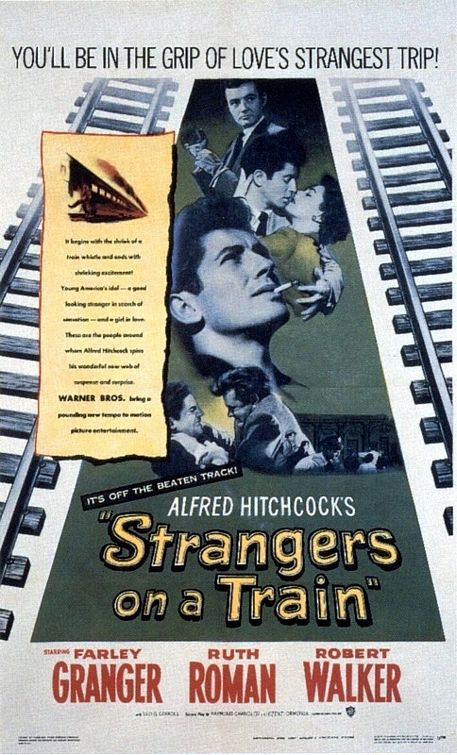
In a continuation of Hitchcock’s habit of focusing on the wrong man, Guy looks like he could be implicated in the crime by some evidence that Bruno has kept. It’s a little complicated, but the woman that Guy wants to marry, helps him plan an opportunity to catch Bruno in the act of planting evidence, thus freeing himself from the threat of a false prosecution. The tension in the third act all starts with a tennis match that needs to finish as quickly as possible. Every serve and every long volley, builds up the tension as we wonder whether or not Guy will be able to intercept Bruno in time.
Along the way in the film there are some fantastic shots, typical of Hitchcock’s cleverness in framing the story. One of the most Eerie visual moments involves watching a murderer approach his victim in the lens of a pair of eyeglasses. Later in the film, there is another moment where Bruno, when demonstrating to some Society ladies, the ease with which a person could take a life, while having a rather Twisted discussion about murder at a cocktail party, loses control and begins to relive his moment and actually starts to strangle one of the elderly women.
Of course the plot is a little exaggerated, and there are some things that the police probably wouldn’t be doing in the way we see it being done on screen. Nevertheless the story holds up and we want Guy to exonerate himself and Bruno to be punished. Since this film was made in the 1950s by an established director with a major Studio you can probably guess that it all turns out all right.
I first watched this film back in the 1980s on one of my cable channels and became fascinated with it. I’ve seen it several times since but always on television . It was great getting a chance to go down to the State Theater and see it on the big screen. I was a little surprised at how jovial some of the audience members were about the threats presented by the antagonist, as if they were not serious and were only comically created. I, on the other hand , watch the way an audience might have back in 1951. Horrified by the suggestion and terrified by the circumstances. But most of all ultimately thrilled by the Mastery of Alfred Hitchcock.
Modern Times (1936)

It’s always great to see a Charlie Chaplin film but it’s especially so when you get a chance to see it on the big screen. “Modern Times” isn’t strictly a silent film, but there is so little dialogue that it might as well be. It contains some of the well-known visual gags of Chaplin’s career. The story includes his insertion into a large manufacturing tool, and the moments when he’s fed automatically by a machine designed to speed up the workplace lunch break.
The story is very episodic, and that tends to be a feature of silent films, but nevertheless it is still engaging and the presence of Paulette Goddard adds the romantic element that this type of film needs. The production design on this film is on a level equivalent to the performance of the star / director himself. The famous conveyor belt job requires the substantial movement of men, machinery, and equipment, in a sequence that requires expert timing. Today all of this would be accomplished with AI and computer graphics. To see this accomplished back in the 1930s with just human endeavor is pretty awesome.
There’s plenty to laugh at in the movie, but they’re also a couple of spots where your heartstrings will be tugged. There’s a sequence on roller skates that is pretty phenomenal, and hysterical at the same time. I kick myself every time I see a silent film, because I, like a lot of other people, hesitate to commit to those movies. The truth is I haven’t been disappointed in a single one that I’ve seen, so let’s make the effort to get out there more often. Charlie Chaplin was a hero of the movie industry, and everybody should see those films.

