Paramount Summer Classic Film Series-Sunday Double Feature

Viva Las Vegas

Over the years, I have had to make a lot of choices as to how to spend my movie time. When I was a kid, if an Elvis movie was on tv on a Friday or Saturday, that is what I watched. I loved the King and was not very discriminatory about the quality of the films. I know I saw parts of this movie when I was younger, but I was not sure I’d seen the whole thing. In the more recent past, I missed a chance to see this on the big screen at the TCM Film Festival. Last Sunday helped me remove my doubts, I had seen the movie, and just forgotten parts of it. One of the Paramount Staff (Zack I believe) told the programmer, Steven Janise, that after watching all of the Elvis movies in a recent binge, that “Viva Las Vegas” was the best. I seem to remember thinking “Jailhouse Rock” was pretty good, but after our screening Sunday, I would not disagree with the “Viva Las Vegas” rating, it is terrific entertainment.

The story of course does not matter, this is not really a drama, and it barely counts as a romantic comedy. The value of the film is in the musical numbers and the pairing of Elvis with the great Ann-Margaret. The two of them have great on screen charisma, and even some romantic chemistry, but the dramatic elements are unimportant and the script does little to address that. There are at least ten musical sequences that are held together by the slim fabric of the story, and those are the things you come to a movie like this for.

The title song gets three showcases, the first is over the titles, with glimpses of Vegas in 1963 shown underneath the credits and making me nostalgic for some of the long gone venues of old Vegas. Elvis gets a showcase presentation of the song, which reportedly was done in a single take, the only time that happened in any of his films. “Viva Las Vegas” is also the exit tune, and it’s a good thing the song and performance are so catchy, otherwise a third appearance would be tiresome instead of joyful. Ann-Margaret had some cool dance numbers to songs that were not so easily digested as pop tunes but worked well for the setting of Las Vegas life. Another swinging number by the King is a rendition of “What’d I Say”, the Ray Charles number. Elvis does Ray proud with his version.

The only flaw in the entertainment value of the film, comes in the climactic Grad Prix race. Instead of focusing on the contest between Elvis’ character “Lucky” and all the other drivers, the majority of the drama is in frequent crack ups of cars in the race. Several of those accidents looked life threatening, but they are only in the film to add a visual flare, there were no stakes. The one crash that should have killed the Count, Lucky’s friendly rival, appears to have had no effect since the Count shows up at the end, uninjured and swinging along with everyone else at the celebration. It’s all in fun but those crashes looked like anything but fun to me. Fortunately, the King and his Queen, sing and dance again, so all is forgiven.

A Hard Day’s Night

The same year that Elvis was in Las Vegas, The Beatles were taking over the world with their own film. The story and plot are just as lazy as the first of our films. This is just a day in the life of the pop group as they get ready to perform on a major television program. “A Hard Day’s Night” hold together a little more strongly as a film because it knows it is not taking itself seriously, and all four of the lads get to show their cheeky sense of humor. There is a mix of stage based performances with outlandishly staged musical interludes where the four Beatles are just goofing off for the camera.

Watching the films back to back like this, makes it easy to see how the popular culture was changing in the decade. Although “Viva Las Vegas” is in color with a hip setting, “A Hard Day’s Night” black and white photography and mundane London locations, feel so much more innovative and creative. The humor of the film is sarcastic without being nasty, and the four leads all look like they are having some fun at their own expense. It just feels completely modern in contrast to the Elvis film.

Of course the biggest reason for the success of the film are the eleven or so songs from the Beatles, including the title song. The pop melodies of the era were very different than the styling of earlier rockers. It’s not hard to think of each song as “three minutes of joy”. The songs themselves will stand up without the visual scenes, and that is not the case with many of the tunes in the Elvis film. It would be easy to say that these sequences were precursors of the MTV style videos that would become the standard visual introduction for many artists in the following years.

The subplot about Paul’s Grandfather gives the story a chance to get out of the rehearsal studio presentations of the musical sequences. When there is no music though, the scenes are still very amusing. The idea that Paul’s grandfather would try to cash in on his grandson’s fame is particularly funny. The whole movie is an entertaining high from start to finish. You don’t need to smoke, swallow or inject anything to get the effect, you just have to watch and listen. 

Paramount Summer Classic Film Series Double Feature

We had a Double Feature at the Paramount Theater last night. Two 1980s era musicals about dancing. Not to put too fine a point on it, the line for the ladies room was extremely long, for the gentlemen, not so much.

Dirty Dancing

I saw this film when it originally came out in 1987 and I remember enjoying it but not particularly embracing it. I think I have seen it once since then, but more that twenty years ago, again, with some appreciation but not necessarily enthusiasm. After last night’s screening however, I think I can say I am a fan. Maybe it was the passage of time, the fact that I was seeing it with my daughter, or simply the audience enthusiasm that became contagious that converted me. This is a very well made movie. It may be a little hokey, but all of that hoke works the way it is supposed to. 

Patrick Swayze and Jennifer Grey are terrific in the movie. He is a dynamic dancer with looks that can make a female audience member swoon, and she is fresh and authentic and has the dramatic chops for the part that she is playing. So what that the story is the well worn plot path of two people from different worlds falling in love. They get to do so against a great soundtrack, with a nostalgia painted background and dance while it happens. 

Jerry Orbach as Baby’s (Grey) Father, manages to create the kind of father figure who remains sympathetic in spite of his opposition to the pairing. His interjection into the story because of a medical emergency seems right, after all he is a doctor, and the confusion about what is happening was understandable. The third person perspective the audience has allows us to identify with all the characters, and also applaud when the indifferent villain of the piece gets his comeuppance, both at the hands of Johnny (Swayze) and Baby’s Dad. 

The audience last night filled the Paramount with cheers, catcalls and swoon filled ahhhs, as Baby and Johnny come together. The humorous courtship through a crash course in mambo dance training was just the ticket for the blossoming romance. Little expressions on the faces of the two lovers, or a gesture from one to another, elicited a tickled response from the audience. I had not remembered how long the dance sequence in the employees quarters was near the start of the story, but it was worth it.   

In spite of a serious abortion subplot, most people will remember this as a light romance with charismatic actors who had great on screen chemistry. I have read that Swayze and Grey had some personal clashes but managed to successfully work together in making the movie. From watching them in the film, it is hard to believe they frequently did not get along. Choose the fantasy. 

The second film had lost nearly a third of the audience but none of the enthusiasm.

Footloose

Although not as well constructed as “Dirty Dancing”, “Footloose” manages to be just as entertaining, with it’s own sense of purpose as well. No doubt there are repressive communities like the one imagined here, but the stereotypes are a little more jarring in comparison to the first movie. This was a star making turn for Kevin Bacon, who is still in demand as an actor, forty years later (He appears in “Maxxxine” which I will be seeing later today).

The dance sequences in “Dirty Dancing” grow out of the story setting, with dancers at a Catskills resort. Here, there have to be invented moments which will allow for some of the dance moves to be demonstrated. The audience approved of the moves in Bacon’s warehouse solo dance scene, although those approving cheers were frequently preceded by laughter at the set up. Regardless, I think I will have to agree with Peter Quill:

Peter Quill:  on my planet, we have a legend about people like you. It’s called Footloose. And in it, a great hero, named Kevin Bacon, teaches an entire city full of people with sticks up their butts that, dancing, well, is the greatest thing there is.

As much as the dancing is about Kevin Bacon, most of the drama is about Lori Singer. I wasn’t convinced by her relationship with Bacon’s Ren, but she does hit the mark with her contentious but still loving relationship with her father played by John Lithgow. Reverend Moore is trying to protect his whole congregation, in an attempt to compensate for the loss of his son, and the pain he feels is balanced by his sincerity. When he snaps and slaps his daughter Ariel, it is a shocking moment that brings uncomfortable realism to an otherwise light weight fantasy film.

The “Footloose” soundtrack is filled with original compositions that were co-written by the screenwriter, Dean Pitchford. He has eight credited songs in the film, songs that he worked on with the likes of Kenny Loggins, Jim Steinman, Sammy Hagar, and Eric Carmen. It has a very different feel than the 60s needle drops of the other film on this double bill. The scene where Ren plays “chicken” on a tractor, gets the over the top Steinman treatment and it is a perfect fit of grandly over the top song with ridiculous scenario. “Let’s Hear it for the Boy” is a comic gem in the spot that it is used. Overall, the audience was thrilled. 

I’m inclined to accept this summary.

Peter Quill: The Avengers?

Thor: The Earth’s mightiest heroes.

Mantis: Like Kevin Bacon?

Thor: He may be on the team. I don’t know, I haven’t been there in a while.

Movie Music Magic: The Film Music of Jerry Goldsmith

 I subscribe to a Pop Series at the Austin Symphony Orchestra and the final show in that series this season was a concert featuring music from my favorite film composer, Jerry Goldsmith. I looked forward to this evening all year long and it did not disappoint. 

The opening of the concert was a fanfare, like you might get from one of the Major Studios at the start of their films. I’m not sure, but I think it might have been the fanfare written by Goldsmith for the Oscars. It was not credited in the show notes, but I do have a link for you if you want to hear it.

The Opening piece was from the Science Fiction film “Total Recall”. It uses some non-traditional instruments, which was typical for Goldsmith. It sounds a little like a Basil Poledouris piece.  

It is a powerful and driving theme that fits with an Arnold Schwarzenegger film. Loud and Bombastic with some banging percussion that gets you in the mood for spy games on Mars.

Long before I knew his name, Jerry Goldsmith had scored films that in my youth I saw on television. “The Blue Max” with George Peppard is a WWI flying movie about a German Pilot. seeking to become an Ace while also having a love affair with his commanding officer’s wife. The flying sequences are quite good.

As the program went through each selection, Robert Faries, a writer, actor and dirctor from the Austin Arts community, introduced each piece with a little history and background on the film and how Goldsmith’s work was used. His information was enlightening and enhanced the music selections greatly.

There was a medley of motion picture themes that were strung together in an effortless manner that made the styles that Goldsmith worked in seem incredibly vast. This included pieces from “The Sand Pebbles”, “Chinatown”, “Air Force One”, “A Patch of Blue”, “Poltergeist”, “Papillion”, “Basic Instinct” and my favorite Goldsmith work, “The Wind and the Lion”.

The first half of the evenings program finished with a suite of music from “Gremlins”. I mentioned it in a couple of posts in the past, “Gremlins” was the inspiration for me to write the only fan letter I ever composed. I sent it to him at Warner Brothers. I have no idea if it ever reached it’s target but I am pleased to remember that I did reach out to this music giant when his work moved me. 

After the intermission, we quickly dove back into some great science fiction music from “Capricorn One”.

Goldsmith always tried to find the contrasting themes to the characters and scenes that the movies he wrote for presented. “First Blood” certainly needed action music, but there is a contemplative theme that permeates the movie. The show notes say “Rambo: First Blood II” but the tune is from the first film, this is an instrumental version of the theme song sung by Dan Hill.

Goldsmith and “Alien” director Ridley Scott did not agree on the tome for the theme of the film. Goldsmith reworked it to the satisfaction of Scott, but as Robert Faires explained, there were also old themes from previous Goldsmith compositions that got used as temp tracks and then stayed in the picture. Regardless of the controversy, the end title music is used in several spots in the film, it is a Goldsmith classic. 

Many people will know Jerry Goldsmith because of his connection to “Star Trek”. He composed the music for “Star Trek The Motion Picture” and the theme became the theme for the television series “Star Trek The Next Generation”. He subsequently scored a few more of the Star Trek Films and TV Shows.

The encore consisted of two themes from movies about American Heroes of WWII. I have never seen MacArthur, but “Patton” is the film that made me fall in love with Goldsmith’s music. A Fitting end to the show. 

Paramount Summer Classic Film Series- This is Spinal Tap

When I wrote about this movie 10 years ago, I suggested in my post that the songs from this movie should have filled all the categories for best song at the Academy Awards. I stand by that statement because these songs do what a music piece in a film is supposed to do, advance the story, illustrate a problem faced by the characters, or tell us more about the characters themselves. All of the songs played by the band Spinal Tap in this movie do those things. I was reminded of this as I watched the film last night, and found myself tapping my toes and mouthing the words while simultaneously laughing.

This Is Spinal Tap is a documentary/ Mockumentary that tells the tale of a band that went from 60s pop to 80s heavy metal and suffered ups and downs like all musical groups do as the fads that they ride go in and out of fashion. Rob Reiner, Christopher Guest, Michael McKean, and Harry Shearer accomplish the task of making characters that we can laugh at and simultaneously identify with, at least to a point. Everyone has felt stupid doing something that others applaud, at the same time we love doing stupid things because we get to get away with it. Rockstars is a notorious for doing exactly this.

When this film came out we were at the height of hair metal popularity, and aging bands playing the nostalgia circuit. Spinal Tap may not have been a real band before this, but after this movie came out the actors who are also the songwriters discovered that their characters had an exterior life, and they have done subsequent tours and special events, and there’s even a sequel in the works. Frankly this movie produces more laughs per minute than most other films are able to accomplish in 90 minutes. The only other movies that I’ve ever felt comparable to the laugh ratio are Mel Brooks films, Monty Python films, and a few early seventies gems. I sure hope that Tap can sustain the laughter in a new entry.

Once again I was at the beautiful Paramount Theater in downtown Austin enjoying a classic movie on a summer evening with several hundred like-minded folks. The audience at last night’s screening laughed continuously and they all seem to get the joke. I could tell that several people in the audience were seeing this for the first time because their laughter was simply too spontaneous to reflect any memory. The movie is a brisk 90 minutes, with several performance set pieces that will leave you chuckling. If the shenanigans that take place during the Stonehenge number don’t make you laugh, you probably have no sense of humor.

Let’s be happy that metal music still exists, that rock bands from the 70s still make the rounds, and that fans of that genre can laugh at themselves when watching a film Like This Is Spinal Tap. Let’s face it, if you can’t enjoy someone else’s amusement at your own foibles, then you were too stuck up to really be a rock fan. Let’s tap into the next great song.

Yesterday

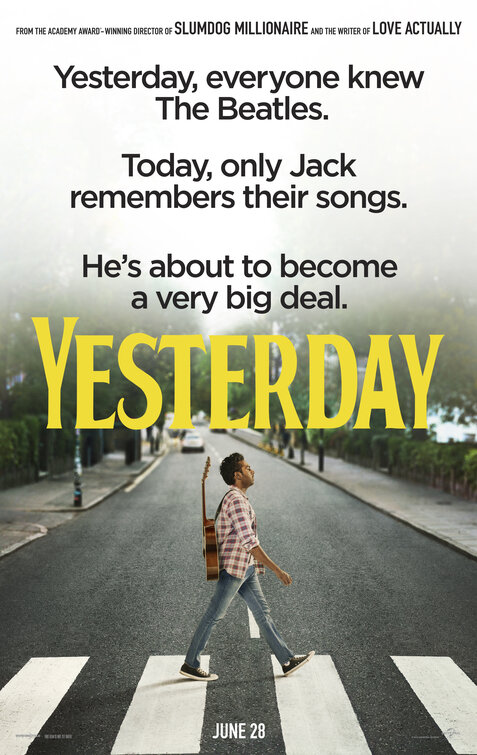
“Yesterday” is a delightful little fantasy, that has little on it’s mind but everything in it’s heart. It is a love story about the music of the Beatles and the love of music in general. There is also a romantic element that weaves through the main story that dramatizes some of the same ideas that are being told in the main tale. Ultimately however, it is merely a fantasy film, designed for audiences that care both about music and the nostalgia of history.

The premise is pretty well summed up in the trailer. After an accident that results from a worldwide blackout, Jack Malik, an unsuccessful, struggling musician, is the only person who seems to know the Beatles. It’s as if Thanos snapped his fingers and just wiped out part of cultural history, rather than half the population of the planet. Like most fantasy, you have to be willing to go along with the conceit and not worry about the logic behind it, because there isn’t any. Much like a body switch comedy from the 1980s, we don’t need to know why the phenomena occurred, we just need to handle the consequences. Jack remembers the songs and lyrics of the greatest pop music ever written and starts reproducing it for himself. Himesh Patel has a face that conveys defeat and frustration at every turn. His failure to connect with an audience outside his circle of friends is sapping his spirit and draining the passion he has for music. The chance to make a success out of his life by claiming the music of the Beatles as his own offers him a conflict that we as an audience can sympathize with. He becomes the greatest plagiarist in history, but he does so in the most guileless way imaginable. He just wants to play the songs. Success is great but he knows he is riding on the work of someone else, but those people will never be able to produce the material themselves.

Jack’s school chum Ellie, has been his manager for all of the time he was not a success, and she steps aside for his career to advance because she can’t really represent him effectively, without altering her life too much. Lily James plays Ellie and she is lovely and sweet and as a secondary character asks on multiple occasions, why have the two of them never gotten together.  Much like a time travel story, “Yesterday” wants us to think about the opportunities that we missed along the line and ponder why circumstances end up as they do. Jack and Ellie seem perfect for each other but after years in the “friends” zone, they are making choices that are fall back positions. Ellie withdraws to a new relationship and Jack pursues fame and fortune with the Beatles songs.

The music is of course terrific, we can thank Lennon and McCartney for that. Patel performs the songs with passion, and although he has a good voice, it is clear why he never made it on his own. The songs he writes are not bad, they simply lack the magic that came from the musical genius of the fab four. When people hear the tunes and the lyrics, they are captivated by the music, not the musician.  Success feels hollow for Jack because he has lost his friend and the songs are not his own. There is a building plot point that concerns whether he will be revealed as a fraud, and in fact he has a nightmare about that possibility. The resolution to this plot line is a good twist and it has one of the most satisfying “what if” scenes that a film like this wants us to speculate on.

It is interesting to think about the way the world might be different if the music of the Beatles did not exist. There are references to some contemporary artists who certainly were influenced by the Beatles but they seem to be unaffected by the disappearance of  John, Paul, George and Ringo. While this might make a logical movie feel off completely, this is a fantasy, and the story gets by simply by acknowledging one influence that would be altered, instead of making it as widespread as it clearly would be. That reference was my biggest laugh in the film, it also opens up another line on music for Jack to take advantage of if he keeps going.

The music business is also lampooned a great deal. Kate McKinnon arrives to manage Jack’s career and make him rich, but mostly make the record company richer. Her greed based, heartless music executive is a stereotype that we will recognize, but she also knows how to manipulate Jack by using his own momentary short comings to guilt him into her way of thinking. Ed Sheeran plays himself, and he cheerfully goes along with sending up his own image. In fact, he may be a little too brutal on himself for comfort.

Screenwriter Richard Curtis takes a premise he created with another writer and makes some magic that will be very recognizable to fans of “Love Actually” and “Four Weddings and a Funeral”.  It is possible that he is mining the same material from his own film from 2013, “About Time“, which has many of the same fantasy elements and dilemmas. This movie is directed by Danny Boyle, who will not be doing James Bond but still can end up on an anticipated list of movies that I want to see. “Yesterday” is a good sized hit for the kind of movie that it is. I think it plays to an older audience because of the Beatles connection, but the young stars probably have added to it’s appeal for a younger audience. If the Beatles music means nothing to you, feel free to skip this movie. But if you are a part of the population with the good sense to know how important that music is, I suspect you will enjoy the film in spite of some flaws along the way.