In spite of the fact that “The Outsiders” was released in 1983 and was made by one of my favorite directors, it has only just dawned on me that I had never seen it. I have been to NYC twice to see the musical stage adaptation, and I own the Complete Novel Version DVD/Blu-ray of the film, so I thought I’d had this as part of my history, but while watching it, I came to the realization that this was a completely new experience for me. Knowing the story is not the same as seeing actors play out the roles on screen or watching a director make choices to emphasize one visual element over another.
I have been lax this summer in keeping up with my blog and the films that I have seen. Some of this passivity is a result of the large number of retrospective films I have been seeing, but an even bigger influence has been my devotion to the LAMBcast episodes and the videos, which take up a lot of my time and reprioritize my efforts. Which is why this post is both late and not as complete as I had originally intended. in the first few years of this blog, I wrote about the films I saw immediately after seeing the movie. Sometimes I would stay up into the next morning to get my thoughts down completely. That has not been the case for the last couple of years and since I don’t take notes, when a post goes up days or even weeks after a screening, I have forgotten many of the things I wanted to write about while watching the film. That has happened with this movie.
I know there were performance moments that I thought were great, but I cannot recall the images or nuances that struck me at the time. I do know that I thought the church fire scene worked much more effectively in this film than I was expecting. C. Thomas Howell and Ralph Macchio were really strong in the film and this sequence was a standout.
Francis Ford Coppola and his cinematographer Stephen Buram, captured the golden hue of the evening that matches the poem and the theme for Ponyboy at the end of the movie. In fact, the whole film does a nice job of creating the 60s era without over doing cultural images that give us a shorthand way of seeing the time period.
The rest of the cast was also great, with Matt Dillon and Rob Lowe the standouts. Tom Cruise is in the edges of the film and his breakout role in “Risky Business” came this same year. Many of the cast members were reunited for “Red Dawn” the John Milius film of 12984, and they all seemed to play off of each other pretty well.
If I see the film again, I will try to be quicker in writing about it so that you get a more complete picture of my experience. Until them Stay Golden.
While I was watching this movie, I was not sure if I liked it or not. There were a number of things about it that were intriguing, but it also seemed to be taking a long while to get to the point. I like a Slow Burn, after all I grew up on the films of the ’70s, where everything was a Slow Burn. Weapons however, seem like every time it got to second gear it downshifted again. The reason for this is the storytelling structure of the film. In the end I’ve come down on the side that this is a terrific way to tell the story and I should get over my occasional sense of impatience.
I don’t think it gives away too much to tell you that the story is told around six distinct characters. Also the narrative path is a little bit like “Memento”, where the previous sequence means more after we’ve seen the follow-up sequence. Stories are interlocking, but they rarely repeat the same Beats. There might be a brief moment or two, that is repeated in each of the sequences, but for the most part they stand alone and give us the kind of context that make the events feel more real and a heck of a lot more interesting.
Julia Garner, Josh Brolin, Alden Ehrenreich, and Benjamin Wong, are all terrific in their roles as players in this horror scenario. As an unjustly maligned teacher, Garner is sympathetic but she is also not perfect. Her flaws make her a better protagonist. The only character who doesn’t have an obvious flaw is Benjamin Wong, as the school principal Marcus. He is the epitome of an effective principal would be like. That of course makes it particularly disturbing when we see the first truly horrific scene in the film. Up until the part where Marcus loses it, our main horror element was dread. When the turn here takes place, it is fear and revulsion that take over.
There is a major character in the story that I’m not going to talk about, because it feels like it would be a spoiler. Although seen around the edges of two or three of the opening sequences, it is only when this character steps into one of those stories openly, that we start to figure out what the hell is going on with the children who have vanished.
Director Zach Cregger, who previously made the film “Barbarian”, has interesting ideas and fun Concepts in his stories. And well they are admirable I’m not going to buy into the hype that these films are exceptional. There are still narrative problems, and inconsistencies, but Cregger does have the ability to direct the film well enough to distract us from those flaws , and still deliver something highly entertaining to watch.
For the first two thirds of the film this feels like a melodrama, posing as a horror film. Once we get to the final character story, The Narrative plays itself out straight, and the usual horror elements do appear. The climax of the film does feature several deaths, and disturbing images, and surprisingly a little bit of Hope for some of the characters who are left. I do need to say however that the film starts off telling us a lie, which distracts us from what’s really happening, and then ignores the lie at the end of the film. As long as you don’t mind being Hoodwinked into seeing a film that is not what is advertised in the opening moments, weapons will satisfy your Jones for a summer horror flick. It’s not perfect, but it’s pretty darn great.
Sunday was a double dose of Paul Verhoeven satire and action. The first movie was the perfection that is “Robocop”. I don’t know if I can count the number of times I have seen this film. I do know that I have seen it at least a half dozen times on the big screen, including a 2023 screening right here at the Paramount Theater. Quentin Tarantino apparently agrees with me that the script is perfect. What is also perfect are the performances from the main actors in the film. Dr. Peter Weller fully commits to the persona of the cyborg, but only after charming us as the eager to please Dad and new partner.
Kirkwood Smith, sneers his way thru the movie as the repulsive Clarence Boddicker, the crime boss of old Detroit. Although they don’t all get as much time to display their horrendous sides to us, the four toadies that make up his crew are equally loathsome, with special emphasis on Paul McCrane as Emil, the one bad guy who gets a deservingly nasty end to his story.
I have always loved stop motion animation when it is integrated into real life surroundings. Ray Harryhausen was a cinema hero to me. Phil Tippet and his crew do a great job with ED-209, with little touches everywhere that add to the humor and tension of the film.
Robert Rodriguez Presented both films and his opening remarks are in the message above.
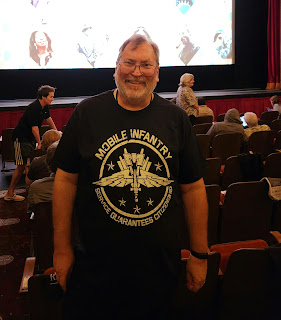
Starship Troopers came out a decade after “Robocop” but it contained a lot of the same bitter satire that the earlier movie did. The hostility to fascism is clear, but of course it is largely missed because we get engaged in Johnny Rico’s story and we can admire his mentors in spite of their authoritarian tendencies. Michael Ironside and Clancy Brown are terrific as the older generation, trying to mold the youth of this world into soldiers and subsequently citizens. It also doesn’t help the anti-fascist theme to have Rico’s parents be a couple of mealy mouthed characters that today might be revered to as woke.
The Special Effects in the film were pretty impressive for 1997. The vast numbers of bugs that the Mobile Infantry has to face is intimidating. Anyone who has dealt with an ant infestation will recognize how much we are outnumbered. In this world however, the bugs are not small and you can’t just stomp on them.
Our host is friends with the star of the film and got him on the phone when it was time to go to the second movie.
One of the great masterpieces of Cinema played on the Paramount screen last Wednesday, and once again I was there to appreciate it. What I was really flabbergasted by though, was the fact that so many people in the audience were seeing “Psycho” for the first time. Our host, the programmer of the Paramount Classic Summer Film Series, asked for a show of hands for people who had never seen “Psycho”. It was hard to believe that almost a third of the audience in attendance that night raised their hands.
The rest of us, who are seeing “Psycho” for the umpteenth time, waited in glee for the many twists and turns that take place during the story. In the long prologue to the violence, Marion Cranes transaction with the used car dealer got a lot of laughs, but you could also sense a great deal of tension in the audience. In fact the laughter that came from the audience almost certainly was generated by people who had seen the movie before and knew the irony of a particular statement, we’re waiting for the turn that comes very quickly.
Once again I think the best scene in the movie takes place in the parlor as Norman Bates tries to relate to Marion, but marks himself as a strange fellow with every sentence he utters. We can still empathize with Norman at that moment, because of the brilliance of Anthony Perkins performance. We can also see the moment of redemption when Marion decides to face her mistakes and return to Phoenix and try and clear up the horrible decision she had made. This is the moment where the movie turns from being a mere thriller to a tragedy, and the two actors in the scene are both brilliant in the way they play their parts.
It must be nearly impossible in modern culture to be on the outside of the big twist in Psycho. 25 years ago I tried to keep my kids from knowing about Norman Bates and his mother, until they had a chance to see the film for themselves. Social media, YouTube, endless memes, all results in fewer surprises for film audiences. That’s too bad. One of my friends on the Lambcast refuses to watch trailers for films, and I completely understand her perspective. I just wish trailers didn’t give so much away. But I still need to have some sense of what a film is about if I’m going to decide to watch it. I think we could use more trailers like the one above, famous for Alfred Hitchcock walking us through the set of his movie.
Anytime you can watch “Psycho” from beginning to end, you should take advantage of it. Anytime you can see it with an audience in a real theater, the real crime would be skipping it.
A lot of people when asked what it is the best shark movie after Jaws, might choose Deep Blue Sea. I saw DBS a week or two ago and was once again impressed with how much fun the movie is. Genetically altered sharks, hunting humans, in the middle of a natural disaster, is obviously a lot of fun. The story is filled with mayhem related to the cumulative destruction of the Marine Research Center where the sharks are housed. As entertaining as this film is however, I must say that it pales in comparison in regard to tension, anxiety, and reality, to the shallows.
This is practically a one-woman show, as Blake Lively plays a surfer, confronting a shark in a shallow bay, somewhere on the Mexican Coast. The setup for the film is very strong, there’s a reason that nobody will miss her for a night, and there’s a reason that the shark lingers in the area, which doesn’t require it to have any particular emotional Arc that it is following. Unlike Jaws the Revenge, it’s not really personal it’s instinct.
Our protagonist is Nancy, a medical student who is uncertain that she wants to continue and become a doctor. She’s retracing the steps of her deceased mother, to locate an isolated beach in a bay that was her mother’s favorite place. She caught a ride with a local, while her traveling companion has been rendered incapable of going with her by inebriation and infatuation with man that she met near their hotel. So Nancy is on her own except for a couple of other surfers with whom she shares the secret of the perfect waves in this idyllic location.
The shark who becomes her nemesis, is there feasting on a whale that it has killed and which is floating into the bay. Perhaps even more harrowing than the shark, which is a consistent threat, is the shallow reef and rock formations, which have rendered Nancy injured, bleeding, and trapped on. After an initial attack, Nancy looks for refuge as she tries to figure out how to reach the shore while the shark doggedly pursues her and lingers in the area attracted by both the whale and her blood in the water.
The film builds a lot of tension, as others enter into this scenario, unaware of the danger that faces them as they interact with Nancy from her perch on a rock outcropping. Actually, Nancy has had three locations from which she tries to stay away from the shark. The first is on the floating dead whale, but as that is like seeking sanctuary on a a dinner plate, that location is not secure for long. The high and low tides exposed part of the reef and shallow rock bottom, at least enough to give Nancy a safe spot to contemplate her woes. Her injuries are significant, including a bite wound that threatens to leach the life away from her. It is convenient that as a budding physician, Nancy understands how to apply a tourniquet and create a pressure bandage out of part of her wetsuit. The Third location that she seeks protection on is it nearby buoy, which becomes her final refuge in the extended confrontation with the shark.
They are desperate attempts to acquire materials that will help her in her fight, some of which work and some of which fail. Her hopes are raised by the arrival of others on the beach, but those hopes are often dashed by the motives of the beachcombers, or by the actions of the shark. As horrifying as a shark bite would be, the moments that caused me physical pain watching the film came from seeing her tumble on the rocks or crawl across the poisonous coral. There’s also a painful interlude with jellyfish, all of which will give you plenty of reason to cringe in your seat.
Most shark movies have some goofy element to them , or a human conflict in the background. “The Shallows” takes an experience that is very serious, and treats it in a way that makes you share the pain and frustration of our protagonist. The only thing that might make this movie feel a little artificial, is the climax and the resolution with the shark. It is dramatically solid, although a little improbable. In the end though none of it matters because we’ve spent two hours living an incident completely through our senses, and hope never to have to share.
I could have sworn I’d written about this film before, but as I looked for any version of a review on the site I came up empty. It must simply be that I’ve talked about it with other people on a regular basis and so I thought I had actually written something about the movie. There are a couple reasons why this feels somewhat personal, but it has nothing to do with my drug use or participation in the adult film industry. Many of the reasons that I identify with this film have to do with the time and setting of the movie, which in some ways do parallel my own life.
The house that Eddie, our main character, lives in with his parents, before he becomes Dirk Diggler, is in Torrance California and it looks exactly like the home of my college debate partner who lived in Torrance. The interior layout and the exterior Frontage might very well have been filmed in his neighborhood. In 1981, which would be in the middle of the time that this film is set, I had a summer job making deliveries of photographic supplies to a variety of businesses, and one of my routes consisted of the San Fernando Valley. Famously, this was the home of the pornography industry at the time, much like it’s depicted in the film. Some of the locations that I made deliveries to were in fact producing magazines that were largely pornographic. So I have a tangential connection to what was going on. The one element of the film however that most closely connects me to the story, is maybe the most compelling scene in the film, the drug deal that goes wrong. One of my closest friends in college took a wrong turn and ended up working as a low-level drug dealer, in the valley. By the time he was doing this I only saw him occasionally for lunch or to talk to on the phone just to check in. I was not immersed in his lifestyle, except that there was one experience when we met for lunch and I drove him to a location where he was making drop off of his supplies. It was one of the most uncomfortable experiences I ever had with him. A year later he was murdered by his partners in the drug business. So although the experience is not exactly the same I can certainly share the perspective of how crazy and dangerous the times were.
My personal connections with the story aside, this is an incredibly watchable movie that is propulsive and uses needle drops and inserts to create a sense of verisimilitude. There are some truly great performances in the film, Mark Wahlberg gives us a desperate, insecure character in the last act, for whom you can feel surprising sympathy. Philip Seymour Hoffman is a minor character in the film, but he develops a sense of pity from us that feels quite realistic. Burt Reynolds notoriously disowned the film, but his performance in it, as the father figure / pornographic film director, is one of his career best. Julianne Moore, William H. Macy, Robert Ridgely, John C Reilly, and a dozen other players all create characters with big faults that we still find ourselves empathizing with, to our surprise.
I was flying solo at this performance at the Paramount, and I got there a little bit later than I usually do. I had to sit near the back on the orchestra level because the theater was packed for this Thursday night screening. The audience was incredibly receptive, and Paul Thomas Anderson, who is not making his debut with this film but for whom this was my first exposure, impressed me and everybody else with how this movie was put together.
It only happens occasionally but this is one of those times, a film will enter my regular blog posts, but also be included in the Strathmore film project. Strother has a minor part in his great 1968 Western directed by Sam Peckinpaugh, a man that Strother had worked with before and would work with again. Any film fan is familiar with the Wild Bunch and it’s significance as part of the new Hollywood.
An elegantin Western sit near the end of the frontier days, the Wild Bunch is about the passing of old ways, and the violence that ensues. The film stars William Holden, Ernest Borgnine, Ben Johnson, and Warren Oats as a band of Outlaws whose competence is in question, and who is being pursued by a posse of prairie scum led by their former compatriot played by Robert Ryan. As surprising as it might seem there are themes of loyalty in the film, and when considering the nature of these men, loyalty is not one of the characteristics you would expect. In fact there is a clear example of such hypocrisy at the very beginning of the film. In escaping from the town and the trap that had been set for them, they abandoned their youngest member, to be set upon by the citizens after the others have escaped.
There is virtually no one in the film that could be described as an honorable person. Everyone is guilty of some form of murder or theft. However, there are moments when the bandits act with dignity, and a sense of a moral code, that seems so foreign to the way they act to the rest of the time. In addition to the issue of loyalty, the biggest theme seems to be autonomy. No one in the film, from the bandits to the Posse to the Mexican soldiers, wants to be told what to do or how to act. The desire to have command over your own decisions seems to be a strong motivator, especially for Holden and Borgnine.
Robert Ryan as an aging Bandit himself, now trapped into leading a posse against his former partners, is the poster child for the theme of autonomy. His inability to act in the manner that he wants, and the fact that he is forced to work with characters for whom he has disdain, is another driving force in the film. Two of the scum that ride with the Posse are TC and Coffer, played by Buddies lq Jones and Strother Martin. If there is anything close to comic relief in the film by these two losers, who bicker with each other like an old married couple over issues like whose bullet killed a victim in the streets, or which one of them gets to keep the boots of the latest dead man they have found. While Pike Bishop and Dutch Engstrom are hardly models of social nicety, they certainly Tower over the likes of Deke Thornton’s mob of Misfits.
Sam Peckinpaugh became famous for the stylized violence in his films, often featuring slow motion deaths. This is the film that probably initiated that reputation. The movie is bookended by two over the top shootouts, which feature Mass deaths in slow motion bullet holes and falls. If there is a third theme running through the film, it may be that violence is inevitable and inevitably futile. There is a coda to the film which also includes violence, but after the massacre of the Mexican troops and the Wild Bunch itself, Peck and Paul wisely allows the massacre of the Posse to occur off screen. So anyone who says that Peck and paw shows no restraint must have missed this last scene.
There’s a lot more to the movie than the two big shootouts, but I’ll leave that for another time. I have no doubt that I will return to the Wild Bunch for a separate entry on the Strother Martin film project. For now it’s just a pleasure to have seen the film once again on the big screen, and bathe in the Macho themes and images that dominate this movie.
It seems like there were dozens of “Jaws” rip-offs in the late seventies. Killer Orcas, Grizzlies, and in this film, genetically modified piranha that can strip a man to the bone in minutes. This was an exploitation picture that launched the career of director Joe Dante. It has only a little of the sideways humor that characterizes his best films, but it does try to keep the audience engaged with frequent piranha victims every few minutes.
The formula is a clear set of beats stolen from “Jaws”. We start with a titillating experience that results in death, followed up by a slow discovery of what is happening, and then a series of denials of reality by officials. One of the main differences is that the obnoxious character who is trying to dismiss the whole thing, gets a comeuppance, unlike the mayor in the shark movie.
Bradford Dillman was a seventies staple as a suspicious official or businessman, and he was in a ton of TV shows of the era. Here he plays a drunk hermit like loser, who hets turned into an action hero for no particular reason. Heather Menzies, who played one of the Von Trapp children in “The Sound of Music” and Strother Martin’s daughter in Sssssss, is a bounty hunter who gets caught up in the action, and veteran horror icon Kevin McCarthy starts a long association with director Dante, playing a crazed scientist. Don’t ask why there is a small lizard man walking around the laboratory in the early part of the film. It never becomes important and it is simply a loose thread.
“Piranha” is an efficient, low budget fright film. The film makers do the best they can with their resources and imaginations. Although many consider it a cult classic, it simply feels standard for the times. But of course those were my times so I loved it.
Most of the entries coming up will be brief, I am still trying to catch up on posts for all the theatrical screenings in the last couple of weeks. I cannot however, skimp on my opinions about this particular film. “Zodiac” has been one of our family favorites since we saw it in it’s original theatrical release. Over the years, it has become a default movie for us. Whenever we have trouble deciding what we should watch , someone inevitably suggests “Zodiac” as an alternative and nine times out of ten, we are watching it again. This screening at the Paramount Theater was the first time I have seen it in a theater since 2007, and it is the first time since I started blogging, that it gets included on this project.
I was eleven years old when the Zodiac killings started drawing press attention across the state of California. So I was old enough to be aware of the story, but still young enough that it did not obsess me the way that it did the characters portrayed in the story. Robert Graysmith , as portrayed by Jake Gyllenhaal, is a cartoonist for a San Francisco newspaper, one that received messages from the killer. His tangential connection lead to an intense desire to know who the killer was, and he wrote the book this movie is based on. Director David Fincher, portrays the writer as an innocent bystander, watching the horror play out around him. Gyllenhaal looks like a baby-faced kid among the police and newspaper professionals that surround the case. His sincerity is achingly displayed on his face as he asks questions of his colleague Paul Avery, who is covering the Zodiac for the paper. Avery is played by a pre-Iron Man Robert Downey Jr. Avery is also presented as an obsessive, but his pursuit is more professional and it consumes him in a different way than Graysmith.
The third leg of the tripod that the story of the investigation rests on is Dave Toschi, a police inspector in charge of the S.F. part of the investigation. Mark Ruffalo plays Toschi as an overwhelmed professional, frustrated by jurisdictional impediments and inconsistent evidence. The two newspaper guys supplement and interfere with his task, but ultimately, it is Toschi who gets to chillingly interrogate a suspect that seems to fit the information that they have. All three of these men get moments of horror as they confront individuals or places that may be a key to solving the crimes. Downey Jr. is playing a character who descends into alcohol and drug use as his paranoia and professional life collide. There is an honesty about those destructive forces that may be a reflection of his real life struggles in the years that preceded this film. Ruffalo seems to be calmly frustrated reacting to both the killer and his amateur pair of Zodiac hunters.
Everyone in the movie is top notch in their performances, but I will single out two of the supporting players to show how well the movie is put together. Toschi has a partner, Bill Armstrong, played by Antony Edwards. Armstrong is a dedicated professional but he remains more impartial than Toschi. He is analytical but not obsessive. Edwards exudes competence with an aura of detachment. He wants to solve the case as much as his partner, but he doesn’t let the frustrations of the case overwhelm him. Edwards is the cool straight man to Ruffalo’s, only slightly warmer counterpart. They make a great team.
The second outstanding secondary performance is by John Carrol Lynch, who plays the eventual main suspect, Arthur Leigh Allen. We only see Allen in the context of the investigations. There are no scenes where he is depicted as the killer engaged in the crimes. We learn about his character in interviews with his former friends and family. When Toschi, Armstrong and two other law enforcement personnel question him at work in the break room of the facility he works at, all sorts of alarms are going off in our heads as the cops listen with gapped mouths to the explanations and information that Allen shares. Lynch is calmly aloof as he spills suspicious conduct and details to the investigators. His face never reveals a fear that he is trapped, or that he is on alert in the face of the questions he is getting. His quiet comment “I am not the Zodiac. And if I was, I certainly wouldn’t tell you.” is as chilling as some of the murders that we see depicted in the film.
The verisimilitude of the film is found in a thousand places in the movie. The location shots are all consistent with the era. There is a sequence with Melvin Belli, a famous attorney who was a celebrity because of the lawsuits and clients he was involved with His depiction reflects the commercial television practices of the time. Toschi is shown attending a special screening of “Dirty Harry” which is a film that has a character inspired by the real life criminal he is pursuing. One of the most haunting and realistic uses of music of the time occurs in the attack on the couple in a car at the start of the film. Donovan’s “Hurdy Gurdy” man plays out over the scene, and you can almost smell the aura of the 1960 descending on the moment.
I would not classify this as a horror film, just as I would not say “The Silence of the Lambs” is a horror film. There are certainly frightening moments but the key is realistic suspense. These are thrillers with horror elements. The creepiest scene takes place in a basement, and there is no blood, weapon or violence shown, but the hair on the back of your neck will certainly stand up at the moment. Charles Fleisher, who is best known as the voice of “Roger Rabbit”, provides an additional supporting character to make this movie the masterpiece that it is.
“Zodiac” was not a huge success when it was first released, but there has been a lot of reassessment in the last two decades and I think you will find that this movie will hold your attention, frighten you and haunt you for a long time. I am happy to have had a chance to see it again in it’s natural habitat and I encourage everyone to spend some time with this excellent film.
I was a big fan of the original “28 Days Later” from 2002, and I also appreciated the sequel “28 Weeks Later” as well. I expected a “28 Months” movie fifteen years ago but it never materialized. So instead, almost 28 years after the original (really only 23) we get a legacy sequel which tries to restore the franchise to life, which is an odd thing considering that many people consider it a zombie film. Regardless of how it is classified, the new film stays relatively true to the preceding movies, with a couple of variations that are bootstrapped in to make the story feel more substantial and original.
An idyllic community has been established on a coastal island, which is only accessible on a bridge that is only accessible during low tide. While there is a threat of infection from the mainland, that possibility is remote. The bigger issues facing the community are limited resources, lost knowledge and in one case, the absence of medical facilities that might be life saving. The community has become a cult of rituals, meant to perpetuate the group and prepare youngsters who were born into this cloistered society, how to deal with the world they live in. The first act of the film is a father-son bonding ritual which involves confronting the outside world, killing some of it, and surviving the terrors that exist on the mainland. Spike, a twelve year old who trusts his father and adores his mother, gets confronted with a confounding situation when his expedition reveals things about his Dad and the world that his mend is not ready to handle.
If there is a weakness in the story, it is not in the action or characters but rather in the short sighted thinking of a kid. His motives are pure but his method is nuts and he should know that. The story becomes a quest for help that lays past the sections of the map that in the old days would be labeled “Here there be dragons”. Spike is resourceful, but there are a couple of convenient moments that solve problems that he would have been unable to manage on his own. There is a good deal of tension in this middle section, as the threat of rage-infected humans looms around every corner. he action is intense, and the escapes are narrow, and the complications are interesting.
The third act is mystical and disturbing, and it is almost a polemic on euthanasia. Ralph Fiennes appears as the most interesting character in the story, and his narrative, while a little preachy, does give us some issues to think about. The conclusion of the movie will throw you off, but I understand that if you live in Great Britain, it will make a lot more sense. There are apparently two sequels coming so Aaron Taylor-Johnson, who plays the dad, will probably be back after disappearing from act two and most of act three. Jodie Comer will be missing for an obvious reason, but that should not surprise anyone who makes it into the movie for twenty minutes. By the way, the opening, which is a revisit to the onset of the zombie apocalypse, is smashing. Those sequences in these kinds of films usually are.