Sunset Blvd.-Paramount Summer Classic Film Series (2025)

Monday Night we returned to our summer house, the Paramount Theater in Austin Texas, to enjoy a 35mm screening of “Sunset Blvd”, from writer/director Billy Wilder. This poison pen love letter to Hollywood is suspenseful and reflective of the cutthroat nature of the film business. The industry has changed a lot since 1950, but some things remain the same. Writers are neglected by audiences as part of the film making process, in spite of the fact they are essential. Older stars are abandoned with indifferent cruelty, after all, who wants to see the elderly in a romantic clinch? And finally, the grasping secondary people will sell off their self respect to make it in the world.

Norma Desmond is a rich but washed up silent movie star, who clings to a dream of being relevant and being adored by an audience. Gloria Swanson does a magnificent job of conveying her delusional self image while also grasping at the desperate attempts she makes at holding onto the dream. William Holden is cynical and callous enough as the down on his luck screenwriter, who allows himself to be snagged like a fly in Norma’s web. He is not guilt free, but we can empathize with every character in the movie, and he is our main protagonist.

The black and white photography, the dark themes and a  femme fatale all qualify “Sunset Blvd” as a Noir film. The floating body of the protagonist at the start of the film does the same in spades. The behind the scenes views of Hollywood in the golden age also make this film, unlike any other movie of the era. The below the line talent hangs out at Schwab’s drugstore, they part like normal people on New Years Eve and they are malleable to circumstances like everyone else.  Betty Schaffer may be an innocent run over by the system in pursuit of stepping up in class, but she was also willing to abandon her love interest for a more promising prospect, at least until she found out who he really was.

When my daughter was still in school at USC with a minor in film, we took in a screening of “Sunset Blvd” at the Arclight Theater in Hollywood. Just to show her how steeped in film the whole town was and is, I drove straight up the street that we turned out of the parking garage on, and drove four blocks up to Joe Gillis apartment. It is still there, exactly where he said it was in the opening of the film. That is a pleasant memory of Hollywood, “Sunset Blvd” reminds us all, that the fantasy comes at a price.

Paramount Summer Classic Film Series Double Feature-Orson Wells

Another double feature at the Paramount Theater on a Saturday afternoon. Two films featuring Orson Wells, one of them was also directed by him. Both films have classical elements to them which might put them on anybody’s Best Lists.

The Third Man

Carol Reed directs a post war thriller created by Graham Greene specifically for film. This was a David Selznick Production so everything was first class but it is certainly an unusual setting for a Selznick film. The actual producer was Alex Korda so it is more accurately a British Film and it thoroughly feels like that. The film is considered a noir, although some traditional elements of a noir seem to be minor. The thing that most justifies that classification is the style in which the film is shot.

The use of black and white is highly expressionistic and the shadows, silhouettes and sudden reveal of Orson Wells character are famous for the atmosphere they create. One characteristic that does not feel noir like at all is the soundtrack, infused with zither instrumentation, it is terrific for the film but rarely ominous or sinister. Still, a non-traditional noir is still a noir when it features a mysterious murder, duplicitous characters, unfaithful women, and a villain who is charming, even if he has no scruples.  

Joseph Cotten  is Holly Martins, a writer of pulp westerns, who has travel to Vienna to join his friend Harry Lime, only to discover that Lime is dead, and Vienna has no use for him. There are a number of bumbling American tropes thrown in to make him feel even more out of place, but his loyalty to his friend may be the one that is most subtle and important. It takes a lot for Holly to recognize that his friend would not be recognizable to him, if Holly knew his real business. The famous shot of Harry Lime being revealed is the start of Holly’s doubts. Before he could dismiss evidence and opinion, but his own eyes tell him that Harry can’t be trusted. 

In addition to the mystery, and ultimately a chase through the sewers of Vienna, there is an unrequited love story. Anna Schmidt loves Harry, Holly falls in love with Anna, Harry never really loved Anna, and apparently loved Holly’s friendship under false pretenses. It is all very complex, and it gets more so as Harry’s confederates murder witnesses and even help frame Holly for the crimes. The British, who were fooled at first but Lime’s deception, don’t fall for any of the subsequent traps, so Holly is never really at risk, but it does make for an interesting twist two thirds of the way into the film.

Two quick James Bond connections; future Bond director  John Glen was working in the editing department at Shepperton Studios when the film started production. He had a similar build to Joseph Cotten and was enlisted to supply the sound of his footsteps in post-production sound dubbing. Bernard Lee, who plays the sympathetic British Sargent and fan of Western Novels, would go on to play “M”, 007s boss in eleven Bond films.

I don’t think anyone left after the first feature, it looked like the house stayed the same size for the second film.

Touch of Evil

I  have seen this film several times, but I have to admit, they have all been after it was restored in 1998. The stories of how the film was butchered after it was delivered by Welles seem to echo the experience he had with “The Magnificent Ambersons”. Still the film had a solid reputation even before the repairs were made to it in 98. I should probably admit to an affinity for the movie because it also came out in the year of my birth, so whenever one of those calendar references comes up, it is sitting right there.

The drug gangs of today are certainly more brutal than the mob that is in this film. Here the criminals seek to tarnish the legacy of their main adversary through a complicated plot. Today’s cartels would simply torture him, cut off his head and display the body in public to discourage follow up. I don’t think we are getting more civilized as we move forward. I suppose it is justifiable to say that in modern times, Charlton Heston would never be cast to play a Mexican using brown face make up, but that social constraint is mild compared to the truth of border town life these days.  

The movie opens with the famous continuous tracking shot, culminating in an explosion. Director Orson Wells is showing off here, but it seems that the studio largely left him alone while the film was being made, so he had a lot more fun playing around with these moments then he’d had on other studio films. Wells was a husky but handsome figure in “The Third Man”, but ten years later in this film, he is clearly overweight and looks unhealthy. Much of that was the make-up and prosthetics but not all of it, and it shows at times. 

Wells did have control over the story, since he is the one who switched the nationalities of the two leads and made Charlton Heston a Mexican. Much of the film is shot at night so we get many sequences that make the film feel noirish. Wells seems to have wanted to confound the audience with the plot, and used characters in several over the top moments (notably Dennis Weaver) to distract the audience from paying too close attention to what was going on. The score is jazz infused and dark, which fits the mood of the picture well. It is no surprise that the Mexican Government was not keen on letting the film be shot in the planned Tijuana, this is not exactly a tourism ad. Venice California substitutes for TJ, and my understanding is that this is an even more accurate switch today, because of thew homeless problem. 

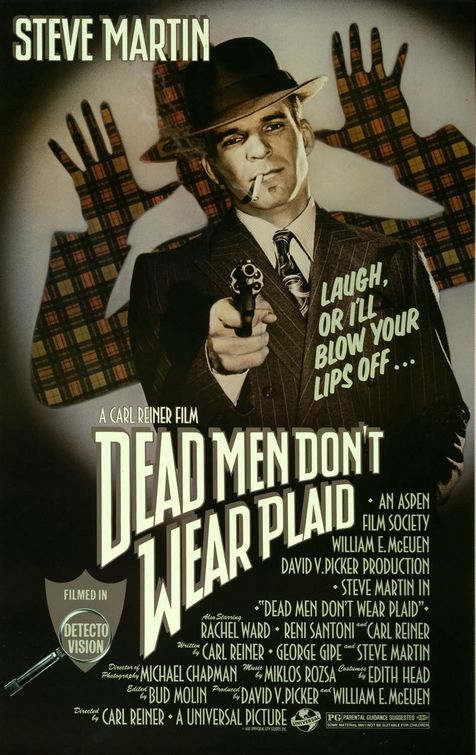
dead_men_dont_wear_plaid_ver1

Steve Martin and Carl Reiner collaborated several times in the late 70s and 80s. Some of their films are silly and some are brilliantly realized concepts. Dead Men Don’t Wear Plaid is both. It is an homage to the film noir of the 40s and 50s, with a Saturday Night Live sensibility. They took clips from more than a dozen classic films and mixed them with new material that was specially created for the movie. Martin rocketed to fame as a stand up comedian, and Reiner honed his comedy chops on improve and 50s variety shows. They seem to have been perfectly combined for this movie.

I saw this movie when it opened in May of 1982. I still have the promo button they passed out at preview screenings proclaiming that opening day was National Plaid Day. It remains very funny but the technology for merging older film stock with contemporary materials is much greater today than thirty four years ago. It still looks great but we are spoiled today by the digital wonders that come from progress. My guess is that Zelig and Forrest Gump would also suffer a little by comparison as each uses a similar technique to this film to tell it’s story.

Rachel Ward was the “It” girl of the early 80s after starring in “The Thornbirds” on TV. She is the damsel in distress rather than a femme fatale here, which she would be two years later in the neo noir “Against All Odds”.  Steve Martin gets to man handle her a couple of times for big laughs in the movie and she was indeed a beautiful woman, although she has no comic touch at all. Reiner himself appears as the butler, and maybe a little bit more, and he hams it up with Martin very effectively. Most of the costars are actually big names from past films who appear for a few brief seconds but are integrated so well into the movie that I hope their families are getting residuals.

Mr. Reiner was honored after the film with a short assemblage of film clips put together by TCM and a nice introduction by actress/author Illeanna Douglas. She proceeded to try to interview him but Reiner was “On” and would not be contained. The 94 year old actor/writer/director/producer was full of jokes, side track stories and assorted foolishness. He was very entertaining but I was occasionally left wondering if he sometimes just lost track of what he was doing and went to a comfort zone.  The big house at the Chinese Theater was packed and the nearly 1000 of us lucky enough to get in gave him a standing ovation greeting that was very sincere.

He talked about his days with the Dick Van Dyke show and was clearly quite proud of his accomplished children, including his director son Rob, his psychologist daughter and artist younger son. He shared George Burns ribald comment with the audience as to what sex was like in your 80s, after all they did work together on “Oh God”, but he had to make sure there were no children in the audience. The analogy was disgusting and funny as heck.  He appears to be in good health and still very amusing with his improvisational comments during the interview.  It was an afternoon well spent and reminds me that I should be visiting my DVD collection more often, where “The Man with Two Brains” and “All of Me” reconnect him with Steve Martin. There are several other films to post about from Friday and Saturday, but I will have to catch up during the week, it’s just too late when we are getting back to do any coherent writing.