Maestro

Leonard Bernstein was one of the Towering figures in the culture of the 20th century. A conductor, a composer, an intellectual and a humanitarian he was also a man who had a conflicted emotional life and who’s personal relations seem to have complicated all of his history. Director actor Bradley Cooper has attempted to create a biopic that does justice to this man, in a short 2-hour period. That he largely succeeds has to do with the tools that he used and the choices that he made. Cooper also co-wrote the script and I suspect the combination of his direction and screenwriting is largely responsible for the way this film feels different than a traditional biopic would.

One of the immediate indications that the film is going to be different is in the way it plops us down directly into the story with very little setup. Although we start with a key incident in Bernstein’s life, most of the film does not attempt to highlight the key moments in his life but rather reflect the way he lived that life. Bernstein got the opportunity to conduct for the first time on a live radio broadcast very early in his career. The event made him a national figure almost immediately. Cooper stages this at the beginning of the film in a very interesting way with very limited concert footage and instead a creative setup of the situation, and then a follow-up with a press conference that seems to provide plenty of narrative explanation without forcing the issue too much.

The dialogue in this film is delivered in a rapid manner with occasional opportunities for the characters to speak over one another. This however does not feel like a cluttered Robert Altman script but rather a more natural form of conversation. Cooper’s script, along with the way he has directed the actors, makes these moments feel very much like we are watching home movies of these conversations and events rather than something that is being restaged for the film. Bradley Cooper and actress Carrie Mulligan both deliver their lines at a quick pace but one that seems to reflect the characters rather than the technique of the filmmaker.

The film focuses on the marriage between Leonard Bernstein and actress Felicia Montealegre. The fact that they are focusing so much on this relationship makes it key that the actors treat the characters as people rather than merely parts that are being played. Cooper for his part does a fantastic representation of Bernstein who had well-known mannerisms, vocal patterns and an appearance. There’s been some controversy about his use of a prosthetic nose to create a closer resemblance to Bernstein, but that use seems to simply be a typical dramatic tool that actors have been using for centuries. Anybody who takes umbrage at this tool seems to be looking for something to create controversy, rather than genuinely being concerned about some ethnic slur. Mulligan’s character is less well known so it’s hard to say that her performance is spot on, but it is easy to say that it is very effective. In many ways her role is the key one in the story since Bernstein is largely reflected in the relationship that he had with her, rather than focusing on his musical accomplishments.

In addition to the script taking a different path in order to make this biopic stand out, Cooper uses a couple of cinematic techniques that do the same thing but, I do think that they draw a little attention to themselves. The first third of the movie is in black and white. It looks beautiful and it feels appropriate for the time period, which I suspect was the point that Cooper was trying to make in the first place. The last half of the film is in color and it also looks distinctive to the time periods of the 60s and 70s, the era which makes up the majority of the period that the film covers. The other technique that looked obvious to me but I’m not quite sure what it accomplishes, is the use of a 1: 33 aspect ratio. When we are dealing with the black and white section of the film, that aspect ratio might resemble a television of the time, so I can see that in creating something that is supposed to resemble real life, the artificial box shape would actually feel more realistic to an audience that recalls that time from what they saw on television. It was not clear to me why we continued to use that aspect ratio when the film transitioned to color. We only get a widescreen presentation at the very end as the credits begin to roll.

In addition to his brilliance Bernstein was a bit of a libertine when it came to his sex life and in the later parts of his life, perhaps to the use of cocaine. This film never suggests that drugs were in any way a help or a hindrance to Bernstein’s career or relationship. The sexual issues however, are in fact, the main point of conflict in the relationship between him and his wife. Felicia apparently was aware that Leonard took lovers of both sexes and well not necessarily approving, had accepted that that was part of his persona. As we watch the avuncular and outgoing Bernstein go about his daily life we can understand at least a little bit how he seemed to embrace all of his Passions with little regard to the conventions of the day. His wife seems to simply expect him to behave with some discretion, and it is divergence from that expectation that leads to the tensions that come up occasionally. Even knowing that he was not always faithful to her, Felicia seems to be Lenny’s most ardent supporter. Cooper depicts the main conflict as occurring when it’s possible his daughter, as a young adult, begins to hear rumors about his infidelities. In this script it appears that Leonard was not ashamed so much of the fact that he was unfaithful to his wife with other men, but rather that he is forced to lie to his daughter because of the conventions of the day and the limitations his wife has imposed on him.

In no way is the suggestion made that Leonard Bernstein had anything other than love for his wife. Rather, the way Cooper has portrayed him is simply a reflection of his ebullient personality and his unwillingness to contain his passions, both for music and for sexual satisfaction. Bernstein does not come across as somebody who is being thoughtless of his partner, but rather has someone who is so enamored of his own lifestyle that he is unaware that sometimes, even though his wife knows of his infidelities, he has hurt her. Although same sex relationships are part of his history, they occur largely off screen in the film.

There are references to Bernstein’s musical accomplishments throughout the film but most of that is presented in a very offhand manner. There are only three or four moments where the music dominates the narrative. That is not to say that the music is tangential in this story, quite the opposite. We know that Bernstein is a figure far above the average composer of the 20th century. Two illustrations show us this in the film. There is a sequence of a Broadway ballet featuring three sailors in which Bernstein and Felicia ultimately participate, and which shows how his music can transport us into a different world. Most film goers will recognize that this is the source of the material for the film “On the Town”. The second major musical sequence that is a key component, both of the drama and of the character that is being portrayed, is the segment where Bernstein conducts a piece of music by Mahler in the National Cathedral. The music itself is a moment of elevation, but the portrayal of Bernstein by Cooper in this moment, is also sublime. It also marks a point in the drama where the maestro and his wife reconcile after a particularly unpleasant separation.

As I was watching the movie I was not sure if I was really enjoying it or if it was just presented in a mannered way simulating the characters in the time period. However the longer the film went on and the more I have thought about it since I finished watching it, the greater degree of respect I have for the movie. It is growing on me even now as I’m writing these words. What I initially thought might be a solid film is turning into one of my favorite films of the year. And most of that has come the deeper I have thought about the movie and the way it has been made.

This is a Netflix film and congratulations to them on producing something so artistic and worthy, but shame on them for having it in theaters for such a limited amount of time and continuing to pursue creating a streaming audience rather than a theatrical audience. This movie is only scheduled to be in theaters for a short period of time. Maybe the fact that it is in an aspect ratio that fits an old television will make it seem like this is an appropriate choice, but I think in the long run audiences will find it a disappointment if they experience this at home rather than in the theater with an audience and a terrific sound system. I’m not in charge of these things but if I had my way this would be a movie that would stay in theaters long enough to collect honors and awards at the end of the year and then move to home video where a wider audience will discover it, but maybe not appreciated as much.
Licorice Pizza

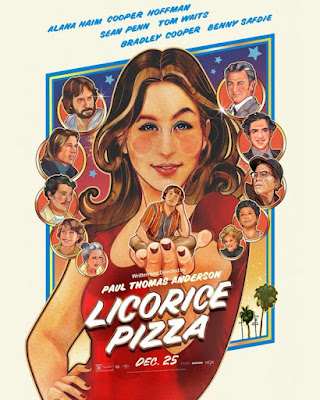
I don’t want to say I was disappointed in this movie, because I am not, but I will say that my expectations were so high that it was unlikely to be satisfied with whatever ended up being on screen, and that became my reality. The first time I saw the trailer, I was wondering if Director Paul Thomas Anderson was doing an Inception number on my head. The schools, the clothes the haircuts and the attitudes were right out of my memory. I didn’t live in the valley but at one time I had a girlfriend who did. The next girlfriend I had, (who I eventually married) did not live in the Valley, but the character of Alana reminded me so much of her at times I had to remind myself that Encino was not my stomping grounds. I was set to love this film, and I only liked it a lot.

The strengths of the movie are  largely the result of Anderson being able to evoke the period so well. The houses and production design are easy tipoffs as to the era. Gary, the male lead, is a young actor, aging out of kids parts and moving into other enterprise because he is basically a go-getter. Not yet 16, he has drive, self confidence, and just enough money from his career up to that point that he can invest in the next thing, be it arcades, waterbeds or Alana. Alana Haim, plays a twenty five year old woman who has not grown up and who has not had her ambitions in life stirred up yet. A decade older than Gary, she nonetheless becomes the object of his fixation, and frankly, he intrigues her enough despite their age difference, that she mostly ignores that decade.  The characters are the heart of the film, they complement one another very well. She grounds Gary’s ambitions and helps channel his boundless energy. She also provides an outlet for his maturity that would not be satisficed by a relationship with kids his own age.   Alana get inspired by Gary. She can see possibilities that she either ignored before or was blind to. Even though she is older, Gary offers her a maturity that she has not had in her family life or profession, such as it is.

It is the random episodic nature of the events in the film that make it feel a little pointless at times. There is never a driving force that moves the characters through their lives and ultimately toward one another as more than friends. It may be an accurate depiction of how we really develop as people, but it is nit a satisfying story telling tool. Gary goes through several business opportunities and Alana pushes him away and clings to him simultaneously. Their brushes with random celebrities are interesting but do nothing to advance the story. I have seen “boogie Nights” and “Magnolia”, so I am familiar with Anderson’s style [Boogie Nights is one of my favorite films], but there is an energy in those films that propels the characters though to the resolution. The incidents here just feel random and they never develop much momentum, only the characters do that. 

Some criticism has been made of the age difference and the notion that if the genders were reversed it would certainly be seen as inappropriate. First of all, most of the film does not involve a direct romance between the characters. They are friends but they do develop longings that would go past mere friendship. Second, it is the younger character who has a more mature attitude about life. Alana is sympathetic but she need someone to give her a push to get her life started. This is almost a gender reversal of “Manhattan” , and I know the Woody Allen reference might undermine my argument, but the film does not. The younger character can see things that the older character can’t. This is a story about how two people fill one another’s needs in ways that are not romantic, and how that ultimately leads to romance. 

Telling a story set in Southern California seems to necessitate the inclusion of show business personalities. I am not sure why we get thinly veiled characterizations of Lucille Ball and William Holden, but Jon Peters and Joel Wachs are both portrayed as themselves. The person who steals the movie entirely is Bradley Cooper, who plays the narcissistic film producer Jon Peters. The few minutes he is on screen give the movie the electricity it needed in several other spots. Cooper shows us a manic, sex addict, social climber who demands perfection from everyone except himself. Aside from the young leads, who are making starring debuts, this is the performance that the movie will be remembered for. 

“Licorice Pizza” is a film with all the components of a great movie but somehow manages to only be very good. I suspect it will grow on me as it matures in my memory and I experience it again. I can’t say that anyone praising this as the best film of the year is wrong, I can only say I don’t see ot that way at the moment. 
 

Nightmare Alley (2021)

I’ve been a big fan of the original “Nightmare Alley” from 1947 since I was a kid. The denouncement of that film is one of the great gut punches in movies. The lead character in that film is a charming heel, but he never seemed outright evil, rather just an opportunist. The Guillermo del Toro version makes Stanton Carlisle a much more malevolent figure and that makes the remakes payoff feel even more potent. The 47 version danced around the edge of crime but was not really a murder mystery. This updated version makes death a key component for all the characters, not just the pitiful mentalist who disappears pretty early in the story. 

The film is a slow burn that picks up speed rapidly in the last act. The set up of Carlisle and his assistant Molly is nice and completely believable. I like the fact that Molly takes things slowly and recognizes the dangers that Stanton is taking as he moves his mentalist act into “spook show” territory. The film may not resonate as much with contemporary audiences because the nature of technology and the media have rendered us cynical about all sorts of things, and we might wonder how anyone could be taken in by Carlisle’s tricks. Although it seems that it is still true that Nigerian Princes requesting money still seem to get a response somewhere on the internet. The main reason I think this sort of thing can continue is that we are all like Stanton, we figure we are smarter than the other guy so no one can fool us. 

The two stories remain faithful up to a point, and then there is a break. I have not read the original novel so it is not clear to me if this is del Toro’s addition or inclusion, but the character of Ezra Grindle played by Richard Jenkins is startlingly ominous, backed as he is by the thug-like but devoted presence of Holt McCallany as his strong right hand. This is not just a mark for the long con, but a potential land mine of a personality that could easily destroy the things Stanton and Molly have accomplished. Cate Blanchett is the seductive and treacherous psychologist who is both manipulated by and manipulating Stanton Carlisle. Her character presents another perspective on the need to be the smartest person in every room, and that motivation conflicts with Carlisle pretty effectively. It was not quite clear to me how she managed to create a chink in Stanton’s armor, but there is a reason that the mentalist should not be drinking. 

The best thing this film has going for it is the production design. I may bot have been a big fan of “The Shape of Water“, but I can’t deny that it was an amazing looking movie. The carnival that is at the center of the opening act is almost as creepy as Willem Dafoe’s character. The wagons and tents and the advertising flys all reek of authenticity and aging utility. The nightclub that Stanton and Molly appear in, is the epitome of the art deco entertainment venues that make me wish I could have lived in that era. Dr. Ritter’s office has the wood inlay walls that scream power and success and there are little pieces of art, furniture and simple background that will draw you in like a magnet. There is a momentary shot of the Spidergirl attraction, and I like the fact that I was personally involved in building a few of those for carnivals and circus use back in the 1970s. 

The film is also populated with some great actors who are doing the kind of work that we expect of them. Toni Collette is sexy but diffident as she ages, David Strathairn is terrific as the pickled former mentalist with the secret Stanton longs for and the wisdom that Carlisle ignores. Roony Mara is earnest as heck as Molly. Mary Steenburgen has two scenes, the first is sympathetic desperation and the second is bone chilling mania, she was great. I would strongly recommend the film as long as you are aware that atmosphere take priority over action in the story. It will be playing in Black and White next month, I plan on going back for that version as well. 

The Mule

The man is 88 years old and still working hard to make good films. I skipped the first of his 2018 movies, the poorly reviewed “15:17 to Paris”. I was initially interested in seeing it, but the reviews were so bad that even the idea of the actual heroes playing themselves was not enough to induce me. This film does not any gimmick to it, it simply has the one essential plus that could over power any doubts; Clint is acting in the movie. In addition to directing, which has been his main focus for the last decade, he has come out of semi-retirement as on on-screen presence to deliver a performance to potentially cap off his amazing career.

It’s unlikely that he will receive Awards attention, he will be stereotyped as playing a character that he is, an old man. That character can also be seen as not to distinct from Walt in “Grand Torino”, a man who today’s generation would see as a racist because of the generation he grew up in. He is also likely to be ignored because he has crossed some lines that politically are Hollywood landmines. Regardless of whether he gets some professional accolades, I’m willing to give him some personal ones. For most of his career, he has played steel willed characters with a streak of sardonic humor. He keeps the humor for this part but adds some personal weaknesses and doubts. A lot like his character in “Million Dollar Baby”, Earl, the ninety year old drug mule in this film, struggles to connect with family and sees the most selfish impulses as the easiest ones to choose. His stubbornness is the real reason the title describes him. Earl has always done things his own way, and the fact that it might inconvenience his cartel employers is one lesson he has trouble learning.

The fun and personable aspects of Earl’s character are shown in the early scenes of his horticulturalist success, and later in the film as he parties with the drug lords. Clint manages to make a flinty old man a subject of amusement and charm. At the same time, we see that he recognizes some of his faults. There is an opening scene where he should be reminded of his own daughter’s wedding, and he brushes it off without a second thought. Towards the end of the film, we get to see that he can’t do that anymore. He sincerely wants to be there for his mostly ignored family. The facial expressions on his phone call with his granddaughter are contained looks that are appropriate for the character and the film. When Clint plays against Diane Wiest as his former wife, you can see the frustration she feels, but the aura of sadness and realization and defensiveness that Earl feels is palatable.  There is a slightly manufactured scene where Earl comes across his counterpart, a younger version of himself, someone who is driven to succeed but may be doing so at the expense of his family. As he offers advice, the voice contains the weariness that should tell the younger man that this is a man with the kind of experience to learn from.

Although this is a family drama, the crime elements are barely in second place. We care about this head strong, recklessly casual nonagenarian. He jokes with the guys he is taking the drugs from, and we laugh as he struggles to figure out texting, or makes ethnically insensitive jokes with the wrong guys. You will almost certainly smile when Dean Martin is crooning and the gang is all a part of it, but when the timetable is upset or the actions of a uptight handler threaten Earl, you will feel tension and that is exactly the kind of thing that a director like Eastwood knows. He plays a old man, in over his depth, who is trying to get by on the same charm that works with his VA buddies and his friends, but we know that that is not the audience he is playing to, and disaster is on the horizon.

The cast is thick with talent, Bradley Cooper, Michael Pena, Lawrence Fishburne and Andy Garcia are all in small but valuable roles. Diane Wiest has only a few scenes but she shows again that she is one of the most talented character actors working. She is twenty years younger than Clint but you will not sense that difference in their performances. The cast that plays the drug cartel drones is chosen for their looks but they also are capable. Eastwood has picked an interesting story, put together an involving drama, and turned in a effective performance and he has done it as he himself is approaching Earl’s age. We should all be so talented and full of ambition.

A Star is Born (2018)

Frankly, I may not be in much of a position to give this film a fair and objective evaluation. There has been a huge amount of upheaval in my life in the last month. My emotions are very heightened at this time and as a result, my reactions could be influenced by my state of mind. With that caveat in your head, let me say that the emotional journey this film takes you on is likely to be one of the most satisfying in many a year. This is a third retelling of a story that is very well known now, but it manages to get a lot of mileage out of the romance and heartbreak of a love story with a blossoming career and a exploding one as background.

First time director Bradley Cooper has managed to not only get a naturalistic performance from his first time star Lady Gaga, he has directed himself in an honest and mostly low key performance which is filled with examples of both their talents. “A Star is Born” is an adult story with enough bells and whistles to make a less introspective audience happy as well. While it does have some modern sensibilities like brief nudity and frequent use of the worlds most over indulged adjective, it still maintains many of the traditions and touches that the older films have. Hell, the font for the title could easily have been used for the 1954 version of the story, and the placement of the star in that title frame is all about the notion of an emerging star as envisioned by audiences in four different decades before.

You know that Lady gaga can sing. She has a powerful voice and a great range that she uses with much greater subtlety than most of today’s divas. The first song she does is a rendition of classic era tune that is primarily French. The subsequent moments as her talent emerges in front of the eyes of Country Rock Star Jackson Maine, are heartfelt modulated nearly folk performances. The chanteuse that will arrive in the second half of the film, identified with a single name like “Cher” or “Madonna”, is much more contemporary pop icon, but as the reticent songwriter who is falling in love with the bad boy singer, Lady gaga emulates a striking but contained sort of performance. Her songs fit the audience she is thrust in front of and her voice matches those expectations. Cooper as Maine also manages an amazing range of vocal performances. For a guy who is not really a singer, he sings really well.

When this story moved from backstage Hollywood to the concert stage in the Streisand version, we got a chance to see the talent of the male lead instead of merely having it talked about. Kristofferson was well cast and effective, but Cooper manages to project a real artist on both the stage and in the love story. The success of this film is largely due to the fact that the lead actor’s story is finally presented as an equal plot thread as opposed to something merely for the lead actress to react to. The duets and collaborations here go much deeper than other versions which makes the romance more effective. Ally is not a milquetoast woman standing by her man and quickly overlooking his flaws. Lady Gaga gets some real hurt in her eyes at some of the events that happen in the story. The screenwriters have set up some of that personality but she is the one who manages to carry it off.  Even when she does seem to simply be loyal to Jackson despite a humiliating public experience, she does so in a way that suggests the kind of fed up tolerance that someone in love really feels.

Gaga doesn’t have to worry about another female drawing away from her role, she is largely the only woman in the main cast. It seems a little unfair that the star part has to be supported by so many men, but let’s say that it is a pretty great set of men. The always welcome Sam Elliot gets to be the rationale voice in the head of Jackson’s character, even when his character ends up estranged from the singer. Ally’s Dad is played by none other than Andrew Dice Clay, who continues to show that he has talent as an actor, dismissing any criticism of his long time role as stand up provocateur. Dave Chappele and Eddie Griffin ditch their funnyman backgrounds as well and step up as minor characters in the most romantic sections of the film.

There are a dozen great songs in the film and another dozen that are wholly satisfying without necessarily being great. “Maybe Its Time” “Shallow” and “First Stop Arizona” were the standouts for me, but the gut punch end song “I’ll Never Love Again” resonates too much for me in this time of my life for it not to be my favorite. Maybe I have always been too sentimental for my own good, but when I hear the words to that song and think of my own life, I wept. This film may have flaws that will be more noticeable on second and third viewings, but at least you are going to want a second and third viewing.