I have written about “Jurassic Park” on many previous posts. (Here, Here, and Here), so there is plenty of content on the site to cover the film I saw again on the big screen last weekend.
Instead of elaborating ore on a film you all know, I want to take this opportunity to vent. I am frustrated to no end by a decision made by one of my beloved movie chains.
Alamo Drafthouse popularized the idea of theater dining and drinking. Those have never been my favorite part of going to an Alamo Presentation, but the experience has been less intrusive than I feared when the whole thing began. (Disclosure: The first in theater Dining Experience I had was at an AMC) The idea of waiters delivering food and taking orders while a movie was playing seems antithetical to me. The process is disruptive to the viewing experience.
Alamo had managed it as well as could be expected, but they have suddenly stepped into their own trap. For years, the thing that was unique about the Alamo Drafthouse Experience was the forcefulness of their no phone policy.
Last year they introduced an option to use your phone before the movie, as a way to order. This year, it has become mandatory. If you want any concession, food order or assistance, you have to use your phone. This was our first time under the new exclusive ordering system, and it was not a pleasant experience. Everyone in our row was grouching about the idea that to get concession items, you have to violate the long time “No Phones” policy. When the No Phone Slide shows up on screen before the film starts, it has a disclaimer now, excluding their own app. You could hear derisive laughter throughout the theater.
As long as this new policy stays in place, I will be resisting it the best way that I can. The Alamo Experience had two things going for it, They have the best programming and they had the no phones policy. To me, the food and drink service was always secondary at best. We did often order food and we enjoyed it, but it is not special enough to continue if this intrusive Phone approach is going to stay in place. So, AMC and Cinemark, you will see me more often. I’m not canceling my Alamo Movie Pass, I’m just not going to order anything when I go to a film that I can only find at the Drafthouse. Local eating establishments will be getting my business if I am hungry. #sneekinginmyjuniormints.
We got an early peek the other night at one of the films that will certainly be a highlight of the first quarter of 2026. This movie features two stellar performances, and a very efficient reenactment of a real life event from 1977. I was in college in 1977, but I’d been doing quite a bit of traveling with the debate team, and at the time that this news event took place I was only vaguely aware of it. I’m glad that I didn’t have a complete memory of what happened, so although there was an actual historical antecedent I was surprised by the turnout of the events.
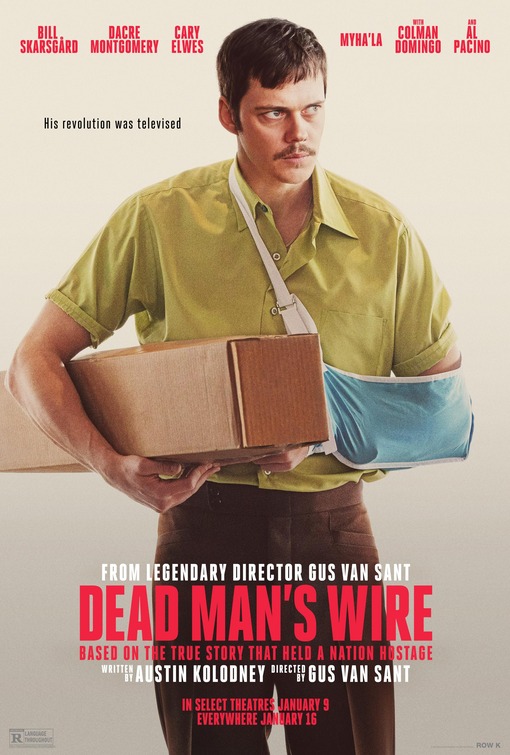
“Dead Man’s Wire” tells the story of a man frustrated by his inability to overcome economic forces that were crushing him. If you took the hostage drama of “Dog Day Afternoon” and combined it with the injustices that drive the characters in “Hell or High Water”, you would have a pretty good template for this movie. Tony Kiritsis takes a man hostage by looping a wire around the man’s head connected to a sawed-off shotgun with another wire connected to Tony. His goal is to recover economically from the dirty deed that a mortgage company has done to him, or at least that’s how he sees it. There’s been a long-standing dispute between Tony and the company over his mortgage on a piece of property that he hoped to develop in which he claims the mortgage company interfered with in order to force him into liquidation. It’s not merely the money however it bothers him. Tony is on a righteous crusade to get an apology from the president of the mortgage company who was his original target, but instead he is forced to take the vice president, who is the son of the president, as his hostage.
The real life incident took place in Indianapolis, and the filmmakers do a good job replicating the feel of 1977. The film stock seems to be from that era, with a good clear image, but a patina of shading it seems authentic to the time. Indianapolis is not a big city like New York, they didn’t necessarily have a hostage negotiator available, or a specialized SWAT team trained in all kinds of responses. Frankly the authorities are befuddled as to how to proceed. The suspense derives from the fact that any assault on Tony would result in the immediate death of his victim Richard.
Tony is played with gusto by the versatile Bill Skarsgård, who has become an obsession of my daughter. I think I saw three films starring Skarsgård last year. I can say however that this is his best performance without being under a pile of makeup. Tony has a righteous indignation, but he is not particularly cruel or vindictive to Richard. That helps keep him a sympathetic character which is exactly what the real Tony Kiritsis became to the public back in the day. He feels like a crusading Robin Hood trying to right a wrong that everybody else could identify as a thing they could easily have fallen prey to. The little guy against the system is the main theme of the film. Although the movie is very serious, like “Dog Day Afternoon”, there are moments of levity that occur because of the quirks of the characters.
Richard is played by actor Dacre Montgomery, best known for his portrayal of Billy in the show “Stranger Things”. He looks completely different in this role, and unlike the muscle bound preening Billy of the TV show, here he comes across as a bit of a nebish with a stoop and an awkward way of being polite that puts him at odds with Tony. These two actors account for most of the screen time but there is some other activity that’s worth mentioning. Richard’s father, the real villain of the piece, is played by Al Pacino with a little too much of that Foghorn Leghorn articulation that he’s developed over the years. If there is a weak link in the film, it’s from the most experienced of the actors. The father is equally self-righteous that he has done nothing wrong, to the point where he abuses his son Richard almost as much as Tony did.
The collection of local officials, some of whom knew Tony, as a local businessman, bar buddy, and occasional public nuisance. The undercover police officer who first arrives at the scene of the original kidnapping, is an acquaintance of Tony from a local bar. No one can believe that Tony is attempting this audacious Act of Justice, which violates the law and decency in an attempt to be treated decently. The cop is played by an unrecognizable Cary Elwes, and he is also terrific in the part. Even more impressive, once again, is Colman Domingo, who plays a local DJ, Fred Temple, who takes Tony’s call and helps mediate the crisis while trying to keep things cool.
There’s also a huge amount of social commentary in the way the news business handles this event. In the days before 24 hour cable news, local stations provided updates but not the continuous coverage that we would see today. The local news gets picked up for National presentation, so the two and a half days that this incident covers was closely watched by a nation that was not used to seeing crimes carried out live on TV.
As an audience, our sympathies are with both men, Tony for the Injustice done to him and Richard for the threat that’s being placed on his life. Neither man deserves what is happening. The police, and ultimately the FBI, arrange a deal with Tony, that you hope is going to resolve things. I won’t spoil the resolution for you, but I will say that it is a real world illustration of how the justice system can get something right even though they do so in the wrong way.
This movie deserves your attention, and it will command your interest through the performances of the two leads in the improbable but real life story. It’s hard to believe that it took 50 years to turn this into a movie, but first time screenwriter Austin Kolodney has done a nice job taking the unusual aspects of the real life story and turning it into a compelling narrative with an interesting theme. The movie is seamlessly directed by veteran Gus Van Zant. This may be the most accessible film he’s made since “Good Will Hunting”. Hopefully it’ll enjoy a good deal of success and bring attention to the actors who deserve credit for making us care.
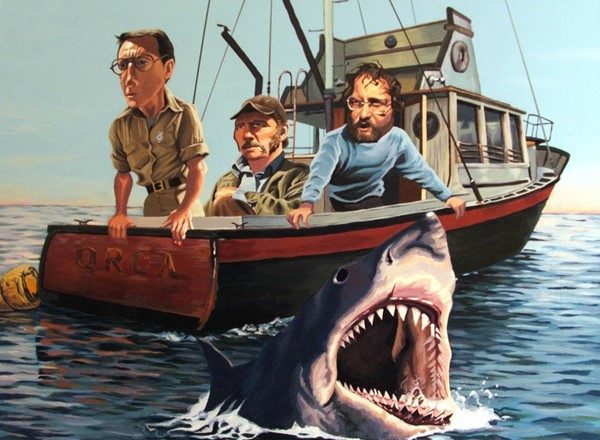
A lot of people when asked what it is the best shark movie after Jaws, might choose Deep Blue Sea. I saw DBS a week or two ago and was once again impressed with how much fun the movie is. Genetically altered sharks, hunting humans, in the middle of a natural disaster, is obviously a lot of fun. The story is filled with mayhem related to the cumulative destruction of the Marine Research Center where the sharks are housed. As entertaining as this film is however, I must say that it pales in comparison in regard to tension, anxiety, and reality, to the shallows.
This is practically a one-woman show, as Blake Lively plays a surfer, confronting a shark in a shallow bay, somewhere on the Mexican Coast. The setup for the film is very strong, there’s a reason that nobody will miss her for a night, and there’s a reason that the shark lingers in the area, which doesn’t require it to have any particular emotional Arc that it is following. Unlike Jaws the Revenge, it’s not really personal it’s instinct.
Our protagonist is Nancy, a medical student who is uncertain that she wants to continue and become a doctor. She’s retracing the steps of her deceased mother, to locate an isolated beach in a bay that was her mother’s favorite place. She caught a ride with a local, while her traveling companion has been rendered incapable of going with her by inebriation and infatuation with man that she met near their hotel. So Nancy is on her own except for a couple of other surfers with whom she shares the secret of the perfect waves in this idyllic location.
The shark who becomes her nemesis, is there feasting on a whale that it has killed and which is floating into the bay. Perhaps even more harrowing than the shark, which is a consistent threat, is the shallow reef and rock formations, which have rendered Nancy injured, bleeding, and trapped on. After an initial attack, Nancy looks for refuge as she tries to figure out how to reach the shore while the shark doggedly pursues her and lingers in the area attracted by both the whale and her blood in the water.
The film builds a lot of tension, as others enter into this scenario, unaware of the danger that faces them as they interact with Nancy from her perch on a rock outcropping. Actually, Nancy has had three locations from which she tries to stay away from the shark. The first is on the floating dead whale, but as that is like seeking sanctuary on a a dinner plate, that location is not secure for long. The high and low tides exposed part of the reef and shallow rock bottom, at least enough to give Nancy a safe spot to contemplate her woes. Her injuries are significant, including a bite wound that threatens to leach the life away from her. It is convenient that as a budding physician, Nancy understands how to apply a tourniquet and create a pressure bandage out of part of her wetsuit. The Third location that she seeks protection on is it nearby buoy, which becomes her final refuge in the extended confrontation with the shark.
They are desperate attempts to acquire materials that will help her in her fight, some of which work and some of which fail. Her hopes are raised by the arrival of others on the beach, but those hopes are often dashed by the motives of the beachcombers, or by the actions of the shark. As horrifying as a shark bite would be, the moments that caused me physical pain watching the film came from seeing her tumble on the rocks or crawl across the poisonous coral. There’s also a painful interlude with jellyfish, all of which will give you plenty of reason to cringe in your seat.
Most shark movies have some goofy element to them , or a human conflict in the background. “The Shallows” takes an experience that is very serious, and treats it in a way that makes you share the pain and frustration of our protagonist. The only thing that might make this movie feel a little artificial, is the climax and the resolution with the shark. It is dramatically solid, although a little improbable. In the end though none of it matters because we’ve spent two hours living an incident completely through our senses, and hope never to have to share.


 Kirkham A Movie A Day