Throwback Thursday #TBT
Throwback Thursday on the KAMAD site will be a regular occurrence in the next year. As a motivational project, to make sure I am working on something, even in a week where I don’t see a new film in a theater, I am going to post on movies from 1975. Along with 1984, this is one of my favorite years for movies and it is full of bittersweet memories as well. 1975 was my Senior Year in High School and my Freshman Year in College. The greatest film of the last 60 years came out in 1975, as well as dozens of great and not so great cinematic endeavors. Most of the films in this weekly series will have been seen in a theater in 1975, but there are several that I only caught up with later. I hope you all enjoy.
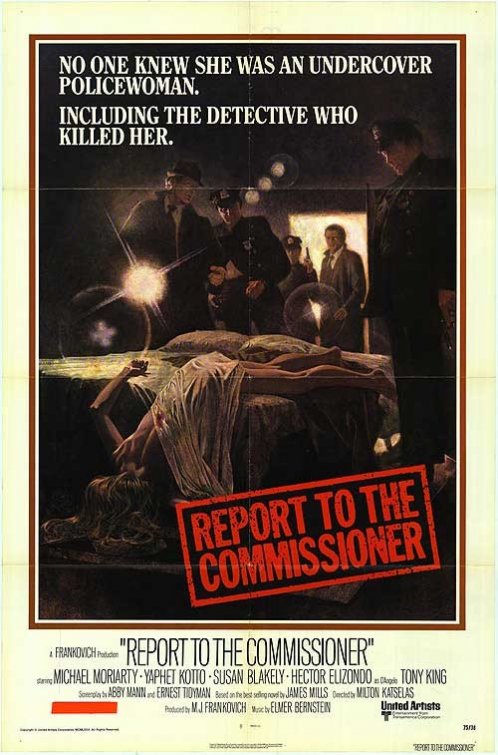
Report to the Commissioner
One of the lost gems of 1975 is this gritty police thriller that draws us once again into the mean streets of NYC in the seventies. Much like “Serpico” which came out two years earlier, it follows a rookie police detective as he ends up over his head with official corruption and nasty criminals which are hard to sort out. It is hard to tell the good guys from the bad guys sometimes, because the cops can get just as violent as the crooks. There is also a heavy pall of racism hanging over the detective squad that our young protagonist is assigned to.
It’s tough enough being the new guy in any situation, school, a party, or the workplace. When you don’t fit in physically or culturally, the inside group looks at you with suspicion and mistrust, and that is the scenario that faces Bo Lockley, played by Michael Moriarty. Moriarty was an interesting actor who is still working but has moved to material that is far from the quality work he did early in his career. He has a baby face and a mild voice, which makes him perfect for the naive and idealistic Detective Lockley. The sincerity of the character is what ends up bringing on the major dramatic points of the film.
Just a quick, synopsis as we get going. Detective Supervisor Hanson and Captain D’Angelo, authorize a questionable undercover operation featuring a pretty young policewoman. Bo Lockley is unwittingly used as cover for her identity, but his dogged pursuit of his assignment, runs afoul of the operation. Hanson is played by character actor Michael McGuire, who will come up in a post on “Hard Times” later this year. D’Angelo is played by the great Hector Elizondo. The year before, he had played the arrogant pain in the ass who may be so mad they threw him out of the Mafia Mr. Grey, in “The Taking of Pelham 1-2-3”. D’Angelo is politically adept but soulless and it is his arrogance that leads to the complicated resolution of the storyline.
The film is filled with actors that you will know and others you will recognize. Yappet Kotto is in another NY Detective Squad, and he plays Bo’s training officer/partner. Dana Eclar , who you may recognize from “The Sting” and Vic Tayback, play Kotto and Moriarty’s superiors. William Devane shows up late in the movie to play a slick,sympathetic, but sinister district attorney, Sonny Grosso, the real life detective that Roy Scheider’s character is based on in “The French Connection”, plays another detective, naturally. Richard Gere makes his film debut as that most elusive creature, the white pimp.
Susan Blakely, who had a bit part in “Shampoo” and was about to become a TV Icon in “Rich Man, Poor Man”, is the doomed undercover detective, who was the women no one could believe was a cop, and sent hundreds of pushers to prison. Her crusading ingenue has a pretty broad range of what is acceptable undercover work. The fact that she is dedicated to staying undercover is one of the complications that the film features as part of the story.
I saw this movie originally, at the El Rey Theater in Alhambra (a location that no longer exists). I went with my best friend Art, who worked for the Edwards Movie chain and got us in for free. I think I paid to see the movie again a couple of weeks later. Or, it may have been a second feature with some other film I saw, and fifty years later I just don’t remember.
The two scenes that I do remember vividly were very different from one another. Bob Balaban, plays Joey, a Vietnam War veteran, injured mentally and physically. Bo becomes a bit of a friend of his by returning the roller sled he uses to push himself around the streets on, having lost the lower portions of his legs. Years later, I saw Eddie Murphy riffing on a character like this in “Trading Places”. Anyway, Joey tries to follow Blakley’s character for Bo, while Bo is having trouble finding a functioning payphone. The sequence I remember is him rolling through the traffic of NYC and holding onto the bumper of a Taxi, so he could keep up with the subjects he is following. It was a pretty harrowing chase, and very different from the usual car chases you get in movies.
The other memorable sequence is the climax of the film, when Bo and “Stick”, the pusher/arms dealer that the woman detective was ingratiating herself with, get trapped in an Elevator at Saks 5th Ave, and basically have a Mexican Standoff with each other in a claustrophobic environment. Cop and crook are faced with bad choices and the characters do a little philosophizing while there.
The film is filled with the casual racism of the era, and Yappet Kotto expresses some of the dissonance that he has to accept in order to fit in with his fellow cops. Moriarty is basically playing a hippie type and that also is a source of the alienation he seems to have, even from his own father, for whom he really joined the force for. The squad rooms, decaying lofts, marquees of the Times Square Theaters, all give this film an aura of the times. It is gritty, dangerous and exciting all at once. Bo gets swallowed up in it, just as his partner predicted, and some of the higher ups try to take advantage of that.
Formatting the story as a series of flashbacks, usually punctuating some narration from “The Report”, the film feels fresh in contrast to some of the other movies of the time. Director Milton Katselas was a respected acting coach and teacher at the Beverly Hills Playhouse. “Butterfly’s are Free” is probably the best know of the few films he directed.
Although the report that is submitted, finally clears things up, this is another one of those 1970s films with a downer ending. “Chinatown”, “Dog Day Afternoon”, “Electra Glide in Blue” and a dozen others, all follow the trend of the time, and this picture does as well. In this case, the ending is earned, but that doesn’t make it any less despairing.

 Kirkham A Movie A Day