I saw this film with my wife when it first came out and we enjoyed it but frankly, I did not think it was a great film. It is a popcorn picture that looks a little cheaper than it should. They must have spent most of the budget on Sean Connery for his brief time in the story. I enjoyed Christopher Lambert in “Greystoke: The Legend of Tarzan” two years before. He was okay in this film, but it was clear that he was going to get by on physical charisma in his career and not acting chops. Clancy Brown on the other hand, understood the assignment and went full on nuts. He mugs and hams it up, just the way his character should.
Sean Connery, shows up for the second act and plays the part of a mentor to Lambert’s Conner MacLeod. Much ridicule has been made over the years of his being cast as an Arab, from Spain, with a Scottish Accent. However, it may not be inconceivable that in the 1200 years he was alive, he picked up some traits from all the places that he’s lived. Also, if that is the credibility stretcher for you, you have not been paying attention.
The best element of the movie is the notion that immortality takes it’s greatest toll on those that we love and must leave as they die. MacLeod suffers from his loss obviously, but the strain on his Scottish wife was pretty well drawn in the film. Another character from the 20th Century illustrates it as well. I don’t want to give the movie too much credit, it is still a cheesy piece of pop fantasy, but it is completely watchable and I enjoyed the revisit.
Local Director and friend of the Paramount, Robert Rodriguez, hosted and scheduled this program. He does a nice job talking about the films and the film makers that he had connections with. He shared his story about this movie in the conversation you can listen to below.
The Untouchables (1987)
The second film in our double feature is the terrific Brian DePalma movie, “The Untouchables”. It is impossible to imagine a better Sean Connery part (with the exception of the film I will be writing about next). Connery plays a put upon beat cop, who has resisted temptation and played straight with the law instead of getting into bed with mobsters. He becomes a mentor to the enthusiastic but as yet untested Elliot Ness, a Treasury agent, in pursuit of Al Capone.
The relationship between Ness and Jimmy Malone (Connery) is funny, fatherly and frustrating at times. Jimmy needs to trust Ness and Ness takes some getting used to because of some tentative characteristics. The team gets substantially enhanced by Andy Garcia as a rookie cop, with deadly shooting skills, who gets drafted into their unit. Garcia is fine in the action scenes but doesn’t have as much to say in the rest of the plot. Charles Martin Smith however, as Treasury Accountant and agent Oscar Wallace, is a delight in bringing a spark to the team because of his distinctive background. He is the square peg that they find a way to fit in.
The bad guys are pretty vivid with Robert DeNiro hamming it up as Capone. Billy Drago is a chilling Frank Nitti and his comeuppance is one of the great satisfactions of the film. DeNiro’s scene with a baseball bat in his hand is his big moment on screen. The scene is directed with the usual style of Brian DePalma, it is elegant, and suddenly violent in an ugly way. The two big set pieces of the film are the border raid and the train station shootout. Both of these are strongly enhanced by my favorite Ennio Morricone score.
I have seen this movie dozens of times, and probably a half dozen times on the big screen. My first viewing was at the Cinerama Dome in Hollywood when the movie opened in 1987, it remains another hallmark moment in my Dome history. I am glad I can now pair it with a screening at the beautiful Paramount Theater in Austin.
Frankly, there may not be a more charming film in existence than “Babe”. The story of an orphan pig who tries to find his place in the hierarchy of the farm is just too sweet not to love. It charmed the hell out of us back in 1995 when my kids were seven and nine. I took the youngest with me to this screening, she is now thirty-seven and she still loves it. (She will deny it, but I suspect it played a big part in her aversion to pork).
This film won the Academy Awards for effects the year it came out, over the shots of a space launch and rescue mission in “Apollo 13”. That win should be an indicator as to how animation and CGI were soon to dominate the film landscape. This was also the same year as “Toy Story” so you can feel the earthquake and aftershocks with those two movies.
James Cromwell received a big boost to his career after this, and we were very sad that we missed him at the TCM Film Festival, talking about this movie, back in April. We did get to see it on the big screen through the “Paramount Summer Classic Film Series” and although it was promoted as a kids matinee, there were plenty of adults there to share in the pleasure of our talking pig hero “Babe”. The relationship between Farmer Hoggett and his pig is a complicated one with a couple of grim moments, but Cromwell makes a joyous human who learns to trust his instincts and his porker buddy.
The Greek Chorus of Mice that introduce the various chapters of the story, are still amusing 30 years later, and when the lead sheepdog, swallows his pride to get help for “Babe” from the sheep, we get a few life lessons as well. I do think having a duck do the rooster’s duties would be a lot of fun here at the house.
This movie was such a change up from the shark serial killer movie of the previous evening. Maybe all double features should work this was as a one-two punch, start with something hard hitting and then finish with something heartwarming. Two good days at the movies.
[Just a clip from the film, because the official Trailer gives away too much
I want to be careful not to classify this as an Indian film because I believe it comes from Pakistani filmmakers. Still it is set in London, so it is in English and takes place for the most part in a western environment. This movie caught me completely off guard, I really had no idea what it was about, I just know that Amanda and I had talked about seeing it a year or two ago and we never got around to it.
The fact that it was playing at the Paramount for the Summer Classic Movie Series was just serendipity. As it turns out the movie is largely a martial arts fantasy featuring two sisters of Pakistani heritage, struggling to find their place in the world, and not getting much assistance from anybody else. I was a little worried at first that I would not be able to distinguish the two actresses because they have similar appearances, but that thought disappeared after just a couple of minutes. Both actresses are young and quite lively and lovely.
Although it is a martial arts film it did remind me a little bit of “Bend It Like Beckham”, where a girl who is an outsider because of her heritage, struggles with friendships with her Western counterparts.” Polite Society” however goes over the top in creating what is almost a James Bond type of Adventure, based on some strange motivations that when they are revealed are quite hysterical. The performances at first are deliberately exaggerated, but the writers and the director clearly have an affinity for the characters, in particular our lead actress Priya Kansara. She plays Ria, a high school student who wants to be a stunt woman, that’s her goal in life and nobody seems to feel like she’s really thinking very practically. Ria does get reluctant support from her sister Lena played by Ritu Arya, but her sister has her own problems.
There’s a lot of cross-cultural humor, particularly in regard to the courtship of the older sister and a handsome biomedical researcher from a wealthy family. The passions of the younger sister can simply not be contained and they spill over in a lot of hilarious ways. Frequently her frustration is manifested by her attempts to engage in some of the acrobatic martial arts practice by her stunt woman idol.
There’s plenty of music in the film, a mix of Rock and more traditional Eastern Tunes. There are needle drops for everybody. There’s also some clever camera work and the cinematography which does a nice job conveying different locations and moods. The music and cinematography are hilariously used to create a mood around the potential villain of the piece. If you see the film you’ll know what I’m talking about. It’s the filmmaking style that creates a caricature of the preening and domineering woman who may be a threat.
There’s also a dance number, that I know is not a Bollywood Style, but the mood that it sets is very similar to those that you might have seen in a movie Made in India, although the music and the dance are certainly not repetitive of those Indian styles.
The story takes a couple of interesting turns, and just when you’re set to believe that we’re looking at some woman’s fantasy and overreaction, her paranoia is revealed to be justified. The conflict between creating Trust with her family, after the way she has been behaving, creates a lot of the humor in the last part of the film. Ultimately however the movie is familial friendly.
I laughed on a regular basis, prizes that came with this creative variation of a romantic comedy mashed up with a James Bond Thriller. “The gods whispered to the warrior, ‘You will not withstand the fury.’ The warrior whispers back, ‘I am the fury!’ Have fun.
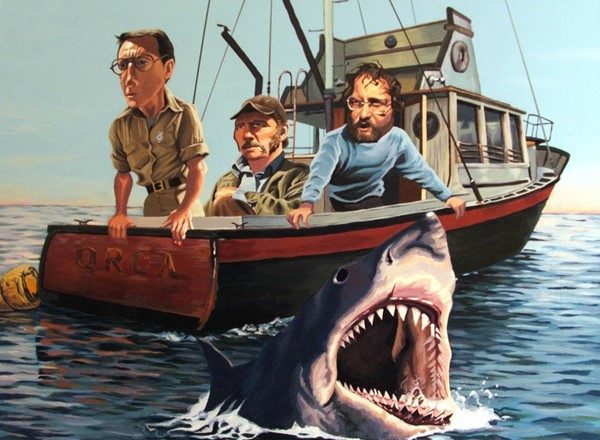
There are plenty of posts about the movie Jaws on this site, and I’m going to be writing more in the near future because I’m seeing the film again at least twice this summer. So I’m going to digress a little bit on this post and just talk about the experience rather than the movie itself.
The screening was at the Alamo Drafthouse at the Mueller location on the east side of Austin . We have been to this theater several times before and frankly it’s not our favorite. It requires that we park in a structure that requires us to login and pay in an online app. We do get validation for the time we’re at the theater, so it’s not the fact that we have to pay that is the problem, it’s just the technical process that is a little annoying.
The theater is located about 30 miles from our house, and we left a good hour and a half early because we want to be at the theater well before the movie starts to take in the pre-show videos and trailers that Alamo curates for us. Also we usually order dinner so we want to get there so that our meal arrives before the movie actually starts. All of those plans went to hell when we got on the highway and the rain started coming down. We had a torrential downpour of biblical proportions, and it was complicated by high winds and hailstones that were usually golf ball sized but sometimes even bigger. I had to slow down on the drive, put on my hazard lights and struggled to see the cars in front of me on the road. We finally got a break in the rain and we got to the parking garage just in time for an even stronger deluge of hail, and rain that was mostly blowing sideways. We stood in the parking garage for about 15 minutes waiting for a break. When the hail stopped we made a run for it but we’re careful not to run on the ice because it would have been easy to slip and fall. However that care meant that we were in the rain long enough to be completely soaked when we got into the theater.
The theater complex has individual bathrooms that are gender neutral and then sinks outside of the toilets that are available for everybody to use. They didn’t have the hand blowers that would have been helpful in drying off our clothes before we went into the theater. I had to run a couple of paper towels through my hair to dry it enough to feel like I wasn’t still swimming in the ocean.
This was a movie party, and as you’ve probably seen before the movie parties at Alamo include some props. We got a shark fin foam hat, we got a bath bomb in the shape of the Orca, and we got a small inflatable life preserver with a simulated bite taken out of it, maybe I can use it to float a drink in the pool. I also participated in a game before the show where two people competed for the prize shark head popcorn bucket. Unfortunately for me, the game consisted of a contest to draw on a chalkboard a shark. I need a ruler and a compass to draw a straight line or a circle, so I knew I wasn’t going to be winning right from the beginning. I had fun anyway.
As usual the movie was great, and as I said before I’ll write about it again a couple times this summer. I can say that when I’m looking for details that I didn’t always pay attention to in my previous 137 screenings, I noticed that the kids on the beach at the start of the film did in fact have some crab legs that they were gnawing on.
Although I didn’t win the shark head bucket, the hostess for the show did say that it was available for purchase at the concession or concierge stand. So when the movie was done we thought we would be able to finally get this prized addition to our popcorn bucket collection. Imagine our frustration however when the concierge station was closed and we looked at the buckets that were sitting across the counter on a Shelf and we’re unable to purchase one. Another frustrating experience on this excursion.
2 days later we did make a trip down to the Lakeline Alamo, and Amanda dashed in in the hopes that she would be able to get one of those popcorn buckets. Lo and behold we scored.
For more than a decade now people have been making films that attempt to just string together long action sequences to make a movie that is definitively 100% active. Usually there’s a brief set up followed by a long string of action set pieces, combat sequences, and a variety of gunplay. This formula works as long as the events make sense, and the actors are well cast. “Fight or Flight” does a pretty good job of these things and it makes the wise decision to cast Josh Hartnett in the lead role.
Harnett was at one time the next big thing, but he never quite crossed over as a success in a big movie. He has had a good career, but he’s also had a bit of a Renaissance in the last couple of years. He was in last year’s “Trap”, and he’s had a couple of supporting roles in movies that have made good use of the screen presence that he offers. This movie fits him like a glove. It requires him to be a little bit older, appear on screen in a sort of a scuzzy form, and at the same time allow him to be a badass. It works.
There’s also something about planes in the air in the last couple of years. Earlier this year we had the Mel Gibson and Mark Wahlberg thriller” Flight Risk”. This took place in a small plane, whereas” Fight or Flight” takes place on a regular airliner. That means there is enough room to run around, occasionally hide out, and sometimes dispatch the bad guys in a bathroom or luggage compartment. Hartnett plays a former federal agent who is getting a chance to get back in the game and his controller, a former love interest, is manipulating him remotely. .
Of course there is a plot twist and the original goal of the mission gets somewhat inverted. Hartnett’s character ends up with a couple of unusual allies, which allows for a lot more martial arts action, including some of the wild variety of acrobatics that people have come to expect in modern martial arts sequences. Does any of it make any sense? The answer is no, but you won’t care because you’ll have a good time watching all of the Mayhem. Look, we get a pleasant lead, and a couple of fun turns in the storyline, for an action picture that is usually sufficient.
Don’t stay home on Friday night to watch this on a streaming service, you should still go out and do something fun. However you’ll be happy to watch this on a night when you shouldn’t be compelled to socialize and you just want to veg in front of the TV.
A whole series of disparate events come to a violent conclusion and dozens of bad guys are killed. That’s about as much of a plot summary as you need for a movie like this. Action films can work well with a minimal backstory, and sometimes they work well when the plot gets convoluted. This is one of the latter. A sequel to “The Accountant” from almost a decade ago, it finds Ben Affleck as an autistic but functioning human being with extraordinary financial skills. In the first film he was a savant and an extraordinary killer. He’s not really an assassin anymore, but his old skills have not left him and he calls on them along with his estranged brother by John Bernthal, to wreak havoc on a trafficking organization.
If you want the audience to really hate the bad guys, you give them the worst kind of criminal activity to be involved in. In this case it is human trafficking, primarily of illegal immigrant women into prostitution. I don’t think it’s a spoiler to discover that one of the ways the organizations controls the women, is by imprisoning their children. We don’t see it on the screen, but there is little doubt that an economic stream involving the children will eventually be in their future as well. It is by a strange series of coincidences, that the head of the FBI Financial crimes unit gets involved in a case that connects the trafficking group with an assassin.
Of course to fight against assassins, it helps to have a couple of Assassins on your side. That’s where Affleck and Bernthal come into play. The FBI chief gets a little squeamish working with killers who don’t have the same restrictions of legal Authority on them. Still they end up approaching the case from different directions, and ultimately connecting a dangerous assassin, to the crime ring. There is a bit of a twist in this plot development, I’m not sure it makes a whole lot of sense, but they do try to explain it.
Affleck’s character lives in an Airstream trailer, and connects with his financial Empire through a mysterious computer center, filled with children who, like himself, have some Savant abilities. It’s been almost 30 years now that filmmakers have been trying to make computer hacking interesting on screen. Programmers, typing in code onto a computer screen, has to be inter-cut with a lot of other activity to make it watchable. The “Accountant 2”, does these hacking scenes as well as anybody else has.
Although you would not want to know either Affleck or Bernthal’s characters in real life, they make a fascinating pair in the movies. Occasionally questions come up concerning morality, but they’re never really answered. There is usually some joke that gets them out of a moral quandary. This was a very effective action piece, with a story that was mysterious enough to keep you intrigued for the 90 minutes that the movie runs. Then we get a shootout, multiple deaths of bad guys, and a couple of closing lines suggesting that we’ll be back with this crew again.
For me personally I’m not sure the Day Two of the film festival could have started off any better. The first movie we were scheduled to see was a James Bond film, celebrating it’s 60th anniversary. It’s hard to believe that the James Bond films are almost as old as I am. I’ve been a lifelong fan of 007 and is a child of the 60s it’s easy for me to be nostalgic for one of the most significant cultural films of that decade. “Thunderball’ was a commercial earthquake that signaled the significance of action films, spy films, and general popular culture.
The 4th of the 007 films, “Thunderball” did everything bigger and more spectacularly than any film up to that time. The history of the film’s origin is well known, Fleming developed the original story with a couple of other writers for a TV series that never went anywhere. Authorship claims were resolved by agreeing to allow one of the claimants a producer credit on this film. Regardless of what happened behind the scenes what happens on the screen is over the top, beginning with the use of a jetpack to escape from the bad guys in the pre-title sequence. The slogan for the film was “He3re Comes the Biggest Bond of All.”.
Maybe the most thrilling moment I felt at the whole festival was when the titles for “Thunderball” came up and we got those great Maurice Binder titles with Tom Jones belting out the song on the big screen. This is a restoration of the film, and frankly I thought it looked great before. This is the movie where all of the tropes from Austin Powers originated. There are sharks however, they don’t have any lasers on them. The spectacular underwater battle that takes place at the climax of the film still could use a little trimming, but it didn’t seem nearly as long to me today as it has in the past. Probably because I’m watching it on the big screen.
The guest for this morning’s presentation was actress Luciana Paluzzi, who played the SPECTRE assassin Fiona Volpe. She was 27 when the film was made which makes her 87 today. She still looks terrific and she was sharp as a tack with a great sense of humor. She talked about her long friendship with director Terrence Young, who made three of the first four James Bond films. In fact director Young gave her away at her wedding to her husband to whom she is still married. It was fun to listen to her share stories of being on the set with Sean Connery, and shooting the various scenes that she was in. I’m glad we got this opportunity well we still have some surviving members of the cast to talk about the film. Thank you TCM.
Because of the length of the film, and the fact that the talk took place after the movie, we were too late to queue up for either the films that we were planning on filling in the rest of our morning with. So we missed babe and The Time Machine. We did take a little break over in the lobby of the Roosevelt Hotel, before making our way back to the big house for “The Fabulous Baker Boys”.
The Fabulous Baker Boys
Michelle Pfeiffer was the guest for this presentation, and moments before the movie and the discussion she had participated in the traditional handprint and footprint in concrete in front of Grauman’s Chinese Theater. I hadn’t seen this film since it came out in 1989, but I remember being impressed with it and thinking it deserved some of the accolades that it received. Most especially Miss Pfeiffer’s performance being nominated by the Academy. I do remember it was a bit of a surprise that she didn’t win.
The story is a small one, focusing on the relationship between two brothers who have a piano lounge act that is moderately successful. The older brother played by actor Beau Bridges, is engaged and cheerful during their performances, and he takes the lead in trying to keep their act financially lucrative. The younger brother is played by Jeff Bridges, his real life brother, a piece of terrific casting. Jeff Bridges character is the more talented musician, who is resentful of his occupation and the playlist which the brothers usually perform. When they run into trouble keeping the act booked, they decide to hire a girl singer to join the show, enter Michelle Pfeiffer who plays Susie Diamond, an escort with a nice voice, who wants to make the transition legitimate performances.
There are basically two love stories in the film, the one between the brothers which is strained by sibling rivalry, and different views of what they ought to be doing. And of course the younger brother who is always been a philanderer begins a romantic relationship with Susie, which we can see is not going to end well for either of them. Susie Diamond is a hard case, but her heart is not as buried in concrete as is the younger Baker brother. All three leads are excellent, and they make the drama of the film feel quite real.
It is not a news flash to anyone, but Michelle Pfeiffer is a stunningly beautiful woman. She is the same age I am and clearly looks a hell of a lot better than I do. She was friendly and Charming, and she tried to answer the questions what’s that Ben Mankiewicz tossed at her. Sometimes the questions were a little awkward, and her answers would end up being more ambiguous than you might expect, but she was doing her best. This was also the first time I’ve noticed in the decade that I’ve been attending the festival, that the Stars security team was present on the sides of the platform where the guests in the host were seated. I’m sure security has been there for many presentations, but miss Pfeiffer security team had one individual standing on each side of the platform. That was a little surprising but completely understandable.
Misery
Our third film of the day, was also at the TCL IMAX theater, generally known as Grauman’s Chinese, and talk about a contrast in the way the actors are portrayed in the two movies, Michelle Pfeiffer is luminous beauty is now contrasted to the harsh persona and visage of Kathy Bates in “Misery”.
“Misery” is a Stephen King story translated to the screen by Rob Reiner, who did the same thing for another king story in the film “Stand By Me”. This is a drama that is actually a horror movie, and when you see how it plays out I don’t think there’s any doubt that it is a Fright Fest.
Kathy Bates won the Academy Award in 1990 as the character Annie Wilkes, a deranged fan of the romance novels that feature a character named misery. Author of those books from a car accident in the blizzard, and cares for him in her home. But of course talking about going from the frying pan Into the Fire, the danger to the author seems to get greater and greater the longer he stays in her care. For the most part the film features two actors, the aforementioned Kathy Bates, but also the great James Caan, who plays the injured author. It takes nothing away from Kathy Bates performance to point out that Caan is terrific in the more physical performance. His character does not have the emotional range that Bates did, but he has to do a lot more torturous crawling, climbing, and sweating. The two of them together were really good.
I’ll briefly mention the late Richard Farnsworth also, who plays the local sheriff, trying to figure out what happened to the missing author. Farnsworth was always a welcome presence in movies, and when I mentioned to my daughter that he was in a G-rated film from David Lynch she practically fell out of her chair.
The screening emphasizes for me once again how important the theatrical experience is. The theater full of people responded to the events taking place on screen with screams, laughs, and nervous tittering at times. You could hear that the audience was reacting to the movie exactly how the storytellers had intended. And it must have been very gratifying to the two guests to hear the way the audience responded to their work.
The guests for this film were the director Rob Reiner and the lead actress herself Kathy Bates. They talked about the process of rehearsing the picture, and they noted that James Caan had a different style of acting then Bates did. Rainer talked about how he had tried to manage their different styles in the film and use that as a way to reflect the characters that the two were playing. There were a few tidbits of information that came out about the screenplay that I thought were particularly interesting. It was written by the great William Goldman, the Reiner added several pieces to the film as they went along, including the dinner sequence which includes a great suspense sequence, and a twist that had the audience moaning with frustration.
The American President
Our fourth feature of the day, was also playing in the main house, so after leaving the theater, queuing up to wait for the next screening, we return to exactly the same position we were in for the previous two films to watch “The American President”. This is a film that was a precursor to the television series The West Wing, one of our favorites. The film was written by Aaron Sorkin, and once again it was directed by Rob Reiner. Frankly Reiner had a run from 1985 to 1995 that is pretty amazing in terms of quality. He made the following films: “The Sure Thing”, “Stand By Me”, “The Princess Bride”, “A Few Good Men”, and “The American President”. That’s a murderer’s row of great films from that decade.
We’ve seen the film dozens of times, it has been a go-to in the house ever since it came out. The story of widowed president who attempts to start dating again while a resident in the White House. There are of course a lot of political machinations, and the hysteria over guns and climate change is exactly the same 30 years ago as it is today. Regardless of whether those issues matter, the story is really about how personalities influence the political process. Everybody is faced with some ethical dilemmas in the story, but of course the good guys get the best speeches, thanks to Aaron Sorkin.
Screenwriter Sorkin and director Reiner where the guests for the presentation, and they talked about the Genesis of the film, and the way it transformed itself to some degree. Originally scheduled to Star Robert Redford, and be merely about the romance and comedy of a president trying to date, the film turned into something a little more weighty and probably better balanced when Sorkin and Reiner decided to inject some political elements to the film. Redford wasn’t interested in doing a political film, he’d already done that. So enter Michael Douglas and the rest is as they say history.
Ambitiously we had hoped to see Rocky Horror at a midnight screening, but are better judgment sent us home after this film and we didn’t attempt to do the time warp late into the evening. I would have enjoyed seeing Barry Bostwick is the guest, but after hearing that the screening went off half an hour late I was very grateful that we made the decision to stop at four films for the day.
During the break we went over to the TCM Lounge and found this on display.
In the 7 years since he won the Academy Award for best actor Rami Malek is struggled to create a strong on-screen identity as a lead. His biggest part since Bohemian Rhapsody was as the antagonist in the last James Bond film no time to die. He’s made a couple of other films since then all of which are perfectly but none of reached the level of Excellence that I’m sure he hoped for and that his fans would like to see him rise to. This new entry into the Spy genre is an attempt to leverage himself back into serious movies, and I suspect potentially create a franchise.
If you’ve seen the trailers for this film you know that there is a Revenge plot at work here, is Malik’s CIA techno wizard seeks the people responsible for the murder of his wife. It should come as no surprise that is a spy film there’s also a conspiracy element to the movie, and it’s not as simple as it appears to be at first. I’m not sure the CIA has ever been depicted as the straight Heroes in any film where they were a featured part. Usually the CIA is engaged in some subterfuge or illegal activity that they’re trying to hide from the world but especially from their Congressional overseers. Even the mission impossible films have relied on internal cabals to generate plot points for the movies.
The idea of a techno geek going after hardened terrorists is an interesting idea but it does require that we swallow a big dose of reality suspension. Malik is effective in showing the Brilliance of his character as he tracks down using his technical tools, the terrorist team that took out his wife. We immediately become suspicious however when his CIA handlers attempt to muzzle and Corral him. It doesn’t take long to understand why. Their rationalizations are perfectly reasonable, but it is also clear that they are not too concerned with the collateral damage that is being wrecked upon the world. Malik’s character is not naive but he is bureaucratically pure up to a point. And then of course we get the traditional rogue agent.
For the most part this is a Slow Burn through the first half, with maybe one solid scene that builds some suspense and excitement. However halfway through his list of miscreants to eliminate the Mallet character picks up some collaborators, and the action gets more intense. The political intrigue is given cover by suggesting that these operations are occurring outside of the normal chain of command. They would certainly need to because many of the operations and Malik discovers are both illegal and deadly including to our allies.
Like most Revenge pictures we take the greatest satisfaction in those moments when our protagonist deals out Justice to the evildoers in some creative way. Our CIA operative sometimes seems hesitant to carry out the executions he himself is designed. Usually his hesitancy seems to be in Pursuit of additional information about the Spy gang. Regardless, the first two deaths that he creates are interesting, and there is a Twist or two along the way. We get a few red herrings along the way, but after a certain point we suspect that Rami’s character really is smarter than everybody else. Laurence Fishburne plays both an ally and an antagonist, and the one thing that feels wrong with this movie is the cheat that comes at the end. On the other hand John Bernthal was not in the movie Enough to generate the kind of support yet that a sequel would demand. He does however get a very good narrative sequence.
This is a pretty intelligent spy film, it relies on the old trope of an agent operating outside of official channels, and fighting those channels at the same time. It’s not quite as clever as black bag earlier this year, but it does sit up there near the top of my list of well-designed spy films, and for the year so far this one fits near the top of the list one of my favorite films. It’s still early but I would recommend the amateur to anybody who’s a fan of either Remy Malik or the Espionage genre.
For a period of time in the 1970s, film directors were given free reign to create some of the most personal and well acted films to ever come out of Hollywood. In an era that was filled with personalities like Martin Scorsese, Francis Ford Coppola, and the young Steven Spielberg, maybe the director who got a foothold on the zeitgeist of the era the best, was Peter bogdanovich. Has a director he had a string of successes from 1971 to 1975 that are incredibly impressive. The first of those truly great films is this 1971 requiem for bygone era.
The Last Picture Show is known for the huge cast of future stars that made appearances in the film. Jeff Bridges, Timothy Bottoms, Randy Quaid, Cybil Shepherd, Eileen Brennan, and Ellen Burstyn are all getting ready to have huge careers in the next two decades. The film also gives parts to older veterans Cinema, or give it a chance with the Fantastic script to write a little silver in the sky and help us remember what film dialogue is all about. Cloris Leachman and Ben Johnson want Academy Awards for supporting actor and actress, and they did it on the strength of a script that treated them like real people, who deserve dignity even in the most undignified circumstances.
I’m not sure I can think of a film that has sadness more clearly as its theme Than The Last Picture Show. The social relations between the members of the senior class, or sometimes harsh and thoughtless, and at other times heartbreaking. Cybil Shepard plays Jacy, the headstrong popular girl, who uses sex to gain status and learns that she is simply repeating the mistakes of the past. In the wake of her Reckless Behavior she leaves two best friends who become estranged, one because he is a rejected lover, and the other because he rejected his one opportunity of love in this small town.
Everything in this movie screams of being depressing. The diner is shabby and the waitress who works there, although wise and surprisingly friendly, is also beat down by her existence. The pool hall is the social center of the town, and it is a dust filled ramshackle Hangout for men too old to do much and for boys too young to be doing anything. Ben Johnson plays the older man with enough gravitas to actually earn the respect of the youngsters. Although life is dealt him a pretty crappy hand he is not embittered by his fate, simply nostalgic for the good things that have long passed him by. Sam the lion is a character that we can all admire and he gets a sequence where he narrates part of his life in such an eloquent way that Johnson brings him to life and earns the accolades that were heaped upon him that year. And of course there’s not a happy ending when it comes to Sam.
Ruth Popper is a woman who is aware that the best parts of her life are long in the past, and for whom every day is a struggle against depression and potential Health catastrophes. When she becomes the unlikely lover of one of the two young men who are close friends, it feels dangerous, absurd, and also the most hopeful thing in the movie. And of course it also doesn’t end well either. Cloris Leachman, clenches her hands, walks with the faltering step, and dry cries through many of her scenes. Her performance is one of physicality, where she conveys a world weariness Beyond her years, and a rejuvenation it is unexpected when she discovers what she thinks is a new love. The conclusion of this film includes the death of a much younger character, and it turns out that that is not the saddest thing in the story. The way in which this will Lonely woman, is mistreated and embittered his heart-wrenching. What is also sad is that even after standing up for herself, she has enough Humanity to offer a drop of console, despite it not being earned.
The town is full of people who will never leave and as a result will likely bleed on Happy lives, or their people who are anxious to get out, but afraid to because they know they’ll never be able to come back to things the way they were. The closing of the movie theater in a small town like this maybe the saddest symbol of filmgoer like me is likely to see. The black and white photography in this film makes everything feel dusty and forlorn, but it also makes the people look either incredibly beautiful or sadly unpleasant. I guess that’s the way the world is, or more precisely… Was.
This is an unusual movie designed to put us in the field with the Warriors who defend us in Dark Places. It represents the memories of the men who went through the actual event, and is designed to replicate as closely as possible the firefight that these men participated in. I don’t see an agenda or political perspective in the way this film is being presented, the men who are performing their Duty are average Americans, who are well trained, but respond like human beings in the dangerous circumstances they find themselves in.
Although there are a couple of familiar faces in the cast, this is certainly not a star driven vehicle. At least two dozen characters appear on the screen and have lines, but you could not point to a single one of them and say they were the main focus of the story. It is the event that is the star of the film. A military Advanced team, probing an enemy territory, during the Iraq occupation, discovers that they are the target of an insurgent attack. The events unfold for the most part, in real time, and the threat of death exists in every frame of the last half of the movie. There are moves that are made by the Marines in this story, which in hindsight might seem problematic, but given the outcome, and the survival of some of their comrades, we should certainly be willing to forgive some Divergence from military bureaucracy.
Even though they’re under attack, the Marines Express every confidence in the situation that they are capable of responding appropriately. They have Superior Equipment and Superior training and they also have reinforcements that will system although it will take some time. To me the astonishing thing about the events depicted in the film are the nearly heroic actions taken to save the lives of the injured Marines when an IED explodes as they are preparing to withdraw. Injuries that we saw in Saving Private Ryan, were horrifying but the story doesn’t linger over them and the agony that those soldiers went through. In this film the consequences of the injuries seems to be the main justification for telling the story. Both the injured Marines, and their teammates never really give up in spite of the pain and the fear that they must be going through. Some may have a moment’s hesitation, some are trying to cope with with shock and concussions and temporary deafness. They all however do their jobs.
I will warn you that the injuries depicted are brutal, and there are moments when the agony of the victims is hard to bear. The stalwart efforts platoon of Marines is admirable in and of itself regardless of the outcome of the battle. This is not a story where retribution is heaved upon the enemy in a dramatic moment of Revenge. The forces that are being used, often appearing to be overwhelming, are done for the purpose of saving the lives of their comrades in arms. We really have no idea what kind of damage was inflicted on the enemy at the end of the day. This is a war film that is not a drama about some narrative, rather it is a narrative about an event that took place and that these Warriors survived.
War is evil, but sometimes necessary. The Men Who engage in war are usually not evil, but simply doing their jobs, fulfilling the plans of someone else to make the world a better place. The struggle to accomplish that requires incredible fortitude. Warfare attempts to depict that fortitude and put the audience at the scene. It succeeds in its visual execution, by allowing us to see the chaos and confusion in this sort of combat operation, but also the professionalism and determination of well-trained men. Because the story is told from the perspective of the men who actually went through this, the dialogue is filled with technical terminology Battlefield jargon and a variety of military language. Nothing is done to make this film dumb enough for an audience to understand. It requires an audience that is smart enough to know that what they are seeing is something they never want to go through themselves.


 Kirkham A Movie A Day