You’ve Got Mail (1998) / Empire Records (1995) Paramount Summer Classic Film Series Double Feature

You’ve Got Mail

Tom Hanks and Meg Ryan were the epitome of screen couples in the 1990s. They made three romantic comedies together and all of them are worth a look, but my personal favorite is their last one, the Nora Ephron directed and co-written “You’ve Got Mail.” The film is a remake and update of the 1940 Classic, “The Shop Around the Corner”. It is extensively inspired by the then new phenomena of electronic communication. America On-Line (AOL) was the portal that most users of the internet in the mid to late 90s were found on. Instant messaging and e-mail were sparkling new toys that enticed people into communities, chat rooms and ultimately on-line relationships. 

Although the movie holds up pretty well when it comes to story, the technology has developed so much in the last thirty years that several things seem incredibly quaint to older viewers and foreign to younger audiences. The dial up tones for connecting to the internet have vanished and they are only a memory for early users of the internet. The notification in the mailbox that there were new messages, was probably useful in 1998. I recently covered “Eurotrip” on the LAMBcast, and the audio notification on e-mail there is quite different, just six years later. Of course today, if I had an audio notification for every new email, my phone would never shut up. 

The original film featured Jimmy Stewart and Margaret Sullavan. Hanks has frequently been compared to Stewart for his aw shucks personable style and open faced handsomeness. Of course he has a quick wit and can dash off a line with flare, which is different than Stewart’s deliberate and often halting delivery of lines. The two actors have different styles regardless of personality or physical similarities. Meg Ryan is completely different in her character than Sullavan was in the 1940 film. Kathleen is quiet and deferential at the start of the film, it is only after she gets advice from Joe Fox that she is able to actually confront Joe Fox. The realization that her words might be cruel, is a lesson that most people on the internet should learn.

This is a big spoonful of nostalgia for me. Like “Sleepless in Seattle” from a few years earlier, I experienced this movie with my late wife who adored it. The DVD was one of the first DVD purchases after we acquired a player late in 1998.  There was a promotional sale at “Comp USA” an long defunct computer store, which had a location about ten miles from our home and I remember driving over there on a Saturday, with the kids in the minivan, to buy the movie for the low price of $14.99. It has some Christmas sequences, but I have never thought of it as a Christmas movie. This is a romanticized view of New York Movie. It’s sort of funny that there is a joke about Rudy Giuliani as mayor because it was largely his policies that allowed the idealized view of New York to flourish in the 1990s. If this film had been made in the seventies, it would have been set in San Francisco rather than NYC.

Empire Records

This was a strange pairing for the double feature. The tone of the two films is very different, and although they came out in the same era, it is very clear that they were seeking very different audiences. “Empire Records” is the antithesis of “You’ve Got Mail” in a number of ways. Both films feature a ton of needle drop musical moments, but “Mail” is all about established and well worn songs and moods, “Empire” is contemporary and focused on clashing subcultures of music. The former is all about polish and smooth story telling, the later is chaotic and frenetic. 

A dozen characters are featured with storylines in the film. They are not background but main arcs of the movie. The film bounces around all of those stories and barely lets us know the characters, much less develop any affinity for them. The cliched stereotypes are the short hand way in which we are expected to connect with these young people. The store appears to have more employees than customers and all of the employees have quirks that are off putting to some degree, regardless of whether they have other traits that might endear them to us. 

I suppose it is the retail workplace setting that makes this combination of films feel any sort of theme between them. Both the “Shop Around the Corner” and “Empire Records” are businesses on the brink of collapse due to competition from newer business models. It is a little ironic that youth lead internet culture subsequently consumed both industries to a large degree. Books and  Music were first, but movies are in the same buffet, and will soon be swallowed up by on-line users who will be soulless and will crush the individuality of all of us.

This movie was not a success when it was released but it has become something of a cult film as a result of cable exposure over the years. I can see why. Watching this in a theater reveals all of the films flaws, and makes it a chore to get through. This is one of the few films I think works better on a small screen and at home viewing. You can tune in and out of the dialogue without losing anything because most of the dialogue is not very good. The sequences don’t really build on one another, so if you miss something while answering the door, going to the bathroom or getting a snack, it won’t matter. This is not a film that was mad for my generation, but it tries to take the attitude of a touchstone film from my era like “Caddyshack” or “Animal House” and apply it to the millennial audience.   Unfortunately, from my point of view, that is a fail. 

The Outsiders (1983) Alamo Drafthouse Movie Party

In spite of the fact that “The Outsiders” was released in 1983 and was made by one of my favorite directors, it has only just dawned on me that I had never seen it. I have been to NYC twice to see the musical stage adaptation, and I own the Complete Novel Version DVD/Blu-ray of the film, so I thought I’d had this as part of my history, but while watching it, I came to the realization that this was a completely new experience for me. Knowing the story is not the same as seeing actors play out the roles on screen or watching a director make choices to emphasize one visual element over another.

I have been lax this summer in keeping up with my blog and the films that I have seen. Some of this passivity is a result of the large number of retrospective films I have been seeing, but an even bigger influence has been my devotion to the LAMBcast episodes and the videos, which take up a lot of my time and reprioritize my efforts. Which is why this post is both late and not as complete as I had originally intended. in the first few years of this blog, I wrote about the films I saw immediately after seeing the movie. Sometimes I would stay up into the next morning to get my thoughts down completely. That has not been the case for the last couple of years and since I don’t take notes, when a post goes up days or even weeks after a screening, I have forgotten many of the things I wanted to write about while watching the film. That has happened with this movie.

I know there were performance moments that I thought were great, but I cannot recall the images or nuances that struck me at the time. I do know that I thought the church fire scene worked much more effectively in this film than I was expecting. C. Thomas Howell and Ralph Macchio were really strong in the film and this sequence was a standout. 

Francis Ford Coppola and his cinematographer Stephen Buram, captured the golden hue of the evening that matches the poem and the theme for Ponyboy at the end of the movie. In fact, the whole film does a nice job of creating the 60s era without over doing cultural images that give us a shorthand way of seeing the time period.  

The rest of the cast was also great, with Matt Dillon and Rob Lowe the standouts. Tom Cruise is in the edges of the film and his breakout role in “Risky Business” came this same year. Many of the cast members were reunited for “Red Dawn” the John Milius film of 12984, and they all seemed to play off of each other pretty well. 

If I see the film again, I will try to be quicker in writing about it so that you get a more complete picture of my experience. Until them Stay Golden. 

Ghostbusters (1984)-Revisit/Alamo Drafthouse Movie Party

Whenever I get a chance to see one of my 1984 films on the big screen, I am going to take it. Last week the Alamo Drafthouse had a Movie Party Screening of “Ghostbusters”. The Movie Party screenings include a theme hosted introduction with a contest for a prize, and props are distributed as you enter the theater. In the past, some of the props are clever, but not useful for the interactions of the Party Atmosphere. This event however did include some props that made the screening feel like a party. We were given two foot long glowstick streamers that allowed us to join in on the ghost hunts when the proton packs came out. 

Everyone in the half full theater would wave their proton streams whenever the Ghostbusters did. It was quite a sight. I did not record during the screening, that would still be a no no by Alamo standards, but you can imagine the effect by looking at the video above. 

No one used the slime in a jar during the movie, but I did see several people eat their marshmallow at the end of the film when the Stay Puft Man makes his appearance.  

Here is a link to a decade old post on one of my visits to see Ghostbuster in a theater. 

and here is a 30th Anniversary screening link as well. 

One more link for you, this is the post on my 30 Years On Project from 2014. 

I am always happy to revisit a film that I love in a theater. Getting to do so with other fans is one of the things that makes movie going special for me. Oh, by the way, I wone the ring toss Slimer game and got two passes for an Alamo Screening. Not to shabby for a 41 year old movie and an even older fan. 

Legally Blonde (2001)/ Clueless (1995) Paramount Summer Classic Film Series Double Feature

A rare Wednesday double feature at the Paramount this week with a screening of “Legally Blonde” and “Clueless”. Both films have elements of female empowerment in them, and both of them have completely silly components, which keep them firmly in the comedy category and diminish any social commentary. Not that that’s a bad thing.What both films have going for them are charming leads, and comic scenarios that get resolved with happy endings. In other words they are audience fantasies that deliver what people want from their entertainment.

LEGALLY BLONDE

Legally Blonde was the Breakthrough movie for Reese Witherspoon, and it’s success catapulted her to the ranks of Highly sought after actresses in the first decade of the century. Playing a high school senior who is pursuing her boyfriend to Harvard Law School, Witherspoon plays Elle Woods, a fashion merchandising 4. 0 student who manages to excel on the LSAT after cramming very hard. The fact that she’s a cute blonde in a bikini in her video essay doesn’t with the admissions committee either. So when the film makes a point about the importance of female accomplishments over appearance, that is going to be undermined by this plot point. Okay that’s the last serious thing I’m going to say about Legally Blonde.

What I will say is that it is delightfully droll, Witherspoon is a blast playing a perky Fish Out of Water in an elitist cultural niche which judges you by your family in source of wealth more than your character or even income. Harvard I’m sure appreciates being portrayed as an exclusive Miley sought after admission, but the movie shows us some of the most stereotypical intellectual snobs that you can imagine, as being the sort of students that Elle will have to compete with.

The courtroom antics are fine, but you will actually get a better sense of legal procedure by watching My Cousin Vinny. Legally Blonde resorts to an old Perry Mason trick to finish off this Underdog Story. But no one will care because Elle Wood is a good person who wins out in the end, and all of the other good guys win as well. Cue the Applause from the overwhelmingly female audience that attended Wednesday’s performance.

CLUELESS 

Cher, the heroine in this reimagined version of Emma, is played by Alicia Silverstone. This was another one of those films that established young actors as the Bedrock of ’90s and early 2000 films. In fact we’re still getting Paul Rudd, who looks pretty much like he did back in 1995, starring in movies. Silverstone is the quintessential spoiled dumb blonde of classic film. Although she sees herself as the authority in the story, the rest of us recognize quite early on that she is the one who is out of Step.

I can’t tell you how authentic the relationships between teen girls in Beverly Hills are represented by this film. It is however easy to imagine Petty jealousies and misunderstandings creating broken friendships or lost romantic opportunities. The themes in Clueless are actually a little bit more serious than the legal drama of Legally Blonde. Everybody engages in some kind of manipulation, sometimes we have the best of intentions when doing so, but in the long run we should really reassess the choices we make. Like Jane Austen’s Emma, Cher is manipulating others in what she sees is an altruistic attempt to help them out. The problem is she puts her own vision ahead of what is best when it comes to her friends.

Once again it all works out, and there are serious laughs to be had throughout the film. I’ve always liked Dan Hedaya who plays Cher’s dad, and even in the small role that he has here he puts his grumpy but sympathetic persona to good use. Wallace Shawn shows up as the stern but naive debate coach, and I see too much of myself in this role, fortunately I can laugh at myself.

About a third of the audience left after Legally Blonde, but those who remained embraced Clueless almost as enthusiastically and we all shared a laugh as we left later in the night than we usually do during the week.

Robert Rodriguez Presents: Double Feature Robocop and Starship Troopers-Paramount Summer Classic Film Series

Sunday was a double dose of Paul Verhoeven satire and action. The first movie was the perfection that is “Robocop”. I don’t know if I can count the number of times I have seen this film. I do know that I have seen it at least a half dozen times on the big screen, including a 2023 screening right here at the Paramount Theater. Quentin Tarantino apparently agrees with me that the script is perfect. What is also perfect are the performances from the main actors in the film. Dr. Peter Weller fully commits to the persona of the cyborg, but only after charming us as the eager to please Dad and new partner.

Kirkwood Smith, sneers his way thru the movie as the repulsive Clarence Boddicker, the crime boss of old Detroit. Although they don’t all get as much time to display their horrendous sides to us, the four toadies that make up his crew are equally loathsome, with special emphasis on Paul McCrane as Emil, the one bad guy who gets a deservingly nasty end to his story.  

I have always loved stop motion animation when it is integrated into real life surroundings. Ray Harryhausen was a cinema hero to me. Phil Tippet and his crew do a great job with ED-209, with little touches everywhere that add to the humor and tension of the film.

https://w.soundcloud.com/player/?url=https%3A//api.soundcloud.com/tracks/2149667739&color=%23ff5500&auto_play=false&hide_related=false&show_comments=true&show_user=true&show_reposts=false&show_teaser=true&visual=true

Richard Kirkham · 2025_08_03_19_02_28

Robert Rodriguez Presented both films and his opening remarks are in the message above.

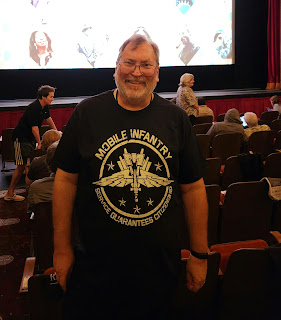
Starship Troopers came out a decade after “Robocop” but it contained a lot of the same bitter satire that the earlier movie did. The hostility to fascism is clear, but of course it is largely missed because we get engaged in Johnny Rico’s story and we can admire his mentors in spite of their authoritarian tendencies. Michael Ironside and Clancy Brown are terrific as the older generation, trying to mold the youth of this world into soldiers and subsequently citizens.  It also doesn’t help the anti-fascist theme to have Rico’s parents be a couple of mealy mouthed characters that today might be revered to as woke.

The Special Effects in the film were pretty impressive for 1997. The vast numbers of bugs that the Mobile Infantry has to face is intimidating. Anyone who has dealt with an ant infestation will recognize how much we are outnumbered. In this world however, the bugs are not small and you can’t just stomp on them. 

Our host is friends with the star of the film and got him on the phone when it was time to go to the second movie. 

https://w.soundcloud.com/player/?url=https%3A//api.soundcloud.com/tracks/2149675263&color=%23ff5500&auto_play=false&hide_related=false&show_comments=true&show_user=true&show_reposts=false&show_teaser=true&visual=true

Richard Kirkham · 2025_08_03_21_11_17

The Sound of Music (1965)-Revisit Paramount Summer Classic Film Series

You already know a few of my favorite things, so I will spare you my singing about them and instead praise Julie Andrews for singing about a few of her favorite things. The Sound of Music is one of those films that inspires both love and derision from film aficionados. Cynics object to the sugary take on the Von Trapp family story. They would say the children are too upbeat, the songs are treacle, and the pretty people facing Nazis is a misuse of History. I’m cynical about a lot of things, but “The Sound of Music” isn’t one of them. This is just a joyful experience with Sweet Moments, terrific staging, and some of the best songs of the 20th century.

The movie is a love story, but it is not just a story about a love between a man and a woman. Christopher Plummer and Julie Andrews portray the adults who fall in love in perilous times and difficult circumstances. There are however still seven children who also need to fall in love, at first with a governess and finally a new mother. The way in which Maria wins over all of the children, by exhibiting more patience than is imaginable, and singing about their very needs, makes for a great story. Don’t forget it’s also a story about people who love their country, and see it being torn apart by the events of the day. I can understand if you don’t like “The Sound of Music” because you don’t care for musicals, or if Julie Andrews just isn’t your cup of tea, but if you don’t like this movie because of the themes or the story( which for the most part is true), then you are missing the point. And I feel sorry for you because you’re going to lead a less fulfilling life.

The exuberance of some of the dancing sequences, which really aren’t about dancing at all but just about children playing at being adults, is part of the fun. The world is full of people who don’t like it when kids appear in movies, they should probably stay away from this as if it were the plague. I on the other hand am perfectly content to try to remember the names of each of the children, like Maria does when she says her prayers. By the way, I didn’t forget Kurt. 

The synchronization between the helicopter shot and the introduction of Maria on the hillside is a miracle a filmmaking at the time. Today it would be accomplished with drones and computer adjusted shots. Yet it wouldn’t be any better. A lot of sequences go on for a while, without the heavy editing of a director who is trying to hard to show off. Robert  Wise knows exactly what he is doing when telling this story. It may have moments of suspense in the Final Act, but it is not a thriller that requires Quick Cuts and close-ups of sweaty faces. This is a character piece with music, something that Wise has already shown he can handle.

Once again I cannot recommend highly enough seeing a film like this on the big screen with a receptive audience. This was one of the family films for the Paramount classic summer film series, and there were plenty of families there to experience this film on its 60th anniversary. The world is a better place for it.

The Wild Bunch (1969)- Paramount Summer Classic Film Series

It only happens occasionally but this is one of those times, a film will enter my regular blog posts, but also be included in the Strathmore film project. Strother has a minor part in his great 1968 Western directed by Sam Peckinpaugh, a man that Strother had worked with before and would work with again. Any film fan is familiar with the Wild Bunch and it’s significance as part of the new Hollywood.

An elegantin Western sit near the end of the frontier days, the Wild Bunch is about the passing of old ways, and the violence that ensues. The film stars William Holden, Ernest Borgnine, Ben Johnson, and Warren Oats as a band of Outlaws whose competence is in question, and who is being pursued by a posse of prairie scum led by their former compatriot played by Robert Ryan. As surprising as it might seem there are themes of loyalty in the film, and when considering the nature of these men, loyalty is not one of the characteristics you would expect. In fact there is a clear example of such hypocrisy at the very beginning of the film. In escaping from the town and the trap that had been set for them, they abandoned their youngest member, to be set upon by the citizens after the others have escaped.

There is virtually no one in the film that could be described as an honorable person. Everyone is guilty of some form of murder or theft. However, there are moments when the bandits act with dignity, and a sense of a moral code, that seems so foreign to the way they act to the rest of the time. In addition to the issue of loyalty, the biggest theme seems to be autonomy. No one in the film, from the bandits to the Posse to the Mexican soldiers, wants to be told what to do or how to act. The desire to have command over your own decisions seems to be a strong motivator, especially for Holden and Borgnine.

Robert Ryan as an aging Bandit himself, now trapped into leading a posse against his former partners, is the poster child for the theme of autonomy. His inability to act in the manner that he wants, and the fact that he is forced to work with characters for whom he has disdain, is another driving force in the film. Two of the scum that ride with the Posse are TC and Coffer, played by Buddies lq Jones and Strother Martin. If there is anything close to comic relief in the film by these two losers, who bicker with each other like an old married couple over issues like whose bullet killed a victim in the streets, or which one of them gets to keep the boots of the latest dead man they have found. While Pike Bishop and Dutch Engstrom are hardly models of social nicety, they certainly Tower over the likes of Deke Thornton’s mob of Misfits.

Sam Peckinpaugh  became famous for the stylized violence in his films, often featuring slow motion deaths. This is the film that probably initiated that reputation. The movie is bookended by two over the top shootouts, which feature Mass deaths in slow motion bullet holes and falls. If there is a third theme running through the film, it may be that violence is inevitable and inevitably futile. There is a coda to the film which also includes violence, but after the massacre of the Mexican troops and the Wild Bunch itself, Peck and Paul wisely allows the massacre of the Posse to occur off screen. So anyone who says that Peck and paw shows no restraint must have missed this last scene.

There’s a lot more to the movie than the two big shootouts, but I’ll leave that for another time. I have no doubt that I will return to the Wild Bunch for a separate entry on the Strother Martin film project. For now it’s just a pleasure to have seen the film once again on the big screen, and bathe in the Macho themes and images that dominate this movie.

Sorcerer (1977)-Paramount Summer Classic Film Series

One of the greatest films of the 1970s is also one that is largely forgotten. The reasons for this are complex but include the fact that this film came out in the wake of Star Wars, replaced that film on the Chinese Theater screen for only a week, and then was replaced itself by Star Wars. This was the film that no one knew what to do with, it’s an action adventure film with protagonists who are all loathsome in some way. Their heroic actions are always mitigated by the fact that they are criminals, terrorists, fraudsters, and murderers. When your rooting interest is someone that you would avoid if you cross paths with them on the street, it’s not hard to imagine that a film is going to struggle to find an audience.

“Sorcerer”, may be William Friedkin’s best film, and he made “The Exorcist” and “The French Connection”. This sweat-laden, rain soaked, mud  encrusted thriller,  will not leave you with a warm feeling, but it will leave you with deep admiration for the director’s skill at building tension and following characters through their true natures.

This was my first time seeing the film on the big screen. I only caught up with it on cable years later, and then finally when the remastered Blu-ray came out about a decade ago, I Revisited it andI appreciated the story. Seeing it in a theater however, is truly a great experience. There are sequences in this film that are so fraught with tension that I felt like sweating myself. Those of you not familiar, the main part of the story focuses on four displaced men, struggling in a poverty stricken Village in the nameless South American country, who take on the job of transporting volatile explosives 200 miles across the jungle.

The first half hour of the movie however, has nothing to do with the main adventure, it simply details what these four men were like before they came together in this anonymous part of the world. Each of their stories has a degree of vibrancy to it that makes their subsequent activities feel more important. Roy Scheider plays the displaced American, a gangster who is wanted by other gangsters for a crime back in the States. There is also a Palestinian terrorist, a French financier, guilty of a massive fraud, and a professional assassin as part of this team of drivers taking on this hellish task because they are desperate.

Perhaps the most amazing part of this film is that it was shot without CGI, or in a studio. The road that this group has to travel is filled with dangerous sinkholes, impossible to pass barriers, and a raging river with a rickety bridge that will give you nightmares. All of it is on screen and all of it is real to some degree. Of course some of the biggest threats come not from nature but from other men. There is revolution in the air, and there are criminal elements who take advantage of the Revolutionary impulses of others, to steal and kill.

Although we got backstories for all four of the drivers, Scheider remains our main protagonist, and our link to the civilization that seems largely out of reach In this jungle locale. As is typical in 1970s films, the ending of the story is downbeat, but not at all in a manner in which you expect. The inevitability of our guilt catching up with us is one of the main themes of the story. I’m not sure if that’s a part of the original film  this movie is based on. I have seen that movie, but it has been a long time and I didn’t have the context of this film to compare it to at the time.

So if you want to feel your sphincter tighten, and have your sympathies be conflicted, then you should make it a point to see this film. And of course if you get a chance to see it on the big screen you need to put your money down and go.

Piranha (1978)

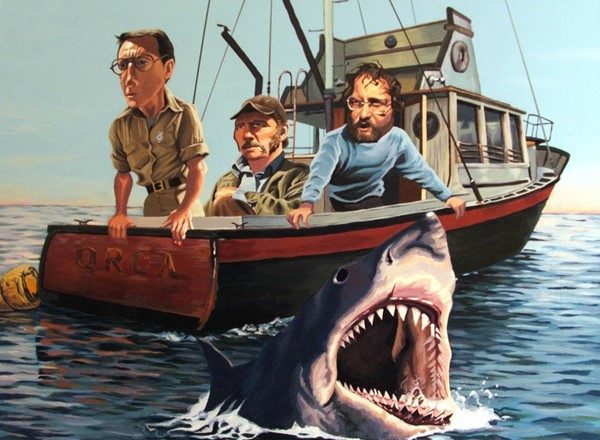
It seems like there were dozens of “Jaws” rip-offs in the late seventies. Killer Orcas, Grizzlies, and in this film, genetically modified piranha that can strip a man to the bone in minutes. This was an exploitation picture that launched the career of director Joe Dante. It has only a little of the sideways humor that characterizes his best films, but it does try to keep the audience engaged with frequent piranha victims every few minutes.

The formula is a clear set of beats stolen from “Jaws”. We start with a titillating experience that results in death, followed up by a slow discovery of what is happening, and then a series of denials of reality by officials. One of the main differences is that the obnoxious character who is trying to dismiss the whole thing, gets a comeuppance, unlike the mayor in the shark movie.

Bradford Dillman was a seventies staple as a suspicious official or businessman, and he was in a ton of TV shows of the era. Here he plays a drunk hermit like loser, who hets turned into an action hero for no particular reason. Heather Menzies, who played one of the Von Trapp children in “The Sound of Music” and Strother Martin’s daughter in Sssssss, is a bounty hunter who gets caught up in the action, and veteran horror icon Kevin McCarthy starts a long association with director Dante, playing a crazed scientist. Don’t ask why there is a small lizard man walking around the laboratory in the early part of the film. It never becomes important and it is simply a loose thread.   

“Piranha” is an efficient, low budget fright film. The film makers do the best they can with their resources and imaginations. Although many consider it a cult classic, it simply feels standard for the times. But of course those were my times so I loved it.

Zodiac (2007) Paramount Summer Classic Film Series

Most of the entries coming up will be brief, I am still trying to catch up on posts for all the theatrical screenings in the last couple of weeks. I cannot however, skimp on my opinions about this particular film. “Zodiac” has been one of our family favorites since we saw it in it’s original theatrical release. Over the years, it has become a default movie for us. Whenever we have trouble deciding what we should watch , someone inevitably suggests “Zodiac” as an alternative and nine times out of ten, we are watching it again. This screening at the Paramount Theater was the first time I have seen it in a theater since 2007, and it is the first time since I started blogging, that it gets included on this project.

I was eleven years old when the Zodiac killings started drawing press attention across the state of California. So I was old enough to be aware of the story, but still young enough that it did not obsess me the way that it did the characters portrayed in the story. Robert Graysmith , as portrayed by Jake Gyllenhaal, is a cartoonist for a San Francisco newspaper, one that received messages from the killer. His tangential connection lead to an intense desire to know who the killer was, and he wrote the book this movie is based on. Director David Fincher, portrays the writer as an innocent bystander, watching the horror play out around him. Gyllenhaal looks like a baby-faced kid among the police and newspaper professionals that surround the case. His sincerity is achingly displayed on his face as he asks questions of his colleague Paul Avery, who is covering the Zodiac for the paper. Avery is played by a pre-Iron Man Robert Downey Jr. Avery is also presented as an obsessive, but his pursuit is more professional and it consumes him in a different way than Graysmith.

The third leg of the tripod that the story of the investigation rests on is Dave Toschi, a police inspector in charge of the S.F. part of the investigation. Mark Ruffalo plays Toschi as an overwhelmed professional, frustrated by jurisdictional impediments and inconsistent evidence. The two newspaper guys supplement and interfere with his task, but ultimately, it is Toschi who gets to chillingly interrogate a suspect that seems to fit the information that they have. All three of these men get moments of horror as they confront individuals or places that may be a key to solving the crimes. Downey Jr. is playing a character who descends into alcohol and drug use as his paranoia and professional life collide. There is an honesty about those destructive forces that may be a reflection of his real life struggles in the years that preceded this film. Ruffalo seems to be calmly frustrated reacting to both the killer and his amateur pair of Zodiac hunters. 

Everyone in the movie is top notch in their performances, but I will single out two of the supporting players to show how well the movie is put together. Toschi has a partner, Bill Armstrong, played by Antony Edwards. Armstrong is a dedicated professional but he remains more impartial than Toschi. He is analytical but not obsessive.  Edwards exudes competence with an aura of detachment. He wants to solve the case as much as his partner, but he doesn’t let the frustrations of the case overwhelm him. Edwards is the cool straight man to Ruffalo’s, only slightly warmer counterpart. They make a great team. 

The second outstanding secondary performance is by John Carrol Lynch, who plays the eventual main suspect, Arthur Leigh Allen. We only see Allen in the context of the investigations. There are no scenes where he is depicted as the killer engaged in the crimes. We learn about his character in interviews with his former friends and family. When Toschi, Armstrong and two other law enforcement  personnel question him at work in the break room of the facility he works at, all sorts of alarms are going off in our heads as the cops listen with gapped mouths to the explanations and information that Allen shares. Lynch is calmly aloof as he spills suspicious conduct and details to the investigators. His face never reveals a fear that he is trapped, or that he is on alert in the face of the questions he is getting. His quiet comment “I am not the Zodiac. And if I was, I certainly wouldn’t tell you.” is as chilling as some of the murders that we see depicted in the film.

The verisimilitude of the film is found in a thousand places in the movie. The location shots are all consistent with the era. There is a sequence with Melvin Belli, a famous attorney who was a celebrity because of the lawsuits and clients he was involved with His depiction reflects the commercial television practices of the time. Toschi is shown attending a special screening of “Dirty Harry” which is a film that has a character inspired by the real life criminal he is pursuing. One of the most haunting and realistic uses of music of the time occurs in the attack on the couple in a car at the start of the film. Donovan’s “Hurdy Gurdy” man plays out over the scene, and you can almost smell the aura of the 1960 descending on the moment.

I would not classify this as a horror film, just as I would not say “The Silence of the Lambs” is a horror film. There are certainly frightening moments but the key is realistic suspense. These are thrillers with horror elements. The creepiest scene takes place in a basement, and there is no blood, weapon or violence shown, but the hair on the back of your neck will certainly stand up at the moment. Charles Fleisher, who is best known as the voice of “Roger Rabbit”, provides an additional supporting character to make this movie the masterpiece that it is.  

“Zodiac” was not a huge success when it was first released, but there has been a lot of reassessment in the last two decades and I think you will find that this movie will hold your attention, frighten you and haunt you for a long time. I  am happy to have had a chance to see it again in it’s natural habitat and I encourage everyone to spend some time with this excellent film.