I have written about “Jurassic Park” on many previous posts. (Here, Here, and Here), so there is plenty of content on the site to cover the film I saw again on the big screen last weekend.
Instead of elaborating ore on a film you all know, I want to take this opportunity to vent. I am frustrated to no end by a decision made by one of my beloved movie chains.
Alamo Drafthouse popularized the idea of theater dining and drinking. Those have never been my favorite part of going to an Alamo Presentation, but the experience has been less intrusive than I feared when the whole thing began. (Disclosure: The first in theater Dining Experience I had was at an AMC) The idea of waiters delivering food and taking orders while a movie was playing seems antithetical to me. The process is disruptive to the viewing experience.
Alamo had managed it as well as could be expected, but they have suddenly stepped into their own trap. For years, the thing that was unique about the Alamo Drafthouse Experience was the forcefulness of their no phone policy.
Last year they introduced an option to use your phone before the movie, as a way to order. This year, it has become mandatory. If you want any concession, food order or assistance, you have to use your phone. This was our first time under the new exclusive ordering system, and it was not a pleasant experience. Everyone in our row was grouching about the idea that to get concession items, you have to violate the long time “No Phones” policy. When the No Phone Slide shows up on screen before the film starts, it has a disclaimer now, excluding their own app. You could hear derisive laughter throughout the theater.
As long as this new policy stays in place, I will be resisting it the best way that I can. The Alamo Experience had two things going for it, They have the best programming and they had the no phones policy. To me, the food and drink service was always secondary at best. We did often order food and we enjoyed it, but it is not special enough to continue if this intrusive Phone approach is going to stay in place. So, AMC and Cinemark, you will see me more often. I’m not canceling my Alamo Movie Pass, I’m just not going to order anything when I go to a film that I can only find at the Drafthouse. Local eating establishments will be getting my business if I am hungry. #sneekinginmyjuniormints.
Gore Verbinski has created a lot of films that I’ve enjoyed , most of which have a strange twist or odd angle to them. One of my favorites is Rango, the animated film that earned him a very deserved Academy Award, because let’s face it no one is going to give him an award for overseeing the chaos that is the Pirates of the Caribbean franchise, regardless of how much he managed to make sense of it all.
In anticipating “Good Luck Have Fun Don’t Die”, I was expecting the usual degree of visual insanity and quirky characters that have characterized much of his previous work. To be honest a lot of it is here, but somewhere the funny got lost and instead of having a light touch with a serious subject, this movie feels as if it has a heavy thumb on the scale of sadness.
I can’t fault Sam Rockwell as the star of the film because he does exactly what he’s supposed to be doing. He is maniacal, controlling, and at the center of all of the chaos. It’s just that the chaos doesn’t feel quite as chaotic as it should, and even though the premise is off center, it just doesn’t feel off center enough. To me, the best section of the film is the opening where his character shows up and appears to be recruiting a team from the patrons of the diner that he’s in. We are led to believe that he’s done this over 100 times before and is simply looking for the right combination of customers to get into his desired objective. The way in which he rejects or demands participation is truly amusing. Unfortunately once they escape the diner, what follows is a rather mundane Quest picture where the quest is just not as interesting as it should be.
The last half hour of the film does attempt to reinvigorate the crazy sensibility of the story. The fact that it is so dominated by visual effects that probably use the same kind of computer technology that the story is ultimately about, feels like it is undercutting the goal. I appreciate the characters of the company that Rockwell takes on his mission, and as we lose a couple on the way I was sad because they provided some of the best moments of the film.
It’s hard to understand what’s going on from the very beginning, but as we get closer to the climax we do get a sense of what it all means. I’m not going to spoil it for you, but there is another twist at the end, and although I could see it coming, that doesn’t mean that I thought it was appropriate. Let’s just say if we take the film at face value we are only watching a single chapter in a book that is not going to be completed. If there was hope that this could be a continuing series that has probably been dashed by the lack of box office, not to mention the less than enthusiastic reviews.
I’m glad I saw the movie, and I would certainly recommend it to fans of Sam Rockwell, because after all everything is better because he’s in it. Since his failure with the Lone Ranger a dozen years ago, Verbenski has not been able to get a movie made on the scale of his previous dozen years. I’m afraid this movie is not going to change his situation. He has a great visual eye, but his storytelling chops seem to be muted at least for the moment. So let me finish by saying good luck, trying to figure out how this all works, have fun, watching the Clockwork Orange turn, and don’t die from your bloated expectations.
I have no doubt that this will trigger some of my friends and readers. If there is a more toxic subject on line these days than Trump, I don’t know what it is. Implicitly, this movie is likely to be seen as Trump Propaganda, and there is certainly reason to believe that based on some of the content. I think however, that someone capable of critical thinking should be able to separate the political boosterism, from the informational context that is being presented. Those of you who can only see evil in anything related to Trump should probably skip this just out of habit. If you stick with it, I hope you will find an accounting of the film as I saw it.
There are three aspects of the First Lady’s movie that I think I would like to talk about, her fashion sense and design background, her goals and role as first lady, and the process of the Inauguration itself, including all the social accoutrements that go along with it. There is some political talk in the film, but it is relatively minor and not the subject that brought me to the film in the first place. One cannot deny that the reason any of this matters is because of her marriage, but that side of the political discussion is out of bounds on this site.
Melania Trump may be the most enigmatic First Lady of my lifetime. Her background seems alien to most of us to begin with. She is not from the political class and she is not from humble beginnings as a girl growing up in an American neighborhood, she is an immigrant who comes from a family steeped in the fashion and design ecosystem. She has been a model and a fashionista from the earliest moments of her life, but her exposure to Americans as that person has been superficial. This film attempts to show her in a more engaged light. I don’t pretend to have any sense of fashion or class elegance, but I can appreciate that there is a reason that state functions are not held on picnic tables with paper plates and Solo cups. I am reminded by that moment in “The Untouchables” when in the depths of despair after the murder of his colleague, Elliot Ness gets off the phone with his wife, he shakes his head in wonderment that somewhere in the world, someone cares about the color of the walls in the kitchen. Melania Trump clearly does.
The opening section of the film follows FLOTUS as she inspects, and approves of various elegant touches related to the Inauguration process. Plates and dinnerware need to be judged. The invitations have to be elegantly presented, the flower arrangements must reflect the dignity of an event. Most of us don’t care much about those things, but brides at their own weddings do, diplomats at state functions do, and political powerbrokers care about them as well. So Melania turns her fashion forward eyes to these little things, including her own wardrobe for the Inaugural balls and the ceremony itself. The width of a hat brim and the accompanying band, must be just right. Her confidence in this realm of her position seems unassailable if pretentions.
In regard to her position as FLOTUS, we learn of her charities and the way she has reached out to the world, in a manner that is sometimes invisible. A Facetime chat with the First Lady of France shows us some of the social functions that go along with politics. These behind the scene moments are the reasons that anyone interested might want to overcome their revulsion of Trump and get some inside skinny. The segment with Aviva Siegel, a Gaza War hostage, talking about the trauma of being held and the fear for her husband who was still in captivity at the time of filming, would certainly be seen by jaded political observers as propaganda, but I saw it as a reflection of true human concern, and a story that was not fleshed out by the media, but gets some sympathetic ears from Melania.
The time frame for the film is from the first of the year to Inauguration Day on January 20th. There are meetings and public events that all lead up to the start of the new term. We are given an insiders view of some of those moments. The security measures that are required are outlined without revealing anything top secret, and the planned outdoor event got scrapped by the inclement weather in D.C. in January 2025. I was fascinated by the process of moving out the Biden’s and moving in the Trumps at the White House. It was interesting to see up close some of the posturing that went on from each side as the tension in the moment is being assiduously avoided.
I’m sure MAGA fans will find more to love about this film, and those who hate Trump will find plenty of fuel for their fire as well. As a documentary on the subject it claims to be about, it was generally satisfying. There is not a hard nosed point of view or axe to grind, this was the kind of film one might have seen on Biography or the Discovery channel once upon a time. Because the political factions are so hot right now, it gets turned into a litmus test for idealogues on both sides. I found it to be as innocuous as any other portrait of a First Family might be. Jackie Kennedy giving a tour of the White House, Ladybird Johnson advocating to Keep America Beautiful, Laura Bush promoting reading, Michelle Obama suggesting health exercise, they are all part of the same tradition. The most difficult thing most people these days seem to be incapable of, is digesting an normal tradition as simply being normal. This movie is not a sign of the Apocalypse, and it will end up in a documentary queue on Amazon, with all the other vanilla flavored First Lady documentaries, so relax.
So on my birthday 2 weeks ago I got a chance to revisit a film from 2000. It was very entertaining but was largely ignored at the time it was released. A little over a year ago I had a chance to attend a screening that was largely a party at the Paramount Theater celebrating Josie and the Pussycats. As it is, I was just celebrating my birthday with the Pussycats this time.
I’ve said it before, this film was way too clever for its own good. People misread it as a simple teen comedy, which it is to some degree, but it is also a sharp satire on the music industry, the media, and even the movie industry and its obsession with product placement. It is witty and sharp and full of jokes that will pass you by if you’re not paying close attention. The opening of the film is loaded with shots at the commercialization of filmmaking because everything is branded.
The deeper pleasure in Josie and the Pussycats however is the music. The songs by this faux band are so upbeat, clever and tuneful that it’s hard for me to understand how they weren’t all hits, much less how they were ignored at the Academy Awards that year for best song which they were certainly more deserving of than what really won.
I posted on this movie before and you can read about that here. and here. I just want to celebrate one more time the fact that this movie exists, and that it evokes good memories from 25 years ago. I went to see it with my daughter and she was just a tween when we saw it the first time. She’s now a grown woman and she made the effort to secure tickets for us so that we had something special to do on my birthday, thanks hon.
I make no secret of the fact that this is my favorite Sam rami film, yes even ahead of “Evil Dead 2” and “Army of Darkness” and all the Spider-Man movies. The reasons are apparent when you look at the trailer: it is a western, it stars Gene Hackman, and it features a badass woman with a gun. That is a formula that is hard to screw up, and when you add in Sam Rami’s directing style and Sharon Stone as the Lady, it is perfect. (Which I said back in 2013).
We saw this as part of an Alamo series of films, saluting Gene Hackman and David Lynch and others. Those of you here for the first time will learn that Gene Hackman is my favorite actor and this is one of his great villain performances. John Herod is an evil prairie scum who has leveraged his way into absolute authority over a border town, and maintains control by holding a quick draw contest each year to preoccupy and identify potential threats. There is always a threat from Leo DiCaprio who may be Herod’s illegitimate son. There are rival gunslingers who show up to challenge the undisputed dictator of the town of Redemption, and there is a mysterious woman who challenges the expectations of the 19th century Western Frontier, played by the aforementioned Sharon Stone.
The movie is a homage to the spaghetti westerns of Sergio Leone, borrowing heavily from “Once Upon a Time in the West” but also Leone’s style. There are sequences where the close ups get closer and they linger for more time than is comfortable. There are beads of perspiration that tell stories all by themselves, and the music while not being epic like Morricone, uses the instruments they way the master would, to set mood and accentuate a scene. Alan Silvestri is a terrific composer of movie scores and his work here is equal to the task.
I listened to a podcast “That’s Da Bomb” on this film, and after the BS that starts the show, there is a nice discussion of this movie, although my opinion of the film is far higher than theirs. Even better, I went back and listened to the “Lambcast MOTM from February 2022″ where five of us discussed the movie in some detail. Once again, I am an outlier but I am also right. “The Quick and the Dead” rules, and there are just not enough people out there who appreciate to the degree that it deserves.
I have loved Sam Rami films ever since I discovered “the Evil Dead”. His style of film making is vibrant, eclectic and the stories that he tells are off kilter enough that they are memorable, even if they are buried in a genre that gets easily dismissed. He has a new film coming out in a couple of weeks that I am looking forward to, and this coming weekend, I will also be seeing my favorite Sam Rami film, “The Quick and the Dead”. Last weekend however, I got to see his 1990 Comic Book hero creation, “Darkman”, starring Liam Neeson in action mode, years before “Taken” launched him as a senior citizen tough guy.
This is a standard origin story, but it is about a character who is not standard at all. Peyton Westlake becomes the Darkman because of a vicious attack by gangsters, and an accident of medical intervention that results in rage generated strength while being largely impervious to pain. Because he was a scientist, working on artificial skin, he has the ability to create flesh masks of anyone he can obtain a photograph of. Thus he can disguise himself in a way that allows him to manipulate the men who disfigured him, in a way that turns them against each other.
Westlake also has to create a mask of himself, to be able to reach out to his girlfriend, played by future three time Academy Award winning actress Francis McDormand. Neeson plays a tortured scientist, who pines for the life he lost, and also rages against those who mutilated him and murdered his colleague. Wearing his own face as a mask, there are several scenes where his interaction with Julie, McDormand’s character, go off the track. In an incident at a carnival, Peyton’s temper gets the best of him and director Rami amps up the situation with Dutch angles, zoom close ups, and intercutting of disturbing carnival images. It is very much like one of his Evil Dead movies for a moment.
The main villain is played by Larry Drake, who was well known at the time as a benign character on “L.A. Law”, so here he was playing against type and he was great. Robert Durant is a confident bully who delights in removing the fingers from his victims, in a dispassionate manner. As if his lack of emotional display is a sign of professionalism rather than sociopathy. There were two direct to video sequels to this film, the first of which revived the character of Durant from the dead. This is a bit like killing the survivors of “Aliens” to start the third film, it undermines some of the things that were great about the earlier film.
The music score was from Danny Elfman, who had done “Batman” the previous year. This second dark hero has a theme that is familiar enough to echo the famous Batman theme, but distinctive enough to clearly fit with the aesthetic of a Sam Rami movie. Jenny Agutter shows up in a scene as the neurologist treating the injured Dr. Westlake, she reportedly did so as a favor to John Landis, who has a tenuous connection to the film, including a part as an extra. There were a series of novels following the further adventures of Darkman, most of which were too dark to consider basing a movie on. This Alamo screening was a blast and I laughed with delight at a number of moments. The make-up effects are also pretty spectacular, you can see that Darkman is a forerunner of Two Face in the “Dark Night” Batman movie.
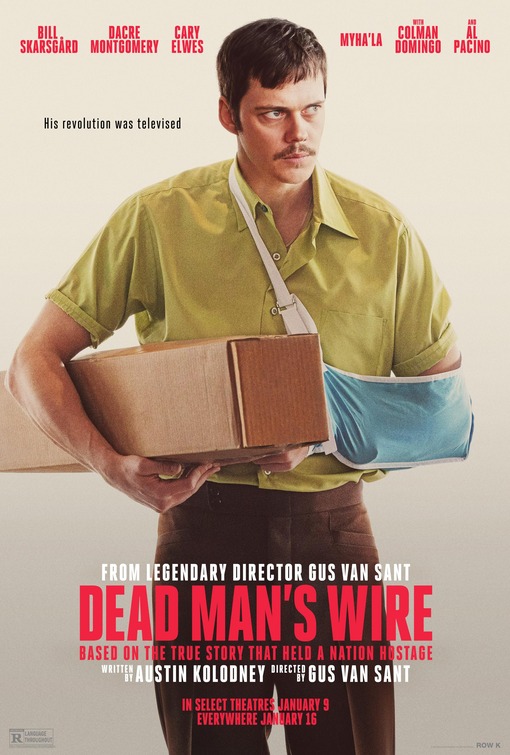
We got an early peek the other night at one of the films that will certainly be a highlight of the first quarter of 2026. This movie features two stellar performances, and a very efficient reenactment of a real life event from 1977. I was in college in 1977, but I’d been doing quite a bit of traveling with the debate team, and at the time that this news event took place I was only vaguely aware of it. I’m glad that I didn’t have a complete memory of what happened, so although there was an actual historical antecedent I was surprised by the turnout of the events.
“Dead Man’s Wire” tells the story of a man frustrated by his inability to overcome economic forces that were crushing him. If you took the hostage drama of “Dog Day Afternoon” and combined it with the injustices that drive the characters in “Hell or High Water”, you would have a pretty good template for this movie. Tony Kiritsis takes a man hostage by looping a wire around the man’s head connected to a sawed-off shotgun with another wire connected to Tony. His goal is to recover economically from the dirty deed that a mortgage company has done to him, or at least that’s how he sees it. There’s been a long-standing dispute between Tony and the company over his mortgage on a piece of property that he hoped to develop in which he claims the mortgage company interfered with in order to force him into liquidation. It’s not merely the money however it bothers him. Tony is on a righteous crusade to get an apology from the president of the mortgage company who was his original target, but instead he is forced to take the vice president, who is the son of the president, as his hostage.
The real life incident took place in Indianapolis, and the filmmakers do a good job replicating the feel of 1977. The film stock seems to be from that era, with a good clear image, but a patina of shading it seems authentic to the time. Indianapolis is not a big city like New York, they didn’t necessarily have a hostage negotiator available, or a specialized SWAT team trained in all kinds of responses. Frankly the authorities are befuddled as to how to proceed. The suspense derives from the fact that any assault on Tony would result in the immediate death of his victim Richard.
Tony is played with gusto by the versatile Bill Skarsgård, who has become an obsession of my daughter. I think I saw three films starring Skarsgård last year. I can say however that this is his best performance without being under a pile of makeup. Tony has a righteous indignation, but he is not particularly cruel or vindictive to Richard. That helps keep him a sympathetic character which is exactly what the real Tony Kiritsis became to the public back in the day. He feels like a crusading Robin Hood trying to right a wrong that everybody else could identify as a thing they could easily have fallen prey to. The little guy against the system is the main theme of the film. Although the movie is very serious, like “Dog Day Afternoon”, there are moments of levity that occur because of the quirks of the characters.
Richard is played by actor Dacre Montgomery, best known for his portrayal of Billy in the show “Stranger Things”. He looks completely different in this role, and unlike the muscle bound preening Billy of the TV show, here he comes across as a bit of a nebish with a stoop and an awkward way of being polite that puts him at odds with Tony. These two actors account for most of the screen time but there is some other activity that’s worth mentioning. Richard’s father, the real villain of the piece, is played by Al Pacino with a little too much of that Foghorn Leghorn articulation that he’s developed over the years. If there is a weak link in the film, it’s from the most experienced of the actors. The father is equally self-righteous that he has done nothing wrong, to the point where he abuses his son Richard almost as much as Tony did.
The collection of local officials, some of whom knew Tony, as a local businessman, bar buddy, and occasional public nuisance. The undercover police officer who first arrives at the scene of the original kidnapping, is an acquaintance of Tony from a local bar. No one can believe that Tony is attempting this audacious Act of Justice, which violates the law and decency in an attempt to be treated decently. The cop is played by an unrecognizable Cary Elwes, and he is also terrific in the part. Even more impressive, once again, is Colman Domingo, who plays a local DJ, Fred Temple, who takes Tony’s call and helps mediate the crisis while trying to keep things cool.
There’s also a huge amount of social commentary in the way the news business handles this event. In the days before 24 hour cable news, local stations provided updates but not the continuous coverage that we would see today. The local news gets picked up for National presentation, so the two and a half days that this incident covers was closely watched by a nation that was not used to seeing crimes carried out live on TV.
As an audience, our sympathies are with both men, Tony for the Injustice done to him and Richard for the threat that’s being placed on his life. Neither man deserves what is happening. The police, and ultimately the FBI, arrange a deal with Tony, that you hope is going to resolve things. I won’t spoil the resolution for you, but I will say that it is a real world illustration of how the justice system can get something right even though they do so in the wrong way.
This movie deserves your attention, and it will command your interest through the performances of the two leads in the improbable but real life story. It’s hard to believe that it took 50 years to turn this into a movie, but first time screenwriter Austin Kolodney has done a nice job taking the unusual aspects of the real life story and turning it into a compelling narrative with an interesting theme. The movie is seamlessly directed by veteran Gus Van Zant. This may be the most accessible film he’s made since “Good Will Hunting”. Hopefully it’ll enjoy a good deal of success and bring attention to the actors who deserve credit for making us care.
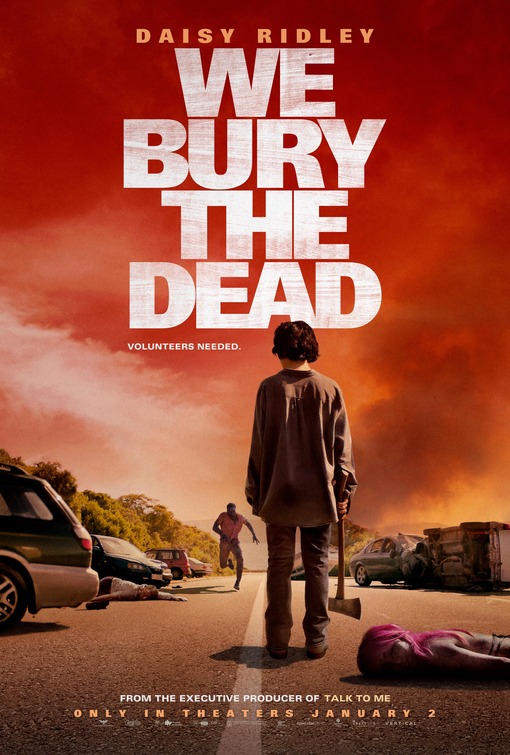
An interesting little drama disguised as a horror film, “We Bury the Dead” stars Daisy Ridley as a woman who may in fact be a widow but it’s not sure yet. The fact that she is an American becomes an issue because of the potential threat her husband faced. It seems that the United States was testing an electronic weapon in the southern seas when an accident occurred and the entire population in part of Australia was wiped out. Although it may be that they were not wiped out entirely, because this is something of a zombie film.
As a way to get to the distant location where her husband was located deep in the disaster area, Ava volunteers to be part of the National Emergency Recovery team, which basically consists of volunteers to collect the dead and identify those who have been damaged into a zombified state. As she engages in this volunteer work, she is also plotting a way to get the few hundred miles south to the resort island where her husband is supposed to be.
In a way all zombie films are meditations on grief, and our unwillingness to let go of our loved ones even in the worst of circumstances. There are other characters in this story, who are volunteering for their own personal reasons as well, and Ava forms an alliance with one of them to make her way South with his assistance. So, it is also going to be a road trip movie. Although we know that there are living dead in the affected region, this rarely becomes the traditional kind of horror film that features zombies. It is really only one jump scare that makes this a horror film, as usual, the real monsters in these stories are the living who take advantage of the circumstances.
The story is told with a series of flashbacks to the time before she and her husband were separated by this trip. We learn over several of these mediations that while they were in love, they did have problems. So this is also a film about the discovery in your love relationship. There are complications on the road, and a sense of foreboding haunts us through most of the movie, but there are only two or three moments of real tension. Those moments however were staged very effectively. Ava is viewed suspiciously a few times during the film because of her nationality, but politics is not really on the minds of the filmmakers, they are worried about our emotional psyche.
I thought the film was pretty efficient at telling its story and keeping it interesting. Those people looking for a zombie film that is filled with double taps, infected bites, and standoffs against hundreds of the Living Dead, will be disappointed. There are a couple of interesting turns during the film, one of which has already been explored in last year’s “28 Years Later”,.so this film is second to that theme. There is also an interesting reveal about the personal problems between Ava star and her husband, which comes at the start of the third act.
This must have been a moderately budgeted film, but the director is getting the most out of the resources that they were given. And even though it is a zombie infested Wasteland, the Tasmanian locations are still going to be an inviting tourist spot for those who take in the film. Ridley is solid, operating in a zone between the stupor of grief and the mania of trying to get to her husband. There are two other major characters, and they provide opposite ends of a story continuum, in an outcome that is more hopeful that is realistic.
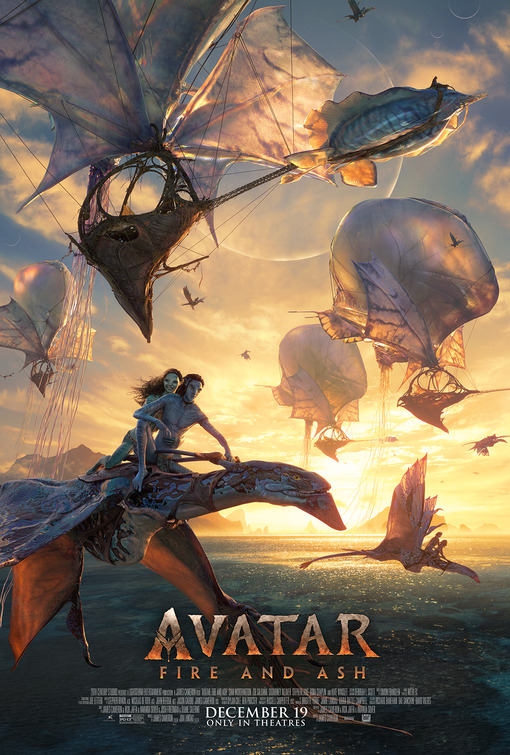
Let me Begin by stating that I have nothing but admiration for James Cameron and his technical accomplishments with the Avatar films. From the very first film back in 2009 up through this most recent film, Cameron has been pushing the outside of the envelope reaching for greater and greater cinematic experiences to make movie going worthwhile. As far as I’m concerned an Avatar movie deserves to be on the biggest screen that you can find with the best sound system available and ideally in 3D. That’s because the Craftsman Behind These films are at the Apex of their talent.
I have to admit however that the Avatar films don’t hold my interest as far as storytelling is concerned. They are interesting enough while I’m watching them, and create enough suspense to engage me for the three hours or so, that they take up. On the other hand I have never felt the need to rewatch the films in any setting other than a theater. Unlike a film series like the Lord of the Rings, these stories do not feel essential. They are entertainments rather than universals. As a consequence I don’t find myself invested in waiting for the next movie to come out. It took more than a dozen years for the first sequel to show up, and I was fine with that. It’s only taken about 4 years for this second sequel to show, and to be honest I wasn’t even sure I was interested in seeing it. I’m glad I did because I enjoyed the spectacle, I just can’t seem to warm up to any of the characters or care much about what happens to the cultures being presented here. I’m not sure if that is a storytelling fault or simply result of the genre that is being developed, although I am strongly anticipating the third film Dune franchise.
Fire and Ash, continues the story of the navi and the metamorphized Jake Sully. I mostly don’t remember how it is that this human became a navi, and the fact that antagonist characters do the same thing is also somehow outside my frame of reference. And once again I don’t really care. The film is mostly a series of chases and battles fought in the lustly designed environments that have been created on the planet of Pandora. The jungles and oceans of that world are visually stimulating and filled with creatures and Flora that are spectacular to behold especially in 3D. Is one of my friends jokes the planet deserves to be in 3D because the characters are barely 2D.
Like the previous versions of the film series, fire and Ash feels like it comes to a stopping point, and then adds another 40 minutes. You are going to get your money’s worth no matter how unnecessary it is for the films to be as long as they are. Because of the plot line repeats itself so often in the same movie there’s not a lot of suspense about the story only about how the incidents that occur in the story are going to be resolved. From my point of view that’s not a great way to stay engaged with characters or long-term story arc,
One thing that I am grateful for in this new addition is the presence of antagonists who are not merely human exploiters but are instead, Renegade Navi who don’t really subscribe to the same Planet mysticism as the residents we’ve already met. I’m not quite sure why they can reject the authority of the planet, because they have the same ethernet port hanging off of them that our Heroes do. There is a little bit of mumbo jumbo about how this tribe was abandoned by the great mother, but we don’t really know what took place, and why the fault should have been laid in the center of the planet. They do however have some cool new designs including a headdress that probably is a form of cultural appropriation that Cameron and manages to get away with.
A smart person will never bet against James Cameron when it comes to box office success. This movie appears to be doing as well as the previous sequel and although there has been some talk of pausing the planned 4th and fifth films, can’t see that happening. I was a little surprised that the lamb community was not interested in a show on this particular film, which might have left me believing that there was going to be a serious drop off in interest. It certainly isn’t the case with the General Cinema audience, so maybe it’s just a function of the time of year.
As I’ve already said, the film is worth seeing if you are seeing it in a theater on a big screen with the purpose of enjoying a mass entertainment. If you’re looking for anything else however there are plenty of superior options. As most of you who’ve read these posts before probably know, I almost always want a movie to succeed, even those that let me down occasionally. Avatar fire and Ash is entertaining enough, but outside of the technical craft and look of the film, I think it’s flatlined.
We lost Val Kilmer this last year, and that is certainly a tragedy. He is best remembered by most as Iceman from the Top Gun films, and he was Doc Holliday in the best performance of his career in Tombstone. It is unfortunate that his role in “Kiss Kiss Bang Bang” is sometimes overlooked . Gay Perry, the private detective, is one of the great sarcastic narrators in film noir. When you add Robert Downey Jr and his sardonic delivery to the narration, you have what should qualify as a classic.
Shane Black is created two of the best Neo noir films of the century. “Kiss Kiss Bang Bang” along with “The Nice Guys”, is the perfect mix of mystery, thriller, and comedy. There’s a seemingly convoluted plot that is the basis of the mystery in this film . If you get to the end of the movie and you are still confused, don’t worry about it. The real joy in the film is just watching the characters be smart asses in the face of danger and their own stupidity.
The dialogue for this movie is pinnacle Shane Black. He should probably only write for action movies, and film noir. Although his version of the Predator does undermine his action credentials a little bit. Still,l this movie gives him enough excess status that he can burn a little bit of it on some failed outings. Downey Jr plays Harry Lockhart, a loser and small-time crook who somehow gets caught up in the film business and is being mentored on how to be a private eye by Perry Von Schrieke, Kilmer’s character. When real murders start to happen, Harry insists on trying to solve them and tries to muscle Gay Perry into helping him. The by play between the two of them consists of some of the wittiest back and forth you will see on the screen since the days of the screwball comedies of Preston Sturgis.
Well not a parody in the pure sense of the word, “Kiss Kiss Bang Bang” certainly plays on the tropes of the traditional film noir. A detached detective, a femme fatale, and enough tough guy suspects to fill an arena for a fight to the death. We frequently get those fights as well. The deadpan delivery of the two stars, along with the outrageous plot points and coincidences, keep this film intriguing and lively.
One of the best illustrations of the biting and sarcastic dialogue comes when Perry in the fit of frustration asks Harry if he knows what he’ll find when he looks up the word idiot in the dictionary. Harry gives a smart-ass answer which would have been the end of it in the lesser film, but Gay Perry puts a button on the joke and dialogue rises to a new level.
Michelle Monaghan is also quite good in the film as the not quite good girl that Harry has always been in love with. She is both funny and sexy simultaneously. She is also pretty resilient in spite of her flighty character traits. As usual it’s not too hard to figure out the mystery, when a pretty substantial character actor is introduced early in the film, and then remains on the periphery during the exposition. Let’s just say that you will know who the bad guy is the minute he appears on screen. Again that isn’t really important, since the plot is mainly designed to put Harry and Perry in awkward situations and allow them to quip their way out.
It’s a little hard to believe that this film is 20 years old, and they’re only a couple of pieces of technology that give that away. Otherwise this movie remains as fresh as it was in 2005, and although I don’t think it quite qualifies as a Christmas film, it does its best to try.



 Kirkham A Movie A Day