TCM Film Festival 2025 (Day 4)

It feels a little like sundowner syndrome when we arrive at the fourth day of the film festival. Everyone has had a wonderful time for 3 days but we all know that it’s about to be over with, even though there are wonderful things still scheduled for the afternoon. Our fourth day at the film festival was really pretty simple, we had two films that we were going to see both of them were pretty long, and then we had the closing night film.

2001 A Space Odyssey

Amanda and I made the decision to split up for the first film of the day, she had never seen “Oklahoma” before and was anxious to catch it on the big screen. And as I’ve said in other posts, although I love my daughter she has disappointed me in her lack of appreciation for “2001 A Space Odyssey”, that’s the film I decided that I would go to see. I was especially interested in seeing 2001 again on the big screen, because the guest of the day was going to be the star of the film Keir Dullea. The festival programmers seem to be doing their best to get to important guests while they are still around. Mr Dullea, is maybe the 5th or 6th guest that I saw this weekend who is in their late 80s. All of us are due to leave this Mortal coil at some point, and I’m glad that so many of these guests chose to spend some time with us while they still could.

2001 on the big screen, at the Egyptian, is something I’ve done several times before. And once again seeing the movie in a theater with a rapt audience is thrilling. We were given the whole effect, including Overture, intermission, and exit music. They have also made sure to make these presentations authentic in another way, they closed the curtains and then open them again when it’s time for the feature. To me, the sense of excitement as the curtains part and the credits begin to roll, is one of the things that makes me most love the movies. They should be an event, not just content.

The conversation with Keir Dullea, was quite interesting, including stories about how he was cast and about his working with Stanley Kubrick on the set. His wife accompanied him onto the stage to help keep him focused on particular questions. He was by no means senile, but he would wander off track occasionally or miss the meaning of the question and she assisted him quite ably without necessarily suggesting that there was anything wrong. Especially appreciated the prompt that she had at the end when she reminded him that he wanted to talk about a piece of dialogue that got cut from the film, but for which he had spent a great deal of time trying to memorize, and still has it in his head.

I did an audio recording several parts of the conversation, and I’m going to try to include them here.

“2001”, along with “Jaws” is on my list of 10 favorite films of all time. So this is a pretty good weekend for me.

Apocalypse Now

When I met up with my daughter after her screening, we were queuing up to get numbers for this 1979 Francis Ford Coppola classic. She had been quite enamored of “Oklahoma”, and I hate that I missed sitting through it with her, because I quite like the film. I really enjoyed her embrace of the songs and the story and the joy that she seemed to be having. I was a little worried that this next film would destroy some of the cheerfulness that surrounded the mornings experience for her. After all Apocalypse Now is not a happy film.

I’m not sure how she managed to get to her age without being exposed to this film more. She told me she’s only seen a few clips and doesn’t really know much about the movie. So that made our decision to see “Apocalypse Now”, here at the film festival, really an appropriate one. The guest for this presentation was director Antoine Fuqua who has directed a ton of action films that I have loved over the last 20 years. He had nothing to do with the production of “Apocalypse Now”, it just happens that it’s his favorite film and inspired him to become a director and make movies that feature kind of grit and action that Coppola provided. His commentary on the film was mostly that of an enamored fan, which is not really a bad thing. It was certainly encouraging to hear his enthusiasm for the movie, as we tried to gird ourselves for the experience.

I mentioned that in the 2001 screening, the festival was trying to create an authentic experience included the ritual with the curtains. For this screening, the authenticity was enhanced by the distribution of a booklet, that contain the credits for the film. Back in 1979, the premier screening of this movie it Cannes, was done without any credits appearing on the screen, but rather in a Nifty little pocketbook with pictures. That item was reproduced and provided to all of us who attended this Sunday afternoon screening of a decidedly depressing War film.

There are variations of “Apocalypse Now” that have become quite popular in the last few years, but this presentation was the original theatrical cut. That’s the only version of the film that I know. I’ve seen the film occasionally over the years, and I have bounced back and forth between disliking it and embracing it. Whenever I think of the distaste I might have had for the movie, it probably reflects the negativity that is such a huge part of the story. 

This time I was happy to embrace the film, and I was glad that Amanda was suitably impressed with it as well. Now if only I could get her to respond to 2001 the same way maybe I wouldn’t feel like such a failure as a father.


Heat

The closing night film for the festival was Heat, in the TCL IMAX theater. We had originally planned on watching the silent version of Beau Jeste in the Egyptian Theater. When actor Al Pacino was added to the discussion of “Heat”, we changed our minds and decided we could not miss out on the opportunity to hear one of the great actors of the 20th century talk about this movie.

The original guest was Michael Mann the director of the film, and Pacino joining him made the discussion feel a lot more complete. In fact even though there were questions, the situation felt more like a conversation with two old friends on the couch rather than an interview. Each of them remembered some things slightly differently, and they occasionally made the effort to correct a misstatement or a difference in memory.

Now I do have a confession to make, we chose not to stay for the screening of the film after the conversation. We had watched Heat last year and Amanda was not up for repeating it. It is a long film, and if we had stayed we wouldn’t have gotten home until midnight at least. So we stayed for the conversation between Pacino and director Michael Mann, and then we made our way out of the theater is quietly as possible so that we can return to the Southern California house and my daughter and her husband are living in. We got to have dinner with them instead of sending down in the diner with Robert De Niro and Al Pacino.

TCM Film Festival 2025 (Day 3)

Earth vs. the Flying Saucers

Our third day of the TCM Film Festival started off with a science fiction classic from the 1950s featuring Special Effects by the great Ray Harryhausen. I don’t think I’ve ever seen this film before “Earth vs. the Flying Saucers”. The morning’s presentation was introduced by Joe Dante a director that I’ve admired for almost 50 years. Just as a side note that behind him at the screening of the Bruce Willis film “Sunset” in the Cinerama Dome.

Earth versus the flying saucers is a straightforward fifties sci-fi film, which means that it features military types who are hysterical about contact with new species, and weapons that we have not encountered before which will require a sudden development of Technology that we haven’t used before. Many times the aliens in these movies are standings for communism, the idea that a totalitarian race wants to dominate us and control our resources and lives sounds like it’s a pretty straightforward interpretation of the Soviet Union, only with cool space suits.

I’m sure I’ve seen actor Hugh Marlow in something else but at the moment I can’t remember what it would be. Many of the actors portraying generals looked quite familiar, I suspect they probably worked regularly in the 1950s playing military types. The highlight of these films is usually the special effects and in this particular case it’s the flying saucers and the Damage they cause Washington DC. Ray Harryhausen he’s always been one of my favorite producers, who’s specialty is stop motion animation, that he did mostly on his own. The effects look really cool on the screen, although in this particular film they were a little repetitive until we got to the attack on DC.

Colossus: The Forbin Project

Our second film of the day was one that I was looking forward to from the moment I first saw the schedule. In the decade Plus that I have attended the TCM Film Festival, I’ve made sure to see the presentations from Craig Barron and Ben Burtt. These two gentlemen have extensive background in sound and special effects, receiving multiple Academy Awards, and having a clear knowledge of the history of their own disciplines. The very first film I saw at one of these festivals was my favorite, “The Adventures of Robin Hood” with Errol Flynn. Barron and Burtt were the presenters for that screening and they had such interesting detail and background history on the movie that I resolved never to miss an opportunity when they were speaking again.

The film they were working on this day, was “Colossus: The Forbin Project”, from 1970. While not the most well-known science fiction film of its ilk, Colossus is a forerunner of some of the most prescient films of the last 50 years. James Cameron was clearly influenced by exposure to this movie because the whole concept of Skynet is stolen from this film. The premise of the film is simple, we have created an artificial intelligence to run our defense systems, and the worst things that can happen do.

I was a little surprised that this was the film that these two gentlemen were working on for the festival, because I didn’t remember that there were extensive effect shots. Of course I forget sometimes that matte paintings and sound design are a big part of how a movie like this manage to impress. The opening shots of Dr Forbin, walking through the Colossus computer as it is being booted up, require some difficult matte paintings that were done by the great Albert Whitlock. The descriptions that the speakers provided impressively explained why we should take note of this subtle work.

I also found it quite interesting, that the sound of colossus’s voice in the television interface that originated at the World’s Fair in 1939, was classified during World War II. The sound technology was used for the direct communication line between Franklin Delano Roosevelt in Winston Churchill. It was a nice simulation of what their call would have sounded like using the encryption sound technology that was later used for this movie. Once again one of my favorite things at the TCM Film Festival was a presentation by Craig Barron and Ben Bert. As an added bonus the star of the film Eric Braeden made an appearance. He did a brief introduction before the movie, and then participated in a little Q&A 

Brigadoon

The third film for the day had us returning to the Egyptian Theater for the first time since last year. Although I love the Chinese IMAX I have to say that the Egyptian is my favorite venue for the festival. When I lived in Southern California I was a member of the American Cinematique, who operated the Egyptian. It is since traded hands and is now a Netflix venue, and while that may not be something I think is great, they have done a fantastic job updating the theater while still maintaining it’s historical ambience. Such ambience seemed particularly important for this film, a 1950s Musical that I have never seen before Brigadoon.

I’m a fan of musicals and of Gene Kelly, so it’s a little surprising that I hadn’t seen this for myself at some point in the past. I don’t know that it has the best reputation in the world of musicals, after all I’m not sure there’s a song in it that was a hit. The film however it does have a number of charms, and it’s a good reminder of how the studio system of the golden age of Hollywood could produce a film on sound stages that made you feel like you were in Scotland. In case you are not aware Brigadoon is a village that is either cursed or blessed depending upon your point of view. It’s residents appear to be living nearly forever, because the village is only active for a few days every hundred years. Of course when Gene Kelly and Van Johnson stumble upon the village, complications ensue, but so do some wonderful dance sequences. I was not aware that Van Johnson danced in any films, but he did a pretty credible job with one number in this movie.

The real dancers in the film however were represented at the screening today by two of their own, Barrie Chase and George Chakiris. Both of these actors/dancers are well into their 80s, and they occasionally scratch their heads trying to remember some details about the particular film. They certainly gave us some insight into the way that dancers in those days found jobs or auditioned. I got the definite impression that Barry Chase lost a few opportunities because she would not submit to Arthur Freed . The casting couch was alive and well in those days.

While most of the film looked pretty good there were some sequences that probably needed to be remastered. I was happy to catch up on this classic and enjoy the look of the film even if the story is a little slight, and inconsistent on its own world building. After all it’s really a musical not a science fiction fantasy film interested in creating its own universe.

JAWS

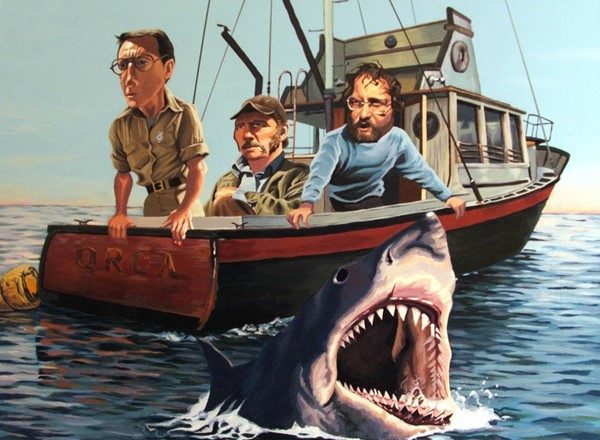
When we left the theater after Brigadoon we immediately got a new cue card and got in line to get back into the Egyptian for the most important film of our at TCM. This year is the 50th anniversary of the greatest film of the second half of the 20th century. Jaws is influential, groundbreaking, and once again in my opinion the best film that Steven Spielberg has ever made.

I am not sure that there is another movie that I have seen in a theater as often as I have Jaws. It made me very nostalgic to be seeing it here at TCM in the Egyptian Theater, since at least a half dozen of my earlier screenings also took place at this iconic venue. Anybody reading this can find more than a dozen posts about the movie Jaws on this blog site. I’m not going to recap the story or the significance of the movie on this day. Instead, main thing I want to talk about is the guest Lorraine Gary, who played Ellen Brody in the film. 

She was married to Sid Steinberg, who at the time was the chief at Universal Studios and Steven Spielberg’s mentor. This is the part that she will be remembered for, all of her other roles were primarily supporting TV characters. Frankly she’s terrific in the movie, although she disappears from the film entirely in the third Act. Advanced age of 88 she had No Reservations about being honest concerning her co-workers. She was dismissive of Richard Dreyfuss, without giving any details of why she didn’t care for him. She also expressed the opinion that Roy Scheider was it somewhat mean co-star, and she didn’t have any warm memories of working with him. She did however confess to having a crush on Robert Shaw, which I find completely Charming and ironic given their parts in the film.

The print of the film that was screened for us came from the British Film Institute, and had been preserved since a 1981 presentation on the BBC. The color dyes in this print are probably as close to the original version of the film from 1975, as we are likely to ever see. The film looked magnificent. It was surprising when Ben Mankowitz ask for a show of hands of people who had never seen the movie, that there were dozens of hands in the air. Listening to the audience during the film I had no trouble believing that those people were being honest, because you could hear the intake of breath, the shots of surprise, and the Applause of delight for all those little things that make Jaws the quintessential Blockbuster in one of my favorite films.

Blade Runner

We repeated the process at the end of this film walking out of the theater getting in line immediately to get a new cue card to go back in and see our final film for the evening. Although it was not a financial success in 1982 when it was first released, Blade Runner has been a critical success and a cult favorite for more than 40 years. 

One of the first Criterion Collection laserdiscs that I purchased was Blade Runner, back in the 1990s. That version does not include the director’s cut in the Final Cut, but there is discussion of some of the things that would later be included in revised editions of the film. The version we saw appears to have been the Final Cut, so there is no narration in the ending is slightly different, although to be honest we only stayed through the first hour of the film. As I’ve already mentioned we were staying at the house in Glendora so we had a 45 minute ride home, if we stayed for the whole film we would not have been in bed until 1: 30, and we needed to get up at 5: 30 to make Sunday.

The special guests for this film was the female co-star Sean Young, who was only 19 when the film was made and who was making her debut as a film actress with this movie. Miss Young has always been known as an outspoken and opinionated actress and nothing has changed even if she is aged the way I have. She spoke about working with Harrison Ford, the rigors of the makeup chair, and generally working in Hollywood. Her talk was not limited to Blade Runner though, as she made brief comments about several films and actors that she had worked with. She seemed fond of the late Gene Hackman when she worked with in no way out, but never seem to get very close to Kevin Costner who was her leading man. She did say that Blade Runner was the favorite film that she made, but the bigger reaction from the audience was to her second favorite film which was Ace Ventura.

Watching Blade Runner at home on Blu-ray, streaming, or even my beloved LaserDisc, cannot do it justice. Seeing it on the big screen and listening to the score and the sound design of the film in the theater like the Egyptian is one of those things that everybody should experience. We only stayed through the scene where James Hong meets his demise, but I can tell you everything up to that point looked and sounded spectacular on the big screen.  

At one time it had been my hope to make a couple of the midnight movies, and “Wild at Heart” would have been another film at the Egyptian had we not been so tired. So we ended our day with the fun talk from Sean Young and the brilliant vision of Ridley Scott.

TCM Film Festival 2025 (Day 2)

Thunderball

For me personally I’m not sure the Day Two of the film festival could have started off any better. The first movie we were scheduled to see was a James Bond film, celebrating it’s 60th anniversary. It’s hard to believe that the James Bond films are almost as old as I am. I’ve been a lifelong fan of 007 and is a child of the 60s it’s easy for me to be nostalgic for one of the most significant cultural films of that decade. “Thunderball’ was a commercial earthquake that signaled the significance of action films, spy films, and general popular culture.

The 4th of the 007 films, “Thunderball” did everything bigger and more spectacularly than any film up to that time. The history of the film’s origin is well known, Fleming developed the original story with a couple of other writers for a TV series that never went anywhere. Authorship claims were resolved by agreeing to allow one of the claimants a producer credit on this film. Regardless of what happened behind the scenes what happens on the screen is over the top, beginning with the use of a jetpack to escape from the bad guys in the pre-title sequence. The slogan for the film was “He3re Comes the Biggest Bond of All.”. 

Maybe the most thrilling moment I felt at the whole festival was when the titles for “Thunderball” came up and we got those great Maurice Binder titles with Tom Jones belting out the song on the big screen. This is a restoration of the film, and frankly I thought it looked great before. This is the movie where all of the tropes from Austin Powers originated. There are sharks however,  they don’t have any lasers on them. The spectacular underwater battle that takes place at the climax of the film still could use a little trimming, but it didn’t seem nearly as long to me today as it has in the past. Probably because I’m watching it on the big screen.

The guest for this morning’s presentation was actress Luciana Paluzzi, who played the SPECTRE assassin Fiona Volpe. She was 27 when the film was made which makes her 87 today. She still looks terrific and she was sharp as a tack with a great sense of humor. She talked about her long friendship with director Terrence Young, who made three of the first four James Bond films. In fact director Young gave her away at her wedding to her husband to whom she is still married. It was fun to listen to her share stories of being on the set with Sean Connery, and shooting the various scenes that she was in. I’m glad we got this opportunity well we still have some surviving members of the cast to talk about the film. Thank you TCM.

Because of the length of the film, and the fact that the talk took place after the movie, we were too late to queue up for either the films that we were planning on filling in the rest of our morning with. So we missed babe and The Time Machine. We did take a little break over in the lobby of the Roosevelt Hotel, before making our way back to the big house for “The Fabulous Baker Boys”.

The Fabulous Baker Boys 

Michelle Pfeiffer was the guest for this presentation, and moments before the movie and the discussion she had participated in the traditional handprint and footprint in concrete in front of Grauman’s Chinese Theater. I hadn’t seen this film since it came out in 1989, but I remember being impressed with it and thinking it deserved some of the accolades that it received. Most especially Miss Pfeiffer’s performance being nominated by the Academy. I do remember it was a bit of a surprise that she didn’t win.

The story is a small one, focusing on the relationship between two brothers who have a piano lounge act that is moderately successful. The older brother played by actor Beau Bridges, is engaged and cheerful during their performances, and he takes the lead in trying to keep their act financially lucrative. The younger brother is played by Jeff Bridges, his real life brother, a piece of terrific casting. Jeff Bridges character is the more talented musician, who is resentful of his occupation and the playlist which the brothers usually perform. When they run into trouble keeping the act booked, they decide to hire a girl singer to join the show, enter Michelle Pfeiffer who plays Susie Diamond, an escort with a nice voice, who wants to make the transition legitimate performances.

There are basically two love stories in the film, the one between the brothers which is strained by sibling rivalry, and different views of what they ought to be doing. And of course the younger brother who is always been a philanderer begins a romantic relationship with Susie, which we can see is not going to end well for either of them. Susie Diamond is a hard case, but her heart is not as buried in concrete as is the younger Baker brother. All three leads are excellent, and they make the drama of the film feel quite real.

It is not a news flash to anyone, but Michelle Pfeiffer is a stunningly beautiful woman. She is the same
age I am and clearly looks a hell of a lot better than I do. She was friendly and Charming, and she tried to answer the questions what’s that Ben Mankiewicz tossed at her.  Sometimes the questions were a little awkward, and her answers would end up being more ambiguous than you might expect, but she was doing her best. This was also the first time I’ve noticed in the decade that I’ve been attending the festival, that the Stars security team was present on the sides of the platform where the guests in the host were seated. I’m sure security has been there for many presentations, but miss Pfeiffer security team had one individual standing on each side of the platform. That was a little surprising but completely understandable.

Misery

Our third film of the day, was also at the TCL IMAX theater, generally known as Grauman’s Chinese, and talk about a contrast in the way the actors are portrayed in the two movies, Michelle Pfeiffer is luminous beauty is now contrasted to the harsh persona and visage of Kathy Bates in “Misery”.

“Misery” is a Stephen King story translated to the screen by Rob Reiner, who did the same thing for another king story in the film “Stand By Me”. This is a drama that is actually a horror movie, and when you see how it plays out I don’t think there’s any doubt that it is a Fright Fest.

Kathy Bates won the Academy Award in 1990 as the character Annie Wilkes, a deranged fan of the romance novels that feature a character named misery. Author of those books from a car accident in the blizzard, and cares for him in her home. But of course talking about going from the frying pan Into the Fire, the danger to the author seems to get greater and greater the longer he stays in her care. For the most part the film features two actors, the aforementioned Kathy Bates, but also the great James Caan, who plays the injured author. It takes nothing away from Kathy Bates performance to point out that Caan is terrific in the more physical performance. His character does not have the emotional range that Bates did, but he has to do a lot more torturous crawling, climbing, and sweating. The two of them together were really good.

I’ll briefly mention the late Richard Farnsworth also, who plays the local sheriff, trying to figure out what happened to the missing author. Farnsworth was always a welcome presence in movies, and when I mentioned to my daughter that he was in a G-rated film from David Lynch she practically fell out of her chair.

The screening emphasizes for me once again how important the theatrical experience is. The theater full of people responded to the events taking place on screen with screams, laughs, and nervous tittering at times. You could hear that the audience was reacting to the movie exactly how the storytellers had intended. And it must have been very gratifying to the two guests to hear the way the audience responded to their work.

The guests for this film were the director Rob Reiner and the lead actress herself Kathy Bates. They talked about the process of rehearsing the picture, and they noted that James Caan had a different style of acting then Bates did. Rainer talked about how he had tried to manage their different styles in the film and use that as a way to reflect the characters that the two were playing. There were a few tidbits of information that came out about the screenplay that I thought were particularly interesting. It was written by the great William Goldman, the Reiner added several pieces to the film as they went along, including the dinner sequence which includes a great suspense sequence, and a twist that had the audience moaning with frustration.

The American President

Our fourth feature of the day, was also playing in the main house, so after leaving the theater, queuing up to wait for the next screening, we return to exactly the same position we were in for the previous two films to watch “The American President”. This is a film that was a precursor to the television series The West Wing, one of our favorites. The film was written by Aaron Sorkin, and once again it was directed by Rob Reiner. Frankly Reiner had a run from 1985 to 1995 that is pretty amazing in terms of quality. He made the following films: “The Sure Thing”, “Stand By Me”, “The Princess Bride”, “A Few Good Men”, and “The American President”. That’s a murderer’s row of great films from that decade.

We’ve seen the film dozens of times, it has been a go-to in the house ever since it came out. The story of widowed president who attempts to start dating again while a resident in the White House. There are of course a lot of political machinations, and the hysteria over guns and climate change is exactly the same 30 years ago as it is today. Regardless of whether those issues matter, the story is really about how personalities influence the political process. Everybody is faced with some ethical dilemmas in the story, but of course the good guys get the best speeches, thanks to Aaron Sorkin.

Screenwriter Sorkin and director Reiner where the guests for the presentation, and they talked about the Genesis of the film, and the way it transformed itself to some degree. Originally scheduled to Star Robert Redford, and be merely about the romance and comedy of a president trying to date, the film turned into something a little more weighty and probably better balanced when Sorkin and Reiner decided to inject some political elements to the film. Redford wasn’t interested in doing a political film, he’d already done that. So enter Michael Douglas and the rest is as they say history.

Ambitiously we had hoped to see Rocky Horror at a midnight screening, but are better judgment sent us home after this film and we didn’t attempt to do the time warp late into the evening. I would have enjoyed seeing Barry Bostwick is the guest, but after hearing that the screening went off half an hour late I was very grateful that we made the decision to stop at four films for the day.

During the break we went over to the TCM Lounge and found this on display. 

TCM Film Festival 2025 (Day 1)

The first day of the TCM Film Festival varies depending upon what kind of pass you have purchased. We have gone for the Essentials pass for the past several years because that gives us access to the opening night film which this year was The Empire Strikes Back, celebrating the 45th anniversary of its release. 

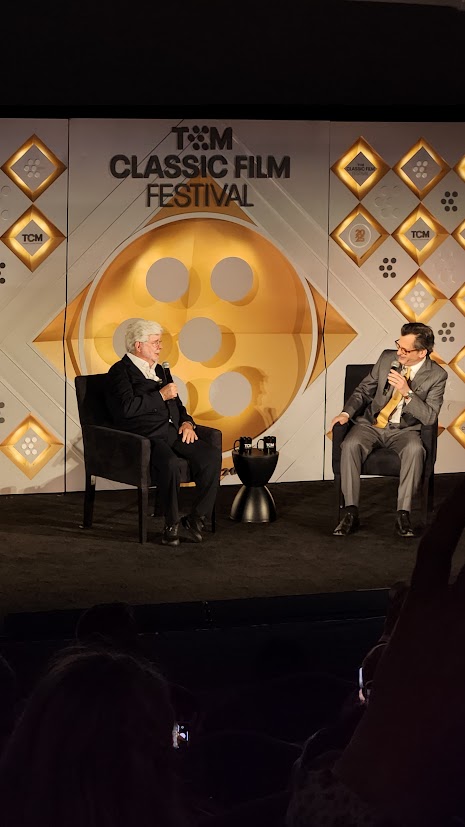
We get a chance to walk the red carpet, have some free popcorn and soda, and sitting an audience for an introductory talk with the legendary George Lucas. Ben Mankiewicz did the best you could to draw the often reserved Lucas into a coherent conversation, but he frequently struggled because Lucas becomes focused on the way he wants to tell his story, and often seems unaware of the audience that’s listening. Eventually Lucas gets to the point of Mankowitz’s question, but it was a very roundabout approach.

Before the conversation began however, I had one of the many great experiences I look forward to each year when TCM comes around. One of the LAMBs that appear on the LAMBcast on a regular basis, was attending the opening night presentation as a media guest with his friend journalist Scott Mendelson. Aaron Neuwirth is one of the delightful regulars on the podcast, and I had hoped to entice him to attend the with the screening of Mothra that took place after the Empire Strikes Back premiere. He wasn’t planning on doing that but on the last minute, he was able to come to the Empire screening, and we connected briefly in the audience sharing a handshake and some jokes, and connecting in the real world not simply in the virtual.

The movie that was screened was in fact one of the revised Editions that Lucas put out with some additional visual elements. Fortunately, of the three original films that got the Lucas revisionism, Empire is the one that suffers the least from his intervention. One or two additional shots clarify a couple of early scenes, and added crowds and vehicle shots make the sequences on bespin a little more cinematic. There is nothing is egregious as editing Han Solo to the point where he shoots only after being shot at, so I didn’t object to this choice of version for the show. Many have said, and I would be hard pressed to disagree, that Empire is the best of the Star Wars films.

My own history with Empire Strikes Back is a little sweet and sour. The sweet consists of the memory I have of seeing the film with my fiancé, and my best friend, the night before his wedding. I don’t think his bride was very happy with him the next day because our screening kept us out until after midnight in June of 1980. The sour consists of the memory I have of my mentor Lee Garrison, who had gone to a screening of the film nearly a month earlier then it’s opening at Caltech where he was the debate coach at the time. He wouldn’t tell us anything about the film, trying not to spoil it for us, and saying only that it would be something that we would really enjoy. Boy he was sure right, the problem is I never got to talk about it with him after we saw it because he was killed in a car accident heading back to Texas just a week after this screening. Still I considered a good memory of my dear friend.

I mentioned that we were talking about seeing a screening of Mothra immediately after this, but we had flown into town the day before, and with the time change our sleep cycle was a little screwed up, and I didn’t good idea to stay until after midnight on the first night of the festival, when we were scheduled to watch films early the next day. We were not staying in Hollywood this year, but rather at my home in Glendora, which meant about an hour commute both ways. That influence our decision on several other films in the next couple of days as well.

So for day one of the festival, it was just the red carpet and the screening of Empire with that conversation with George Lucas and the chance to meet Aaron Neuwirth. I consider that a very successful first day. 

The Amateur (2025)

In the 7 years since he won the Academy Award for best actor Rami Malek is struggled to create a strong on-screen identity as a lead. His biggest part since Bohemian Rhapsody was as the antagonist in the last James Bond film no time to die. He’s made a couple of other films since then all of which are perfectly but none of reached the level of Excellence that I’m sure he hoped for and that his fans would like to see him rise to. This new entry into the Spy genre is an attempt to leverage himself back into serious movies, and I suspect potentially create a franchise.

If you’ve seen the trailers for this film you know that there is a Revenge plot at work here, is Malik’s CIA techno wizard seeks the people responsible for the murder of his wife. It should come as no surprise that is a spy film there’s also a conspiracy element to the movie, and it’s not as simple as it appears to be at first. I’m not sure the CIA has ever been depicted as the straight Heroes in any film where they were a featured part. Usually the CIA is engaged in some subterfuge or illegal activity that they’re trying to hide from the world but especially from their Congressional overseers. Even the mission impossible films have relied on internal cabals to generate plot points for the movies.

The idea of a techno geek going after hardened terrorists is an interesting idea but it does require that we swallow a big dose of reality suspension. Malik is effective in showing the Brilliance of his character as he tracks down using his technical tools, the terrorist team that took out his wife. We immediately become suspicious however when his CIA handlers attempt to muzzle and Corral him. It doesn’t take long to understand why. Their rationalizations are perfectly reasonable, but it is also clear that they are not too concerned with the collateral damage that is being wrecked upon the world. Malik’s character is not naive but he is bureaucratically pure up to a point. And then of course we get the traditional rogue agent.

For the most part this is a Slow Burn through the first half, with maybe one solid scene that builds some suspense and excitement. However halfway through his list of miscreants to eliminate the Mallet character picks up some collaborators, and the action gets more intense. The political intrigue is given cover by suggesting that these operations are occurring outside of the normal chain of command. They would certainly need to because many of the operations and Malik discovers are both illegal and deadly including to our allies.

Like most Revenge pictures we take the greatest satisfaction in those moments when our protagonist deals out Justice to the evildoers in some creative way. Our CIA operative sometimes seems hesitant to carry out the executions he himself is designed. Usually his hesitancy seems to be in Pursuit of additional information about the Spy gang. Regardless, the first two deaths that he creates are interesting, and there is a Twist or two along the way. We get a few red herrings along the way, but after a certain point we suspect that Rami’s character really is smarter than everybody else. Laurence Fishburne plays both an ally and an antagonist, and the one thing that feels wrong with this movie is the cheat that comes at the end. On the other hand John Bernthal was not in the movie Enough to generate the kind of support yet that a sequel would demand. He does however get a very good narrative sequence.

This is a pretty intelligent spy film, it relies on the old trope of an agent operating outside of official channels, and fighting those channels at the same time. It’s not quite as clever as black bag earlier this year, but it does sit up there near the top of my list of well-designed spy films, and for the year so far this one fits near the top of the list one of my favorite films. It’s still early but I would recommend the amateur to anybody who’s a fan of either Remy Malik or the Espionage genre.

The Last Picture Show (1971) Revisit

For a period of time in the 1970s, film directors were given free reign to create some of the most personal and well acted films to ever come out of Hollywood. In an era that was filled with personalities like Martin Scorsese, Francis Ford Coppola, and the young Steven Spielberg, maybe the director who got a foothold on the zeitgeist of the era the best, was Peter bogdanovich. Has a director he had a string of successes from 1971 to 1975 that are incredibly impressive. The first of those truly great films is this 1971 requiem for bygone era.

The Last Picture Show is known for the huge cast of future stars that made appearances in the film. Jeff Bridges, Timothy Bottoms, Randy Quaid, Cybil Shepherd, Eileen Brennan, and Ellen Burstyn are all getting ready to have huge careers in the next two decades. The film also gives parts to older veterans Cinema, or give it a chance with the Fantastic script to write a little silver in the sky and help us remember what film dialogue is all about. Cloris Leachman and Ben Johnson want Academy Awards for supporting actor and actress, and they did it on the strength of a script that treated them like real people, who deserve dignity even in the most undignified circumstances.

I’m not sure I can think of a film that has sadness more clearly as its theme Than The Last Picture Show. The social relations between the members of the senior class, or sometimes harsh and thoughtless, and at other times heartbreaking. Cybil Shepard plays Jacy, the headstrong popular girl, who uses sex to gain status and learns that she is simply repeating the mistakes of the past. In the wake of her Reckless Behavior she leaves two best friends who become estranged, one because he is a rejected lover, and the other because he rejected his one opportunity of love in this small town.

Everything in this movie screams of being depressing. The diner is shabby and the waitress who works there, although wise and surprisingly friendly, is also beat down by her existence. The pool hall is the social center of the town, and it is a dust filled ramshackle Hangout for men too old to do much and for boys too young to be doing anything. Ben Johnson plays the older man with enough gravitas to actually earn the respect of the youngsters. Although life is dealt him a pretty crappy hand he is not embittered by his fate, simply nostalgic for the good things that have long passed him by. Sam the lion is a character that we can all admire and he gets a sequence where he narrates part of his life in such an eloquent way that Johnson brings him to life and earns the accolades that were heaped upon him that year. And of course there’s not a happy ending when it comes to Sam.

Ruth Popper is a woman who is aware that the best parts of her life are long in the past, and for whom every day is a struggle against depression and potential Health catastrophes. When she becomes the unlikely lover of one of the two young men who are close friends, it feels dangerous, absurd, and also the most hopeful thing in the movie. And of course it also doesn’t end well either. Cloris Leachman, clenches her hands, walks with the faltering step, and dry cries through many of her scenes. Her performance is one of physicality, where she conveys a world weariness Beyond her years, and a rejuvenation it is unexpected when she discovers what she thinks is a new love. The conclusion of this film includes the death of a much younger character, and it turns out that that is not the saddest thing in the story. The way in which this will Lonely woman, is mistreated and embittered his heart-wrenching. What is also sad is that even after standing up for herself, she has enough Humanity to offer a drop of console, despite it not being earned.

The town is full of people who will never leave and as a result will likely bleed on Happy lives, or their people who are anxious to get out, but afraid to because they know they’ll never be able to come back to things the way they were. The closing of the movie theater in a small town like this maybe the saddest symbol of filmgoer like me is likely to see. The black and white photography in this film makes everything feel dusty and forlorn,  but it also makes the people look either incredibly beautiful or sadly unpleasant. I guess that’s the way the world is, or more precisely… Was. 

Warfare (2025)

This is an unusual movie designed to put us in the field with the Warriors who defend us in Dark Places. It represents the memories of the men who went through the actual event, and is designed to replicate as closely as possible the firefight that these men participated in. I don’t see an agenda or political perspective in the way this film is being presented, the men who are performing their Duty are average Americans, who are well trained, but respond like human beings in the dangerous circumstances they find themselves in.

Although there are a couple of familiar faces in the cast, this is certainly not a star driven vehicle. At least two dozen characters appear on the screen and have lines, but you could not point to a single one of them and say they were the main focus of the story. It is the event that is the star of the film. A military Advanced team, probing an enemy territory, during the Iraq occupation, discovers that they are the target of an insurgent attack. The events unfold for the most part, in real time, and the threat of death exists in every frame of the last half of the movie. There are moves that are made by the Marines in this story, which in hindsight might seem problematic, but given the outcome, and the survival of some of their comrades, we should certainly be willing to forgive some Divergence from military bureaucracy.

Even though they’re under attack, the Marines Express every confidence in the situation that they are capable of responding appropriately. They have Superior Equipment and Superior training and they also have reinforcements that will system although it will take some time. To me the astonishing thing about the events depicted in the film are the nearly heroic actions taken to save the lives of the injured Marines when an IED explodes as they are preparing to withdraw. Injuries that we saw in Saving  Private Ryan, were horrifying but the story doesn’t linger over them and the agony that those soldiers went through. In this film the consequences of the injuries seems to be the main justification for telling the story. Both the injured Marines, and their teammates never really give up in spite of the pain and the fear that they must be going through. Some may have a moment’s hesitation, some are trying to cope with with shock and concussions and temporary deafness. They all however do their jobs.

I will warn you that the injuries depicted are brutal, and there are moments when the agony of the victims is hard to bear. The stalwart efforts platoon of Marines is admirable in and of itself regardless of the outcome of the battle. This is not a story where retribution is heaved upon the enemy in a dramatic moment of Revenge. The forces that are being used, often appearing to be overwhelming, are done for the purpose of saving the lives of their comrades in arms. We really have no idea what kind of damage was inflicted on the enemy at the end of the day. This is a war film that is not a drama about some narrative, rather it is a narrative about an event that took place and that these Warriors survived.

War is evil, but sometimes necessary. The Men Who engage in war are usually not evil, but simply doing their jobs, fulfilling the plans of someone else to make the world a better place. The struggle to accomplish that requires incredible fortitude. Warfare attempts to depict that fortitude and put the audience at the scene. It succeeds in its visual execution, by allowing us to see the chaos and confusion in this sort of combat operation, but also the professionalism and determination of well-trained men. Because the story is told from the perspective of the men who actually went through this, the dialogue is filled with technical terminology Battlefield jargon and a variety of military language. Nothing is done to make this film dumb enough for an audience to understand. It requires an audience that is smart enough to know that what they are seeing is something they never want to go through themselves. 

Ash (2025)

 Ash is a somewhat dystopian science fiction film set on another world that the human race is hoping to be able to terraform and relocate to. We get told all of that information about a quarter of the way into the story after the mystery of the horror has already begun. The way the Story begins is simple a young woman wakes up from a deep sleep and discovers that the ecosystem that she lives in is filled with dead bodies and signs of violence that she has basically no memory of.

The film is a hybrid version of Solaris, alien, and the thing. Ultimately there are about seven actors in the film but for 90% of the movie they’re only two that take up screen time. The woman named Reva, as flashbacks to some of the events, and begins to suspect that what happened might be her fault. File into her ruminations, another character shows up played by actor Aaron Paul, who clearly knows Reva, but was not at the station when whatever disaster befell it took place.

At First the movie looks fairly low budget. The sets are not much more complicated than a series of rooms that have been dolled up with some light fixtures and a few props to suggest something more futuristic. And the film is clearly something that was done on a budget. In the second half of the film though a few special effects show up that suggests that they were saving their money for a little bit more production value. A couple of models and some CGI add a little credibility to the situation. We also get a few special effects makeup sequences that are pretty good. 

The main problem with the film like this is that we are dealing with an unreliable narrator, and we all know why she’s unreliable. Also, nearly everything that we see at one point become suspect, and we wonder if we are looking at something that really happened or if it is just a projection of her consciousness. In the end it does turn out to be something of a monster movie, but it’s trying to do it in a way that is different and a little bit more cerebral. I think the ambitions outstrip the ability of the script to deliver this kind of story. The movie isn’t bad, but it isn’t very compelling either and by the time we get to the end it’s easy to feel detached from what’s going on. There is also attacked on conclusion that makes no sense but his design to create a sense of irony at the end of the story.

The director of the film is also responsible for the music, I get the impression that he is a music personality who is dabbling in the film world. It’s not that he’s on talented, but he’s not experienced enough to make this film more interesting than something to be consumed and almost immediately forgotten, in spite of the film’s ambitions. I suspect that this movie was largely made for streaming purposes, and it received a token release either because of the actors involved or to placate the director. Either way it turned out, it was a reasonable Monday evening, but again I’m not going to remember this very long.

Mulholland Drive (2001)

I am a David Lynch fan, but I am not a completist. The man directed over a hundred projects, including television episodes, shorts and music videos. His list of feature length films is relatively small, only 10 really. Of those ten I have seen eight, with “Mulholland Drive” being my most recent, and the one I have waited the longest to see. This is a film that came out 24 years ago, and up to last Saturday, I had not spent the time to watch it. If I had to venture a reason why, it might be that the plot sounded  a lot like “Lost Highway” with characters becoming completely different people in the course of the story. Lost Highway is the one movie my wife attended with me that she walked out on. I stayed and watched it to the end, but I know I was very confused and I have not returned to it. I think I also suffered from the misnomer that this was a Black and White film, and it would be murky. That set off hesitation and I never took the plunge. With the recent passing of Lynch, the Alamo Drafthouse Cinema Chain has been playing a number of retrospective films and I decided it was unfathomable for me to hold out any longer.

In the end, I think I made the right choice not trying to catch up with this on video, and seeing it for the first time in a theater. This movie is a masterpiece and probably sits in my top three Lynch films of all time. It does get typically murky and convoluted in the last twenty minutes, and I understand what is being attempted, but it really feels like a switch that was done for style more than story, which is a very David Lynch thing to do. I’m OK with the switch, but I wanted the mystery of the original story to keep playing out. Maybe the reason that I find this film so compelling is that it comes the closest in style and mood to the original first season of “Twin Peaks”. Every moment filled with portents, every scene visually unsettling, every music cue intriguing and confounding. This was originally a pilot for a TV series and I could easily see Lynch stringing out his mystery for several seasons if he could be freed from the demands that he solve it, like the demands that threw off the second season of “Twin Peaks”.  Although I guess there is a risk that it could turn out to be “”Lost”.

The sound design of the film is one of the main reasons that seeing this in a theater was the right thing to do. The music penetrates the brain and body differently in the ambience of a packed auditorium. When the singing sequences take place, their juxtaposition with the darker ambient sounds and haunting Angelo Badalamenti score are more powerful. There is a sense of danger when Justin Theroux’s character meets the Cowboy in a forgotten corral on Mulholland, the silence of the scene, the footsteps on the ground and the quiet voice that emanates from the ambiguous figure are all heightened by a theatrical presentation.  

This was the breakthrough role in Naomi Watts career and it is understandable. By the end of the film, she plays two distinct personalities and the range she shows is impressive. Like all Lynch films, the contrast between the world we dream about and the one we live in takes up a major portion of the themes in the film. The jubilant Betty, full of hope and promise is certainly appealing, and the way she absorbs the mystery of  Rita into her life is fascinating. When they cross paths with the missing actress Diane Selwyn,  the facade of hopefulness turns into fear and the twist of identity suddenly makes a little sense. Even if we don’t understand how it all happens and why we are able to observe it, it works.

There are a string of clues that lead to the resolution, if you can call it that, and they are woven into the story effectively, but we are left with a dangling set of story threads that don’t seem to pay off. If Rita is a complete invention in the mind of Diane, as a stand in for the lover who has jilted her, then I suppose it will just be that we came in the middle of someone else’s dream, and we can’t really expect any answers. This though would have been the flow line of the TV series that I now wish had been produced. The surreal plot twists at the end extricate Lynch from having to deal with these points, and they do so in a way that will make analyzing the film fun for eternity. 

As is usual, the ambiguity at the end will delight some and frustrate others. I can appreciate both points of view, and I am just a little surprised that I find myself late to the conversation. I hope all the good speculative discussion has room for one more chattering head. I’m in.  

Death of a Unicorn (2025)

So far my favorite horror film of the year is this entry starring Paul Rudd and Jenna Ortega along with some other veterans, in a tale that mixes fantasy and science. The easiest way to summarize this film is that it is a cross between science gone wrong movies and creature features. Think of it as Jurassic Park only with unicorns instead of dinosaurs.

An estranged father and daughter are traveling to a remote luxury retreat for a weekend so that he can be evaluated as a potential executor of a will for a dying millionaire. He already works for the company at a high level, but hopes to be entrusted with managing the heirs when they take over the company after the death of the patriarch. Rudd’s character has brought his daughter, because he believes that the family that is about to lose its founder, values family above so many other things, that a demonstration of his own family values is necessary.

As usual I try to avoid giving away too much in the movie, if not entirely spoiler free, I certainly try to avoid things that make the movie distinct or valuable. Let’s say that through a confluence of events, the patriarch, his family, they’re small coterie of servants and the perspective executive are all soon threatened by some animals that are angry about the events taking place in the story. It is a little hard to warm up to most of these characters as they are either narcissistic or greedy and come off as entitled a holes, that or they are sniveling sycophants unable to take an action that they know is right but which might be perceived as weak by the others.

Richard Grant, Tea’ Leoni, and Will Pouter managed to make privilege one of the most unappealing characteristics shown on screen this year. Pouter’s character’s amazing superpower is the ability to rationalize any stupid decision that he wants to make. It’s fun listening to him talk and try to convince both the willing and the unwilling to accept his delusions. Leoni plays his mother, not as a nurturing parent but as an enabler willing to put up with his whining. Grant, as the dying patriarch, manages to create a transformation of selfishness so quickly that we are perfectly willing to let his character die, even though the Fates seem to be in his favor at times.

I can’t make it a secret that there are unicorns in the movie, there are. The creatures depicted here are a nightmares version of the traditional mythology of the Unicorn. That is at least to some degree, because it is the failure of the humans that produces eventual mythological creature. The movie has very funny moments but it never reduces itself to a slapstick or parody of more serious movies. If we can accept the fantasy premise in Jurassic Park, we should be able to accept the fantasy in this film, and treat the threat with the same degree of seriousness that we did the Rogue dinosaurs.

The story does take a few shortcuts, and there is one huge inferential leap that is required in order for us to understand the nature the unicorns. Once we passed that point however, I think the film plays it straight with the story that it is set up. There are a couple of ex machina moments near the end of the movie that might undermine the credibility of its premises, but let’s face it, we are talking about a movie about unicorns, let’s not get carried away with story verisimilitude.