I have been a little negligent as of late, keeping up with my posts as quickly as possible after seeing the movie. This post comes four days after I saw this great family film, and I am sorry I can’t do more to promote the movie and save it from the discard pile that it appears to be headed for. Mark Wahlburg and a dog should be a sure thing for most family audiences, but I suspect that the sports based setting may not be as interesting to people on the big screen, since they see this weekly on their televisions.
Frankly, I am a sucker for a dog movie. It is probably a good idea for me to create an inventory of films I have covered on the site that feature a canine co-star. A couple of years ago, Channing Tatum made his directorial debut with a dog film, simply named “Dog“. I liked that one quite well and it would make a good companion film for this movie. Both feature dogs that have some health and psychological issues, but one is a straight drama while this movie is an adventure film as well. There are some beautiful scenes of a race around the jungles of the Dominican Republic, but I did end up worrying about current events in Haiti, which shares the island with the setting of this movie.
Wahlburg plays a long time race figure, who while widely respected, has never come in first in the grueling endurance challenges that these races present. After a humiliating loss, and a two year break, he attempts to return to competition, but his resources are low and sponsors are wary. As we watch him struggle to put together a team for the race, we also see a street dog, struggling to survive in the third world nation, frequently abused and usually starving. The back and forth between these two stories is a nice parallel which pays off in the second half of the movie. When the race starts, the two characters come together in a surprising way, and it would be nearly impossible to buy it, if it had not really happened.
The race presents dramatic challenges, and the dog is included in these as the progress deepens. There are a lot of tense scenes and some lighter moments with the dog. The two both make sacrifices for each other, and at the end, the race results become less important than the survival story of a man’s hope in a dog’s lifeforce. Having recently lost a beloved pet, there were moments in the last act of the film, that I was not prepared for and which evoked some strong emotional responses from me. Even without this personal history, I think the turn that the film takes will be an emotional wallop for most audiences. In the long run, the less you know about the real story, the stronger the conclusion of this film will play.
Mark Wahlburg has become a very reliable actor, and his presence in a film like this makes the story work. Unfortunately, it looks like the audience is missing out on this, probably bad marketing decisions about the release date, and the fact that streaming is going to eat all of these kinds of movies alive in the next few years. Look, this will work on your television, but like most films, it will work better in a theater, and you should go see it now before it gets pushed off of the screens by whatever is coming next week.
You would think that a film from one of the Coen brothers would draw a lot more attention and interest from the film community than this slightly misbegotten exercise in excess has received. I didn’t hate the movie but I was surprised at how over the top some of the things were in the film, and that the director’s choices were also obviously designed to provoke and be distinctive, without being particularly creative. Ethan Cohen has created another crime drama about off-center characters, and crimes gone bad. From the makers of Fargo and No Country for Old Men, this is natural except that the comedic elements are created to accentuate the odd instead of using those odd elements to highlight small parts of the story. The result is an over full collection of vulgarities, violence, and elegant dialogue that would work a lot better if it was used more sparingly.
I had originally planned for this to be a film that we covered on the Lambcast. Unfortunately not a single one of the podcasters or bloggers of our 2,000 members signed up to talk about it. This should have been a signal to me that there was something not quite right about the project. I read after deciding to cancel the podcast, that the original title of the project was Drive-Away Dykes. The change in title was probably designed to avoid putting off people who didn’t care to have that element of sexuality front and center in their crime story. However, a title change doesn’t change the script, and we still get lots of lesbian love, phallic foreplay, and some of the most vulgar and descriptive language that you can imagine. While there are moments of nudity in the film the vast majority of those things that sexualize the film are in the dialogue. And they are not sexy but rather obnoxiously provocative.
I’m not sure that this is a film that will be embraced by the LGBTQ+ community, because the stereotypes in the film seem to be at odds with what would be a more inclusive approach. There is a caricature of a lesbian relationship that seems particularly offensive, and there are sexually based sequences that seem to cater to offensive stereotypes about lesbians. I am also dubious about the desirability of flexible phalluses as the love toys preferred by committed gay women. For a movie about the empowerment of lesbians, the perspective it takes seems to be one of amusement rather than real agency.
Margaret Qualley and Geraldine Vishwanathan, are the two leads and each of them has some pretty effective moments in the film. Qualley was familiar to me from “Once Upon a Time in Hollywood”, where she played Pussycat, the hippie girl that gets Brad Pitt’s character up to the Spahn Ranch where the Manson family is living. Vishwanathan, was very appealing 3 years ago and a fill my liked quite well, “The Broken Hearts Gallery”. In this film she plays a more innocent character to her partner’s Wild Child. The story involves a mis-matched pair of women who take a road trip and inadvertently have in their possession what at first seems like a McGuffin. Later the secret does in fact get revealed. You might think it was drugs, because of the violence involved and obtaining the suitcase with the soon to be revealed contents, but unlike the mystery of the suitcase in Pulp Fiction, we finally see what the contents are, and it’s another one of the crude jokes that the film is based on.
The girls are pursued by a team of inept criminals, similar to the pair in Fargo, or Pulp Fiction. Their dialogue is also frequently over the top, with just enough wit to make it interesting but not enough to allow it to be compared to some of those sparkling sequences in those other films. When we discover what the whole Enterprise is about, it makes even less sense, because most of this could be dismissed without anybody having to be murdered or any money exchanged. A simple denial would be more than sufficient to eliminate the risk that the ultimate antagonist seems to feel exists. We have no providence for the relics, except some perv collectors. The movie has a couple of prominent actors in secondary roles that might almost count as a cameo. Pedro Pascal shows up at the start of the movie, and then a part of him continues to be a present in the film. He was perfectly fine but I’m not sure why director Cohen thought that it was necessary to have such a well-known actor in the part. Conversely when Matt Damon shows up near the end of the film, we understand his casting because the film needs someone with some charisma, to become the antagonist that the movie needs at this point. Once again though, his motivation seems to be highly exaggerated. Denial is not just a river in Egypt, it is a legitimate strategy for public relations. It just doesn’t seem to have been considered.
I probably already given away more than I should have about the film. There are three or four transition sequences that feature psychedelic visuals and remind me of a Saul Bass James Bond title sequence. They don’t make much sense, until the end, and even then they don’t really do much to make the film interesting, they mostly just make it weird.
There are plenty of films that go over the top as a stylistic choice to try and make the movie interesting to a specific audience. I enjoyed the movie “Shoot ‘em Up”, from more than a decade ago, but by the time it was finished I was bored by the excess. This film provides excess on a different subject, and I was bored by it in the first 20 minutes. There is some clever stuff here, and I think you will laugh a few times, but I also think you’ll shake your head and say ” I’ve seen this before”. There’s nothing new to see here, it’s recycled and overdone. You’ll forget about it almost immediately, which is not something I’ve said about many Cohen Brothers films before. Perhaps Ethan needs his brother Joel, to rein in the more preposterous elements of the movie, and make it feel less like a cartoon and more like a satire of crime dramas. That is really what it wants to be. You can safely skip this, but if you watch it at home later, maybe you should send your parents to bed before it starts, trust me it’s a little awkward.
GG (Feb) chosen by Richard of Kirkham A Movie A Day! GG (Genre Grandeur) is a series Rob started a few years back where each month a different blogger chooses a genre for everyone to write a review of their favorite film (s) of the particular genre. (There is no limit or restrictions on the number of reviews)
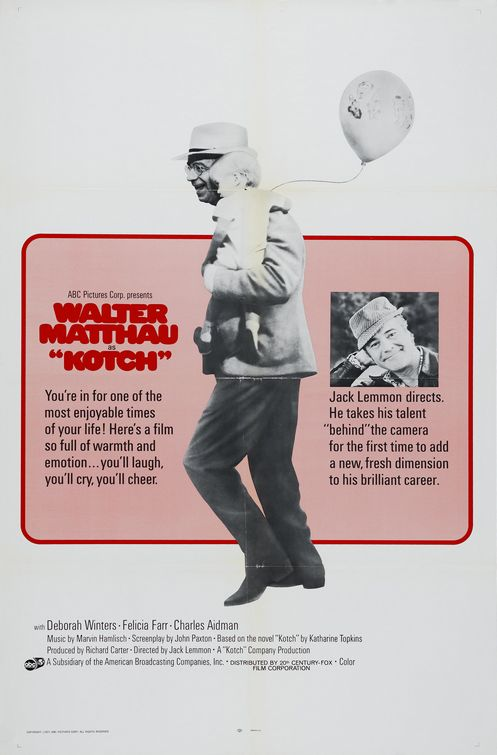
A 1971 picture that contains a nomination for best actor, by one of the big stars of the sixties and seventies, that has largely been forgotten, despite the fact that is the lone directorial effort of another oscar-winning actor. Kotch features a sentimental story about an aged man, coping with the complications of being a burden to his family, while he is still relatively active, cogent, and financially independent. It also contains a sweet story about an unwed mother who’s only 15 and is trying to navigate her pregnancy.
I saw this movie when it came out in 1971, and I remembered it slightly. The details of the story are hard to hold on to because nothing too dramatic happens in the course of events. This is really a character piece and that’s the thing that’s easy to remember here because Walter Matthau is a character in every role he plays but in particular in this one, where he is cast 30 years senior to his actual age. In fact he was only 5 years older than the actor who was portraying his son. Mathau had been in three successful sex comedies in the preceding 3 years, and was probably thought of as a comedian with the leading man’s charisma if not looks. 20 years down the road he would be playing this same part at his own age and making a big success of that as well. If you want to you can kind of think of this as a prequel to “Grumpy Old Men”.
Joe Kotcher is a 73 year old man currently living with his son Gerald, daughter-in-law Wilma, and their toddler child Duncan,in a nice suburban house in Southern California. Kotch does not have dementia, there is no disease on the horizon, and he does not pose a threat to anyone except those who jump to the worst kinds of conclusions about what an old man is doing at a park. However, anyone who has lived with a person, who has personality quirks that may be bothersome, knows that it can be stressful. His daughter-in-law, is maybe wound a little too tight, but of course Joe Kotcher is an avuncular guy who is free with information, opinions, and advice. Those things may not always be welcome and sometimes seem like a bombardment of information that’s unnecessary. Imagine a child who is telling you about their day, and tells you the name of every child that they sat with at lunch, and what they had to eat. It’s not a bad thing but it’s an unnecessary thing for the listener, it seems to be a needed function for the old man, he has to talk,and Kotch is a talker. He keeps a running commentary on all sorts of things, he has a vast knowledge of arcane information he’s happy to drop into every conversation. That’s the kind of thing that is driving a wedge into this family. Walter Matthau plays Kotch as a genial old man not as a curmudgeon, but sometimes you can just be too genial.
The son Gerald, is played by veteran television actor Charles Aidman, who anybody who has seen 70s television, will recognize from some program that they have watched. Aidman is great casting because he has the same hangdog face as his costar. Gerald is a sympathetic son and he is a little bit dominated by his wife who is struggling under the pressure of having her father-in-law live with them. At one point they have the delicate moment when the father and the son have to confront the possibility that Joe is going to relocate to a retirement community. The daughter-in-law is not a monster, she sees how tough this is for her husband and his father. She is the one in fact who sheds tears at the thought that this has become necessary by the way, she is played by the director’s wife). But like “Harry and Tonto”, which will arrive in a couple of years, old people can be a lot more resilient than their children want to think. Kotch has no intention of giving up living the life that he wants just to make his children feel secure.
At one point the old man feels a little bit like an informer because he has to share with his son the fact that the babysitter, while not being negligent, was distracted by having sex on the living room couch during an evening supposedly taking care of the grandson. When he shares this information we think he might simply be acting out of the feeling that he is being nudged out of his child care responsibilities by this young interloper. There’s a nice moment done in a flashback, which reveals that Joe and his late wife Vera, faced some of the same issues that the babysitter did. The location for their assignations was An old Hudson, instead of his parents’ living room couch. Erica, the babysitter, subsequently becomes an important character in the story. After Kotch has spent a little time away from his family traveling, he returns home to discover that the babysitter has been pushed out of school, sent to San Bernardino, because she became pregnant. We learned that her much older brother is her guardian, and there is a brief moment of sadness when we discover the story behind her orphan status. Koch is not going to take this lying down, he feels that he might have betrayed the girl and pushed her on this path because he told his son that the babysitter had misbehaved. He decides that he’s going to help her as best he can.
The film meanders along, giving us a few incidents about how these two, the pregnant teen and the slightly distracted older man, form a dependent relationship and care for each other over the course of her pregnancy. Nothing too dramatic happens, they go out to eat, or they fix meals at home, where they spend time sitting in the living room working on some hobbies that are a little strange but charming. As the end of her term comes, she is faced with some important decisions about her future. And without telling her what to do, Kotch has a huge impact on the decisions that she makes.
This is the only film that Academy award-winning actor Jack Lemmon directed. He got an Oscar nominated performance out of his close friend and frequent co-star Walter Matthau, and efficiently tells the story without an excessive amount of sentimentality, but with just the right amount of humor to keep us going. This time period looks grand in the film, and you might think that Palm Springs would be a reasonable place to move to. Maybe the one big flaw in the story is the location, because even in 1971, Palm Springs was overpriced and maybe not a wise choice for a retiree and an unemployed pregnant girl.
The film received three other Academy Award nominations, so it was widely respected and even though it didn’t win any of those Awards it seems to have gathered enough Goodwill to make it a multiple nominee. I bet if you ask anybody who the nominees for best actor were in 1971 people would only be able to name the winner, Gene Hackman, and maybe one other nominee and not this one. This for the most part is a forgotten film. Kotch is largely done in a style that is not typical anymore. It’s not fast paced, it doesn’t have surprise plot twists, and the characters are all generally good people without there being a villain in the scene. It’s a nice story, about the struggles of a couple of nice people, who find a way to make the world work for them. That seems enough to recommend it.
Throwback Thursday on the KAMAD site will be a regular occurrence in the next year. As a motivational project, to make sure I am working on something, even in a week where I don’t see a new film in a theater, I am going to post on movies from 1975. Along with 1984, this is one of my favorite years for movies and it is full of bittersweet memories as well. 1975 was my Senior Year in High School and my Freshman Year in College. The greatest film of the last 60 years came out in 1975, as well as dozens of great and not so great cinematic endeavors. Most of the films in this weekly series will have been seen in a theater in 1975, but there are several that I only caught up with later. I hope you all enjoy.
The Fortune
As usual, I tried locating a trailer to accompany my film selection, but this does not seem possible with “The Fortune”. I was unable to locate a trailer on YouTube, which is the most likely site that it would be available on. I looked at Google to search for the same thing and also got no results. Maybe this is the reason that this film was a Blind Spot for me, I never remembered seeing anything promoting it, except newspaper ads. The fact that the movie flopped on release probably accounts for it never being available for me to see in 1975. To catch up with it today, I purchased a copy from Umbrella, an Australian Media company, this actually had to clear customs before being delivered to me. Anyway, the above video is a clip from TCM when they showed the film a few years ago.
“The Fortune” stars Jack Nicolson (This is his fourth film in the Throwback Thursday Series) and Warren Beatty (Only his second). They were both big stars at the time and the movie was directed by Mike Nichols. With that pedigree, you would think this was a surefire smash. Unfortunately, like “Lucky Lady”, also in 75, casting cannot make up for all the elements of a movie. Somehow this light comedy farce, just lacks the delicate touch that it takes to pull off this kind of material, and part ofd the problem is the two stars.
Nicolson and Beatty are both laconic actors, who need some pushing to feel like active participants in a movie. Here they seem to be cruising rather than working, and the script and direction are not enough to compensate for a lack of wattage from the stars. There is a scroll at the start of the movie, to explain the complication that the story is trying to deal with. This immediately suggests trouble. When you have to have a history lesson before the story starts, it is never very promising. Basically, the two are small time scam artists, who are trying to get a hold of the wealth of an heiress by marrying her. Unfortunately, the man who wooed her is unable to complete a divorce, so if he takes her with him across the country, he could be violating the Mann Act.
During the 1920s, in the United States, the law known as the Mann Act was much feared. It prohibited transporting a woman across state lines for immoral purposes. Because of the Mann Act, a man who wanted to run off with a woman and was willing, or unable, to marry her, would sometimes go to unusual lengths.
So Beatty wants to marry Stockard Channing, but can’t, so he has her marry his pal Nicholson, as a way of getting around the law. Of course that presents some awkward moments in the story, and those are the only places where the film comes to life. The movie is less than an hour and a half long, but it seems to take forever to get to the real complications. A car ride, train trip and Airplane flight, all use up a lot of screen time, without really building the story or the characters. Once the trio arrives in Los Angeles, and settles into the same courtyard apartment that was used in “The Day of the Locust”, the comedy feels more connected to the goings on. There just isn’t that much of it.
Channing is in her first credited role here, and for the most part she is great, but there are a couple of scenes where bickering is featured and she was given the direction “louder”. It annoys rather than amuses. The final section of the film, is where the slapstick humor comes in, and the hapless con men, having decided to murder the woman they both claim to love, can’t quite pull off the act. There is a scene of a traffic jam on a bridge that showcases what the film could have been, if only that spirit was infused in the rest of the story.
Anyway, it’s not as big a misfire as “Lucky Lady”, it still isn’t something you need to add to your list of essential viewing.
In anticipation of the second chapter of Denis Villeneuve’s Dune films, the first part from 2021, has been released in theaters for a week so that we can all catch up. When I say we, I was hoping that there would be other Dune fans in the theater, sadly I was by myself without another soul in sight. That didn’t change the movie much for me, I still liked it very much, and was happy to see it on the big screen.
There was an interesting phenomenon in the film and my experience in the past 3 years which showed up at yesterday’s screening. I had read the original book again for a book club 3 years ago, and we had talked about some of the scenes that were missing in the film. Apparently my memory of the book intruded on my memory of the film, and I kept waiting for a scene that I saw vividly in my head, but was never in the film to begin with. That’s just my imagination working overtime and filling in some blanks. I may have done the same thing 40 years ago when I saw David Lynch’s Dune, and I thought the film was great even though others saw it as occasionally incoherent. My brain apparently wants me to embrace the concept of Dune as a film in a more complete form than either Lynch or Villeneuve was able to complete.
Next week I am seeing the David Lynch version of Dune on the big screen, and I’ll make more comparisons between the films then, but for now I’m happy to have the new version of Dune. This version has a magnificent score, some terrific visual effects, and casting that is quite effective. Josh Brolin, Jason Momoa, and Oscar Isaacs are all excellent in their respective roles. It’s taking me a little while to get used to Zendaya as Chani, and I’m still not sure why we had to gender swap Dr. Keynes. Timothée Chalamet has turned out to be a much better choice for Paul Atreides than I had hoped.
I know several film fans who are irritated that the film stopped where it does in the story, but given the impracticality of having a 7-hour movie, I think it was the correct cut off point. The story finishes at a spot that completes what is essentially the First Act of the story and sets up what is to come pretty effectively. At the conclusion of the film screening, we got an 8 minute preview style trailer, which featured a long segment that will certainly be coming near the beginning of part two. Paul, riding a giant sand worm for the first time, is the important plot point, and it’s a little surprising that they give away this sequence in a trailer. I guess they don’t think any real Dune fans are unaware of what’s going to happen, and those fans who are casual fans, need a little inducement to push the button.
Of course I have already purchased my tickets, I’m excited for the movie, and I would be happy to go to a double feature and see both part one and part two playing together. I’m sure that will happen sometime down the road, until then the spice must flow.
Last week I got to talk about The Princess Bride and add it to my list of perfect films. The original post that I wrote several years ago included three films that at the time I would classify as perfect. I haven’t changed my assessment of those films, but I continue to evolve in my appreciation of them every time I see them, and I got to see one of them again this week.
It’s been said that Galaxy Quest is the best Star Trek film ever made. I think that’s probably a correct assessment. Those things that we loved about Star Trek, the characters, the camaraderie, and all of the tropes that make up science fiction television of the 1960s are present in this send-up of a Star Trek type television show. The lead actor played by Tim Allen, is a thinly disguised version of William Shatner’s Captain Kirk. The outsized ego of the star, gets put in contrast to the attitudes of the secondary players and co-stars of the series. Sigourney Weaver gets a chance to play comedy, and boy does she nail it. She does let her wig do half the work however. Oh and her push-up bra. I’ll get to the work of the other actors in just a minute.
The thing that makes this film resonate so much with its loyal audience, is that it represents them not in a satirical way but in an affectionate one. We all know those fans who take the minor portions of the thing they love and obsess about them. In this film The “Questers” attend a fan convention and do the usual cosplay, and line up for autographs at $15 a pop. That episode of Saturday Night Live where William Shatner went off on the fans of Star Trek and told them to get a life, feels like it is the basis for several of the moments in the early part of the film. The actors in the cast of the canceled TV series Galaxy Quest, struggle for relevance, while having to make do with personal appearances that cash in on their celebrity from their time on the show. When they are at the fan convention, they recognize for the most part that it is the fans who have sustained any career that they might have. When Tim Allen’s character Jason Nesmith goes off on a fan in the autograph line it, frustrates everybody else and surprises them. Even though they are all irritated that this is what their careers have been reduced to, they still recognize that the fans are sincere and care about them. None of them would want a fan to be disappointed. This film takes geek culture seriously while still mildly lampooning it. The fan boys and girls have their fantasies about the characters, read online sources for information about the show, and have a depth of knowledge that befuddles the cast of the show. It’s those very things that allow the Thermians to be perceived as fans instead of the aliens that they are. Jason has a private gig booked, and it was with some of the fans that he dissed at the convention, and he mistakes the Thermians for the group that he is supposed to visit.
Harold Ramis was supposed to be the director for the film, but he dropped out when Tim Allen was cast as the lead. He thought that this was the wrong move. In fact it was the perfect move because Allen was at the height of his TV Fame and was just crossing over into movies, and the confluence of those situations with the character that is written in the script is just perfection. Sometimes you just get lucky. Speaking of lucky, the supporting cast is so deep with talented actors that it’s a little ridiculous. Tony Shalhoub gets laughs with the mildest kind of expression on his face, looking a wee bit high and befuddled, but also extremely confident in some situations and frantically overmatched in others. I think the implication was that he was chemically treating his emotional issues, and that is reflected in the performance of his character. He is frankly hysterical. Of course hysterical is a relative term and if there is a level that is one step up from that, that is where you’ll find Sam Rockwell in this movie. Almost everything he says is a comic gem, and his desperation, fear and ultimate redemption add some real spark to the story as well as making the emotional heart of the movie even more solid. This may have been the first time I recognized Rockwell’s genius, and I have been enjoying it ever since. I can’t wait until next week when he stars in “Argyle”, the new movie from my favorite contemporary action director Matthew Vaughn.
Fandom is well represented by Justin Long as the leader of the fan group that has big questions for Jason, and is a little too obsessive about the technical readouts of their spaceship The Protector. If you have not seen the film and don’t know what I am referring to, I’m not going to try and explain it to you, this site has never been about simply restating the story for the readers. This is a movie that’s been out for 25 years now, and if you don’t know the premise, you’re just going to have to see it and then come back and read these comments to make sense of it all. Long has the earnestness of a young fan, and the whining voice of a frustrated teen when dealing with his mom. Enrico Colantoni, Patrick Breen, and Missy Pyle all score laughs at some point as the Thermians. At one point Raiin Wilson is in the film, but he disappears completely once we are on The Protector.
The CGI may be a little wonky, after all it is 25 years ago, but none of that matters because the special effects in the original Star Trek were never great, and that never mattered. The value of these shows was in the characters and situations, not in the flash and visual extravaganzas that we get in so many science fiction films these days. I really enjoy the fact that the Thermians built their version of The Protector based on the television show, because some of the technology looks like an adoption of a game console, and some early computer technology. Exactly the kind of thing that might have been done on Star Trek. Even if it is sometimes just Christmas lights, the fans don’t really care because they came for the characters. Which is what I’ve been doing for the last 25 years with this terrific film. Alan Rickman, a comedic performance that is equal to all the dramatic work that he did in the later part of his career. “Galaxy Quest” along with “Robin Hood Prince of Thieves”, contain two of the most iconically hysterical comedic performances of the 1990s. Rickman is sorely missed, but we at least have this iteration of him to cherish in our memories.
I love it when a movie does exactly what it’s supposed to do for you. Some films have a very simple objective, to entertain you in the genre that they’re made in with the talent that is brought to bear. I can’t say that every Jason Statham film I’ve seen has been satisfactory, but the majority of them fall into that category, and with “The Beekeeper”, the average is going to go way up, because this film is exactly what it sets out to be.
As usual Jason Statham is wreaking revenge on individuals who strongly deserve to be punished. There is virtually no attempt to add humor to the story, or to make it dramatically deep, at least not past the requisite set up. Statham plays a man who has retired to take up beekeeping in its literal form, after serving in a Secret Agency where he was referred to as a Beekeeper, primarily to protect the hive when things go wrong. It’s an agency so Secret that even the director of the CIA has little information about it, and that turns out to be a big part of the story.
Maybe someday Jason Statham will be recognized as an actor with Incredible thespian skills, but until that day he should definitely be recognized for his action star persona and credentials. Statham is a one-man Wrecking Crew, much like Bruce Lee in those early kung fu movies where he would take on an army of opponents and single-handedly crush them all, Statham does the same thing. He usually uses his martial arts skills, he certainly does not limit himself to hand to hand combat. He is perfectly willing and able to engage in Small Arms combat, sabotage, booby traps, and assorted other violence to get his way. In this film Statham plays Adam Clay, which may or may not be his real name but it doesn’t matter, what does matter is that he was a beekeeper. The beekeepers are warriors that make the SEAL Teams, the Army Rangers, and assorted CIA Black Ops look like sissies by comparison. They strike fear into the hearts of even the most hardened assassins, and the antagonists in this film have crossed paths with maybe the most dangerous of the beekeepers. You know this is not going to end well for them.
It might be good to think of Adam Clay as The Terminator, because he is an Unstoppable Force that can’t be bargained with, that will never stop and absolutely will reach its goal. Fortunately for us, in this film, the Terminator is the good guy, and we can applaud the way he knocks down the pins that the bad guys represent to this bowling ball of a human being. Basically he hits a strike every time and the pins fall with mechanical precision in interesting ways each and every scene. John Wick would do most of this work with his gun, Adam clay does most of his with his fists, feet , elbows, and head. And when those don’t work he’ll find a gun or a flamethrower or some other handy tool that he can use to kick some more ass.
If the film needs any weight, it gets it from Phillicia Rashad in the opening section as an older woman who has offered Clay some assistance in his transition to actually taking care of beehives instead of international intrigue. When she is the victim of cybercrime, the perpetrators have crossed the wrong path and Statham is on them relentlessly. It doesn’t hurt that three of the villains are so smarmy that you want to kick their ass yourself. And when they finally get their individual comeuppance, let’s just say, it’s the kind of satisfaction that people like me, who treat “Taken” as high art, are going to be applauding.
Jeremy Irons also lends some credibility to the film as the former CIA director who is tangentially connected to the Enterprise that ripped off Adam Clay’s friend. He also knows what’s coming, and half the fun of the movie is watching people who think they understand what they’re getting into discovering that they are in way over their head. When Statham shows up at a call center with two gas cans and he tells everybody that he’s going to burn the place down, you can bet that it’s going to seem incredulous at first as if it can be laughed off. But when he proceeds to do it we’re going to smile and think, hell yeah that’s the way to handle a Consumer complaint.
This movie is not going to receive any awards for its dramatic integrity, but if the Academy finally caves and creates an award for stunts, then there’s a good chance a film like this would get some appreciation. When these sorts of films are providing the backbone for keeping movie theaters in operation and for acting as tent poles for the rest of the theatrical releases by the major Studios, then it seems it would be an appropriate time to maybe have a category at the Academy Awards for face punching, ass kicking, straight shooting, and generally amazing creative fight sequences.
The film Mean Girls came out 20 years ago and was a big success. It has become a touchstone for that generation and continues to be a film many look back on fondly. A Broadway musical was made from the film and has apparently done well enough over the years to justify a film version, which is what we got this month.
Before this week I think I may have seen the original film twice. Once when it came out and once when it was released on home video almost 20 years ago. I revisited the movie the night before last, in anticipation of the new film. It continued to be very entertaining and maybe the high point of Lindsay Lohan’s career in front of the camera. It wasn’t too much longer after this that Lohan seemed to go off the rails and have difficulty in her life and her film choices went severely downhill. Still the movie is warmly remembered, but it’s not that old, so the question then becomes is a new version really necessary? The one thing that the new production has going for it are the songs that are being transferred from the Broadway show. If they were not a part of the film then I would say that this whole Enterprise was superfluous. However the songs are here and they make the movie entertaining enough and distinct enough to give it a mild recommendation.
I don’t want to say anything negative about the young lady who takes on the role that Lindsay Lohan had. She sings quite well and her performance is sturdy. Angourie Rice was in “The Nice Guy” a few years ago and she was great, but when comparing the two Mean Girls ,films which was easy for me to do having seen them back to back on subsequent nights, it’s clear that Lindsay Lohan had some kind of charisma that made her much more effective on screen. It’s not so much that she was a better actress, it’s that her personality and her facial expressions feel more in tune with the material. The current film suffers a little bit because of this lead role. The strongest performance in the film comes from the actress Reneé Rapp,who plays Regina George, the queen bee of the Mean Girls. She has a terrific voice and sells the songs that she’s doing very effectively. In the last part of the film she also successfully transitions from a villainous character to a more sympathetic comic one. When looking at the film, I think it will be judged by each of the musical sequences that make up the 90 minutes of the movie. Regina George has two of the best numbers, and as a consequence Cady, fades into the background a little bit more than she should.
The director of the film has made several cinematic choices that work pretty well in bringing the Broadway play to the big screen. There are for example, several points where we get a selfie shot video from the phones of the stars of the film. That justifies a little bit more of the musical sequences. I never felt however that there was a knockout sequence in any of the musical numbers. There are some effective lyrics, and some funny moments, but the choreography seems relatively tame for a film that is spoofing High School and is spoofing the high school spoof that it is based on. “Anna and the Apocalypse”, a film that probably had 1/10 of the budget, was much more creative and integrated the student body into the big numbers, making it feel like the film really was a musical come to life. In this film the musical sequences seem staged and occasionally perfunctory rather than essential to the tone of the film.
Most of the new film follows very closely the structure of the original. Most of the lines are repeated and there’s not really an essential need for updating the dialogue, with a couple of exceptions. The story of Cady being a transplant from Africa, is largely extraneous to the events that happened in the film, unlike in the first film where her unfamiliarity with the culture explains some of the things that her character does. In this film the African background merely allows for some of the musical sequences to play around with animal motifs and references to more primitive social structures. It’s all well and good and definitely some fun, but it misses the point that was being made in the original film.
Some minor changes have been made to the characters in the film. The most noticeable one may be that there is now a romantic relationship between the teacher played by Tina Fey and the principal played by Tim Meadows. That was missing from the earlier film, and it allows for some slightly different humor than some of the things that took place 20 years ago. Although I’m not sure that the humor was more fun.
As I said the only thing that really justifies this film are the songs, and they are acceptable but not particularly strong. If the sequences where the songs were being presented were more elaborate, perhaps along the lines of the “Barbie” movie, then I might find this film to be more successful. As it is, it is entertaining enough and if I run across the movie in a few years I will probably stop down and watch for a while, but it doesn’t feel like I will be putting this film in myself to watch on a regular basis. And that to me is one of the ways that you can mark a really good film.
I’m starting off 2024 with a challenging proposition, seeing all three of The Lord of the Rings films in one setting. I’ve done it before, in fact twice. But as I get older it does seem to be a little bit more of a challenge to both stay awake and not have my ass hurt at the end of the day. This is going to be a lot of fun regardless of whether I fall asleep or have a sore butt tomorrow.
These films are impressive regardless of the atmosphere that you watch them in, but when they’re presented on the big screen they do take on a special quality. And nowadays it’s most likely that you will see the extended Editions which is indeed what this was. Whenever people ask me which of the three films is my favorite I do answer, but I want to remind people that it’s really just one film broken into three parts. I have a special affinity for the first of the films “The Fellowship of the Ring”. I like the setup in Hobbiton, I like the brief references to Bilbo’s backstory, and I like the introduction of Gandalf as if he is just a traveling performer that the locals both love and fear. Of course the New Zealand surroundings make all of us wish that we could live in the Shire. It is a truly beautiful composition that includes Hobbit holes, quaint Pony Corrals, and a lively Inn where Rosie Cotton serves the drinks.
The Fellowship also has my favorite sequence in the films, the journey through Moria. Gandalf’s confrontation with the Balrog is one of the iconic moments in all of the films, and I love seeing it played out on the big screen in all of its Glory. I’ve written about all three of these films in the past, so I’m not going to cover them again in great detail, or note where changes to the stories are made in bringing them to the screen. The performances continue to be outstanding, and each time I see Sean Astin’s version of Samwise Gamgee I am impressed and wonder how it is that he was not given some sort of award for his performance.
One of the things that I noticed in the special editions is that the title caption comes up in a different spot than in the original theatrical versions, and with Fellowship, I really do think that the original theatrical caption of the main title was Superior. That however may be the only thing that is superior because all of the additions and changes that are made in the special edition really do seem to strengthen the storytelling and build character more effectively. Like most fans of the original books I do miss having Tom Bombadil in the story, but I can completely understand why that would have been a complication that made the movie less efficient.
So many people like “The Two Towers” as their favorite of the films, including my own daughter. I do think that “The Two Towers” is a very good film, and it introduces my favorite character in the stories, King Theoden. Bernard Hill is the embodiment of the character I always saw in my head when I read the books as a kid. The transformation from the possessed version of the king to the restored Theoden is a very solid piece of CGI Magic that works to convince us that evil is in fact in control in Rohan. I also like that Eowyn is depicted both as a Fearless Warrior who must hide her participation in battles, but also as an incompetent cook whose food is not really edible. The films do have small pieces of humor like that which make the movies even more ingratiating. “The Two Towers” is also the film where the character of Gollum appears in his more complete form, and Andy Serkis delivers a great CGI enhanced performance, sometimes against other actors, but in very effective scenes, against himself.
The spectacular combat that dominates “The Return of the King”, is of course deserving of the accolades that it received at the time of its release. It still holds up on screen as one of the most elaborate uses of visual technology, integrated with actors performances. Just as in Fellowship, “Return of the King” has a great moment when Eowyn confronts the witch King and reveals that she is no man. The extended Editions also contain the creepy sequence where the Mouth of Sauron appears on screen and delivers a bone chilling threat to our heroes. In trying to induce a moment of despair, it is Aragorn’s optimism and refusal to accept that Frodo is dead that is the Turning of the tide. Of course the speech that Aragorn gives men of the West is also a moment that will raise the hair on the back of your neck and make you glad that you were watching this movie one more time.
We came well prepared for the event, with sandwiches and scones, which would have to substitute for lembus bread, and we also had clotted cream, butter and jam to add to the scones. We tossed in a piece of chocolate, and we had a blanket that we could lay under if we got tired. It was a long day and I did take a break at one point to come home and feed the dogs, while Amanda stayed in the theater. There were intermissions between the features but they were not clearly marked as to how long they would be. For the third film we went ahead and got our usual popcorn and soda to finish off the day, because after all, we were in that theater for 13 hours watching the three films, and we deserved some movie treats. I don’t know if I will ever be able to do the trilogy again on the big screen, but I do know if I get the chance I might be willing to attempt it, these films are that good.
Everybody loves an Underdog Story. When they happen to be true it makes them even more compelling. George Clooney has directed a film that takes the underdog motif and uses the 1936 Olympics as a way to engage the audience in a rooting interest. The rowing team at the University of Washington was a consistent loser to the University of California team for 20 years, but the coach at Washington found eight men who could pull together and overcome their tradition of losing to become winners. The story however does not stop with a success against a local rival. There is also the little guy against the entrenched forces, the rich and well-off against the poor and struggling, and eventually Western democracy against Nazi totalitarianism.
Clooney seems to have an affinity for historical settings, three of his best have fallen into that category. I think the film “Monuments Men” is his best work, but that’s not to undermine “Good Night and Good Luck “ which was another piece set after WWII. He also did a quite good job with a football film set in the early days of the NFL. So it appears that the Depression era United States is a palette that he feels comfortable painting from. The visualizations of the era are authentic, in fact it is a little disconcerting that the shanty town at the beginning of the film is labeled Seattle, but the year 1936 could easily be replaced with 2023. The idea that widespread homelessness accounted for much of the trauma of the 1930s is a little depressing when we look at contemporary times. Maybe we’ll get lucky and some extraordinary story will grow out of these times. For now we have the story of the 1936 Washington Huskies eight-man crew.
Actor Joel Edgerton is nominally the lead, but he is supported by several actors that you will probably not recognize. The story does require that the rowers work as a team and that may be one of the reasons that there is not an individual story for everyone. For the most part we get entry into these events through the experience of a single man who is struggling to work his way through college and takes up rowing simply to be able to earn a living and pay for school. I’m not sure if the NCAA existed in this time era, but it sure looks like some of the boosters would be violating what used to be the rules of College athletics, at least before NIL.
The real main character is Joe Rantz, who is trying to get through college after having been abandoned by his family at age 14. There are others on the team who have gone through similar struggles but the focus here is really on the athletic event and the hard work that it takes for a team to truly become excellent. So except for a love story and a brief callback to the past, even Rantz’s story is limited to the team.
Edgerton as the coach is relentless in finding ways for the team to mesh. As entertainment a movie like this can’t really be an instructional film on how the sport of rowing works, but we get enough detail and we see a few examples that let us know how each person’s behavior and skill contributes to the team effort. In addition we get a little bit of personal story about the coach and his struggles to keep the team going in the face of limited success and budget shortfalls, and Joe Rantz and his romantic relationship with a coed at the University. Neither of these side paths takes up much time, which is a good thing because we have at least three major competitions that provide plenty of drama.
Obviously the team manages to be successful so they can end up in Germany for the 1936 Olympics. So the outcome of some of those contests is a foregone conclusion, but director Clooney, like most people who make these films, has found a way to make those kinds of foregone conclusions entertaining and suspenseful. It helps that we got some details about how the crew develops a strategy and in particular how this group, who are actually the JV team at the University, managed to be a force to be reckoned with. I assume that it is relatively accurate when it comes to the way this event was covered by the media. I know that in contemporary times you’re not going to get 100,000 people showing up for a crew race between college teams. But in 1936 the world was a different place, Sports occupied a preeminent place in the culture because there were limited entertainment alternatives, and because it was radio friendly. Maybe the radio friendly thing is the thing that draws Clooney to a story like this.
I’m not familiar enough with the story to say if all of the drama that takes place at the Olympics was in fact historically accurate, but I can say it felt authentic. The showdown at the Olympics is the major set piece of the movie, and it requires some elaborate production design, multiple teams representing different countries to be portrayed on screen, and a special guest appearance by Adolf Hitler himself.
As inspiring as it is to see other nations challenging the Third Reich on the field of sports, the emotional high point for me came earlier when the team had to find a way to finance their way to the Olympics. After having struggled to qualify it seems that only Elite schools would be able to go because they had the financial resources to do so. The University of Washington team had to find what would be a substantial sum of money in order to make the trip. It is in this section of the film that real sportsmanship is demonstrated by somebody who has only been a very tangential part of the story, and in fact would be classified as an antagonist. At least until that moment when we all choke up at the gesture that is made by someone who understands what sports is supposed to be about.
It was a little curious that the actress Hadley Robinson who appears as the romantic interest in this film, was in the film we saw last night “Anyone But You”. Congratulations to her for having two films that open in the same week. That is fairly unusual and is usually an indication that an actress is on the cusp of a breakthrough. The Romantic subplot is not overdone, but it does help give us something to focus on other than the grinding preparation of the boat and team.
I found the movie quite fulfilling, it touched me in an emotional way at a couple of points, and I learned a lot more about the eight man crew and the sport of rowing than I ever expected to know. Although the events occurred nearly a hundred years ago, I think the story still resonates because we all love underdogs, we admire sports, and in our heart we want the good guys to win.




 Kirkham A Movie A Day