One Battle After Another (2025)

It is pretty clear that I am going to be on the opposite side of the canyon on this film. The echoes from the other side are likely to drown out my dissent, but I am used to that. In the past I have been on the minority side of “The Wolf of Wall Street”, The Shape of Water”, “Hereditary” and a half dozen more.  Being the lone voice of objection does not mean I am wrong, but it does mean that people I respect will be looking at my opinion askance, and wondering what is wrong with me. So let me provide a brief rationale before going into the specifics. 

Most of the time, I am a story guy. I care about the plot and want it to pull me in so I can connect with the characters and travel with them on their journey. Sometimes I can let a tone/attitude carry me, but that is a delicate task that requires truly hitting on something compelling. Another thing about me is that I like a rooting interest. There does not always have to be a hero, but I want someone in the film that I care enough about to hope they come out on top. I have enjoyed plenty of movies with anti-heroes, including Hannibal Lecter, Freddy Kruger and gangster pictures galore (Martin Scorsese provides plenty of these). Finally, I have some ethical/moral values that pop up from time to time. I may feel guilty about enjoying people die in the “Final Destination” films, but if the path there is interesting, I will live with the guilt.

“One Battle After Another” left me cold most of the time, angry in a few spots, and bored far more often than I ever expected to feel in a movie from Paul Thomas Anderson. I have seen seven of his previous nine films and two of those, “Boogie Nights” and “Magnolia” would easily make a top 100 list if I were doing one. That said, “One Battle after Another” is the first film from Anderson that I have loathed. It never is consistent in it’s tone, there is not a very interesting story, and the cartoon characters that are on the screen make Dirk Diggler seem like an intellectual. 

This movie contains enough provocative material to fuel the nightmares of both left wing nutjobs and their right wing counterparts. It seems at times to champion the unfettered immigration of one group of people into the country, and makes some of the presumptuous claims of intersectional narcissists the starting point for a conversation on the issue. When people on the right worry about forces that are trying to destroy the culture here, this would be the movie to feed their paranoia. Benicio Del Toro as a benevolent human trafficker has plenty of charm, but the comic book attitude he strides through the film with, does not work as the comedy that I think it was intended as. Meanwhile, for the people on the left, there is a deep state white supremacy group, not made up of drooling hillbillies and Nazi fascists but rather polite bigots who have meetings in secret board rooms and eat pancakes when they are offered. Anderson has constructed a group of facile racists, who look like and act like everyday people, except for their murderous commitment to racial purity. It is only at the end of the film that we get the usual trope of the shirtless, bearded gunman, drinking beer on the porch while a person of mixed heritage is handcuffed to a bench. Like I said, there is something for everyone in the political spectrum to see as the enemy and to feel mocked by as well.

Early trailers suggested this might be a comedy, but if that was Anderson’s intent, he forgot to bring the funny. The scene where DiCaprio’s character corrects his daughter on the metaphor of cards versus dice, is cut to a joke in the trailer, but in the film it just lays flat. It is another annoying point that “Bob” is making, which is too spot on to be clever. Leonardo DiCaprio playing a burnout is hardly new material. The stoner humor here is undercut by the character’s recognition of what he has done to himself. Is it supposed to be amusing or pathetic? Anderson bounces between both tones without much grace.  I will say the the scenes of him trying to clear a phone call without being able to recall the passwords, were one of the few times in the film that I could relate to his character. 

Speaking of characters, let me say the thing out loud that will probably get me the most criticized. There were plenty of characters that I wanted to see killed, pretty early on. By the end of the film, I was not sure that there was anyone left that I was glad had survived to the conclusion. Perfidia, Lockjaw and Jungle Pussy were characters that I wished into the cornfield ten minutes into the film. Only one of those characters got the onscreen death I was hoping for, but at least it happened twice (for no apparent reason). 

Anderson is usually a compelling storyteller, but there was nothing compelling about this story. It pretends to be about something and then it throws in a sexual kink for no particular reason. Sean Penn plays a malevolent character who has one distinct character feature, he can make himself get a hard on when he sees Perfidia. Otherwise, he is a Snidely Whiplash caricature who is hateful to both sides in the story. His slathering delivery of lines in his confrontation with Willa, the daughter of Bob ( or so we are lead to believe at first), is a hash of emotional overkill. He is better when he plays the fabulist who is a victim to a “semen demon” as he tries to finish off his interview to join the “Christmas Adventurers Club”, which has the one consistent joke of the members greeting each other with a ridiculous salutation meant to mock right wing Christmas conspiracy nuts. 

The best visualized scene is an escape made by Willa as she is pursued by two other cars across the deserts of California. The smartest thing anyone in the three hours of the movie run time does, takes place when Willa takes advantage of the road terrain that she is being pursued on. Anderson has the camera following the action as if from the front seat of a car, speeding up and down the bumps in a desert road. It is the only time that any of the many chase scenes in the film feels immediate and tense. There are a thousand other movies that have done this stuff more effectively and entertainingly (Crank/The Italian Job/Silent Night/28 Days/Weeks/Years) Anderson does not seem to be an action director, at least not by the evidence of this snooze fest. 

I was happy to see nuns handcuffed and on their knees. What does that tell you about the quality of the characters in the movie? The vicious sex pervert who is a revolutionary nut, also murders people and gets away with it by ratting out her compadres and then taking a powder on the authorities. Her burnout husband has been living guilt free of the numerous bombing that took place, and unlike Bill Ayers, has medicated himself to the point of incoherence. Frankly, the timing of this film is also a little problematic, given the recent attack on an ICE detention center in Dallas. This movie may be cursed. The positive notices that the film is receiving are largely projections of people’s political opinions. This may win a bunch of awards, but it will not come close to being popular with a wide audience, in-spite of the presence of DiCaprio. 

That’s my opinion, but I could be wrong. (No, I’m not) 

The Outsiders (1983) Alamo Drafthouse Movie Party

In spite of the fact that “The Outsiders” was released in 1983 and was made by one of my favorite directors, it has only just dawned on me that I had never seen it. I have been to NYC twice to see the musical stage adaptation, and I own the Complete Novel Version DVD/Blu-ray of the film, so I thought I’d had this as part of my history, but while watching it, I came to the realization that this was a completely new experience for me. Knowing the story is not the same as seeing actors play out the roles on screen or watching a director make choices to emphasize one visual element over another.

I have been lax this summer in keeping up with my blog and the films that I have seen. Some of this passivity is a result of the large number of retrospective films I have been seeing, but an even bigger influence has been my devotion to the LAMBcast episodes and the videos, which take up a lot of my time and reprioritize my efforts. Which is why this post is both late and not as complete as I had originally intended. in the first few years of this blog, I wrote about the films I saw immediately after seeing the movie. Sometimes I would stay up into the next morning to get my thoughts down completely. That has not been the case for the last couple of years and since I don’t take notes, when a post goes up days or even weeks after a screening, I have forgotten many of the things I wanted to write about while watching the film. That has happened with this movie.

I know there were performance moments that I thought were great, but I cannot recall the images or nuances that struck me at the time. I do know that I thought the church fire scene worked much more effectively in this film than I was expecting. C. Thomas Howell and Ralph Macchio were really strong in the film and this sequence was a standout. 

Francis Ford Coppola and his cinematographer Stephen Buram, captured the golden hue of the evening that matches the poem and the theme for Ponyboy at the end of the movie. In fact, the whole film does a nice job of creating the 60s era without over doing cultural images that give us a shorthand way of seeing the time period.  

The rest of the cast was also great, with Matt Dillon and Rob Lowe the standouts. Tom Cruise is in the edges of the film and his breakout role in “Risky Business” came this same year. Many of the cast members were reunited for “Red Dawn” the John Milius film of 12984, and they all seemed to play off of each other pretty well. 

If I see the film again, I will try to be quicker in writing about it so that you get a more complete picture of my experience. Until them Stay Golden. 

TCM Film Festival 2025 (Day 4)

It feels a little like sundowner syndrome when we arrive at the fourth day of the film festival. Everyone has had a wonderful time for 3 days but we all know that it’s about to be over with, even though there are wonderful things still scheduled for the afternoon. Our fourth day at the film festival was really pretty simple, we had two films that we were going to see both of them were pretty long, and then we had the closing night film.

2001 A Space Odyssey

Amanda and I made the decision to split up for the first film of the day, she had never seen “Oklahoma” before and was anxious to catch it on the big screen. And as I’ve said in other posts, although I love my daughter she has disappointed me in her lack of appreciation for “2001 A Space Odyssey”, that’s the film I decided that I would go to see. I was especially interested in seeing 2001 again on the big screen, because the guest of the day was going to be the star of the film Keir Dullea. The festival programmers seem to be doing their best to get to important guests while they are still around. Mr Dullea, is maybe the 5th or 6th guest that I saw this weekend who is in their late 80s. All of us are due to leave this Mortal coil at some point, and I’m glad that so many of these guests chose to spend some time with us while they still could.

2001 on the big screen, at the Egyptian, is something I’ve done several times before. And once again seeing the movie in a theater with a rapt audience is thrilling. We were given the whole effect, including Overture, intermission, and exit music. They have also made sure to make these presentations authentic in another way, they closed the curtains and then open them again when it’s time for the feature. To me, the sense of excitement as the curtains part and the credits begin to roll, is one of the things that makes me most love the movies. They should be an event, not just content.

The conversation with Keir Dullea, was quite interesting, including stories about how he was cast and about his working with Stanley Kubrick on the set. His wife accompanied him onto the stage to help keep him focused on particular questions. He was by no means senile, but he would wander off track occasionally or miss the meaning of the question and she assisted him quite ably without necessarily suggesting that there was anything wrong. Especially appreciated the prompt that she had at the end when she reminded him that he wanted to talk about a piece of dialogue that got cut from the film, but for which he had spent a great deal of time trying to memorize, and still has it in his head.

I did an audio recording several parts of the conversation, and I’m going to try to include them here.

“2001”, along with “Jaws” is on my list of 10 favorite films of all time. So this is a pretty good weekend for me.

Apocalypse Now

When I met up with my daughter after her screening, we were queuing up to get numbers for this 1979 Francis Ford Coppola classic. She had been quite enamored of “Oklahoma”, and I hate that I missed sitting through it with her, because I quite like the film. I really enjoyed her embrace of the songs and the story and the joy that she seemed to be having. I was a little worried that this next film would destroy some of the cheerfulness that surrounded the mornings experience for her. After all Apocalypse Now is not a happy film.

I’m not sure how she managed to get to her age without being exposed to this film more. She told me she’s only seen a few clips and doesn’t really know much about the movie. So that made our decision to see “Apocalypse Now”, here at the film festival, really an appropriate one. The guest for this presentation was director Antoine Fuqua who has directed a ton of action films that I have loved over the last 20 years. He had nothing to do with the production of “Apocalypse Now”, it just happens that it’s his favorite film and inspired him to become a director and make movies that feature kind of grit and action that Coppola provided. His commentary on the film was mostly that of an enamored fan, which is not really a bad thing. It was certainly encouraging to hear his enthusiasm for the movie, as we tried to gird ourselves for the experience.

I mentioned that in the 2001 screening, the festival was trying to create an authentic experience included the ritual with the curtains. For this screening, the authenticity was enhanced by the distribution of a booklet, that contain the credits for the film. Back in 1979, the premier screening of this movie it Cannes, was done without any credits appearing on the screen, but rather in a Nifty little pocketbook with pictures. That item was reproduced and provided to all of us who attended this Sunday afternoon screening of a decidedly depressing War film.

There are variations of “Apocalypse Now” that have become quite popular in the last few years, but this presentation was the original theatrical cut. That’s the only version of the film that I know. I’ve seen the film occasionally over the years, and I have bounced back and forth between disliking it and embracing it. Whenever I think of the distaste I might have had for the movie, it probably reflects the negativity that is such a huge part of the story. 

This time I was happy to embrace the film, and I was glad that Amanda was suitably impressed with it as well. Now if only I could get her to respond to 2001 the same way maybe I wouldn’t feel like such a failure as a father.


Heat

The closing night film for the festival was Heat, in the TCL IMAX theater. We had originally planned on watching the silent version of Beau Jeste in the Egyptian Theater. When actor Al Pacino was added to the discussion of “Heat”, we changed our minds and decided we could not miss out on the opportunity to hear one of the great actors of the 20th century talk about this movie.

The original guest was Michael Mann the director of the film, and Pacino joining him made the discussion feel a lot more complete. In fact even though there were questions, the situation felt more like a conversation with two old friends on the couch rather than an interview. Each of them remembered some things slightly differently, and they occasionally made the effort to correct a misstatement or a difference in memory.

Now I do have a confession to make, we chose not to stay for the screening of the film after the conversation. We had watched Heat last year and Amanda was not up for repeating it. It is a long film, and if we had stayed we wouldn’t have gotten home until midnight at least. So we stayed for the conversation between Pacino and director Michael Mann, and then we made our way out of the theater is quietly as possible so that we can return to the Southern California house and my daughter and her husband are living in. We got to have dinner with them instead of sending down in the diner with Robert De Niro and Al Pacino.

TCM Film Festival 2025 (Day 3)

Earth vs. the Flying Saucers

Our third day of the TCM Film Festival started off with a science fiction classic from the 1950s featuring Special Effects by the great Ray Harryhausen. I don’t think I’ve ever seen this film before “Earth vs. the Flying Saucers”. The morning’s presentation was introduced by Joe Dante a director that I’ve admired for almost 50 years. Just as a side note that behind him at the screening of the Bruce Willis film “Sunset” in the Cinerama Dome.

Earth versus the flying saucers is a straightforward fifties sci-fi film, which means that it features military types who are hysterical about contact with new species, and weapons that we have not encountered before which will require a sudden development of Technology that we haven’t used before. Many times the aliens in these movies are standings for communism, the idea that a totalitarian race wants to dominate us and control our resources and lives sounds like it’s a pretty straightforward interpretation of the Soviet Union, only with cool space suits.

I’m sure I’ve seen actor Hugh Marlow in something else but at the moment I can’t remember what it would be. Many of the actors portraying generals looked quite familiar, I suspect they probably worked regularly in the 1950s playing military types. The highlight of these films is usually the special effects and in this particular case it’s the flying saucers and the Damage they cause Washington DC. Ray Harryhausen he’s always been one of my favorite producers, who’s specialty is stop motion animation, that he did mostly on his own. The effects look really cool on the screen, although in this particular film they were a little repetitive until we got to the attack on DC.

Colossus: The Forbin Project

Our second film of the day was one that I was looking forward to from the moment I first saw the schedule. In the decade Plus that I have attended the TCM Film Festival, I’ve made sure to see the presentations from Craig Barron and Ben Burtt. These two gentlemen have extensive background in sound and special effects, receiving multiple Academy Awards, and having a clear knowledge of the history of their own disciplines. The very first film I saw at one of these festivals was my favorite, “The Adventures of Robin Hood” with Errol Flynn. Barron and Burtt were the presenters for that screening and they had such interesting detail and background history on the movie that I resolved never to miss an opportunity when they were speaking again.

The film they were working on this day, was “Colossus: The Forbin Project”, from 1970. While not the most well-known science fiction film of its ilk, Colossus is a forerunner of some of the most prescient films of the last 50 years. James Cameron was clearly influenced by exposure to this movie because the whole concept of Skynet is stolen from this film. The premise of the film is simple, we have created an artificial intelligence to run our defense systems, and the worst things that can happen do.

I was a little surprised that this was the film that these two gentlemen were working on for the festival, because I didn’t remember that there were extensive effect shots. Of course I forget sometimes that matte paintings and sound design are a big part of how a movie like this manage to impress. The opening shots of Dr Forbin, walking through the Colossus computer as it is being booted up, require some difficult matte paintings that were done by the great Albert Whitlock. The descriptions that the speakers provided impressively explained why we should take note of this subtle work.

I also found it quite interesting, that the sound of colossus’s voice in the television interface that originated at the World’s Fair in 1939, was classified during World War II. The sound technology was used for the direct communication line between Franklin Delano Roosevelt in Winston Churchill. It was a nice simulation of what their call would have sounded like using the encryption sound technology that was later used for this movie. Once again one of my favorite things at the TCM Film Festival was a presentation by Craig Barron and Ben Bert. As an added bonus the star of the film Eric Braeden made an appearance. He did a brief introduction before the movie, and then participated in a little Q&A 

Brigadoon

The third film for the day had us returning to the Egyptian Theater for the first time since last year. Although I love the Chinese IMAX I have to say that the Egyptian is my favorite venue for the festival. When I lived in Southern California I was a member of the American Cinematique, who operated the Egyptian. It is since traded hands and is now a Netflix venue, and while that may not be something I think is great, they have done a fantastic job updating the theater while still maintaining it’s historical ambience. Such ambience seemed particularly important for this film, a 1950s Musical that I have never seen before Brigadoon.

I’m a fan of musicals and of Gene Kelly, so it’s a little surprising that I hadn’t seen this for myself at some point in the past. I don’t know that it has the best reputation in the world of musicals, after all I’m not sure there’s a song in it that was a hit. The film however it does have a number of charms, and it’s a good reminder of how the studio system of the golden age of Hollywood could produce a film on sound stages that made you feel like you were in Scotland. In case you are not aware Brigadoon is a village that is either cursed or blessed depending upon your point of view. It’s residents appear to be living nearly forever, because the village is only active for a few days every hundred years. Of course when Gene Kelly and Van Johnson stumble upon the village, complications ensue, but so do some wonderful dance sequences. I was not aware that Van Johnson danced in any films, but he did a pretty credible job with one number in this movie.

The real dancers in the film however were represented at the screening today by two of their own, Barrie Chase and George Chakiris. Both of these actors/dancers are well into their 80s, and they occasionally scratch their heads trying to remember some details about the particular film. They certainly gave us some insight into the way that dancers in those days found jobs or auditioned. I got the definite impression that Barry Chase lost a few opportunities because she would not submit to Arthur Freed . The casting couch was alive and well in those days.

While most of the film looked pretty good there were some sequences that probably needed to be remastered. I was happy to catch up on this classic and enjoy the look of the film even if the story is a little slight, and inconsistent on its own world building. After all it’s really a musical not a science fiction fantasy film interested in creating its own universe.

JAWS

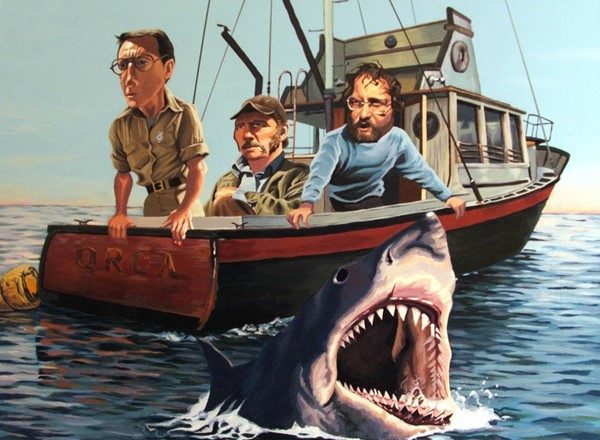
When we left the theater after Brigadoon we immediately got a new cue card and got in line to get back into the Egyptian for the most important film of our at TCM. This year is the 50th anniversary of the greatest film of the second half of the 20th century. Jaws is influential, groundbreaking, and once again in my opinion the best film that Steven Spielberg has ever made.

I am not sure that there is another movie that I have seen in a theater as often as I have Jaws. It made me very nostalgic to be seeing it here at TCM in the Egyptian Theater, since at least a half dozen of my earlier screenings also took place at this iconic venue. Anybody reading this can find more than a dozen posts about the movie Jaws on this blog site. I’m not going to recap the story or the significance of the movie on this day. Instead, main thing I want to talk about is the guest Lorraine Gary, who played Ellen Brody in the film. 

She was married to Sid Steinberg, who at the time was the chief at Universal Studios and Steven Spielberg’s mentor. This is the part that she will be remembered for, all of her other roles were primarily supporting TV characters. Frankly she’s terrific in the movie, although she disappears from the film entirely in the third Act. Advanced age of 88 she had No Reservations about being honest concerning her co-workers. She was dismissive of Richard Dreyfuss, without giving any details of why she didn’t care for him. She also expressed the opinion that Roy Scheider was it somewhat mean co-star, and she didn’t have any warm memories of working with him. She did however confess to having a crush on Robert Shaw, which I find completely Charming and ironic given their parts in the film.

The print of the film that was screened for us came from the British Film Institute, and had been preserved since a 1981 presentation on the BBC. The color dyes in this print are probably as close to the original version of the film from 1975, as we are likely to ever see. The film looked magnificent. It was surprising when Ben Mankowitz ask for a show of hands of people who had never seen the movie, that there were dozens of hands in the air. Listening to the audience during the film I had no trouble believing that those people were being honest, because you could hear the intake of breath, the shots of surprise, and the Applause of delight for all those little things that make Jaws the quintessential Blockbuster in one of my favorite films.

Blade Runner

We repeated the process at the end of this film walking out of the theater getting in line immediately to get a new cue card to go back in and see our final film for the evening. Although it was not a financial success in 1982 when it was first released, Blade Runner has been a critical success and a cult favorite for more than 40 years. 

One of the first Criterion Collection laserdiscs that I purchased was Blade Runner, back in the 1990s. That version does not include the director’s cut in the Final Cut, but there is discussion of some of the things that would later be included in revised editions of the film. The version we saw appears to have been the Final Cut, so there is no narration in the ending is slightly different, although to be honest we only stayed through the first hour of the film. As I’ve already mentioned we were staying at the house in Glendora so we had a 45 minute ride home, if we stayed for the whole film we would not have been in bed until 1: 30, and we needed to get up at 5: 30 to make Sunday.

The special guests for this film was the female co-star Sean Young, who was only 19 when the film was made and who was making her debut as a film actress with this movie. Miss Young has always been known as an outspoken and opinionated actress and nothing has changed even if she is aged the way I have. She spoke about working with Harrison Ford, the rigors of the makeup chair, and generally working in Hollywood. Her talk was not limited to Blade Runner though, as she made brief comments about several films and actors that she had worked with. She seemed fond of the late Gene Hackman when she worked with in no way out, but never seem to get very close to Kevin Costner who was her leading man. She did say that Blade Runner was the favorite film that she made, but the bigger reaction from the audience was to her second favorite film which was Ace Ventura.

Watching Blade Runner at home on Blu-ray, streaming, or even my beloved LaserDisc, cannot do it justice. Seeing it on the big screen and listening to the score and the sound design of the film in the theater like the Egyptian is one of those things that everybody should experience. We only stayed through the scene where James Hong meets his demise, but I can tell you everything up to that point looked and sounded spectacular on the big screen.  

At one time it had been my hope to make a couple of the midnight movies, and “Wild at Heart” would have been another film at the Egyptian had we not been so tired. So we ended our day with the fun talk from Sean Young and the brilliant vision of Ridley Scott.

Kraven the Hunter (2024)

This movie is not good. There is something cringy about most of the Sony films that have tried to spin off Spider-Man characters into their own films. They just feel inauthentic entirely. The “Venom” films work in part because the film makers lean into the stupidity of the premise and they get that the films are commercial junk. “Kraven” is commercial junk that takes itself seriously an is laughable as a result. The opening sequences are really good, but then we get an origin story that is so preposterous, I was laughing at it as it was being played out. 

Aaron Taylor-Johnson looks great in the part, it’s just that the part is ridiculous. The child of a Russian mob figure acquires supernatural powers from a dead animal at a safari hunt with the assistance of a voodoo elixir that comes to him through a civilized girl who is visiting her grandmother’s primitive culture. If chiseled abs were enough to make a movie work, then Taylor -Johnson would have this sewn up. You also need dialogue and story for a movie to work, this film has some very stupid dialogue and some equally stupid story telling.

By the time we get to the CGI climax, I just did not care anymore. The only person who gets out of this unscathed is Russell Crowe, who plays the mob boss father with a heavy accent and a sociopath personality. It’s as if he doesn’t give a crap and just leans into the dumb mess of a film he is in. The film is set up for a sequel, but with the box office returns, I don’t expect anyone is jumping abord for another film in this series. 

I have fallen behind on films that I have seen in the theater here in December, so I am going to keep this short. There was not much to talk about anyway. I will probably turn my derision toward another film that came out more recently. Aaron, wipe your feet thoroughly before you try on James Bond’s shoes. I think you might be great for that series, but you stepped in some pooh here.

The Untouchables (1987) Revisit

This movie is as hypnotic as any DePalma film, with the added advantage that it is straightforward and to the point. Maybe it is just good guys versus the bad guys, but when the Good Guys are lead by Kevin Costner and Sean Connery, I don’t know how anyone can turn away. Throw in DeNiro as Al Capone and you have a heavyweight fight that would break pay per view records if it were a boxing match.

Even before the first scene, the movie is pulling you in with a haunting and propulsive theme played over artistically rendered Titles. Ennio Morricone was Oscar Nominated for the score of this film and it should have been his. The background themes are  great at accentuating the heroes in their glory moments, and the action scenes are supplemented with exciting motifs that come up in various sections of the film. There are plenty of opportunities for the music to make an impact on you.

The botched opening raid is a nice way to set our expectations at a different place. Later, when the group of Untouchable Law Enforcement agents swoop down on smugglers at the Canadian border, we are amped up to see the results after the earlier futile effort. The key set piece is the train station shootout with the slow build and all the closeups. DePalma has studied the Serio Leone films meticulously and lets those beats play out at the same agonizing and tension filled pace as we got in the Spaghetti Westerns. Every complication adds to the suspense, every effort to get the accountant and keep him alive makes our anticipation of Andy Garcia as Stone worthwhile. Costner plays it so cool in this scene in comparison to some of the early moments of the film. You can see the character arc in his demeanor here.

Of course Sean Connery is the lynchpin for the film. His world weary folksiness and Chicago cantankerous nature were a perfect realization of the character. The combination of his story and that of Charles Martin Smith gives license to Eliot Ness to get a little dirty, in spite of his white knight image. Charlie Martin Smith and Billy Drago are the unsung heroes of the cast, one showing the exuberance of a puppy dog and the other reflecting the darkest elements of the Capone organization. Maybe Capone doesn’t go flying to his death, but we know that his empire has crumbled because of the turning of his own tactics against him.

Filmed in the 80s, DePalma and Company make Chicago look like fifty years earlier, and the soundstage sets match up so well with the exteriors, you can believe it was all shot in the time and place depicted. This movie is just a lot of fun. Fidelity to the real story is lacking, and the conclusion in the court is a bit baffling, but you won’t care because everything else is so rousing.   

KAMAD Throwback Thursdays 1975: The Fortune

Throwback Thursday #TBT

Throwback Thursday on the KAMAD site will be a regular occurrence in the next year. As a motivational project, to make sure I am working on something, even in a week where I don’t see a new film in a theater, I am going to post on movies from 1975. Along with 1984, this is one of my favorite years for movies and it is full of bittersweet memories as well. 1975 was my Senior Year in High School and my Freshman Year in College. The greatest film of the last 60 years came out in 1975, as well as dozens of great and not so great cinematic endeavors. Most of the films in this weekly series will have been seen in a theater in 1975, but there are several that I only caught up with later. I hope you all enjoy.

The Fortune

As usual, I tried locating a trailer to accompany my film selection, but this does not seem possible with “The Fortune”. I was unable to locate a trailer on YouTube, which is the most likely site that it would be available on. I looked at Google to search for the same thing and also got no results. Maybe this is the reason that this film was a Blind Spot for me, I never remembered seeing anything promoting it, except newspaper ads. The fact that the movie flopped on release probably accounts for it never being available for me to see in 1975. To catch up with it today, I purchased a copy from Umbrella, an Australian Media company, this actually had to clear customs before being delivered to me. Anyway, the above video is a clip from TCM when they showed the film a few years ago.

“The Fortune” stars Jack Nicolson (This is his fourth film in the Throwback Thursday Series) and Warren Beatty (Only his second). They were both big stars at the time and the movie was directed by Mike Nichols. With that pedigree, you would think this was a surefire smash. Unfortunately, like “Lucky Lady”, also in 75, casting cannot make up for all the elements of a movie. Somehow this light comedy farce, just lacks the delicate touch that it takes to pull off this kind of material, and part ofd the problem is the two stars.

Nicolson and Beatty are both laconic actors, who need some pushing to feel like active participants in a movie. Here they seem to be cruising rather than working, and the script and direction are not enough to compensate for a lack of wattage from the stars. There is a scroll at the start of the movie, to explain the complication that the story is trying to deal with. This immediately suggests trouble. When you have to have a history lesson before the story starts, it is never very promising. Basically, the two are small time scam artists, who are trying to get a hold of the wealth of an heiress by marrying her. Unfortunately, the man who wooed her is unable to complete a divorce, so if he takes her with him across the country, he could be violating the Mann Act.

During the 1920s, in the United States, the law known as the Mann Act was much feared. It prohibited transporting a woman across state lines for immoral purposes. Because of the Mann Act, a man who wanted to run off with a woman and was willing, or unable, to marry her, would sometimes go to unusual lengths.

So Beatty wants to marry Stockard Channing, but can’t, so he has her marry his pal Nicholson, as a way of getting around the law. Of course that presents some awkward moments in the story, and those are the only places where the film comes to life. The movie is less than an hour and a half long, but it seems to take forever to get to the real complications. A car ride, train trip and Airplane flight, all use up a lot of screen time, without really building the story or the characters. Once the trio arrives in Los Angeles, and settles into the same courtyard apartment that was used in “The Day of the Locust”, the comedy feels more connected to the goings on. There just isn’t that much of it.

Channing is in her first credited role here, and for the most part she is great, but there are a couple of scenes where bickering is featured and she was given the direction “louder”. It annoys rather than amuses. The final section of the film, is where the slapstick humor comes in, and the hapless con men, having decided to murder the woman they both claim to love, can’t quite pull off the act. There is a scene of a traffic jam on a bridge that showcases what the film could have been, if only that spirit was infused in the rest of the story.

Anyway, it’s not as big a misfire as “Lucky Lady”, it still isn’t something you need to add to your list of essential viewing.