I said it earlier this summer when I had the chance to see “Terminator 2” at the Paramount, frankly “Terminator” from 1984 was always my favorite of the films in the series. T2 has some great special effects and an exciting story, but the origin of The Terminator and the creativity required by a limited budget, make this version that I prefer. This was a terrific piece of entertainment from that great year 1984, and it fits in perfectly with its use of rear screen projection, stop motion, and puppetry. In addition there is some fantastic makeup work that goes along with the other effects to create a truly terrifying concept.
Arnold Schwarzenegger was just beginning to become the movie star that would ultimately dominate for the next 20 years. This was his second major role in a clearly commercial enterprise. After “Conan the Barbarian” two years earlier, it would have been easy to find himself stuck in fantasy films with muscular guys wearing furs, because that was all the rage in this period. Remember, he also made the sequel to Conan which came out earlier in this year, and the very next year he did “Red Sonja”, so between those three films typecasting was about to become a problem for him. “The Terminator” showed that he was capable of more, even if it was as a robotic killer from the future.
Sometimes there’s just a confluence of events that allows great things to grow from them. The connection between James Cameron and Arnold Schwarzenegger is one of those great connections. That connection started with this film. I’m still hoping for “True Lies 2”. However, watching the movie I was reminded about how many great moments there are which do not feature Arnold. There are secondary characters that people sometimes forget. Paul Winfield and Lance Henriksen are terrific as a pair of put upon cops, following up on a spree killing where the victims share a name. Henriksen’s character just can’t stop talking and making comments that feels slightly inappropriate at the end of a conversation. Winfield’s captain looks at him askew, and seems to suggest “shut up!” with just a glance. Winfield is particularly sympathetic as he comforts Sarah Connor when she first arrives at the police station. We can almost believe that everything’s going to be okay. Of course we know at this point that the police are in way over their heads. Sarah has to rediscover that, and the shootout at the police station is a forerunner of so many contemporary shootout sequences that we see in today’s films. John Wick and Jason Statham clearly have been influenced by these scenes.
Michael Biehn is maybe the great underrated aspect of this movie. Clearly Schwarzenegger and Linda Hamilton are pivotal characters as the film series develops. It is the role of Kyle Reese, the soldier from the future, who arrives to protect Sarah Connor, that sets the standard for badass heroes and plot twists. Reese is just a man, fighting an unstoppable machine, but constantly finding ways to slow it down, and get the best of it. He and Sarah could have easily disappeared, but it is a human error on the part of the pursued victim, that allows the pursuer to track them down. Reese never loses his cool, and even as he’s dying, he plays the badass. You can also clearly believe that he fell in love with the reputation and the Polaroid picture of Sarah Connor from the past. The fact that he becomes the father of the man who was his Commander is just one of those nice twists that come with time traveling stories and a creative like James Cameron.
There were a load of people at the screening at Alamo when we went. Many of them look like they had been in a theater 40 years ago when the movie first opened. Like me, they were experiencing a bit of nostalgia, but also the excitement that comes from seeing something that is really well made, and sells itself based on the innovative ideas and the creative shortcuts that the filmmakers took advantage of. As most of us know, these films will never stop playing, even if franchise follow-ups stop being produced. The best way to say it, is to simply the paraphrase, “this will be back”.
I am getting ready this weekend for a Podcast on the LAMB, covering the 1995 Sam Rami film, “The Quick and the Dead”. I have just watched it for maybe the thirtieth time and I am so excited to talk about the film again. The movie was one of eight that I submitted to be Movie of the Month on the Lambcast. As host, I get to select the films that the community votes for in my Birthday Month. While it is at least the fourth time I have submitted “The Man Who Would be King” as a MOTM option, I am perfectly happy with the results found here because I clearly love this film.
Let me point to the two biggest factors that draw me to this movie. First of all, it is a western, and they don’t make them much any more. The early 90s saw a brief revival of the genre, lead in part by the fantastic Clint Eastwood film, “Unforgiven”. At the time this was shot, there were a number of other westerns being made and reportedly, costumes became a little sparse. When I was growing up, most of the westerns being released were post modern critiques of the traditional genre. “The Man who Shot Liberty Vallance”, “The Wild Bunch”, and the spaghetti westerns of Sergio Leone, focused on breaking down the myths of the western, and giving us anti-heroes as our protagonists. Of course there were television westerns all over the three major networks, and that saturation probably lead to the decline of the film genre. While some of those featured unconventional heroes, none of them that I remember were out right bad guys for us to root for. Leone and Sam Peckinpah turned shady characters into the stars of their films and ever since, there is a delicate morality to the movies.
The second major factor that keeps me hypnotized by this film is the performance of Gene Hackman. I have made no secret of the fact that Hackman is my favorite actor. He is not movie star handsome, he is not chiseled like a superhero, and unfortunately, he stopped working in movies in 2004. The thing that he is is talented. He seems to have an instinct for the characters he is playing and the everyman quality he brings to the screen, actually enhances both his roles as good guy and as villain. In “The Quick and the Dead”, he is clearly the later. Unlike the brutal sheriff of Big Whiskey, that he won the Academy Award for best supporting actor in “Unforgiven”, John Herod, the town of Redemptions usurper king, has no pretentions as to morality and justice. He is a self centered monster who rules with an iron sidearm and an iron fist. More about his performance in a bit.
So those are the two primary draws, but they are not the only sugar bringing this fly to the table. The star and co-producer of the film is Sharon Stone. This film came out the same year as her Academy Award Nominated role in “Casino”. She was at the height of her star power and sexual charisma, and she is using it in this movie. There is something striking about a woman in the traditional gunfighter’s role that makes it compelling. The film is drawing on her bigger than life persona to turn her character into the person that we most want to see succeed in the story. The fact that her wardrobe flatters her, and she still gets to wear very western garb is visually satisfying in almost every scene. “The Lady” as she is usually referred to as, wears a her holster and the gun at a slightly different angle. Her style is also just different enough to be noticeable without it becoming an artificial conceit. Slightly forward on her hip rather than low and on the outside.
When it comes to talent and charisma, the film does not run out of steam with the two leads. There are two actors billed after Hackman and Stone who will dominate the masculine acting roles for the next twenty five years. Russel Crowe is making his American film debut with this appearance and he quickly leans into Sam Rami’s style and looks the heartthrob that he would become for a decade after.
The part of Cort, gives him a meaty role that allows him to act as well as engage in the action. He is a reformed criminal who is doing penance for his previous life by taking up the role of preacher and is reluctantly dragged back in to the town by the will of his former mentor and now enemy, Herod. His conflicted participation in the quick draw contest that frames the story is dramatically satisfying without sucking up all the air in the revenge drama that Stone’s character is playing out.
Speaking of heartthrobs, this movie features a young actor, fresh off of his first Academy Award Nomination and just two years away from playing the biggest romantic lead in the biggest romantic movie of the last fifty years. Leonardo DiCaprio, was 20 years old when he played the part of Fee, better known as The Kid, opposite the three other acting legends. He looks like he is twelve, and playing cowboys with the big kids. He does however have a winning smile and a effervescent way of talking that belies the characters desperation to be accepted at the grown up table by his suspected true father, Herod. Of all the actors, he needs the most help with the gunplay required of his part. He manages the bravado of the tricks and the poses, but he just seems slow in comparison to everyone else.
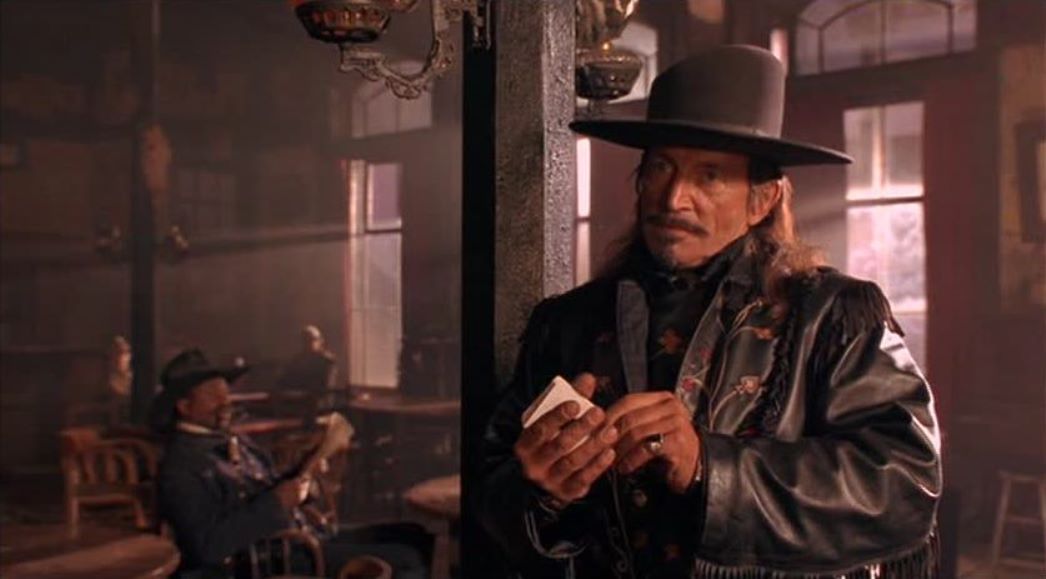
Cantrell in the Background Ace with his deck
So those are the stars, but the acting wattage does not really end there. Among the cast are veteran TV character actors like Roberts Blossom, Kevin Conway and Mark Boone Junior. They are grimy character actors who make up so much of the environment of the movie. The personalities that fill in the background are even bigger. Keith David is Sgt. Clay Cantrell, a self described gentlemen’s adventurer and shootist. His enigmatic character faces down Hackman both in the parlor of Herod’s house and on the street of Redemption. The polite banter that he and Hackman engage in is an opportunity to see the professionalism that the two gunfighters want to project to the world. Another gunfighter, played by Lance Henriksen, is the blow hard Ace Hanlon. A self promoter who has affectations that mark him as something of a buffoon, including a deck of cards stacked with aces, one for every man he has killed, and boots to die for, Hanlon is a character that enters the film dramatically and exits it too early.
Momentarily I will get to the plot and it’s connection to the Leone films of the 1960s, but one actor who appears in the flashback sequences should also be named. A year after his nomination for Best Supporting Actor in Forrest Gump, Gary Sinise, plays the long ago Marshall of the town of Redemption. His character is the catalyst for the revenge story that Sharon Stone is following. Even though his scene is broken up into bits for the brief flashbacks, he creates a sympathetic character that the audience can see as important to the story arc that Ellen (The Lady) is carrying out. Sinise does the whole scene balanced on a chair and choking. What happens creates a different kind of choking on the part of the audience.
The film’s story and the look of the movie, are clearly influenced by Sergio Leone and Clint Eastwood. There is an entrance based on riding by the local undertaker as they enter the town, In “A Fist Full of Dollars” Clint tells the man to get three coffins ready, here, the coffin maker speaks and accurately states the height of Stone’s character, suggesting he will be ready when her turn comes. The duster she wears is not the same as the poncho that the Man with No Name wears in the Dollars Trilogy, but she does have a scarf that gives a very similar effect in her appearance and both of them seem to favor the same tobaccoist.
“The Quick and the Dead” is Sam Rami’s homage to the spaghetti westerns of the 60s and 70s. There are tense close ups in the build to each showdown. The eyes of the characters are doing so much of the acting in those scenes that we barely notice the rest of the surroundings. Rami cross cuts tightly and the images close in, just as Leone did in so many of his films. There is a scene in a gun shop in “The Good, the Bad and the Ugly, where Eli Wallach’s character Tuco, is examining the guns and clicking through the cylinders. Crowe does the same thing as Herod takes him to get armed for the contest in Fee’s shop. Woody Strode, the athlete turned actor who supported John Wayne in Liberty Vallance, and tried to gun down Charles Bronson in “Once Upon a Time in the West” makes his final screen appearance in this film as the coffin maker and the movie is dedicated to him. The most obvious steal is the scene featuring Sinise. Sharon Stone is a much more attractive version of Charles Bronson’s Harmonica from “Once Upon a Time in the West”.
For every idea and stylistic flourish that Rami takes from Leone, he brings his own original style to the movie as well. The dolly zooms that he used so much in the Evil Dead films, fit perfectly in several spots in this movie. The gunfighters stand far apart from one another, but we can feel the tension ratchet up as the next shot zooms the opponent in at a weird Dutch angle.
All of these tricks are needed to help overcome the somewhat repetitive showdown in the street structure of the story. This is a quick draw contest, ultimately to the death, and there are 16 participants so there are going to be a lot of gunfights in the movie that are one on one in the main street of the town of Redemption. When I have seen negative reviews of this film, they often claim that the story is boring because the same event is reenacted over and over. Siskel and Ebert gave the movie Two Thumbs down for that very reason. What people are missing ate the innovative ways each of those gunfights is shot. There are also twists in several of the face offs that make the each contest unique. Additionally, the music themes play up different emotional beats for the fights. Sometimes the score is nearly whimsical and other times it is thunderous.
Two of Herod’s fights demonstrate this. The showdown with Ace Hanlon is slow to develop and then like a whip, the first shot is cracked and then we get a villain’s exposition from Hackman that is so condescending, the end is almost a relief to Ace. With Cantrell, we get two extra shots, one that spins his fancy sidearm around after the man has been shot and then the Coup de Grâce, a point of view shot that is disturbing and inventive and new to the genre. The TV critics down play it as grotesque, but let’s face it, the deadly combat in and of itself is also morbid.
Back to Gene hackman for a few minutes. Herod is an egoist who wants everything to go his way. He demands the retorn of Cort to his town, just so he can lord over him the power that he has. He is dismissive of The Lady at first and then tries to manipulate her to his will. At the dinner scene, Ellen gets the drop on him with a small gun under the table, hidden from view. Herod hears the hammer being cocked and responds with a similar sound to dissuade her from shooting. After she blinks, he gives away the fact that he was bluffing with the hammercock sound he produced, using a metal matchbox. He smiles smugly in his victory over her as she retreats. Hackman does these kinds of smiles and small hand gestures throughout the picture. Before his gunfight with Cantrell, he meticulously files the hammer on his disassembled firearm, to insure it is working properly. Rami tags on a slow motion shot when Hackman is lighting his cigar during a showdown, which accentuates the moment but it is the deliberate manner he uses in a casual way that sells his total control of the situation. Just to add one more element to Hackman’s complete command of the part, he looks elegant in all of his costumes, including the sidearms that go around his suit jacket in one scene.
In previous posts about the film, I mentioned the music, in fact I had a link up to the theme on YouTube, that seems to have expired for some reason. I have an updated link to a suite of the music here:
It is quite lovely, and it does mirror some Morricone themes from the softer moments of the Dollars films. There is nothing as grandiose as the Theme from the Good ,The Bad and The Ugly”, but there are a lot of places where it builds tension really well. Composer Alan Silvestri, who has done scores for “back to the Future” and four of the MCU films, has never received an Academy Award, but his music has received a lot of love from fans, and this is one of the pieces that is maybe not as popular, but it is certainly well matched with the drama of the film.
Director of Photography Dante Spinotti worked with Rami to get the signature shots that enliven the shootouts, but he has also photographed the plains, town and dingy barrooms of Redemption in a beautiful fashion. The sometimes sepia infused lighting is great for some of the interiors and the early shots. I was very impressed with all of the shots supposedly taking place in the rain, especially the shootout between Ellen and Dread. Spinotti would go on to an Academy Award nomination two years later for “L.A. Confidential”.
There will always be more to talk about on this film. Russell Crowe and DiCaprio should merit some comments of their own. Some of this will be discussed on the podcast, and I will come back and add a link to that when it goes up. For now I am just happy to be anticipating the discussion we will have, the notes that I have just given you, and the fact that a 4K version of the film arrived on my doorstep today, and I am about to watch it again.




 Kirkham A Movie A Day