I watched this film a few years ago when it was selected as a movie of the month for the
Lambcast. It was not commercially available to stream, and all of the copies on DVD were out of print. So I had to order a used copy on eBay, and although the packaging was a little strange, because it was some kind of import, the movie still ran, so I was familiar with what was going to happen.
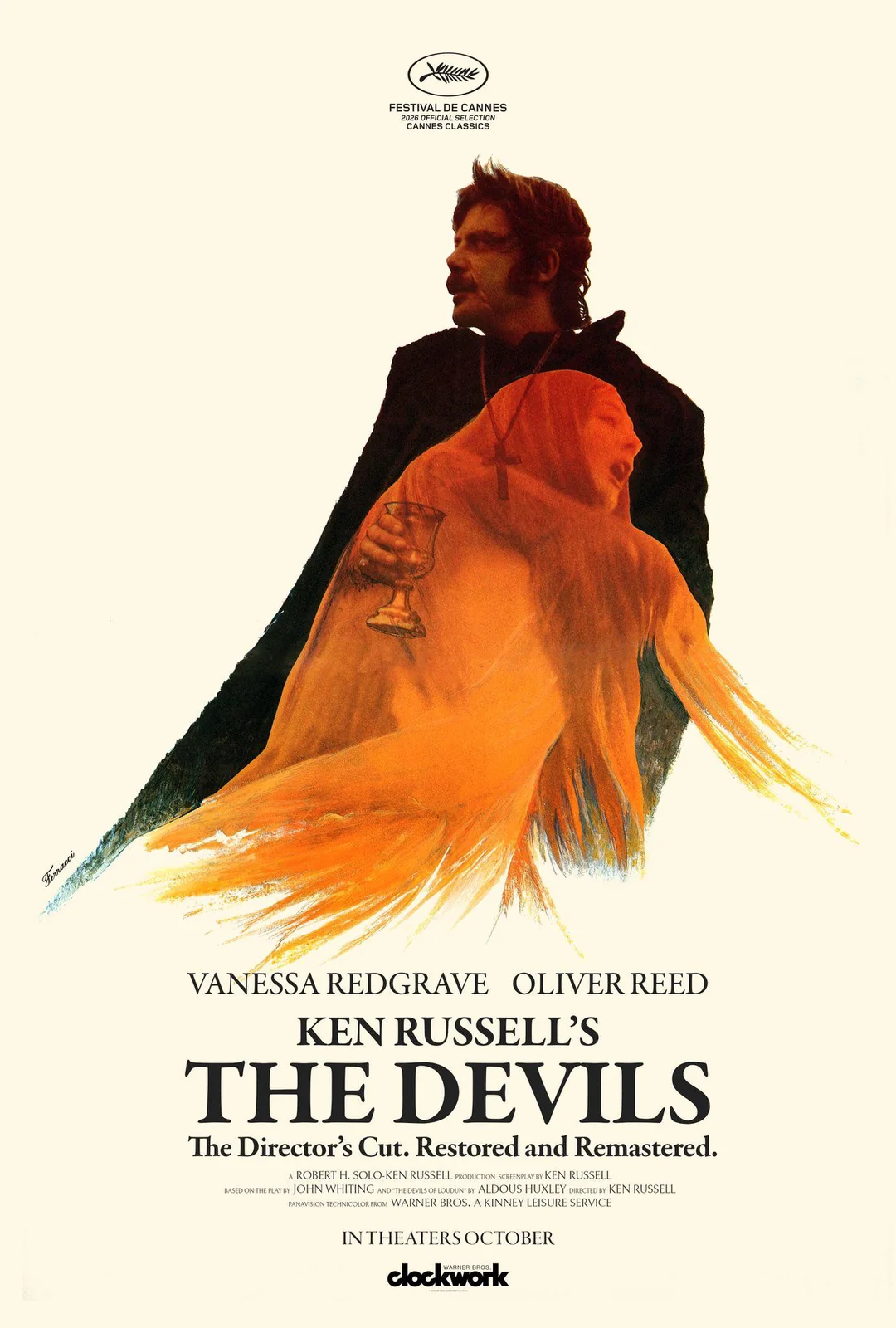
The big talk about the movie now is that it is a rediscovered classic, because the original version that had been heavily edited was restored. The history of this movie and its original release and subsequent appearance in home media is interesting, and you should look into it but you should probably do that someplace else. For my part all I’m going to do here is comment on the film, in the form that it appeared in this theatrical re-release.
Ken Russell’s “The Devils” is one of those films where I completely understand why it was censored. The movie in its current form has an NC-17 rating because the degree of nudity, violence, and cruelty is pretty damn High. You also do not have to be religious to understand the blasphemous nature of some of the sequences, they are repulsive and defensive, and that was Russell’s intention. Because the story concerns group hysteria surrounding a Witch Hunt in a beleaguered town, there are going to be things shown, which will display the excess of the convent and townspeople.
The movie looks stunning, and Oliver Reed, star of the film, gives a very solid performance. Vanessa Redgrave plays the hunchback sexually confused Mother Superior, who creates a convenient Witch Hunt that gives the politically motivated characters the excuse they need to subjugate the town.
The events in the film are frequently loud and overpowering, which makes the experience a difficult one to sit through, but not without some merit. Let’s face it, we are all fascinated by natural disasters and the destruction that can be inflicted on human beings. It is one of the main reasons that the news media exists. Watching this film try to recreate an historical event, using tabloid Style storytelling, is probably a very good metaphor for modern journalism.
The chance to experience this in a theater, and see on the big screen, the images that were cut out more than 50 years ago, justifies this film being released. Was the experience pleasant, not particularly, but was it fascinating, absolutely.
Throwback Thursday on the KAMAD site will be a regular occurrence in the next year. As a motivational project, to make sure I am working on something, even in a week where I don’t see a new film in a theater, I am going to post on movies from 1975. Along with 1984, this is one of my favorite years for movies and it is full of bittersweet memories as well. 1975 was my Senior Year in High School and my Freshman Year in College. The greatest film of the last 60 years came out in 1975, as well as dozens of great and not so great cinematic endeavors. Most of the films in this weekly series will have been seen in a theater in 1975, but there are several that I only caught up with later. I hope you all enjoy.
Tommy
Reading comments on-line, people either love this movie or hate it. The work of collaborators Peter Townsend and Ken Russell has turned The Who’s Rock Opera, “Tommy” into a motion picture and it does not lack for audacity or bombast. This is an in-your-face collection of 1970s excess from a director who was known for his excesses and a producer who would later give us another even more hated Rock Opera based on Beatles songs. Robert Stigwood was a record mogul who became a movie producer and is responsible for some of the biggest hits and flops in musical films of the 70s and 80s. Director Russel might have been willing to live with lesser artists, but Stigwood encouraged the excess by holding out for Elton John and Jack Nicolson to join the cast of this film. This was a confluence of egos that created a visual assault on the audience that can still be felt 48 years later.
Oh, count me in the loves the movie category.
A parable about family secrets creating a cult of personality, “Tommy” is a social satire par excellence. Avariciousness, idolatry, drug use, sexual mores and more, all come in for some bashing with humor and style. Is it excessive at times? Yes, but it is also imaginative, invigorating and fun. Roger Daltry plays Tommy, the boy who has a psychosomatic condition that cause him to be blind deaf and unable to speak. Daltry must have performed the opera hundreds of times as a member of The Who and now he he gets to act as well as sing the part. I personally prefer the sound of the album version of the music, but the soundtrack here is quite good, adding as it does, a variety of other artists to interpret the songs, including some who are not noted for their singing.
The sequence with Eric Clapton as the Preacher, at a temple that worships Marylin Monroe as a deity, capable of performing miracles, is one of the most disturbing conflations of ideas about pop culture that I have ever seen. The dancers who trudge down the aisles wearing a ceramic version of the face they worship is creepy as all heck. Clapton’s low key vocals are hypnotic as the rhythms entice the faithful to kiss the feet and peek up the skirts of an effigy to their object of adoration. This is like a tent show healer without the fire and brimstone but rather the soothing melody of hypnosis as a solution to your problems.
Every few minutes in the film is a set piece highlighting the work of another guest star. Tina Turner dazzles as the Acid Queen and Russell has visualized an Iron Maiden of hypodermic needles to hive us nightmares. Add to that a mirrored split screen and some psychedelic lighting effects and the influence of the director’s madness is evident. The show stopper tune however, is the “Pinball Wizard” contest, pitting blind, deaf and dumb kid Daltry, against a rock icon of the era, never noted for subtlety, Elton John. The audience in the scene is equally frantic and when the Pinball Wizard falls, and is carried out by his oversized boots, you should be getting a great laugh.
Oliver Reed and Jack Nicolson both sang their own parts, although they are not singers. Reed is mostly bullying himself through the process with a gruff voice pushed to short bursts of trying to stay in tune. Nicolson would not be putting out a Christmas album, but he acquits himself very nicely in a short scene where his eyebrows interact with Ann-Margret most effectively. Speaking of Ann-Margaret, she was nominated for Best Actress for this part and I have seen a number of people question that nomination. I think it was perfectly justified, she does all the heavy lifting of the songs that have to hold the narrative together. Her character also has almost as elaborate a story arc as Tommy himself. If you pay attention, you will see that it is not only the scene with the beans, bubbles an chocolate that she throws herself into. She is energetic as all get out in a number of other moments and she is also very poignant at times. It’s best that she did not win, but being in the mix was certainly reasonable.
If you are looking for additional Ken Russell moments, watch the “I’m Free” number, where Daltry swims, runs, tumbles and flies in a kinetic montage while singing one of the best loved songs from the work. Also, the reverse climax of the film which returns us to the long overture segment of the movie is really quite clever. This film is bursting in inventiveness but it is not always tasteful or coherent, which may account for why some people hate the film. It was a huge success when it was released in the spring of 1975, and that is when I first saw it. My memory is that I saw it at the Academy Theater in Pasadena. Today I watched it on a DVD that I burned from my Laserdisc years ago.
The cast, the music and the costumes, and scenery make this a perfect snapshot of 1975.