KAMAD Throwback Thursdays 1975: Bite the Bullet

Throwback Thursday #TBT

Throwback Thursday on the KAMAD site will be a regular occurrence in the next year. As a motivational project, to make sure I am working on something, even in a week where I don’t see a new film in a theater, I am going to post on movies from 1975. Along with 1984, this is one of my favorite years for movies and it is full of bittersweet memories as well. 1975 was my Senior Year in High School and my Freshman Year in College. The greatest film of the last 60 years came out in 1975, as well as dozens of great and not so great cinematic endeavors. Most of the films in this weekly series will have been seen in a theater in 1975, but there are several that I only caught up with later. I hope you all enjoy.

Bite the Bullet

I have been extremely busy the last couple of weeks, including travel. This is a repost of two entries on a 1975 film that I love, but did not have time to watch again fore the project. 

Next time someone tells you everything is available on line, try to get them to find the original trailer for this movie. I looked all over the place and could not find it.

[As you can see above, this has changed since the original post]

That doesn’t mean that it doesn’t exist, but I suspect that may be the case.

Sometimes, you have to make due with what you have. I have this movie on a DVD that goes from a letterbox format for the credits to a pan and scan version for the rest of the film. This is really too bad because a lot of the pleasure in this movie are the vistas and wide-screen images of the contestants in this horse race. The scanning seems to take some of the grandeur and a lot of the energy out of the story, (at least as I remembered it.)

I saw this movie at the Chinese theater, on the big screen. Of course at the time there was only one screen at the Chinese Theater. There are actually quite a few westerns on my list, which is a little surprising since the 70’s were supposed to be the death of the western. It so happens that this particular Western stars my favorite film actor Gene Hackman. I looked over his filmography, and for a guy who got started in the business in the late 60’s, he has actually made a lot of Western Films. Earlier this week, we came across Zandy’s Bride, which I had nearly forgotten and came out a year earlier. Gene Hackman was a big star at this point, he was cast as the leading man a couple of years earlier in “The Poseidon Adventure” but he has always been a character actor to me. When he plays a part, he is the charater he is playing not the star. In “Bite the Bullet” he is the first lead but really just one of a dozen characters that make up the story.

This film features a 700 mile horse race across deserts, over mountains and through forests. There are gunfights, action, dramatic twists and a sense of history as things go on. Hackman and James Coburn play two of Teddy Roosevelt’s Rough Riders a few years after the Spanish-American War. The modern is mixed with the old west at a time when the world was in fact changing. Ben Johnson basically repeats his role as the last of a dying breed from the Last Picture Show. Candice Bergen is the female lead in a pretty solid part for a woman in a movie like this. This same month she was starring in “the Wind and the Lion”, so it was pretty clear she was Box Office at this moment in time. There are other familiar faces as well, but I want to take special note that this was the period of time that Jan-Michael Vincent was ascending and he was very promising in the movie. It is a shame that drugs and alcohol sidelined a guy who could easily have taken over a lot of leading man roles in the next few years.

Opening the movie is a prologue that introduces several character, including the wealthy owner of the favored horse and the newspaper people that are sponsoring the race. It was a little odd that there was so much time devoted to those story arcs and that they basically disappear from the movie. The only thing I felt was unsatisfying about the film was the last ten minutes of the race. The result was fine, but there is no resolution for some characters and it feels like an epilogue would have been appropriate. I recall that the film got a very fine review from the LA times when it opened; probably Charles Champlian wrote the review, he was the main critic at the Times in those days. This movie seems largely forgotten now, which is too bad because it is a good action film with some realistic situations and characters. It runs off the track a bit in the last act, but that can be forgiven pretty easily.

POST #2

This is an update to a post I did nearly two years ago on one of the Original Movie A Day Project Films. I have long wanted to see Bite the Bullet in it’s original widescreen form, but it has not been available. The version in the original post was a pan and scan DVD that I acquired for a very modest price. You can find my original comments here. “Bite the Bullet” was a big scale Western at a time that such movies were dying out. It features a brutal 700 mile horse race across deserts and mountains and plains. It is perfect for a director to compose shots that will fill that screen with those vistas and also show the characters in relevant space. A month ago I read a review of a Blu Ray release of Bite the Bullet and went in search of it. It turns out that the film was not being mass marketed but was a specialty release with only 3000 copies being produced. None of them was available at any of my local retail outlets so off to the internet I flew. I could buy a new copy on Amazon for $36 plus shipping. I found a used copy on ebay for thirty and went for it. I am happy to say that it was worth the investment. I still think the last few minutes of the movie are underdeveloped, but the rest of the film looks spectacular.

There is an early shot of two trains passing each other in a railroad yard that would cut out one of the trains in the pan and scan version. Since the character we are following would need to stay in the frame, a severely cropped for television version leaves out a side of the picture. Here one gets a greater sense of the enormous changes that are taking place in the world at this time because of the trains passing each other in what might charitably be called a small town. Later shots of the railway also cut out the whole train in the shots, but here we get to see it as it moves across a bridge or travels though a forest. These are mostly little points in the movie, the real use of the widescreen comes in the horse race scenes, especially those set in some wide desert vistas. In the current widescreen Blu ray, we can see shots that include several of the contestants in the race at once, although they are clearly a great distance from one another. The empty spaces between them emphasize the desolate nature of the environment. In some later scenes, the layout of the territory in a chase and prison break makes more sense because of the way we can view it. There is a scene in which Gene Hackman’s character chases down Jan Michael Vincent and lays into him for the negligent way he has treated his horse, it has more drama and excitement in it with the space not being as condensed as in the pan and scan version.
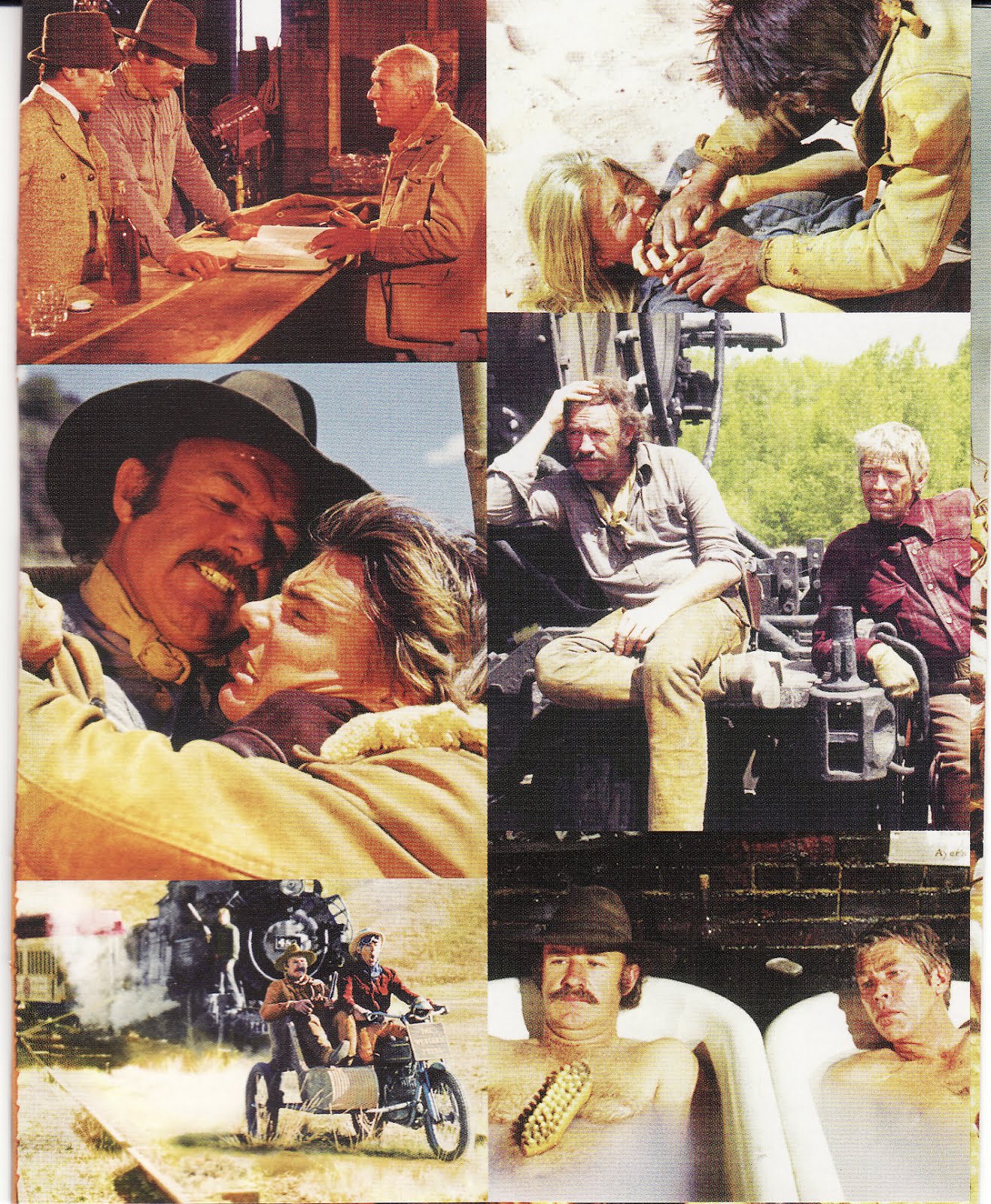
This was one of the first times I remember seeing the death of a horse from exhaustion being visualized in such a dramatic way. John Wayne’s horse in True Grit gives up the ghost when he is trying to get Maddie Ross back to the trading post. Here, we see all of the horses perspiring and covered in foaming sweat. Their legs are shaky and the riders are either tender and cautious or reckless and indifferent. As the animals are falling in the sand or rolling down a hillside, the broad view makes us much more aware of how difficult the race really would be. I am very satisfied with the quality of the picture and the extra price was worth it to me. One more comment about the movie that is unrelated to it’s presentation. Hackman has a great piece of dialogue about the charge at San Juan Hill that his character was supposed to be a part of. It sounds at first like it is going to be a sucker punch slam at the Spanish American War and Teddy Roosevelt. Instead it reminds me,and I hope you, of why Theodore Roosevelt was in fact one of our greatest leaders. After having his glasses shot off and his arm nicked, Roosevelt rallies the Rough Riders to storm the hill. Hackman’s character says that they didn’t follow out of a desire for victory, or to promote freedom. They went willingly with Roosevelt into the rain of death from above because they would have been ashamed not to. If it’s not a true story, it feels like one.

The Great Escape-Paramount Summer Classic Films Series

One of the reasons I took the approach I have for this blog, was so I can do exactly what I am doing now, writing about a film I love, because I saw it in a theater. I have watched “The Great Escape” dozens of times, I own it on Laserdisc, DVD, and Blu-ray, but I have never seen it in a theater on the big screen, what a magnificent film! The story of the biggest prisoner escape during WWII is told in a straight forward narrative with plenty of suspense and great characters along the way.

Take a look at this cast, it is very impressive. There are a ton of British actors that you will recognize, even if you don’t know their names, and the American cast is stacked with legendary stars like Steve McQueen and James Garner. The film is nearly three hours long but never feels too long because all the pieces are put together so well. The plan is laid out for us, we know who everyone is and what their responsibilities are. There are great character points and a bit of humor here and there, but no one simply exists as comic relief. The one plot line that suggests it was designed to amuse us with humor, ends tragically and sets one of the characters on a different trajectory. 

Donald Pleasance, who had made dozens of things before this, first appeared on my radar as Blythe in this film. His fish out of water forger was sympathetic and ultimately tragic, which I think made him stand out for me for the rest of his career. He was Blofeld in “You Onley Live Twice”, he was in “Fantastic Planet”, “THX1138”, a terrific TV Movie version of “The Count of Monte Cristo” and he is Dr. Loomis in the “Halloween” series. Heck, I even liked his parody of Robert Stigwood in “Sgt. Pepper’s Lonely Hearts Club Band”. The relationship he and James Garner develop in the film is one that will resonate well with people who come together under trying circumstances.  Garner is great as a scrounger, he basically played the same character the next year in “The Americanization of Emily”. Garner’s aw shucks flim flam style will sustain him through a dozen future feature films and the television show “The Rockford Files”. 

For a decade, was was sure that Charles Bronson was once an Academy Award Nominee for supporting actor for this picture. It wasn’t until sometime in the 1990s, when I looked it up on line, that I discovered I was mistaken. Watching his performance however, I can easily see why I thought it was true. His character, Danny, The Tunnel King”, is a man of strength who has a weakness that he faces repeatedly, but has finally reached a tipping point. His temporary abandonment of the tunnel as the escape route has some great moments of close up and voice performance. He is so solid in this part, and he mostly is stoic for the rest of his career, I see so much more that did not get played out as it could have in lesser films in his future. 

I don’t know if anyone has ever talked about “The Great Escape” without mentioning Steve McQueen, and if they have, how could they do it and Why? McQueen is the top billed star in this film, but it is an ensemble picture, and he is not in it any more than many of the other actors. The reason everyone remembers him in the movie is because he is magnetic. His character is a defiant iconoclast,  who never the less fits into the military structure very effectively. His casual interplay with Richard Attenborough and Gordon Jackson contrasts nicely with the defiant reminder to the German Commandant,  that he is Captain Hilts. That was a moment of charisma so important, that it is reimagined for “Once Upon a Time in Hollywood”. Of course the biggest moment for him in the film is the motorcycle escape. My wife and I used to joke that if we watched the film one more time, this time he will make it over that second fence. 

Director John Sturges had a way with masculine adventure stories that seemed to peak in the 1960s. In addition to this film, he made “The Magnificent Seven” (also with Steve McQueen, James Coburn and Charles Bronson) and “Ice Station Zebra” the baby boomers gateway drug to submarine movies. Sturges often used Elmer Bernstein to score his films and in addition the his theme for The Magnificent Seven”,  his iconic score for this film is well loved. I read somewhere, probably on IMDB, that soccer fans hum it during games. (I would have thought whistling Colonel Bogey’s March would make more sense).

The fact that this is based on a true story and the techniques used by the prisoners were pretty closely followed in the film, give rise to even greater respect fore the fighting men of the Allied forces in WWII. The film makers do what must always be done in creating an entertainment, they romanticize some things, ignore the inconvenient, and have to change characters around. Still the film feels very honest, in part by the fact that there are no speaking roles for women in a P.O.W. camp. Hogan’s Heroes would fix that later. This is one of those thousand films you must see before you die. so I have several lifetimes worth of viewing it to my credit.

Charles Bronson Film Festival: Hard Times

When the Italians refer to you as “The Ugly One” and the French call you “The Holy Monster”, you know you are not going to be cast as the romantic lead very often. Charles Bronson had a face that looked like a catchers mitt that was left out in the sun for a long time. His skin was tough, his mouth was small and his eyes narrow. As he got older the features deepened and gave him real character. Still he managed to be an effective love interest in several films with his wife actress Jill Ireland. In fact, she appears in four of the five films we are covering for this little festival. The romance was almost always a secondary part of the main story and that is the only slightly different with this movie.

This was the first movie directed by Walter Hill. He had screenplay credits for a number of films before he began directing, including the neo noir “Hickey and Boggs” and the Steve McQueen/Ali Macgraw thriller, “The Getaway”. He would later go on to direct “The Warriors”, “48 Hours” and “Streets of Fire” which was recently featured as the Movie of the Month on the Lambcast. This was a project that seemed destined to bring these two together. I read an interview with the great Strother Martin, where he complained a bit about how the movie was cut. Both his part and James Coburn’s parts were trimmed by several sequences and he felt that the movie seemed like a program filler rather than something special. I don’t know if the studio interfered, but Hill was one of the writers and as director he called the shots. In retrospect the movie is a excellent example of spare story telling and interesting characters. The side plots might have been worthy, but the focus always needed to be on Bronson’s Chaney.

The title says it all, it’s the depression, jobs are hard to come by and everyone is looking to make a buck. Bronson drops into town, a beautifully shot New Orleans, off a freight train with nothing more than six bucks in his pocket. It’s been commented on in the notes on the DVD and on the IMDB page that Bronson has barely 500 words of dialogue in the film. If you watch the first five minutes you will know why. He simply does not need more. The character is laconic because he has little interest in other people or events. He is a loner and can indicate a lot of emotions with that punching bag face. Just watch the way he works the toothpick in his mouth while sitting at the counter of the diner. It moves along with his level of attention to different subjects.I’ve seen plenty of actors use props like cigarettes or food to make a point, Charlie just needs the tiny stick. In the bare-knuckled fights, the opponents usually are the ones with the big talk, Chaney let’s his fists do the talking. There are two scenes where other characters come right out and ask if that’s all he has to say about a subject, he doesn’t even give them a one word answer.

Another reason that it is a good thing that Bronson has few lines is that Coburn has so many. His character is nick named “Speed” and it sounds like that is based on his conversation skills. “Speed” is the loser character of the piece. He is a small time operator who dreams of the big time but almost always blows it on bad choices, especially saying a few words too many. His collaboration with Chaney would seem to be a nice symmetrical match. This is the third film the two stars made together, they previously appeared in “The Magnificent Seven” and “The Great Escape” together. Coburn had moved to the front ranks of film stardom but was slipping a but by this time, Bronson was peaking. This was their last film together.

Strother Martin probably had a bit more right to be irked with some of the trims. There are no scenes in the film where he is doing the work that he is contracted for. Everything he does is in assessing Chaney before a fight, not treating cuts or bruises. In spite of that, he steals the movie in every scene he is in. His dialogue is the best in the script. He plays an opium addict, with a poetic streak a mile wide.

Chaney: Two years doesn’t make a doctor.

Poe: Well, in my third year of studies a small black cloud appeared on campus; I left              under it. Some are born to fail, others have it thrust upon them.

At the final fight, when Chaney has been manipulated  into fighting, Martin picks up a wrench and throws it through the second story window of an office to announce that they are ready to begin.

Actor Robert Tessier specialized in playing menacing tough guys on TV and in the movies in the 70s and 80s. He was an early example of a bald head being used as a symbol of intimidation in the movies. He was a dangerous convict in “The Longest Yard“, a tough guardian angel in “The Deep” and he was the villain with his voice dubbed in “Breakheart Pass“. He is Chaney’s first real test as a fighter and their fight is one of the big action pieces of the film. It is shown from above, and then the crowds are shown at an angle looking up. It is a clever way to add to the staged fisticuffs that are going on in an abandoned factory. His role gives Bronson another chance to show how small acting touches can be so effective. Tessier smiles manically a couple of time during the fight, he even tries to intimidate with a backhanded compliment. Bronson remains mostly impassive, with only the mildest of smiles when he gets the upper hand. The absence of open emotion is the stronger personality in these scenes.

Another actor who works well as cast is Bruce Glover, maybe better known as the father of Crispin Glover these days. His face and voice convey a sadistic streak as the enforcer for a loan shark that “Speed” turns to for a bankroll.  His Mr. Wint in the James Bond film, “Diamonds are Forever” would be the closest character I have seen him play with this type of vigor.

Just as Bronson cuts off conversation with two other characters after they ask if that’s all he has to say, he also initiates conversation with both of them the same way. He simply helps himself to a seat at their dining table. His come on to her in the diner is quiet and non-threatening. It is a little unusual for a guy who is supposed to be taking charge, but it is his confidence not his bluster that gets them connected. This is another great contrast with “Speed” who has to try to get in the last word every time and ends up looking like a fool.

There is a scene where he tries to impose a financial arrangement on Chaney but gets put in his place pretty quickly by Chaney simply standing up to leave. Another example in the script of less is more. “Speed ” is all easy charm and smiles but it can’t get him what he wants, Chaney is coiled silent tension, but even when he strikes it is in a non-flamboyant manner.

On top of the great script and the interesting characters in the movie, the film benefits from it’s look. Depression era New Orleans must have been a bit of catnip to film makers. Bourbon Street has a classic look and many of the older buildings have not changed since the era. Steve McQueen starred in “The Cincinnati Kid” a poker movie set in the same period and the landmarks and factories sell the authenticity of the film. I watched it on a Twilight Time Blu Ray disc and the transfer is stunning. The opening scene where Bronson just jumps off of an arriving train looks beautiful and the rest of the movie follows.

If you are unfamiliar with Charles Bronson, and want to see the kind of actor he could be, outside of the vigilante films he ended up being ghettoized in, than “Hard Times” is a great place to start. The characters make the movie and the acting elevates it. It may not be my favorite Bronson film, but it is my favorite Bronson performance.