As I am putting this post together I just read that screenwriter Robert Towne passed away Monday night at the age of 89. “Chinatown” is his masterpiece, and it certainly seems fitting that we were seeing it on the big screen at the time he was moving on to his final resting place. This is the second time we’ve seen the film on the big screen this year, having enjoyed it at the TCM Film Festival back in April. This year is the 50th anniversary of Chinatown, and celebrating it with multiple screenings, as well as spending time with the book “The Big Goodbye” which is primarily about the making of the movie, all seems fitting.
The screenplay of course is one of those that manages to get everything pitch perfect. We know from the background on the film that it took long battles and big arguments between screenwriter Robert Towne and director Roman Polanski, to get to the finished product. Ultimately, Towne was unhappy with the ending of the movie, which of course features tragedy rather than redemption for the heroine. I think we’re lucky that Polanski won, because the final line of the movie, which everyone knows, is the perfect coda for what we have seen in the previous 2 hours.
Again we need to credit the great Jerry Goldsmith for coming in at the last minute and replacing the score with a jazz infused time period appropriate combination of horns and piano. The film just wouldn’t work without that set of themes or nerve racking minor key piano notes. It’s also easy to give huge kudos to the production design, which manages to make Los Angeles of the 1970s look like Los Angeles of the 1930s. I imagine that there was some graffiti removed around the Los Angeles River, certainly some traffic controlled on Alameda, and the flood control channels look a heck of a lot more pristine than they probably do today. Let me also say that every piece of clothing worn by either Faye Dunaway or Jack Nicholson, should be available for us to purchase today. I know I could rock that jacket that he’s wearing in the last part of the film.
We were encouraged by the Paramount to dress up for the occasion, and although I didn’t have an appropriately colored fedora, I did have a black one that worked pretty well. The tie I picked out belong to my uncle Howard, who was actually my father’s uncle, and I have no doubt that he bought it sometime in the 1930s, the style is just too precious. I added some suspenders but most importantly I added a bandage to my nose to complete the picture. I got several compliments from people walking out of the theater, who appreciated a little bit of extra effort. I know I had fun and I know I love this movie.
I wrote about this film just a few months ago on the Thursday 1975 Throwback project that I am doing. So I will give you that link (here) if you want to see more complete thoughts on the film. For this screening, let me say it was nice to be in a theater full of adults, although I was surprised at the people behind me who had never seen the film before. Their quite cries of anguish when the s*** hits the fan was indicative of the power of this film, even after nearly fifty years.
Nicholson’s performance is so much more physical than I remembered and those moments of pain, rage and enthusiasm are all the things that make his character work. In contrast to the cool Miss Ratched played by Louise Fletcher, McMurphy is an angry bag of cats, waiting to be unleashed. The supporting actors are all excellent as well. Director Milos Forman took actors with very distinctive looks and allowed them room to be “off” if not entirely crazy. DeVito, Lloyd, and Schiavelli have great individual moments, Sydney Lassick practically steals the movie from everyone else. Of course Will Sampson is magnificent when he simply utters an unexpected “Thank You”. Brad Dourif as Billy will break your heart.
The screening was at the State Theater instead of next door at the Paramount. They had a live show booked in there this last evening.
Throwback Thursday on the KAMAD site will be a regular occurrence in the next year. As a motivational project, to make sure I am working on something, even in a week where I don’t see a new film in a theater, I am going to post on movies from 1975. Along with 1984, this is one of my favorite years for movies and it is full of bittersweet memories as well. 1975 was my Senior Year in High School and my Freshman Year in College. The greatest film of the last 60 years came out in 1975, as well as dozens of great and not so great cinematic endeavors. Most of the films in this weekly series will have been seen in a theater in 1975, but there are several that I only caught up with later. I hope you all enjoy.
The Fortune
As usual, I tried locating a trailer to accompany my film selection, but this does not seem possible with “The Fortune”. I was unable to locate a trailer on YouTube, which is the most likely site that it would be available on. I looked at Google to search for the same thing and also got no results. Maybe this is the reason that this film was a Blind Spot for me, I never remembered seeing anything promoting it, except newspaper ads. The fact that the movie flopped on release probably accounts for it never being available for me to see in 1975. To catch up with it today, I purchased a copy from Umbrella, an Australian Media company, this actually had to clear customs before being delivered to me. Anyway, the above video is a clip from TCM when they showed the film a few years ago.
“The Fortune” stars Jack Nicolson (This is his fourth film in the Throwback Thursday Series) and Warren Beatty (Only his second). They were both big stars at the time and the movie was directed by Mike Nichols. With that pedigree, you would think this was a surefire smash. Unfortunately, like “Lucky Lady”, also in 75, casting cannot make up for all the elements of a movie. Somehow this light comedy farce, just lacks the delicate touch that it takes to pull off this kind of material, and part ofd the problem is the two stars.
Nicolson and Beatty are both laconic actors, who need some pushing to feel like active participants in a movie. Here they seem to be cruising rather than working, and the script and direction are not enough to compensate for a lack of wattage from the stars. There is a scroll at the start of the movie, to explain the complication that the story is trying to deal with. This immediately suggests trouble. When you have to have a history lesson before the story starts, it is never very promising. Basically, the two are small time scam artists, who are trying to get a hold of the wealth of an heiress by marrying her. Unfortunately, the man who wooed her is unable to complete a divorce, so if he takes her with him across the country, he could be violating the Mann Act.
During the 1920s, in the United States, the law known as the Mann Act was much feared. It prohibited transporting a woman across state lines for immoral purposes. Because of the Mann Act, a man who wanted to run off with a woman and was willing, or unable, to marry her, would sometimes go to unusual lengths.
So Beatty wants to marry Stockard Channing, but can’t, so he has her marry his pal Nicholson, as a way of getting around the law. Of course that presents some awkward moments in the story, and those are the only places where the film comes to life. The movie is less than an hour and a half long, but it seems to take forever to get to the real complications. A car ride, train trip and Airplane flight, all use up a lot of screen time, without really building the story or the characters. Once the trio arrives in Los Angeles, and settles into the same courtyard apartment that was used in “The Day of the Locust”, the comedy feels more connected to the goings on. There just isn’t that much of it.
Channing is in her first credited role here, and for the most part she is great, but there are a couple of scenes where bickering is featured and she was given the direction “louder”. It annoys rather than amuses. The final section of the film, is where the slapstick humor comes in, and the hapless con men, having decided to murder the woman they both claim to love, can’t quite pull off the act. There is a scene of a traffic jam on a bridge that showcases what the film could have been, if only that spirit was infused in the rest of the story.
Anyway, it’s not as big a misfire as “Lucky Lady”, it still isn’t something you need to add to your list of essential viewing.
Throwback Thursday on the KAMAD site will be a regular occurrence in the next year. As a motivational project, to make sure I am working on something, even in a week where I don’t see a new film in a theater, I am going to post on movies from 1975. Along with 1984, this is one of my favorite years for movies and it is full of bittersweet memories as well. 1975 was my Senior Year in High School and my Freshman Year in College. The greatest film of the last 60 years came out in 1975, as well as dozens of great and not so great cinematic endeavors. Most of the films in this weekly series will have been seen in a theater in 1975, but there are several that I only caught up with later. I hope you all enjoy.
One Flew Over the Cuckoo’s Nest
Obviously we were going to get to some of the prestige pictures of the year 1975. In addition to “Jaws”, “Dog Day Afternoon”, which I have talked about on this project, the other Oscar Nominees for Best Picture are “Nashville”, “Barry Lyndon” and the ultimate winner “One Flew Over the Cuckoo’s Nest”. Famously “Cuckoo’s Nest” won the top five prizes at the awards that year, tying a record with “It Happened One Night” and later repeated by “Silence of the Lambs”. This was the fifth nomination for Jack Nicolson and the first time he won. As you watch the film it is evident why this was going to be the outcome. Maybe Ken Kersey thought Nicolson was wrong for McMurphy, but for a cinematic experience he is the perfect fit.
The part of McMurphy is that of a joker in a situation that is grim, an outsider in the ultimate inside game, and the reluctant hero to a group of reluctant fans. He gets to indulge some of his wild mannerisms and facial expressions, but there are also a number of equally quiet and serious moments. The tension between McMurphy, the prisoner faking mental illness and the head nurse, Miss Ratched, is evident in their looks at one another and their voices express a barely suppressed distain. McMurphy of course, is much more open in his aggressive manner of interacting, Louise Fletcher has to hold her emotions back in the passive aggressive pattern that the nurse uses with all of the patients. Her deliberately calm demeanor may be meant to create a safe space for all of the group, but it comes off as condescending at times and she exerts her power with an icy stare rather than a raised voice. This is a film with two fantastic parts and both actors are completely up to the task of bringing them to life.
Maybe this is about the machine and how it grinds everybody down, or maybe it is a film about individuality and the importance of fighting to keep your unique identity. I always think it is about the banality of evil. Miss Ratched seems on the surface to care about her patients, and she probably thinks she is doing right by them, but at every step of the process, her manner sends the signal that they all need to conform and submit to her power. Authoritarians always think they are right and acting in the greater good, regardless of who’s necks they have to stand on and what the cost is. She is the embodiment of the Covid Crusaders who wanted everyone to do as they were told, regardless of what the consequences might have been to someone else’s life. Ratched acts more aggressively when her power is threatened. What happens to Billy Babbit is a result of her turning the passive control she has exerted over him, into a cudgel, and his betrayal of McMurphy and the self consciousness about being with a woman and the way it will impact his mother are a recipe for disaster, and Nurse Ratched is the one who puts it on the stove to cook.
In an institution filled with troubled souls, you would have a hard time differentiating the patients from the actors. Vincent Schiavelli, Danny DeVito and Christopher Lloyd are three actors early in their careers and their looks were not typical. When you throw in horror icon Michael Berryman in the background, the group seems very much a set of misfits. Sydney Lassick and William Redfield are both very good in parts that have a greater degree of dialogue. Cheswick will make you take pity on a lost soul and everyone will be frustrated with the obtuse Harding, but they are still essential to the group. The other two performances that need to be singled out are key characters in the plot. The “Chief” was played by non-actor Will Sampson. a large man of native American Indian ethnicity, and he makes a great impression in a nearly wordless performance. The moment he does utter a single word, is a transcendent one in the film. Brad Dourif as Billy Babbit makes us root for him and wonder at the world that has produced this sensitive kid that can hardly express himself. Dourif got the nomination that would have gone to the entire supporting cast if the SAG awards Ensemble category had existed in 1975.
Verisimilitude in the film is one of the things that makes the story work. The therapy group sessions are forced, like a true psych experience might be. The patients are all resistant to participating or saying anything that could have a negative consequence. The fact that they shot in a real, active mental institution means that the sets never feel like they are cardboard fronts but caged windows, communal tubs, and a near dormitory existence. The ECT treatment that McMurphy gets looks real and by all accounts represents an accurate portrayal of the procedure. The patients lining up for their medication also seems too real.
The two best sequences in the film are of course the ones that give Jack the biggest opportunities to play to his strengths. When McMurphy breaks out to take the group on the fishing expedition, he plays with all of the other characters and gets a lot out of what is going on. It is a collective moment that he inspires. However, the greatest moment is his improvised calling of a World Series Game that isn’t on the TV. Although all of the supporting cast backs him up, it is really his moments and it feels perfect.
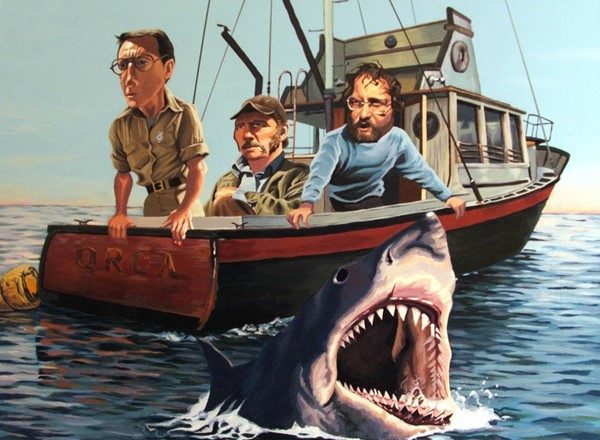
I make no secret of my preference for another film this year, but if “Jaws” is not going home with the stupid trophy, I’m glad that this film did.
Throwback Thursday on the KAMAD site will be a regular occurrence in the next year. As a motivational project, to make sure I am working on something, even in a week where I don’t see a new film in a theater, I am going to post on movies from 1975. Along with 1984, this is one of my favorite years for movies and it is full of bittersweet memories as well. 1975 was my Senior Year in High School and my Freshman Year in College. The greatest film of the last 60 years came out in 1975, as well as dozens of great and not so great cinematic endeavors. Most of the films in this weekly series will have been seen in a theater in 1975, but there are several that I only caught up with later. I hope you all enjoy.
The Passenger
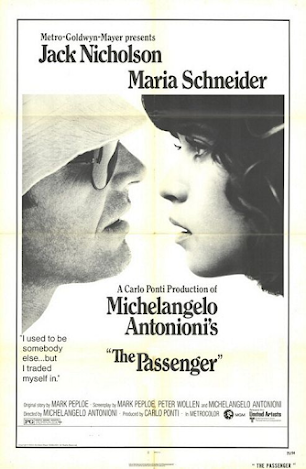
This film is one of my blind spots from 1975. I badly wanted to see it, but it played in limited engagements on the other side of town and I never made it over there to see it. I remember as a 17 year old kid, looking at the Calendar Section of the L.A. Times, wanting to catch up with this highly praised arthouse film, featuring Jack Nicolson. This came out the same year as “One Flew Over the Cuckoo’s Nest”, even though it had been filmed two years before the release.
I always thought it was some kind of thriller, but it turns out to be very different in tone than I was expecting. There is almost no violence in the film, except for two brief moments. One of those moments, disturbingly, is not a fictional killing, but was a filmed execution of a bank robber in the African country of Chad. It is shown as part of a documentary that Nicholson’s character is supposed to be working on. The other moment of violence involves a single karate style kick to the head of a minor character in the film. There are two pivotal deaths in the story but both occur off screen, and they are not designed to create suspense and tension, that isn’t really what the film is about.
As I was watching the first half hour of the movie, I was worried about the pace of the film and the ambiguity of the events being shown. Eventually, most of the uncertainty about characters and their actions gets explained more clearly as the film moves on. The pace also starts to pick up when there is more dialogue. Nicholson plays a journalist, working on a story about conflict and civil war in Africa. In the 1970s, that seems to have been a constant problem, and it doesn’t look like the world has changed that much in the intervening years. His character is David Locke, and he is struggling to connect with the fighters in the conflict, but does not seem to be getting anywhere. The metaphor of spinning your wheels is also visualized literally when his Land Rover gets stuck in the sand. Later, in some flashbacks, we see that his homelife is similarly stuck in the mud, and we get a sense that maybe he is looking for a new life. When a fellow resident at his hotel dies, Locke takes over his identity, a man named David Robertson. This changes his life, but maybe not for the better.
Audiences will have to fill in the blanks and suspend a great deal of disbelief, to accept that Nicholson is able to follow through on some of his new identity’s plans. As I was watching, it seemed strange that the man who was so feckless in Africa, was able to bluff his way through with some dangerous types early in the film. It also turns out that his wife, who thinks he is dead, is a lot more determined than he imagined she would ever be. Without credit cards, or cell phone GPS data, she is able to track down Robertson across Europe. Spain must be a small country because they practically trip over one another in the lobby of a hotel, completely by accident.
Jack plays a disaffected man, seeking a new life, but he is still playing at someone else’s life, and getting close to being burned by doing so. I suppose it is karma that brings him together with a similarly disaffected architecture student played by Maria Schneider. They don’t quite fully commit to each other, but at times, their mutual presence gives each of them a few moments of pleasure in life that they are seemingly missing the rest of the time. Languid conversations in the car, hotel restaurant, or wherever they happen to be, make up the majority of the story in the second half of the film. There are a few chase scenes, but they are not shot like a thriller, so much as they just move us to the next obstacle.
All of the film is a set up for a seven minute shot at the end of the movie, where events play out in front of us and behind where we can see. Almost everyone is in a long shot, and it looks to have been done as a single continuous take. One of the things that is very noticeable in the film making, is the absence of a music score. All the events take place in a vert real world environment, that is not accentuated by movie techniques. Michelangelo Antonioni is the director, the only other film of his that I know I have seen is “Blow Up” and I think that movie does the same sort of thing.
One of the reasons that I had not caught up with the film was that for a number of years it was out of circulation. Nicholson himself acquired the home exhibition rights, and it was not until 2005, that the film became available, except for a very limited VHS release in the 80s. Antonioni was unhappy with several of the cuts he was required to make to bring the film in at a reasonable runtime. The leisurely pace of that opening section might have been a place to trim, and then maybe he could have kept scenes he thought were worthy later in the picture.
I would have preferred to have this film as physical media, but one of the reasons that it is this week’s entry on the Throwback Thursday project is that I wanted to include it in my Lambcast Show this coming weekend, and the out of print discs that I could buy, could not be here in time for that show. So this is the first film that I have purchased, rather than simply renting, on a streaming platform. I hope it does not disappear when whoever now controls the video rights, decides to alter the arrangement. I don’t know how much I might have appreciated the film in 1975. Probably I would have admired it, but not completely understood it. That is not too dissimilar from my current reaction, but I do think I can make a little more sense of it now that I am older.


 Kirkham A Movie A Day