It seems like there were dozens of “Jaws” rip-offs in the late seventies. Killer Orcas, Grizzlies, and in this film, genetically modified piranha that can strip a man to the bone in minutes. This was an exploitation picture that launched the career of director Joe Dante. It has only a little of the sideways humor that characterizes his best films, but it does try to keep the audience engaged with frequent piranha victims every few minutes.
The formula is a clear set of beats stolen from “Jaws”. We start with a titillating experience that results in death, followed up by a slow discovery of what is happening, and then a series of denials of reality by officials. One of the main differences is that the obnoxious character who is trying to dismiss the whole thing, gets a comeuppance, unlike the mayor in the shark movie.
Bradford Dillman was a seventies staple as a suspicious official or businessman, and he was in a ton of TV shows of the era. Here he plays a drunk hermit like loser, who hets turned into an action hero for no particular reason. Heather Menzies, who played one of the Von Trapp children in “The Sound of Music” and Strother Martin’s daughter in Sssssss, is a bounty hunter who gets caught up in the action, and veteran horror icon Kevin McCarthy starts a long association with director Dante, playing a crazed scientist. Don’t ask why there is a small lizard man walking around the laboratory in the early part of the film. It never becomes important and it is simply a loose thread.
“Piranha” is an efficient, low budget fright film. The film makers do the best they can with their resources and imaginations. Although many consider it a cult classic, it simply feels standard for the times. But of course those were my times so I loved it.
Most of the entries coming up will be brief, I am still trying to catch up on posts for all the theatrical screenings in the last couple of weeks. I cannot however, skimp on my opinions about this particular film. “Zodiac” has been one of our family favorites since we saw it in it’s original theatrical release. Over the years, it has become a default movie for us. Whenever we have trouble deciding what we should watch , someone inevitably suggests “Zodiac” as an alternative and nine times out of ten, we are watching it again. This screening at the Paramount Theater was the first time I have seen it in a theater since 2007, and it is the first time since I started blogging, that it gets included on this project.
I was eleven years old when the Zodiac killings started drawing press attention across the state of California. So I was old enough to be aware of the story, but still young enough that it did not obsess me the way that it did the characters portrayed in the story. Robert Graysmith , as portrayed by Jake Gyllenhaal, is a cartoonist for a San Francisco newspaper, one that received messages from the killer. His tangential connection lead to an intense desire to know who the killer was, and he wrote the book this movie is based on. Director David Fincher, portrays the writer as an innocent bystander, watching the horror play out around him. Gyllenhaal looks like a baby-faced kid among the police and newspaper professionals that surround the case. His sincerity is achingly displayed on his face as he asks questions of his colleague Paul Avery, who is covering the Zodiac for the paper. Avery is played by a pre-Iron Man Robert Downey Jr. Avery is also presented as an obsessive, but his pursuit is more professional and it consumes him in a different way than Graysmith.
The third leg of the tripod that the story of the investigation rests on is Dave Toschi, a police inspector in charge of the S.F. part of the investigation. Mark Ruffalo plays Toschi as an overwhelmed professional, frustrated by jurisdictional impediments and inconsistent evidence. The two newspaper guys supplement and interfere with his task, but ultimately, it is Toschi who gets to chillingly interrogate a suspect that seems to fit the information that they have. All three of these men get moments of horror as they confront individuals or places that may be a key to solving the crimes. Downey Jr. is playing a character who descends into alcohol and drug use as his paranoia and professional life collide. There is an honesty about those destructive forces that may be a reflection of his real life struggles in the years that preceded this film. Ruffalo seems to be calmly frustrated reacting to both the killer and his amateur pair of Zodiac hunters.
Everyone in the movie is top notch in their performances, but I will single out two of the supporting players to show how well the movie is put together. Toschi has a partner, Bill Armstrong, played by Antony Edwards. Armstrong is a dedicated professional but he remains more impartial than Toschi. He is analytical but not obsessive. Edwards exudes competence with an aura of detachment. He wants to solve the case as much as his partner, but he doesn’t let the frustrations of the case overwhelm him. Edwards is the cool straight man to Ruffalo’s, only slightly warmer counterpart. They make a great team.
The second outstanding secondary performance is by John Carrol Lynch, who plays the eventual main suspect, Arthur Leigh Allen. We only see Allen in the context of the investigations. There are no scenes where he is depicted as the killer engaged in the crimes. We learn about his character in interviews with his former friends and family. When Toschi, Armstrong and two other law enforcement personnel question him at work in the break room of the facility he works at, all sorts of alarms are going off in our heads as the cops listen with gapped mouths to the explanations and information that Allen shares. Lynch is calmly aloof as he spills suspicious conduct and details to the investigators. His face never reveals a fear that he is trapped, or that he is on alert in the face of the questions he is getting. His quiet comment “I am not the Zodiac. And if I was, I certainly wouldn’t tell you.” is as chilling as some of the murders that we see depicted in the film.
The verisimilitude of the film is found in a thousand places in the movie. The location shots are all consistent with the era. There is a sequence with Melvin Belli, a famous attorney who was a celebrity because of the lawsuits and clients he was involved with His depiction reflects the commercial television practices of the time. Toschi is shown attending a special screening of “Dirty Harry” which is a film that has a character inspired by the real life criminal he is pursuing. One of the most haunting and realistic uses of music of the time occurs in the attack on the couple in a car at the start of the film. Donovan’s “Hurdy Gurdy” man plays out over the scene, and you can almost smell the aura of the 1960 descending on the moment.
I would not classify this as a horror film, just as I would not say “The Silence of the Lambs” is a horror film. There are certainly frightening moments but the key is realistic suspense. These are thrillers with horror elements. The creepiest scene takes place in a basement, and there is no blood, weapon or violence shown, but the hair on the back of your neck will certainly stand up at the moment. Charles Fleisher, who is best known as the voice of “Roger Rabbit”, provides an additional supporting character to make this movie the masterpiece that it is.
“Zodiac” was not a huge success when it was first released, but there has been a lot of reassessment in the last two decades and I think you will find that this movie will hold your attention, frighten you and haunt you for a long time. I am happy to have had a chance to see it again in it’s natural habitat and I encourage everyone to spend some time with this excellent film.
I was a big fan of the original “28 Days Later” from 2002, and I also appreciated the sequel “28 Weeks Later” as well. I expected a “28 Months” movie fifteen years ago but it never materialized. So instead, almost 28 years after the original (really only 23) we get a legacy sequel which tries to restore the franchise to life, which is an odd thing considering that many people consider it a zombie film. Regardless of how it is classified, the new film stays relatively true to the preceding movies, with a couple of variations that are bootstrapped in to make the story feel more substantial and original.
An idyllic community has been established on a coastal island, which is only accessible on a bridge that is only accessible during low tide. While there is a threat of infection from the mainland, that possibility is remote. The bigger issues facing the community are limited resources, lost knowledge and in one case, the absence of medical facilities that might be life saving. The community has become a cult of rituals, meant to perpetuate the group and prepare youngsters who were born into this cloistered society, how to deal with the world they live in. The first act of the film is a father-son bonding ritual which involves confronting the outside world, killing some of it, and surviving the terrors that exist on the mainland. Spike, a twelve year old who trusts his father and adores his mother, gets confronted with a confounding situation when his expedition reveals things about his Dad and the world that his mend is not ready to handle.
If there is a weakness in the story, it is not in the action or characters but rather in the short sighted thinking of a kid. His motives are pure but his method is nuts and he should know that. The story becomes a quest for help that lays past the sections of the map that in the old days would be labeled “Here there be dragons”. Spike is resourceful, but there are a couple of convenient moments that solve problems that he would have been unable to manage on his own. There is a good deal of tension in this middle section, as the threat of rage-infected humans looms around every corner. he action is intense, and the escapes are narrow, and the complications are interesting.
The third act is mystical and disturbing, and it is almost a polemic on euthanasia. Ralph Fiennes appears as the most interesting character in the story, and his narrative, while a little preachy, does give us some issues to think about. The conclusion of the movie will throw you off, but I understand that if you live in Great Britain, it will make a lot more sense. There are apparently two sequels coming so Aaron Taylor-Johnson, who plays the dad, will probably be back after disappearing from act two and most of act three. Jodie Comer will be missing for an obvious reason, but that should not surprise anyone who makes it into the movie for twenty minutes. By the way, the opening, which is a revisit to the onset of the zombie apocalypse, is smashing. Those sequences in these kinds of films usually are.
It was fifty years ago, this month, that “Jaws” the greatest film of the last eighty years, first dropped into our collective culture. Ever since that day, film makers have been striving to recapture the essence of the film. Some have stuck to the basic horror narrative, using the sharks as a monster to hook us into watching. A few films (especially TV movies) have tried to parody shark films into action comedies with varying degrees of success. Only occasionally, has a shark film created a aura that was reminiscent of the classic, “The Shallows” being the most recent example I can think of. This new film, “Dangerous Animals” tries a different approach and succeeds in getting the tension right, and the horror appropriate. It is not anything close to the quality of film that “Jaws” is, but it has some things going for it that make it my favorite film of the year so far.
If you watch the trailer, you will understand the premise very quickly. We have a serial killer whose method of murder is feeding his live victims to ravenous sharks while the victim is still alive. This is potentially a gruesome horror film that could be classified as exploitation, except for the fact that director, Sean Byrne, has learned his Spielberg lessons well. Instead of extended scenes of sharks dismembering the poor subjects of the killers plans, we see just enough to be terrified, but not enough to be revolted. There is blood in the violence, but it is not the over the top fountains of a horror film like “The Monkey”. If ever a horror movie could claim to be in gory good taste, this one is probably it.
The big advantage that this movie has over other exploitation films is that it has two dynamic characters that are really interesting. The main character is Hassie Harrison, as Zephyr, an itinerant American, surfing the coast of Australia. She is emotionally damaged, we can see that, but she is not unreachable as her one night stand with a friendly local explores. She is also not a mere damsel in distress. She is smart, resilient, and relentless in trying to fight back against the antagonist. Zephyr is not simply going to resign herself to a fate that she becomes an eyewitness to, she is going to struggle in any way possible to keep living. She may not be the easiest character to love, but she is clearly one that we are happy to root for, time and time again.
One of the faults of some thrillers is the good luck that the victims sometimes run into, which allow them to escape and give us unearned hope. This movie turns that trope on it’s head. It is the killer who ends up with all the good luck on his side as he repeatedly thwarts Zephyr in her escape plans. Jai Courtney is Tucker, the deranged serial killer who can mask his evil with an avuncular round of “Baby Shark” one moment, and then a knife in the throat the next. I have seen in in half a dozen other movies over the last few years and he always seemed to me to be a guy who was just missing it. An actor who would have occasional moments but never enough to be memorable. He was bland as you could get. This film however, gives him a part that is screaming for some charisma, and he delivers. Courtney has the glint in his eye of a maniac, and the physical form of a damaged brute. It is impossible to take your eyes off him when he is on screen and that says something because his counterpart is attractive as heck and in a bathing suit for most of the film.
The script allows us to believe a few things that are unbelievable. The brief fling that Zephyr has with local Moses, becomes for him an obsession, only in a good way. The fact that Moses and Zephyr are surfers and they are connected by a particular beachfront spot, becomes a key point in building up a chance that Tucker could somehow be derailed. Zephyr knows what is coming because she also meets Heather, a fellow pawn in Tucker’s twisted game. If there is any heart in the film outside of the truncated love story, it is in the few minutes that Heather and Zephyr share as they await their fate.
Sharks are in the film, but first time screenwriter Nick Lepard and director Byrne, seem to know that the fish are the least dangerous animals in the food chain of this thriller. Their role is kept to a supporting part, which makes them all the more effective when they do come into play. For some reason, this film is not getting many screens or much publicity, which is really unfortunate because, like the mother of all shark films, it is really not a horror film as much as it is a thriller. I know it is produced in partnership with Shudder, which is a horror outlet, but you are selling the movie short if you keep it in that box. This is a great twist on the great white, and in spite of the fact that it is being promoted as from the producers of the excretable “Longlegs” you should seek it out.
I’ve said it before, including a mention on the LAMBcastt, there must be something about us that is just wrong for enjoying these movies. The main reason that somebody goes to see a “Final Destination” film is to watch people die in elaborate convoluted accidents. The fascination with this sort of thing is easy to understand, since everybody does some rubbernecking when they pass that accident on the highway, or watches videos online where people get hurt doing stupid things. I suppose we can excuse this behavior in regard to the movie because we know it’s an elaborate fiction, and that there is some malevolent force behind it. Still, when you hear people cheering for some gruesome moment in one of these Rube Goldberg execution methods, it does make you question Humanity.
A month ago on the podcast, we covered the entire “Final Destination” franchise. The people on that show all enjoyed it so much that they volunteered to come back and talk about the new installment, which arrives here 14 years after the last Edition. “Bloodline”s has a couple of twists on the formula which helps make it feel fresh and worth investigating. The biggest innovation is that the original disaster is in fact completely avoided, which leaves a whole lot of deaths unaccounted for in the Grim Reaper’s Ledger book. The storytelling gets a little convoluted and the explanation of how death is just catching up with everybody at this point is awkward. Almost 30 years after he was denied all those earlier deaths he is finally getting around to the main family involved. Those of you who have seen the previous Final Destination films know that there is an order in which the deaths are supposed to occur, and we get a trick here that shows how that has been pushed back for several decades. As you know however, the bill is going to come due.
One of the things that makes “Bloodlines” work is that we get some characters that we do in fact care about. The hero of the original disaster turns out to be the linchpin for this story, and once that plug is pulled we return to the inevitable line of disasters. Interestingly enough though, there are a couple more turns which create some humor in the story and a lot more suspense. Many of these come at the expense of audience expectations from previous entries in the series. Sudden bus deaths are narrowly avoided, and a complex series of events that is reminiscent of two elaborate scenes in the earlier films, turns out to be a red herring.
If you take the time to listen to the podcast that I’m going to post here, you’ll hear everybody ranking their favorite deaths. Once again, our entertainment values are pretty morbid, but they are also satisfied with a well plotted story, some pretty effective character work, and a lot of fan service that turns out to work pretty well.
As horror films, these movies undermine the suspense and thrills a little bit, because we know eventually everyone is in fact going to die. The only questions we have concern how they’re going to die and whether or not it will be entertaining enough to wait around for. This film is just about 2 hours and that’s 30 minutes longer than most of the other entries. I never found my attention lagging, but I did wonder sometimes if in an attempting to create some dread, the filmmakers stepped on their own jokes. For example a character that’s been holding off death for decades is holed up in a cabin that is surrounded by a yard full of things that would be happy to kill her. It feels like the exact opposite of what the character would probably choose. If you want an example of this you can go back to Final Destination 2 and see how Clear Rivers tried to do the same thing.
Minor quibbles aside, this film was a blast and it was exactly what I was looking for. What it says about me that I enjoyed it so much is not clear, but I suspect that most of you who love horror films will find plenty to justify spending your money and your time on “Final Destination Bloodlines”.
Well I’m happy this film is doing so well with the box office, and encouraged by the willingness of people to invest in a story that is not based on some other IP, I don’t want to be blind to the flaws of the movie simply because it succeeds so well and in most aspects. Let me start with the positive things and then move on to a couple of the main criticisms that I have of Ryan Cooglers’s “Sinners”.
The film takes great effort to set a time and place where there is automatically discomfort in the normal settings that the principles find themselves in. A pair of twin black brothers have returned home to their southern roots after having ripped off the mobs in Chicago, well into the Great Depression. The hometown they have returned to, seems calm on the surface, and supposedly the Klan is no longer in operation, but that doesn’t mean that it’s roots are not still near to the surface. The brothers are attempting to create a social club that caters to the local black population, in particular to their taste in music dancing and other frivolities. Most of the social tension that you get at this point is set up for atmosphere, but later on director/writer Coogler, tries to use it as a plot point to finish off the film and that doesn’t quite work.
Anybody who chooses to see this will know that it’s a horror film, but it does take a while for the horror elements to develop. There is some early mumbo jumbo about hoodoos brought from the African Homeland, and maybe some of the Caribbean influence as well. All of that is really in aid of developing a secondary character who will provide some exposition later in the film. The ability to recognize vampires doesn’t really require all of that, but the film goes through the motions anyway.
The characters in the film do the most to create an atmosphere of dread without any particular source. Michael B, Jordan plays the brothers as a pair of menacing hoodlums who recognize their own depravity, but proceed to live life as if they are the ones who are in the right. Their younger cousin, a musician with dreams of blues mastery, gets mixed up in their plan to create a juke joint that will bring in big dollars and hopefully provide him some fame. The brothers are not interested in him becoming a regular part of the entertainment. They seem to sense that this is a one-off opportunity, it’s going to have some negative consequences, and they appear to be trying to avoid trapping him into their own lifestyle. That’s about as close as being noble that the two hoodlum Brothers get.
It takes an hour or so for the supernatural element to enter the story, and when it does it’s pretty creepy. The rapidly multiplying population of monsters sets the stage for a siege segment that is the main action sequence of the film. Viewers steeped in Vampire lore will understand some of the rules that are being followed, but there are also some things that don’t make a lot of sense.
This is where some of the flaws of the film come in. The rules of the world that they have created seem a little ambiguous. Why becoming a vampire turns you into a virtuoso musician, singer, or dancer is not clear. Characters who are turned seem to maintain the personas of their earlier selves, but never for long and it’s not clear what’s driving them. Also for a group of characters who are so intelligent as to give a philosophical justification for their actions, they don’t seem to have planned for the arrival of dawn. Which for vampires is a pretty short-sighted fault.
The best things about the film are the musical sequences which integrate Blues roots into the plot line. In fact it might even be acceptable to call this film a musical based on the number of scenes where the primary emphasis is on a performance. The scenes of the cousin playing guitar in the car, or performing in the Juke Joint, are excellent. The scenes of the vampires trying to use music is a way of enticing themselves into the Juke Joint are also quite good. Apparently being dead can turn you into quite the Irish dancer, I’ll have to keep that in mind for future reference.
Well the film is superior in a number of ways, it does suffer from some of the typical faults of horror movies. The main characters have to make stupid mistakes, someone has to violate the rules, and there will be choices that will make you scratch your head. As usual I try not to give away any spoilers in these posts, but a little of what I’m about to share with you might hint in that direction so proceed in reading with a little caution.
Ryan Coogler cannot find an exit for the movie. He creates a scenario which allows for a satisfying murder of dozens of violent racists, but it has nothing to do with the main plot of the film and it feels tacked on. Even when it’s finished, he is still not done. There’s a final twist in the film which is designed to give us one more musical interlude, and a take which seems to suggest that giving in to being a vampire isn’t necessarily all that bad. The movie should have ended 20 minutes before it did. And regardless of how good the song is or how satisfying an extended sequence of cathartic violence might be, it’s got nothing to do with the main story and it feels like padding. Coogler needed his editor to twist his arm a little bit and say “let’s stop here”.
So the production quality on the film is great, the actors do a terrific job, and the horror story works pretty well even with some of the flaws. It all gets diluted by Coogler’s attempt to turn the film into a social commentary. Something that was not needed in order for the film to be worthwhile.
Our third day of the TCM Film Festival started off with a science fiction classic from the 1950s featuring Special Effects by the great Ray Harryhausen. I don’t think I’ve ever seen this film before “Earth vs. the Flying Saucers”. The morning’s presentation was introduced by Joe Dante a director that I’ve admired for almost 50 years. Just as a side note that behind him at the screening of the Bruce Willis film “Sunset” in the Cinerama Dome.
Earth versus the flying saucers is a straightforward fifties sci-fi film, which means that it features military types who are hysterical about contact with new species, and weapons that we have not encountered before which will require a sudden development of Technology that we haven’t used before. Many times the aliens in these movies are standings for communism, the idea that a totalitarian race wants to dominate us and control our resources and lives sounds like it’s a pretty straightforward interpretation of the Soviet Union, only with cool space suits.
I’m sure I’ve seen actor Hugh Marlow in something else but at the moment I can’t remember what it would be. Many of the actors portraying generals looked quite familiar, I suspect they probably worked regularly in the 1950s playing military types. The highlight of these films is usually the special effects and in this particular case it’s the flying saucers and the Damage they cause Washington DC. Ray Harryhausen he’s always been one of my favorite producers, who’s specialty is stop motion animation, that he did mostly on his own. The effects look really cool on the screen, although in this particular film they were a little repetitive until we got to the attack on DC.
Colossus: The Forbin Project
Our second film of the day was one that I was looking forward to from the moment I first saw the schedule. In the decade Plus that I have attended the TCM Film Festival, I’ve made sure to see the presentations from Craig Barron and Ben Burtt. These two gentlemen have extensive background in sound and special effects, receiving multiple Academy Awards, and having a clear knowledge of the history of their own disciplines. The very first film I saw at one of these festivals was my favorite, “The Adventures of Robin Hood” with Errol Flynn. Barron and Burtt were the presenters for that screening and they had such interesting detail and background history on the movie that I resolved never to miss an opportunity when they were speaking again.
The film they were working on this day, was “Colossus: The Forbin Project”, from 1970. While not the most well-known science fiction film of its ilk, Colossus is a forerunner of some of the most prescient films of the last 50 years. James Cameron was clearly influenced by exposure to this movie because the whole concept of Skynet is stolen from this film. The premise of the film is simple, we have created an artificial intelligence to run our defense systems, and the worst things that can happen do.
I was a little surprised that this was the film that these two gentlemen were working on for the festival, because I didn’t remember that there were extensive effect shots. Of course I forget sometimes that matte paintings and sound design are a big part of how a movie like this manage to impress. The opening shots of Dr Forbin, walking through the Colossus computer as it is being booted up, require some difficult matte paintings that were done by the great Albert Whitlock. The descriptions that the speakers provided impressively explained why we should take note of this subtle work.
I also found it quite interesting, that the sound of colossus’s voice in the television interface that originated at the World’s Fair in 1939, was classified during World War II. The sound technology was used for the direct communication line between Franklin Delano Roosevelt in Winston Churchill. It was a nice simulation of what their call would have sounded like using the encryption sound technology that was later used for this movie. Once again one of my favorite things at the TCM Film Festival was a presentation by Craig Barron and Ben Bert. As an added bonus the star of the film Eric Braeden made an appearance. He did a brief introduction before the movie, and then participated in a little Q&A
Brigadoon
The third film for the day had us returning to the Egyptian Theater for the first time since last year. Although I love the Chinese IMAX I have to say that the Egyptian is my favorite venue for the festival. When I lived in Southern California I was a member of the American Cinematique, who operated the Egyptian. It is since traded hands and is now a Netflix venue, and while that may not be something I think is great, they have done a fantastic job updating the theater while still maintaining it’s historical ambience. Such ambience seemed particularly important for this film, a 1950s Musical that I have never seen before Brigadoon.
I’m a fan of musicals and of Gene Kelly, so it’s a little surprising that I hadn’t seen this for myself at some point in the past. I don’t know that it has the best reputation in the world of musicals, after all I’m not sure there’s a song in it that was a hit. The film however it does have a number of charms, and it’s a good reminder of how the studio system of the golden age of Hollywood could produce a film on sound stages that made you feel like you were in Scotland. In case you are not aware Brigadoon is a village that is either cursed or blessed depending upon your point of view. It’s residents appear to be living nearly forever, because the village is only active for a few days every hundred years. Of course when Gene Kelly and Van Johnson stumble upon the village, complications ensue, but so do some wonderful dance sequences. I was not aware that Van Johnson danced in any films, but he did a pretty credible job with one number in this movie.
The real dancers in the film however were represented at the screening today by two of their own, Barrie Chase and George Chakiris. Both of these actors/dancers are well into their 80s, and they occasionally scratch their heads trying to remember some details about the particular film. They certainly gave us some insight into the way that dancers in those days found jobs or auditioned. I got the definite impression that Barry Chase lost a few opportunities because she would not submit to Arthur Freed . The casting couch was alive and well in those days.
While most of the film looked pretty good there were some sequences that probably needed to be remastered. I was happy to catch up on this classic and enjoy the look of the film even if the story is a little slight, and inconsistent on its own world building. After all it’s really a musical not a science fiction fantasy film interested in creating its own universe.
JAWS
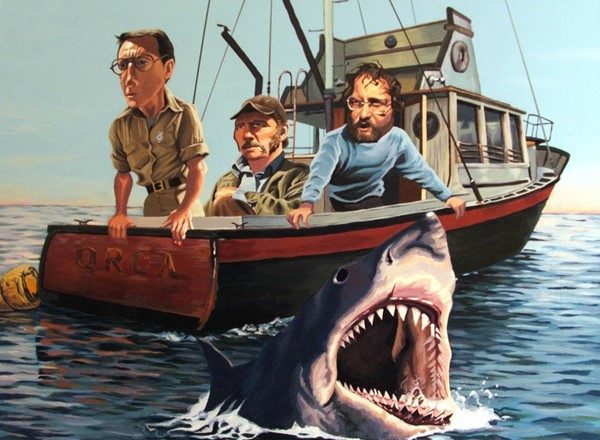
When we left the theater after Brigadoon we immediately got a new cue card and got in line to get back into the Egyptian for the most important film of our at TCM. This year is the 50th anniversary of the greatest film of the second half of the 20th century. Jaws is influential, groundbreaking, and once again in my opinion the best film that Steven Spielberg has ever made.
I am not sure that there is another movie that I have seen in a theater as often as I have Jaws. It made me very nostalgic to be seeing it here at TCM in the Egyptian Theater, since at least a half dozen of my earlier screenings also took place at this iconic venue. Anybody reading this can find more than a dozen posts about the movie Jaws on this blog site. I’m not going to recap the story or the significance of the movie on this day. Instead, main thing I want to talk about is the guest Lorraine Gary, who played Ellen Brody in the film.
She was married to Sid Steinberg, who at the time was the chief at Universal Studios and Steven Spielberg’s mentor. This is the part that she will be remembered for, all of her other roles were primarily supporting TV characters. Frankly she’s terrific in the movie, although she disappears from the film entirely in the third Act. Advanced age of 88 she had No Reservations about being honest concerning her co-workers. She was dismissive of Richard Dreyfuss, without giving any details of why she didn’t care for him. She also expressed the opinion that Roy Scheider was it somewhat mean co-star, and she didn’t have any warm memories of working with him. She did however confess to having a crush on Robert Shaw, which I find completely Charming and ironic given their parts in the film.
The print of the film that was screened for us came from the British Film Institute, and had been preserved since a 1981 presentation on the BBC. The color dyes in this print are probably as close to the original version of the film from 1975, as we are likely to ever see. The film looked magnificent. It was surprising when Ben Mankowitz ask for a show of hands of people who had never seen the movie, that there were dozens of hands in the air. Listening to the audience during the film I had no trouble believing that those people were being honest, because you could hear the intake of breath, the shots of surprise, and the Applause of delight for all those little things that make Jaws the quintessential Blockbuster in one of my favorite films.
Blade Runner
We repeated the process at the end of this film walking out of the theater getting in line immediately to get a new cue card to go back in and see our final film for the evening. Although it was not a financial success in 1982 when it was first released, Blade Runner has been a critical success and a cult favorite for more than 40 years.
One of the first Criterion Collection laserdiscs that I purchased was Blade Runner, back in the 1990s. That version does not include the director’s cut in the Final Cut, but there is discussion of some of the things that would later be included in revised editions of the film. The version we saw appears to have been the Final Cut, so there is no narration in the ending is slightly different, although to be honest we only stayed through the first hour of the film. As I’ve already mentioned we were staying at the house in Glendora so we had a 45 minute ride home, if we stayed for the whole film we would not have been in bed until 1: 30, and we needed to get up at 5: 30 to make Sunday.
The special guests for this film was the female co-star Sean Young, who was only 19 when the film was made and who was making her debut as a film actress with this movie. Miss Young has always been known as an outspoken and opinionated actress and nothing has changed even if she is aged the way I have. She spoke about working with Harrison Ford, the rigors of the makeup chair, and generally working in Hollywood. Her talk was not limited to Blade Runner though, as she made brief comments about several films and actors that she had worked with. She seemed fond of the late Gene Hackman when she worked with in no way out, but never seem to get very close to Kevin Costner who was her leading man. She did say that Blade Runner was the favorite film that she made, but the bigger reaction from the audience was to her second favorite film which was Ace Ventura.
Watching Blade Runner at home on Blu-ray, streaming, or even my beloved LaserDisc, cannot do it justice. Seeing it on the big screen and listening to the score and the sound design of the film in the theater like the Egyptian is one of those things that everybody should experience. We only stayed through the scene where James Hong meets his demise, but I can tell you everything up to that point looked and sounded spectacular on the big screen.
At one time it had been my hope to make a couple of the midnight movies, and “Wild at Heart” would have been another film at the Egyptian had we not been so tired. So we ended our day with the fun talk from Sean Young and the brilliant vision of Ridley Scott.
For me personally I’m not sure the Day Two of the film festival could have started off any better. The first movie we were scheduled to see was a James Bond film, celebrating it’s 60th anniversary. It’s hard to believe that the James Bond films are almost as old as I am. I’ve been a lifelong fan of 007 and is a child of the 60s it’s easy for me to be nostalgic for one of the most significant cultural films of that decade. “Thunderball’ was a commercial earthquake that signaled the significance of action films, spy films, and general popular culture.
The 4th of the 007 films, “Thunderball” did everything bigger and more spectacularly than any film up to that time. The history of the film’s origin is well known, Fleming developed the original story with a couple of other writers for a TV series that never went anywhere. Authorship claims were resolved by agreeing to allow one of the claimants a producer credit on this film. Regardless of what happened behind the scenes what happens on the screen is over the top, beginning with the use of a jetpack to escape from the bad guys in the pre-title sequence. The slogan for the film was “He3re Comes the Biggest Bond of All.”.
Maybe the most thrilling moment I felt at the whole festival was when the titles for “Thunderball” came up and we got those great Maurice Binder titles with Tom Jones belting out the song on the big screen. This is a restoration of the film, and frankly I thought it looked great before. This is the movie where all of the tropes from Austin Powers originated. There are sharks however, they don’t have any lasers on them. The spectacular underwater battle that takes place at the climax of the film still could use a little trimming, but it didn’t seem nearly as long to me today as it has in the past. Probably because I’m watching it on the big screen.
The guest for this morning’s presentation was actress Luciana Paluzzi, who played the SPECTRE assassin Fiona Volpe. She was 27 when the film was made which makes her 87 today. She still looks terrific and she was sharp as a tack with a great sense of humor. She talked about her long friendship with director Terrence Young, who made three of the first four James Bond films. In fact director Young gave her away at her wedding to her husband to whom she is still married. It was fun to listen to her share stories of being on the set with Sean Connery, and shooting the various scenes that she was in. I’m glad we got this opportunity well we still have some surviving members of the cast to talk about the film. Thank you TCM.
Because of the length of the film, and the fact that the talk took place after the movie, we were too late to queue up for either the films that we were planning on filling in the rest of our morning with. So we missed babe and The Time Machine. We did take a little break over in the lobby of the Roosevelt Hotel, before making our way back to the big house for “The Fabulous Baker Boys”.
The Fabulous Baker Boys
Michelle Pfeiffer was the guest for this presentation, and moments before the movie and the discussion she had participated in the traditional handprint and footprint in concrete in front of Grauman’s Chinese Theater. I hadn’t seen this film since it came out in 1989, but I remember being impressed with it and thinking it deserved some of the accolades that it received. Most especially Miss Pfeiffer’s performance being nominated by the Academy. I do remember it was a bit of a surprise that she didn’t win.
The story is a small one, focusing on the relationship between two brothers who have a piano lounge act that is moderately successful. The older brother played by actor Beau Bridges, is engaged and cheerful during their performances, and he takes the lead in trying to keep their act financially lucrative. The younger brother is played by Jeff Bridges, his real life brother, a piece of terrific casting. Jeff Bridges character is the more talented musician, who is resentful of his occupation and the playlist which the brothers usually perform. When they run into trouble keeping the act booked, they decide to hire a girl singer to join the show, enter Michelle Pfeiffer who plays Susie Diamond, an escort with a nice voice, who wants to make the transition legitimate performances.
There are basically two love stories in the film, the one between the brothers which is strained by sibling rivalry, and different views of what they ought to be doing. And of course the younger brother who is always been a philanderer begins a romantic relationship with Susie, which we can see is not going to end well for either of them. Susie Diamond is a hard case, but her heart is not as buried in concrete as is the younger Baker brother. All three leads are excellent, and they make the drama of the film feel quite real.
It is not a news flash to anyone, but Michelle Pfeiffer is a stunningly beautiful woman. She is the same age I am and clearly looks a hell of a lot better than I do. She was friendly and Charming, and she tried to answer the questions what’s that Ben Mankiewicz tossed at her. Sometimes the questions were a little awkward, and her answers would end up being more ambiguous than you might expect, but she was doing her best. This was also the first time I’ve noticed in the decade that I’ve been attending the festival, that the Stars security team was present on the sides of the platform where the guests in the host were seated. I’m sure security has been there for many presentations, but miss Pfeiffer security team had one individual standing on each side of the platform. That was a little surprising but completely understandable.
Misery
Our third film of the day, was also at the TCL IMAX theater, generally known as Grauman’s Chinese, and talk about a contrast in the way the actors are portrayed in the two movies, Michelle Pfeiffer is luminous beauty is now contrasted to the harsh persona and visage of Kathy Bates in “Misery”.
“Misery” is a Stephen King story translated to the screen by Rob Reiner, who did the same thing for another king story in the film “Stand By Me”. This is a drama that is actually a horror movie, and when you see how it plays out I don’t think there’s any doubt that it is a Fright Fest.
Kathy Bates won the Academy Award in 1990 as the character Annie Wilkes, a deranged fan of the romance novels that feature a character named misery. Author of those books from a car accident in the blizzard, and cares for him in her home. But of course talking about going from the frying pan Into the Fire, the danger to the author seems to get greater and greater the longer he stays in her care. For the most part the film features two actors, the aforementioned Kathy Bates, but also the great James Caan, who plays the injured author. It takes nothing away from Kathy Bates performance to point out that Caan is terrific in the more physical performance. His character does not have the emotional range that Bates did, but he has to do a lot more torturous crawling, climbing, and sweating. The two of them together were really good.
I’ll briefly mention the late Richard Farnsworth also, who plays the local sheriff, trying to figure out what happened to the missing author. Farnsworth was always a welcome presence in movies, and when I mentioned to my daughter that he was in a G-rated film from David Lynch she practically fell out of her chair.
The screening emphasizes for me once again how important the theatrical experience is. The theater full of people responded to the events taking place on screen with screams, laughs, and nervous tittering at times. You could hear that the audience was reacting to the movie exactly how the storytellers had intended. And it must have been very gratifying to the two guests to hear the way the audience responded to their work.
The guests for this film were the director Rob Reiner and the lead actress herself Kathy Bates. They talked about the process of rehearsing the picture, and they noted that James Caan had a different style of acting then Bates did. Rainer talked about how he had tried to manage their different styles in the film and use that as a way to reflect the characters that the two were playing. There were a few tidbits of information that came out about the screenplay that I thought were particularly interesting. It was written by the great William Goldman, the Reiner added several pieces to the film as they went along, including the dinner sequence which includes a great suspense sequence, and a twist that had the audience moaning with frustration.
The American President
Our fourth feature of the day, was also playing in the main house, so after leaving the theater, queuing up to wait for the next screening, we return to exactly the same position we were in for the previous two films to watch “The American President”. This is a film that was a precursor to the television series The West Wing, one of our favorites. The film was written by Aaron Sorkin, and once again it was directed by Rob Reiner. Frankly Reiner had a run from 1985 to 1995 that is pretty amazing in terms of quality. He made the following films: “The Sure Thing”, “Stand By Me”, “The Princess Bride”, “A Few Good Men”, and “The American President”. That’s a murderer’s row of great films from that decade.
We’ve seen the film dozens of times, it has been a go-to in the house ever since it came out. The story of widowed president who attempts to start dating again while a resident in the White House. There are of course a lot of political machinations, and the hysteria over guns and climate change is exactly the same 30 years ago as it is today. Regardless of whether those issues matter, the story is really about how personalities influence the political process. Everybody is faced with some ethical dilemmas in the story, but of course the good guys get the best speeches, thanks to Aaron Sorkin.
Screenwriter Sorkin and director Reiner where the guests for the presentation, and they talked about the Genesis of the film, and the way it transformed itself to some degree. Originally scheduled to Star Robert Redford, and be merely about the romance and comedy of a president trying to date, the film turned into something a little more weighty and probably better balanced when Sorkin and Reiner decided to inject some political elements to the film. Redford wasn’t interested in doing a political film, he’d already done that. So enter Michael Douglas and the rest is as they say history.
Ambitiously we had hoped to see Rocky Horror at a midnight screening, but are better judgment sent us home after this film and we didn’t attempt to do the time warp late into the evening. I would have enjoyed seeing Barry Bostwick is the guest, but after hearing that the screening went off half an hour late I was very grateful that we made the decision to stop at four films for the day.
During the break we went over to the TCM Lounge and found this on display.
For a period of time in the 1970s, film directors were given free reign to create some of the most personal and well acted films to ever come out of Hollywood. In an era that was filled with personalities like Martin Scorsese, Francis Ford Coppola, and the young Steven Spielberg, maybe the director who got a foothold on the zeitgeist of the era the best, was Peter bogdanovich. Has a director he had a string of successes from 1971 to 1975 that are incredibly impressive. The first of those truly great films is this 1971 requiem for bygone era.
The Last Picture Show is known for the huge cast of future stars that made appearances in the film. Jeff Bridges, Timothy Bottoms, Randy Quaid, Cybil Shepherd, Eileen Brennan, and Ellen Burstyn are all getting ready to have huge careers in the next two decades. The film also gives parts to older veterans Cinema, or give it a chance with the Fantastic script to write a little silver in the sky and help us remember what film dialogue is all about. Cloris Leachman and Ben Johnson want Academy Awards for supporting actor and actress, and they did it on the strength of a script that treated them like real people, who deserve dignity even in the most undignified circumstances.
I’m not sure I can think of a film that has sadness more clearly as its theme Than The Last Picture Show. The social relations between the members of the senior class, or sometimes harsh and thoughtless, and at other times heartbreaking. Cybil Shepard plays Jacy, the headstrong popular girl, who uses sex to gain status and learns that she is simply repeating the mistakes of the past. In the wake of her Reckless Behavior she leaves two best friends who become estranged, one because he is a rejected lover, and the other because he rejected his one opportunity of love in this small town.
Everything in this movie screams of being depressing. The diner is shabby and the waitress who works there, although wise and surprisingly friendly, is also beat down by her existence. The pool hall is the social center of the town, and it is a dust filled ramshackle Hangout for men too old to do much and for boys too young to be doing anything. Ben Johnson plays the older man with enough gravitas to actually earn the respect of the youngsters. Although life is dealt him a pretty crappy hand he is not embittered by his fate, simply nostalgic for the good things that have long passed him by. Sam the lion is a character that we can all admire and he gets a sequence where he narrates part of his life in such an eloquent way that Johnson brings him to life and earns the accolades that were heaped upon him that year. And of course there’s not a happy ending when it comes to Sam.
Ruth Popper is a woman who is aware that the best parts of her life are long in the past, and for whom every day is a struggle against depression and potential Health catastrophes. When she becomes the unlikely lover of one of the two young men who are close friends, it feels dangerous, absurd, and also the most hopeful thing in the movie. And of course it also doesn’t end well either. Cloris Leachman, clenches her hands, walks with the faltering step, and dry cries through many of her scenes. Her performance is one of physicality, where she conveys a world weariness Beyond her years, and a rejuvenation it is unexpected when she discovers what she thinks is a new love. The conclusion of this film includes the death of a much younger character, and it turns out that that is not the saddest thing in the story. The way in which this will Lonely woman, is mistreated and embittered his heart-wrenching. What is also sad is that even after standing up for herself, she has enough Humanity to offer a drop of console, despite it not being earned.
The town is full of people who will never leave and as a result will likely bleed on Happy lives, or their people who are anxious to get out, but afraid to because they know they’ll never be able to come back to things the way they were. The closing of the movie theater in a small town like this maybe the saddest symbol of filmgoer like me is likely to see. The black and white photography in this film makes everything feel dusty and forlorn, but it also makes the people look either incredibly beautiful or sadly unpleasant. I guess that’s the way the world is, or more precisely… Was.
Ash is a somewhat dystopian science fiction film set on another world that the human race is hoping to be able to terraform and relocate to. We get told all of that information about a quarter of the way into the story after the mystery of the horror has already begun. The way the Story begins is simple a young woman wakes up from a deep sleep and discovers that the ecosystem that she lives in is filled with dead bodies and signs of violence that she has basically no memory of.
The film is a hybrid version of Solaris, alien, and the thing. Ultimately there are about seven actors in the film but for 90% of the movie they’re only two that take up screen time. The woman named Reva, as flashbacks to some of the events, and begins to suspect that what happened might be her fault. File into her ruminations, another character shows up played by actor Aaron Paul, who clearly knows Reva, but was not at the station when whatever disaster befell it took place.
At First the movie looks fairly low budget. The sets are not much more complicated than a series of rooms that have been dolled up with some light fixtures and a few props to suggest something more futuristic. And the film is clearly something that was done on a budget. In the second half of the film though a few special effects show up that suggests that they were saving their money for a little bit more production value. A couple of models and some CGI add a little credibility to the situation. We also get a few special effects makeup sequences that are pretty good.
The main problem with the film like this is that we are dealing with an unreliable narrator, and we all know why she’s unreliable. Also, nearly everything that we see at one point become suspect, and we wonder if we are looking at something that really happened or if it is just a projection of her consciousness. In the end it does turn out to be something of a monster movie, but it’s trying to do it in a way that is different and a little bit more cerebral. I think the ambitions outstrip the ability of the script to deliver this kind of story. The movie isn’t bad, but it isn’t very compelling either and by the time we get to the end it’s easy to feel detached from what’s going on. There is also attacked on conclusion that makes no sense but his design to create a sense of irony at the end of the story.
The director of the film is also responsible for the music, I get the impression that he is a music personality who is dabbling in the film world. It’s not that he’s on talented, but he’s not experienced enough to make this film more interesting than something to be consumed and almost immediately forgotten, in spite of the film’s ambitions. I suspect that this movie was largely made for streaming purposes, and it received a token release either because of the actors involved or to placate the director. Either way it turned out, it was a reasonable Monday evening, but again I’m not going to remember this very long.


 Kirkham A Movie A Day