The Bride! (2026)

I saw this movie in a Thursday Early screening, and I knew there was trouble by the sparsity of the crowd. In spite of coming from an accomplished actress as director with an award nominated film in her directing resume, there was plenty to doubt. This was obviously going to be a punk rock version of the Bride of Frankenstein, but it is hard to tell who would be the audience. We were there as fans of actress Jessie Buckley, who should be grateful this movie opened after the Academy Award voting this year had closed. She was terrific in “Hamnet” but over the top and more anonymous than expected in this. 

From the start of the film, when the ghost of Mary Shelly, reaches out for an insane story follow up to her famous novel, you get chaos. Somehow her spirit possesses a mob good time girl, and then that woman is murdered and her body rejuvenated by a mad doctor, prompted to do so by the creature that Mary Shelly invented. Yeah, it’s that kind of batshit crazy and it gets more convoluted as well. There is a side story that involves the mobster who is responsible for the crime in Chicago in the 1930s, and he is not named Al Capone , but rather has the last name of Lupino, who is pursued by the dead woman reborn who it turns out was named Ida. Film fans will recognize this combination of names as the identity of actress and proto-feminist director Ida Lupino, the most well known woman director of films in the 40s and 50s in Hollywood. That barely scratches the surface of the movie references that the film piles on.

“Frank”, the so named creature (maybe a lazy choice, maybe deliberately stupid), is a fan of Ronnie Reed, a singing and dancing movie star clearly inspired by Fred Astaire. Somehow, the Frankenstein Monster and his Bride, end up in a road picture, like a less romantic Gable and Colbert, more like Bonnie and Clyde or Mickey and Mallory. Death and Michael Jackson dance moves follow. Then we throw in a pursuing detective and his secretary, the real brains of the pair, and you have a chase movie. Scene to scene we watch the pursuers and the pursued, hop skip and jump through towns connected by the movies of Ronnie reed, for no particular reason. At one point a cult of women decide to emulate the Bride as if she were a modern YouTube influencer, advocating death and weird makeup tips. Pay close attention to when this happens because although it gets a whole 30 seconds of screen time, it will be a big part of the resolution of the film. 

OK, so this is all supposed to be absurdist art we are absorbing for two plus hours, but only the occasional image suggests anything artistic, the rest of it is gibberish. Christian Bale and Jessie Buckley, overact the vast majority of the time, diminishing the moments in the film when you might have had some interest in their characters. Peter Sarsgaard and Penelope Cruz as the pursuers are moistly wasted with motives that are fuzzy and story arcs that make no sense. When the credits at the end of the movie start with The Monster Mash as the closing song, it is clear that this was one long cartoon. Randomly sticking incomplete feminist ideas into a Pepe LePew short, makes no sense an swallows up any purpose the movie might have.

I can say that I enjoyed watching the film in several sequences, but that this is clearly not a good movie and it’s existence is a puzzle. Who thought the script was worth the effort, much less the money that it took. Maggie Gyllenhaal got too far out over her skis and the result is a mildly interesting mess that will be lucky to get midnight screenings at art house theaters but not ant acclaim. This is “The Room” for horror film fans, and that may sound inviting, I suspect most of you will not feel so if you spent the night with it.  

Send Help (2026)

Director Sam Rami has been a favorite of mine since the Evil Dead movies of the late ’80s. In fact I recently wrote about two of his films that I saw in theaters this year, “Darkman” and “The Quick and the Dead”. It’s been a while since he’s had a film out that was clearly something that he was built for. He did the best he could to mold “Doctor Strange and the Multiverse of Madness” into a Sam Rami film, but it still had to be a Marvel product.

With “Send Help”, he returns to the horror genre at least peripherally. While not a straight horror film, “Send Help” does have several horror elements to it, and a couple of good jump scares, one of which is clearly horror motivated. It is the scenario set up by the story that makes this more of an adventure drama, but the way Rami directs it, you will feel tension and revulsion as if you were watching a horror film.

One of the things that is unique about this movie, is that it will make us feel sympathetic to someone who commits some atrocious acts. Rachel McAdams stars as the put-upon data analyst and accounting specialist, Linda Liddle,  who is passed over for a promotion by someone who is younger, less experienced and of a different gender. This is done largely because the new head of the firm, the son of the firm’s founder, is buddies with the guy and it’s an old school approach to business.

After having been demeaned and ridiculed by her coworkers and boss, Linda gains the upper hand when their private jet crashes and she and her boss are stranded on an island, with a little chance of rescue. What follows is a series of events where the two characters fight, bond, fight some more, and deal with ambiguous relational issues. You never however get the feeling that all is going to be right. The boss, Bradley, played by Dylan O’Brien, continues to be a person whose lack of power drives him to do things to gain the upper hand. McAdams on the other hand, relishes her situation so much that she ignores some potential opportunities to escape the situation. It may be a trope in these revenge horror type films, that we sympathize with a dangerous character. I remember seeing Willard back in 1971, and knowing that even though he was a little deranged and murderous, I wanted him to get the best of his tormentors.

Surprisingly there are times when we can sympathize with the boss as well. Every time however, that he seems to be more human and someone who can work with his employee, he slips back into the habit of trying to one up his partner in the situation. Sam Rami lights us up with dangerous situations, sudden animal attacks, and a variety of injuries and poisons that make life on this island feel very tentative and risky.

As usual there are a couple of twists in the story, and when the final ones are revealed I think you will discover that the film is a very satisfying two hours of entertainment. That is if you enjoy Sam Rami’s camera style and dark sense of humor. In case you haven’t guessed I do.

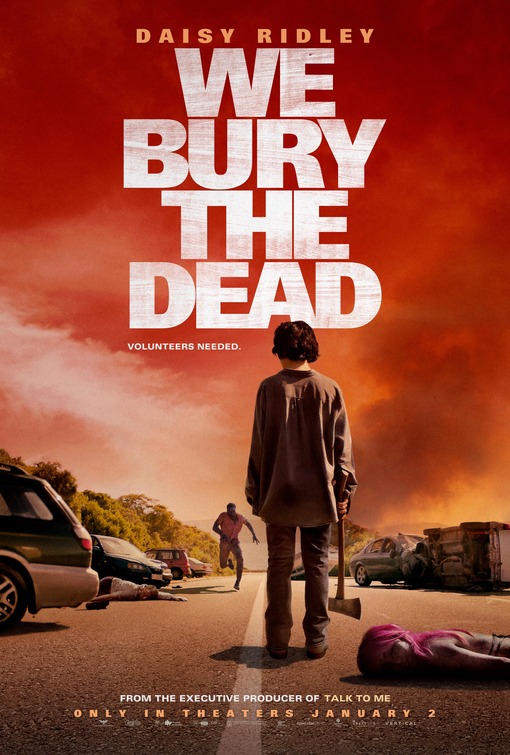
We Bury the Dead (2025)

An interesting little drama disguised as a horror film, “We Bury the Dead” stars Daisy Ridley as a woman who may in fact be a widow but it’s not sure yet. The fact that she is an American becomes an issue because of the potential threat her husband faced. It seems that the United States was testing an electronic weapon in the southern seas when an accident occurred and the entire population in part of Australia was wiped out. Although it may be that they were not wiped out entirely, because this is something of a zombie film.

As a way to get to the distant location where her husband was located deep in the disaster area, Ava volunteers to be part of the National Emergency Recovery team, which basically consists of volunteers to collect the dead and identify those who have been damaged into a zombified state. As she engages in this volunteer work, she is also plotting a way to get the few hundred miles south to the resort island where her husband is supposed to be.

In a way all zombie films are meditations on grief, and our unwillingness to let go of our loved ones even in the worst of circumstances. There are other characters in this story, who are volunteering for their own personal reasons as well, and Ava forms an alliance with one of them to make her way South with his assistance. So, it is also going to be a road trip movie. Although we know that there are living dead in the affected region, this rarely becomes the traditional kind of horror film that features zombies. It is really only one jump scare that makes this a horror film, as usual, the real monsters in these stories are the living who take advantage of the circumstances.

The story is told with a series of flashbacks to the time before she and her husband were separated by this trip. We learn over several of these mediations that while they were in love, they did have problems. So this is also a film about the discovery in your love relationship. There are complications on the road, and a sense of foreboding haunts us through most of the movie, but there are only two or three moments of real tension. Those moments however were staged very effectively. Ava is viewed suspiciously a few times during the film because of her nationality, but politics is not really on the minds of the filmmakers, they are worried about our emotional psyche.

I thought the film was pretty efficient at telling its story and keeping it interesting. Those people looking for a zombie film that is filled with double taps, infected bites, and standoffs against hundreds of the Living Dead, will be disappointed. There are a couple of interesting turns during the film, one of which has already been explored in last year’s “28 Years Later”,.so this film is second to that theme. There is also an interesting reveal about the personal problems between Ava star and her husband, which comes at the start of the third act.

This must have been a moderately budgeted film, but the director is getting the most out of the resources that they were given. And even though it is a zombie infested Wasteland, the Tasmanian locations are still going to be an inviting tourist spot for those who take in the film. Ridley is solid, operating in a zone between the stupor of grief and the mania of trying to get to her husband. There are two other major characters, and they provide opposite ends of a story continuum, in an outcome that is more hopeful that is realistic.

Frankenstein (2025)

The vast majority of people who will be watching Guillermo del Toro’s “Frankenstein” on Netflix, which is the company that produced the film. They will certainly enjoy the film and there is a lot to admire about the movie. I had the pleasure of seeing the film in the environment that it should be experienced in, a movie theater. Netflix was wise enough to play the film for cinema goers for a couple of weeks before reverting back to being exclusively on their streaming service. 

I have a great deal of respect for del Toro, and in fact I have seen all of his theatrical films. We did a directors lookback on the LAMBcast a few years ago and I made the effort to see everything so we could cover it completely on the show.[Episode #502 October 25, 2019] Unfortunately, it is an episode lost from when we changed over the podcast storage. (Jay mat have it somewhere).

Regardless, I can say as a result of that episode that I know del Toro’s work pretty well, and I have opinions that are not always inline with others. “The Shape of Water” is not a film I feel fondly of, in spite of it being his Academy Award winner. It was sanctimonious without earning the righteousness, because the artificial construct of the society was so labored it did not feel real. “Frankenstein” on the other hand, regardless of the CGI environment that it inhabits, feels realistic the whole way thru. It starts with a terrific horror action sequence that sets up the bifurcated story that de Toro has in mind. Victor Frankenstein is examined from his childhood to adult mad scientist. We can see the seeds of his mania from the relationship he had with a doting mother and mercurial father.  The arrival of a younger brother that is unlike him in most ways, does not set up a rivalry, but rather a sibling connection that sometimes feels tender and at other times exploitive. 

The first part of the film gives us Victor’s story, including the information about discovering his scientific breakthroughs. We also get a good bit of the professional world that rejects him, even though his knowledge far outstrips their own. The animated corpse that he uses in his demonstration is one of the many visual frights/delights that the film offers. Oscar Isaac is solid as the frustrated scientist. His initial disappointment with the creation is a little hard to understand, except it is clear he has very little patience. Christoph Waltz shows up as the uncle of his brother’s fiancé, and he has the resources to help Victor, and a hidden agenda. As usual, he improves the movie with his presence. 

Most people are going to remember the creature as embodied by Jacob Elordi. His range covers the pathetic innocence at first awareness, and then the disappointment that comes from knowing that he is different. Finally, and most compellingly, there is the rage that drives him to seek vengeance on the creator who abandoned him. The turn of the creature from mindless brute to thoughtful avenging angel is well developed and usually ignored in most of the monster movies that the creature has been featured in. 

Mia Goth continues to be one of the great, underappreciated actresses of this era. She plays the fiancé of Victor’s brother, and becomes an attractive nuisance to Victor. It is clear that the two of them could easily fall into a relationship that would be damning to both of them, and it is her moral center, as contrasted to Victor’s nihilism, that forms the ethical spine of the story. She is both temptress and redeemer, but more for the creature than Victor. 

The movie is gorgeous on every level, even the things in the world of the time, that are ugly, are spectacular to look at. This handsome production makes elaborate use of CGI sets and backgrounds, but it comes closer to reality than most of the out of focus backgrounds we get in most CGI heavy films.  It looked particularly good on the big screen. The streaming service will be most peoples default viewing, and I can honestly say, you will regret that you didn’t get to see this in a theater. This is one of my favorite films this year. 

Halloween (1978) and The Fog (1980) Panic at the Paramount Presented by Robert Rodriguez

As hard as it is for me to believe, I do not have a post on the original John Carpenter Halloween from 1978. I have seen this movie almost every year for twenty years at least, and I guess I never had the chance to go back and see it on the big screen until now. It seems like there must have been a Fathom Event Screening, but I looked on the site here and found nothing. So thank you Paramount Theater for giving me this opportunity.

Although not the first “slasher” horror film, that title must belong to “Psycho”, John Carpenter’s Halloween defined the genre in the late 70s and for the last fifty years has been the template for all the subsequent slasher films around. Obviously, the title “Halloween” helps make this a perennial, something it most certainly not have achieved under the original title “The Babysitter Murders”. So much care was taken to set up the characters who are being stalked, it is different that almost all the subsequent films which make the victims into nearly nameless notches on the knife, axe, chainsaw of the killers in later films. The three main girls are introduced and each gets some moments to be a real teenager, before they become the target.  Laurie, Annie and Lynda are average girls, with love lives that vary from the raucous to the non-existent. In the end it is Laurie, the virginal Jamie Leigh Curtis who survives and is remembered, but Annie had a well developed suspense scene in the film that is just as effective as the climax moments, at drawing a scared response from the audience.

Donald Pleasance is a little crazed as Dr. Loomis, although from what he knows, it is perfectly understandable. His sense of urgency does carry the pacing of the film in some of the spots where the killer is not on screen or actively pursuing he girls. I was a little nonplussed at the reaction of some of the audience at the screening. They seemed unable to adjust their post modern sensibilities to the late seventies context. They have seen scream too many times to know that the reason that meta narrative exists at all is that the original films took place. I felt a little like Randy at the party, I know the rules and why they existed in 1978, but no one else seemed to care. They did still appreciate the film, but I could not understand why they laughed at some of the moments in the film that are frightening or serious. 

Anyway, I found the movie to be continuously compelling, and well shot, utilizing locations in Southern California that I grew up in as Haddonfield, Illinois. Michael Myers becomes an iconic masked killer and there is a long line of slashers that followed in his wake. 

Director Robert Rodriguez was presenting the film with a surprise second feature, which was only revealed at the screening. It turned out he was planning a Carpenter double feature, by including Carpenter’s next Theatrical Feature “The Fog”   

I saw “The Fog” in it’s original release and I have always liked the movie. It is a ghost story, told as a ghost tory with malevolent forces returning to wreak vengeance on the descendants of those who wronged them.

I like the fact that not everyone who gets murdered by the ghosts, deserves their fate. After all, furious spirits from beyond the grave are not always reasonable. This film puts Jamie Leigh Curtis in the story, but she is not really the star. If there is a featured performer it is the then wife of the director, Adrienne Barbeau. She plays the evening DJ at the local radio station and her studio is at a high point in the seaside community, so she can see the dangerous fog coming off the ocean, and she directs people to flee when it is clear that the fog contains the ghosts that have returned for their justice. 

Jamie Leigh’s Mom, Janet Leigh, is also in the picture, a nice bit of stunt casting but not one that was essential. Carpenter made running from the weather much more thrilling than Shyamalan did in “The Happening”. It is a lot scarier to have the fog manifest as dead sailors bent on killing, than leaves blowing in the wind.

I can’s say it all makes sense, but I like the fact that Tom Atkins gets played as a sex symbol and John Houseman tells a scary story to kids on the beach. All in all it was a ton of fun.

An American Werewolf in London (1981) Panic at the Paramount

The “Panic! at the Paramount” series this year has featured several special presentations that required an additional admission fee past our membership subscription. That has been perfectly reasonable given the quality of the programming. This presentation of the John Landis classic, featured a Q and A after the movie with the film’s star David Naughton, who turned out to be quite the raconteur.  He told us a number of funny stories about the production and working with the special effects make-up of Rick Baker

This is another of the great 1980s horror films that initiated the practice of mixing humor in with the frights. Landis was the right guy to do this having a great background in comedy, having made both “Animal House” and “the Blues Brothers”. This film came out the summer I was working as a delivery driver for a photo supply company in Los Angeles.  One of the places I delivered to, printed movie posters, and I just could not manage to snag one for this movie from the stacks of them I had to walk by when making a delivery to the printing company. 

Jack and David are two college students, traveling through Europe on a summer excursion. They end up in a remote part of England, walking through a rural area, that is populated by a community living with a secret that casts fear over them. They are not particularly friendly natives and the boys are sent packing into the dark with a warning to stick to the road and stay off the moors. The humor had already started with the kibbitzing between the two young men, but it get more intensely humorous when they realize they have wandered off the road and they hear a howling animal near them. The tone shifts suddenly, and a horrifying bloody attack ensues. That is the pattern for the rest of the movie. A moment of levity is suddenly dashed by some horror, or a moment of terror becomes a joke in the hands of the actors and director. 

Rick Baker famously won the first Academy Award for the new make-up category, for the combination of prosthetics, puppetry and hair and make-up moments. The scene where David’s hand extends as it becomes a paw was shot one time. Landis called cut and print and was ready to go to the next shot, but Baker had spent months getting the effect ready and was not prepared to be done so quickly. As Naughton told it, Landis looked at Baker and asked, “Does it do something else” and the flummoxed make up master had to say no, and Landis simply said, “Let’s move on then.”

The use of pop tunes that evoked the moon was another early innovation. Tons of movies use “needle drops” these days, but in 1981, most films relied on original music for their cues. I can’t say that “America Werewolf in London” was the first to use them, but it is the earliest film I can remember that used previous record hits for the distinct purpose of highlighting a scene in the movie. Other films may have used popular songs as background, but this movie was using them as punchlines and energy points.

It might be fair to classify the movie as a romance as well as a horror-comedy. The lovely Jenny Agutter plays the nurse who takes a special interest in David after he is discharged from the hospital. Their love affair is a touching counter-point to the horror story that David is living through. His friend Jack makes frequent appearances in the film, after his character has died, and there are great visual jokes that go along with some gruesome imagery. This is another example of how gallows humor is injected into the story.

I have heard it said that the 1980s were the golden age of horror films. I think that may be a little bit of an exaggeration, but having experienced “Re-Animator”, Fright Night”, “The Fog” and this movie, all in the last month, I might be convinced. 

Fright Night (1985) Re-Visit

Celebrating the 40th Anniversary of it’s release, is one of my favorite horror films from the 1980s, “Fright Night”. This suburban take on vampire lore has all the elements that made the 80s horror films so much fun. There is nudity, blood, great practical effects, and a sense of humor that fit the times so well. It also has a couple of iconic performances from veteran actors, who are utilized perfectly in this film. This is one of the great ones for you horror fans, so sit back and read while I gush about how great this movie is. 

Charlie Brewster is a high school kid, navigating his hormones, struggling with his grades and hung up on a lot of the geeky things that any horror movie fan might care for. He lives with his mother in a nice suburb in an older two story house. His bedroom happens to face the vacant house next door, and as you can imagine, he starts noticing things there that are disturbing. Like a lot of kids in the 70s and 80s, he is a fan of a late night movie show that features horror films, many of them from the 1950s. This fact plays a part because his girlfriend thinks that he is conflating what he sees on the TV with what is happening next door, the arrival of a vampire.

The mundane neighborhood feels like the perfect place for a vampire to hang out, and this vampire is the exquisitely disguised Jerry Dandridge. He looks like a night club lothario, speaks as if he is a cultured antiques dealer and he has an interesting cover that explains some of his activities. Well before it became a cable TV phenomena, Jerry and his familiar Billy Cole, flip houses. So there is always material coming in and out, and the windows might be covered for lighting reasons. They do however fail to cover the upstairs bedroom windows, and that is where Charlie witnesses one of Jerry’s meals being consumed. 

How does a normal kid, convince anyone to listen to him when he cries vampire. The murders in the town point to Jerry from Charlie’s perspective, and when he goes to the police and tries to get them involved, suddenly Jerry is as aware of Charlie as Charlie is aware of him. The battle of wills and the vampire strategies make up the bulk of the plot, aided by two terrific secondary characters. Charlie has a oddball friend, nicknamed “Evil Ed” who provides Charlie with advice about resisting a vampire. Ed is played by Stephen Geoffreys, who was born to play a young Jack Nicolson, if ever they needed an actor for a flashback sequence. His gleeful laugh and haughty distain for Charlie’s story make the plot more interesting.

The character of horror nerd Ed is not the only source of assistance that Charlie seeks out, and this is where the best element in the film comes in to play. Charlie contacts Peter Vincent, the washed up horror movie actor, who hosts the local “Fright Night” movie show. Vincent is played by the late Roddy McDowall. McDowall had more than 250 acting credits to his name, including the Academy Award winning “How Green Was My Valley” and “Lassie Come Home” as well as four of the five original “Planet of the Apes” movies. This was the juiciest  part he ever had, a craven coward when faced with a real vampire, his fearless vampire hunter from the movies is exposed. McDowall hams up the actor part of the script, but also delivers some real pathos to the character. Peter is forced to become what he has only pretended to be in the past. Watching him grow a spine when faced with the consequences of his lack of faith, is one of the great moments of acting in the film. I will continue to insist that he should have been recognized with supporting actor awards for this movie, but of course horror films get overlooked all the time by prestige organizations.

Opposite Peter Vincent is our vampire, played by Chris Sarandon. A vampire named “Jerry” is just the kind of twist that is needed to make the genre fresh for the era. Sarandon follows the script impeccably, presenting Jerry as innocuous at times, and threatening in other moments. He has the slick confidence that a would be Don Juan would portray to the world, all the time he casually munches on an apple , he really is licking his lips with his piercing eyes. He moves casually up and down the stairs and laughs off the challenges of the humans trying to end him. He has tender scenes with both Amy and Ed, suggesting a deeper emotional core than just the need to feed. His performance is the equal of his counterpart, and one of the  most memorable vampires in movies you are likely to meet. 

Finally, I need to say something about the effects and make-up. This is a movie that was made at the height of practical effects, before CGI rendered real on camera props and make-up less important. When Jerry transforms into his vampire shape, it is repulsive and frightening. There is a jump scare moment with a transformed Evil Ed, that is heart wrenching in spite of the plot point he was engaged in. The transformation of Amy is one of the most startling horror images I can remember from that decade. All of those moments will make you long for the artists of that era, and resent the coders that have taken over their roles. I highly recommend this film to everyone. 

Good Boy (2025)

Here is another of the best films of the year, that I am getting to, way past the time I saw it. “Good Boy” is a horror film with a relatively brief running time, but it will deliver the suspense, shocks and dread that you crave with these kinds of movies, and it will give you a real hero to root for in 
Indy” the terrific star of the movie, and the title character. In case you still don’t know, “Indy” is a dog and the film story is told through his point of view. Dog lovers should be entranced with this film and relieved but a bit sad at the resolution. I don’t want to give any spoilers, but be assured, you will be ok as an animal lover when this is all done.

Our lead actor, is the pet of the director, and has not been trained as an actor. “Indy” is reacting to the elements of the story, but the actor Indy is sometimes just being a dog, who is being closely watched by his human companion, so that editing and normal dog behavior can be crafted into s scary story that features a dog. I am all for the praise that the dog is receiving for his performance, but the talk of an Academy Award nomination should probably belong to the editing team as much as our canine leading man. 

The movie is a haunted house type story, although there are moments of possession and human perfidity. Todd is the human featured in the film, but we barely see his face in any of the shots. At first I believed the character was a recovering drug addict, but as the movie goes on, it becomes apparent that Todd is suffering from cancer, and it is effecting his personality and behaviors. There is as a result some ambiguity as to whether some of the events are supernatural or merely the ramification of Todd’s declining health. Indy knows there is something wrong, and he is loyal to a fault. Any dog owner who has instantly regretted snapping at their dog in a moment of stress, knows how wonderful it is that our pets can forget a momentary detour from our usual path. 

Indy wants to do the right thing, but as a dog, he can’t understand some of the things he sees, and that we see through his eyes. There are moments of horror that reflect some violence, but the movie is really about the horror of losing touch with your humanity. There are a couple of good jump scares, and there really is a supernatural element to the movie, but while dread is the feeling that envelops the story, it is really just sadness that forms the climax.

The lack of dialogue and exposition will be challenging to some viewers, but anyone who has loved a dog will want to stay invested in Indy’s journey. The hair on the back of your neck will stand up a couple of times, and there may seem to be jeopardy to the dog, but in the end  this is the story of a good boy, who struggles in his animal brain, to make sense of the world he finds himself in with his human companion. This movie is a triumph and deserves the accolades it is receiving. 

Close Encounters of the Third Kind (1977) Paramount Screening

I basically quoted the above teaser trailer to a couple of guys sitting behind me at the recent screening of “Close Encounters of the Third Kind”. I overheard them asking each other, “What are the first and second encounters?” That I could remember the answer from way back in this 1977 trailer is a credit to my long term memory, now if only I could remember the three things I was going to pick up at the market, I’d be in much better shape.

This was a last minute commitment we made. Some other social engagement fell out, and we are Paramount Movie Pass holders, so this was available to us without an extra charge. It was a 70mm screening of  a newly struck print of the film, and the Austin audience was among the first to see this print. 

I wrote about the film after a screening eight years ago, and I will stand by my comments from that time here..   Every time I see this film, I am more impressed by what it accomplishes. The screening at the Paramount allowed me to be immersed in the sounds of the film very effectively. The opening musical note, sustained and then the jump to a loud retort was perfectly timed to the visual jump opening that the movie comes in with. The roar of the winds in Mexico as the survey team is arriving to discover the lost squadron of WWII planes is a terrific use of sound. The same can be said of the sequence in India, where the throngs of thousands are replicating the humming musical notes that came from the sky. The payoff of the thousands of hands simultaneously  pointing towards the heavens was perfect and another indicator of the brilliance of writer/director Steven Spielberg. That this is the film that followed his masterpiece “Jaws”, cements his place in the hierarchy of film giants. 

Of course If we are going to spend time talking about the sound of the film, we can’t ignore the score from the legendary John Williams. The five note motif is so deeply intertwined with the story of the film, that as I said before, Williams could easily have earned a screenwriting credit for the movie. The editing of the lights and the music in the final scene is one of those times where music can completely replace dialogue and you still understand what is going on. 

I discovered that I did not have a CE3K shirt to wear down to the presentation. So I substituted a shirt that has a secret connection to the film. Those of you who know, will appreciate the joke, and those of you who are confused need to watch both movies. So many cultural references depend on understanding the timing of the events, and this is one of those. The 007 movie came out two years after “Close Encounters”.

I have to admit that I get frustrated sometimes with young people who have no sense of film history. Amanda told me that when she mentioned that she was going to the screening, her co-workers had never heard of the movie. Yes it is forty-eight years old, but they all know “Star Wars” and have at least heard of “the Godfather”. I’m just amazed that this classic from director Steven Spielberg is not imprinted on our collective memory as deeply as I think it should be. I’m probably just a grumpy old guy, but when they discover this film for themselves, I will be seen as a prophet. 

The Long Walk (2025)

I am a little tempted to let the trailer speak for itself. The vast majority of what is great about this movie is contained in this set up and concept. Stephen King came up with the idea when he was 19, and the youth of the cast and the premise show how a young man’s mind can work when it gets a good idea. The close of the trailer “There’s no finish line” is pretty great at setting up the sense of dred a film like this calls for. But, in spite of the fact that it is a King story, and that there is an overall sense of doom, the movie is less a horror film than an existential mediation on friendship, with a lot of death thrown in.

Cooper Hoffman and David Jonsson are the leads. Hoffman, who was great in “Licorice Pizza”, plays the outgoing avuncular young man who signs up for this brutal contest, with a hidden agenda. While he is friendly with everyone, he does keep his deepest thoughts to himself. Jonsson, who was the best thing about “Alien Romulus”, is equally friendly, and more forthcoming about his motivations. As a much more surface level character at first, he reveals greater complexity the longer they are on the road. The friendship that grows between Ray and Peter is at the heart of the film. How much of our hidden selves are we willing to disclose to another human being, when they may very well be the last person we ever talk to? 

There is a whole cadre of other character types, some heroic, some nefarious but all with a sense of desperation on them that may be off putting to some audiences. The other thing that may be a problem is that the film is a nearly two hour walk and talk. Literally ninety percent of the film is watching the kids walk down a road. You may not want the episodes of brutality that accompany each contestants fate, but it is a welcome change in perspective when they arrive. 

Conversation, if it is interesting, can be a perfectly entertaining acceptable form of film making, although it is a rare audience that will be patient enough for a movie where people just talk. As these boys walk the long march of death, they argue, joke, bond, reminisce, and otherwise find ways of moving forward. The idea of sleepwalking is brushed by quickly, so there may be legitimate questions about how this long trek works. There are some times when it is clear that King is attempting some sort of allegory about totalitarian societies. These mostly go nowhere and the flashbacks to earlier events do not feel as organic as they might. 

Two performances that will draw your sympathy and deserve a bit of notice are from Ben Wang and Judy Greer. Wang plays Hank, one of the contestants. He is incredibly confident and cocky, but otherwise appealing enough to become part of the core group of walkers. His desperation near the end of his screen time is a thing that will provoke pain and pity. Greer plays Ray’s Mother, the only parent we get to see since she lives in the state where the walk is taking place. Her two brief scenes connect the audience to the reality of the contest, much more than the other crowds or spectators that the walk draws.

Be forewarned that one of the most gruesome scenes in the film, involves a bodily function that is not normally engaged in while walking. The vividness of the moment and it’s unpleasant outcome will turn your stomach more than the fascism theme that is presented by Mark Hamill as the Major, who oversees the event. The film is quite thoughtful, but it is not as deep and meaningful about the world it takes place in, rather it plows the field of friendship and sacrifice, which all of us can understand.