TCM BIg Screen Classic: The Treasure of the Sierra Madre

So it’s time again to celebrate an anniversary of a classic film. This week it is John Huston”s “Treasure of the Sierra Madre”, starring Humphrey Bogart, Tim Holt and the director’s father Walter Huston. It is a tale of desperation, paranoia, greed and ultimately madness. I’ve probably seen it a dozen times over the years but I don’t think I’ve seen it on the big screen since the seventies. It would most likely have been at a revival theater in those days, but it was presented in a digital format this evening at a local AMC as part of the ongoing programming from TCM and Fathom events.

If any of you are unfamiliar with the film, let me provide a very brief synopsis. Bogart is Fred C. Dobbs, an American down on his luck and trapped in Mexico without the funds to get anywhere. He and another American become partners with a third, much older American in a prospecting venture that takes them far into the wilderness. There the search for and discovery of gold tests their mettle and the limits of their morality. The film is a cautionary tale on the subject of greed, but even more so on the issue of trust and character.

Dobbs is never a particularly nice guy but he seems decent enough and he has some reasonable limitations and goals when we first meet him. Curtin, the character played by Holt is similar in circumstances but maybe just slightly less jaded, at least until both of them are betrayed by a man who gives them jobs but refuses to come up with the money he owes them. This plants the seeds of distrust in both of them, but Dobbs seems to be the most vulnerable to suspicion after that incident. The third member of their partnership is Howard, an American who has found and lost riches as a prospector all over the world. After a couple of lucky breaks, they manage to put together a grub stake and travel into the mountains of Mexico in search of gold.

Walter Huston won an Academy Award as Howard, the old prospector with a ton of wisdom concerning both mining and human nature. The difficulty of the project takes its toll on the two younger men, but they struggle along, managing to overcome brief periods of suspicion but building greater and greater pressure as the film goes along. Huston is a joy to watch in his performance. He is wizened and gleeful and disparaging from scene to scene. His performance is memorable, and even though he admits to having some of the same faults as the other two, he is the most sympathetic character in the story.

If there are two characters that define Bogart as a cinema figure, the first would be Rick Blaine from Casablanca, but a close second would be Fred C. Dobbs. Here is a clip from a Bugs Bunny cartoon that first introduced me to this character.

The opening section shows a beaten man, but one who still has a sense of morality about him. Bogart tightens his belt from hunger, licks his lips from thirst and keeps his eyes downcast from shame as he begs for assistance from fellow Americans. Still he is generous enough to share a cigarette with another man down on his luck and to pick up a bigger share of the grub stake when the project starts. We can see in his manner however that he is becoming more paranoid by the minute once fortune smiles down on them. All three have a moment of morality failing when they choose what to do about an interloper on the trail, but they are spared having to live with the consequences by luck. Holt has a moment of weakness when he considers the idea of allowing Dobbs to stay buried in a mine collapse, but ultimately pulls himself out of it. Bogart just can’t get out of those doubts. Two or three times he is shown how wrong he is to be suspicious but he never learns to get over those doubts and he succumbs to a failed moral choice. Huston’s was the stand out performance but Bogart is no slouch. I suspect that the nature of his character prevented as much praise as the performance probably deserved.

The music by Max Steiner is another outstanding feature of the film. And let’s not forget that the movie contains the frequently misquoted lines about badges.  The film is playing two more times in theaters this week. For some reason those screenings are on Tuesday instead of the usual Fathom/TCM Wednesday schedule. So all you old movie weirdos out there, put on your stinking badges, travel back 70 years, and enjoy a classic on the big screen.
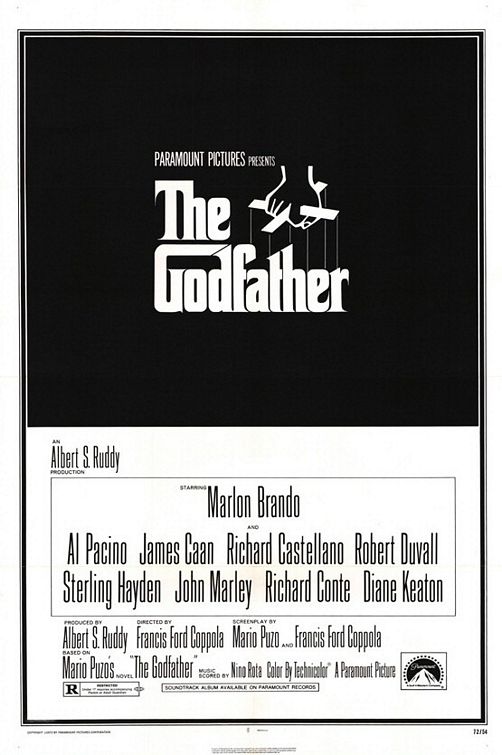
TCM/Fathom Events: 45th Anniversary of The Godfather

Sometimes you just have to sit in awe of what great film makers are able to achieve in the hot spot of their careers. For the ten years between 1969 and 1979, Francis Ford Coppola was the undisputed king of American Cinema. Four of his films were nominated for the Academy Award for Best Picture, two of them won the award, and a third film that he wrote also was named Best Picture. This evening I celebrated in 45 years of basking in his masterpiece, “The Godfather”. I surreptitiously read the book when I was fourteen years old. I know my parents would not have approved but it was something everybody was talking about so I took a paperback copy with me around the corner from our apartment building and sat on a curb, devouring it for several days. Sure I memorized the racy bits, I was 14, but I also could tell this was a tremendous story and it should make a heck of a film. I’m not sure how I managed to talk my Dad into taking me to see it, but I know we went that Spring, when the lines were long and saw it in the Alhambra Theater. I was maybe a little self conscious sitting next to my old man when the nude scene showed up, but the rest of the film was so powerful that such discomfort never detracted from the experience. That was 1972.


I’m sure I saw the film a couple more times in the following two years as I awaited the sequel, a concept that up to that point was largely the realm of genre films.  One of the first dates I had with my future bride involved dragging her to a double feature of the two Godfather films, one where it turned out they decided to skip an intermission between movies. So my girlfriend and I sat there for six and a half hours straight, and she still married me a few years later. The film was one of the first acquisitions I made when VHS tapes came along. Before the price points dropped in the mid-80s to create a sell through market, most films were only available for $70 or $80 bucks, and this was more than thirty years ago. I pulled that trigger as soon at I could. It was a substantial commitment for a young married couple, and I was trying to get by on part time teaching. That’s how important as a piece of art and culture it was and is to me.

I’ve seen it several more times over the years, on the big screen. The last time was two years ago when it was accompanied by a live orchestra performing the score for three hours as the film played for nearly six thousand people in what was at the time the Nokia Theater in Los Angeles. Tonight’s screening was nothing so fancy. It was a 4K projection at a Chain Complex on a Wednesday night. There were maybe twenty people there, but when it was all over several of us spoke to one another about what a wonderful experience it was. There was applause at the end of the movie, and the somber silence that always comes when that door gets closed on Kay’s face.

I tried to watch things that I did not always focus on in prior screenings. There are two exceptional moments when the camera slowly takes in what is happening in front of us and lets the anticipation occur without fanfare. The reveal of exactly what it is that Jack Woltz has in his bed is horrifying enough. We watch as he turns in his sleep ever so slightly, then the satin sheet gets pulled down from his face fairly slowly. He feels the dampness but hesitates just a moment, the right amount of time before he throws down the bedclothes past his waist, and then, there is the quick reveal of Khartoum and the lingering horrified cry of fear and anguish from the movie producer, which extends in a echo as the scene shifts to Don Corleone with just the slightest of smiles on his face. The whole scene is iconic but watch how the pacing builds it so well. The second spot I distinctly remembered is in the restaurant before Solozzo and Captain McClusky make their exits from the story. We know what the plan is, we can see tension on Michael’s broken face but we have to sit still as the waiter, brings a bottle of wine, shows it opens it with an old fashioned corkscrew that takes some time, and then pours a small amount into a glass that Solozo then extends to Michael. Waiting for the waiter to go through that whole ritual, without any dialogue, just the characters sitting there waiting themselves, it is something you don’t see in movies anymore.

There are a hundred other moments that deserve some attention, but that will have to wait for another time. Everyone reading this has almost certainly seen this film and if you haven’t what the hell is going on? Make an effort to share this experience with a group of strangers in a dark theater. Be prepared to try and catch your breath as it is stolen from you by the brutal poetry of this story and film. There is a reason that many consider it the greatest film ever, it is visual and emotional perfection.

North by Northwest TCM Fathom Events

With many film series, it is easy to say what your favorite is. Star Wars fans seem pretty passionate about “The Empire Strikes Back” and let’s face it, no one likes “Cars 2”. With directors, the same is not as obvious. When the film maker has such a unique style but also the talent to apply it to almost any genre, it gets to be more difficult. If asked, I would say my favorite Hitchcock films are “Vertigo“, “North By Northwest” and “Psycho“. As to which one I think is the best, well it depends on which one I saw last. Today, my favorite is the Cary Grant, Eva Marie Saint, James Mason thriller from 1959.


Since I am such a big fan of James Bond, it seems natural to love “North by Northwest” because it really feels like it set the groundwork for contemporary spy films.  There is an intricate plot, but most of the mystery is background for a series of sequences that are amazingly staged or performed. The actors get to play with their characters and make them something unique because the dialogue is so arch. 007 could easily have spouted the lines spoken by either Cary Grant or Eva Marie Saint. Mason is a forerunner for Dr. No and a dozen other masterminds who trade quips with the protagonist and make plans that in the end go awry.

Two major Hitchcock themes are fully exploited by this film. There is a cool blonde with the aura of danger surrounding her and there is the innocent man, caught up in a story wrongfully but effectively. Mild maneuvered mama’s boy Roger Thornhill does not seem to be the type to be able to stand up to ruthless spies and killers but he turns out to be resourceful and charming enough to get halfway across the country to the climax of the film. His cleverness at escaping is demonstrated by his witty performance at a Chicago auction. The manner in which he thwarts the henchmen of the lead baddie is just the kind of thing that James Bond and Indiana Jones would specialize in later. Eva Marie Saint comes on like a locamotive which is appropriate given where she first meets Grant’s Thornhill. Eve Kendall is a mystery wrapped in a most appealing package and dropping hints as to what is inside in the sexiest way possible.

Eve Kendall: I’m a big girl.

Roger Thornhill: Yeah, and in all the right places, too. 

Their exchanges while on the train to Chicago are worth the price of admission all on their own.

The two big set pieces of this movie are justifiably famous. The whole sequence with Grant out in the hinterlands of Iowa, waiting for a non-existent man to meet him in the middle of nowhere, is facilitating. From the time his bus drops him off to the moment the crop duster ends up as it does, there is basically only the sound of the fields and the infrequent traffic on the roads. Hitchcock doesn’t have to sweeten the suspense with music at this point. Everything build tension by developing slowly and quietly. It is a far cry from the manner of most modern films which overdo it ninety percent of the time.  The spectacular chase across the heads and faces of Mt. Rushmore however, are perfectly framed by the amazing Bernard Hermann theme from the film. When silence is required, the music pulls back to allow the menacing face of Martin Landau to move closer to our heroes and really frighten us.

Everywhere in the movie, Hitchcock and his collaborator , writer Ernest Lehman, have created little moments of character that provide humor for the story. Roger Thornhill is a befuddled man, but he is also a creative advertising executive who can toss off a quip as easily as most jingles of the day. He has lines to his secretary, the thugs who kidnap him and his love interest, that would be memorable if they were in a pure comedy. Lehman and Hitchcock put those bon mots in his mouth at just the right time for effect but never in the way that some of the lines made famous by action stars of the 80s dropped like a hammer. Subtlety is a gift that the makers of this piece of entertainment provide us in regular doses.

I own this Blu ray and have watched it a number of times, but as usual with film, the experience of seeing it in a theater with an audience just as captivated as you are is intangibly better. There is an extensive selection of films being provided by TCM and Fathom for the next few months. Maybe if you are lucky, you will find something as wonderful as this movie to fill your eyes and brain with.