Gladiator II (2024)

A sequel to “Gladiator”, the Best Picture winner from 2000, was considered almost immediately, although frankly there was absolutely no need for it. The story of General Maximus, a Spaniard in charge of Rome’s Northern Army, turned slave and then Gladiator/Rebel/Avenger, was complete in the Russell Crowe film. Director Ridley Scott, did not receive the award that year for directing, and has subsequently failed to be honored for that skill ever since. Maybe it is the indignity of having the film you were responsible for be so revered and awarded, while you have to bask in the glow from the sidelines, that makes someone want to go back to the same well again. Scott’s talents are still there, but I doubt that “Gladiator II” will be raking in the laurels like it’s predecessor. It is a strong action film with some marvelously assembled scenes, but as a drama, it feels like an unsatisfying second helping. 

One of the biggest reasons that “GII” isn’t up to snuff is that it lacks the charisma element that made the first film so memorable. Actors Paul Mescal, who plays the now adult Lucious, and Pedro Pascal, who plays a General supposedly mentored by Maximus, are insufficient replacements for Crowe. Maximus was a force of nature in pursuit of his vengeance. Mescal seems to be simply riding the wave of the vengeance theme rather than driving it. Pascal is a nearly superfluous character. He has a terrific arena scene, but outside of the combat sequences at the start of the film and his Coliseum moment, his character barely resonates. Connie Nielson returns to the story as Lucilla, the mother of Lucious, ex-lover of Maximus and wife of Pascal’s General Acacius. In the twenty years since Maximus died in defeating Commodus, Rome has been static. The popular revolution never appeared and it seems that the backlash forced Lucilla to send her son into exile, in fear of twin Emperors Geta and Caracalla. Rome is still dominated by an elite, the populous is sated by games in the arena, and war drains the resources of the empire more than the conquests they acquire.   

So we get two heroes to replace Maximus, and two Emperors to replace Commodus, and it is still not enough to electrify the story line. That’s where Denzel Washington comes in. He is Macrinus, a wealth citizen, providing men and weapons to the battles in the Coliseum, but also plotting to gain power while staying close to the two megalomaniac Emperors.  He does his best to replace Joaquin Phoenix and Oliver Reed simultaneously.  He needs to do that because the story beats of the two films are essentially the same. There is an opening battle, three subsequent arena confrontations, and a climactic confrontation at the end. The weakness is the thread that holds those pieces together. We know almost nothing of the political environment in which the story takes place. The twin rulers are mostly cartoon characters. Macinus, is a cypher, deliberately vague on what he hopes to accomplish and why. 

The strength of the film is in the action sequences themselves. Mescal is solid in the first arena combat scene where he is pitted along with fellow captives against a troop of baboons. When he finally gets to the Coliseum, he fights a rhinoceros riding cowboy of a gladiator. It may have some historical validity but it looks like a scene from a Ray Harryhausen film. The tigers in the first film were a threat, the rhino feels like a prop. There is a spectacular water battle in a flooded arena floor, that jacks up the danger by adding sharks. That was maybe the most improbable moment in the film, although it looked great and offered a little bit of fun. Acacius and Lucilla are featured in an additional sequence set in the Coliseum, and that segment of the film looks great but is emotionally less than it needs to be because we have had so little development of the two in this film up to that moment.  

There is a final combat sequence and it is staged well, although it looks like it was spontaneous in some parts, the shots clearly indicate that it was well planned and not improvisational. Whereas in the original film, we have anticipated the final showdown between the two leads,  and really want that moment of catharsis that comes when the villain gets what is coming to them, this story line feels perfunctory and is never driven by the passions of the two combatants. Lucious and Macrinas are in conflict as a result of circumstances, rather than the machinations of a revenge plot.

As usual, the effects work is strong and the editing of the film is spectacular. “Gladiator II” is a good looking action film that strains for the level of the first film but falls short. The action set pieces can’t quite overcome the story weaknesses, which require some retconning to pull off and a big gob of suspension of disbelief to make it all work. Sometimes the leftovers can make an enjoyable meal, but they can’ repeat that first plate of food experience. 

The Equalizer 3

As long as Keanu Reeves, Liam Neeson and Denzel Washington keep showing up in movies to dispense some violent justice on bad guys, I will be going to watch. This is the third “Equalizer” film, and it carries over some of the background we got in the second film. We always knew Robert McCall was a former C.I.A. wet operative, but his spy connections became the framework for the story in the second movie and they return here with just a slight twist. 

I never watched the original series and I have not seen the reboot with Queen Latifa, so I can’t say there is much overlap in the approach. The basic idea always seems to have been that McCall is assisting someone who has run out of options. In this film, it is a whole town that has run out of options. The evil doers are numerous and incredibly violent, but they discover that they barely know what violent means when they cross paths with McCall.

Denzel is low key in this film. His character has always been even keeled and a bit OCD, and that shows up in a number of ways in the movie. His polite demeanor when first talking with people he is going to kill, suggests a huge degree of confidence. Even when at one point he might be sacrificing himself for the good of others, he never raises his voice, looks at all concerned or hints that he is not ready to handle an unpleasant job. The closest we come to seeing him conflicted over the killings he has committed is a flashback to the events that open the movie. That moment does not feel like remorse however, it only feels like a memory. 

Director Antoine Fuqua has made a bunch of these action films, and he and Denzel know how to build up the anticipation of vengeance. You show how intolerable the bad guys are, and here they are truly insufferable. There are two brothers who head a mafia style family, and they act like untouchable apex predators to everyone, including the police. Their vile acts of violence and the threat they present to the local Southern Italian town that McCall has become invested in, but their actions have bigger ramifications and McCall’s former employers take an interest. The operative they send is played by Dakota Fanning, which is a nice touch since she was the little girl who needed violent rescue by Denzel in “Man on Fire” back in 2004. 

Does the plot get convoluted, yes, but it makes sense in the end. Are there enough action scenes, yes, but no chase scenes like you might usually see in these films. The violence is usually close up and personal, and when Robert has a bottle in his hand or a nearby poker or lanyard, you can be sure he will use it in a gruesome manner. Even an empty revolver becomes a penetrating weapon. This film is R rated for a reason, and it is the reason that we go to these movies. Justice dispensed without mercy in a violent manner on people we know deserve it. Pass the popcorn. 

the little things

Crime procedurals are a dime a dozen on television. In forty minutes we can get a set up, surprise reveals, a fake lead, a new piece of evidence and the case wrapped up with a soul searching song over the titles. So why do we need a movie like this? There are a couple of reasons and they start with the main leads. You have three good actors who can make the story work without feeling as if you are being rushed through things. These three men bring something to the table that you will not get in episodic television.


The main star is Denzel Washington, who adds gravitas just by showing up. Of course Denzel never just shows up, he invests himself in his roles. Here he is playing a pretty conventional character, the world weary detective who is burned out by the years of exposure to the horrors of the world. Writer/director John Lee Hancock adds an ambiguous backstory to layer the morality of Officer Joe Deacon’s mission. On the same track but many years behind, hotshot homicide detective Jimmy Baxter overlooks the warnings he gets from former colleagues of Deacon’s, in order to get a handle on a case that has him stymied.  Rami Malek is all wide-eyed intensity as he starts to see the case from the old timer’s perspective. The third side of the triangle is provided by a suspect, who screams his guilt without ever providing any evidence. The way Jared Leto smirks as Albert Sparma, the suspect who denies killing anyone but acts as if he knows everything about what is happening, make you want to punch the character yourself.


Our story opens with a crime being executed but blocked along the way. That sequence is suspenseful and pulls us in, but in the big picture it has little to do with the main process. It comes up at one point, mainly as another complication for the investigators rather than a piece of the puzzle that will answer their key questions. That sort of thing is the main thrust of the story. Lots of little things point to the involvement of the subject,  but all of them leave the case short of a definitive outcome. The leads are not false, they simply stop short and that is what is driving the two investigators to the edge.

There is a turn, with the last act, that requires a huge suspension of disbelief. Up to that point, there were plenty of standard moments to draw us in, point at guilt, and start to care about the characters and their past and future selves. However, when the plot device shows up, it smacks us in the face to remind us that this is a work of fiction. Characters can be made to do something that any rational person would know is not a good thing. The trap has been set but I did not think that the need of the target had been built up enough to go for the bait that was being offered. If we decide to go along with what occurs, the movie ultimately works at fleshing out the moral struggle of the police officers. If we keep thinking about what happened and we can’t accept it, the whole thing falls apart. I was willing to accept it but it did diminish the film in my eyes and I wish the resolution could have been arrived at without resorting to the theatrics of that last plot deviceAs in all films of this type, the “criminal” is smarter than he would ever be in real life. The politics of the police department are impenetrable. The main detectives are flawed in ways that undermine their position but also makes them good cops.  Once again, my hometown of Los Angeles, provides an atmospheric background for the story, with assists from Kern county, Ventura, and one wordless shot at an Alhambra restaurant, that fills a modern story (one set in 1990) with depression era noir tones.  In the process of baking this, the cake fell and it doesn’t come out as well as it should, it is however still tasty.

The Equalizer II / EQ2

Let’s face it, the review for this is simple. Denzel is at his stone cold best killing people who deserve to die. If you want that, here it is.  That’s it.

OK, as much as I want to leave it with the above couple of sentences, there really is more to the movie and it is worth talking about. If all you are looking for is a recommendation, see above. Mr. Washington is back as former government operative Robert McCall. He is a man with deadly skills who is putting them to use in the most productive ways he can think of. The 2014 film was something of an origin story, if like this film, you can see this character as a superhero. In my original review of that film, I suggested that this is an inversion of a horror story, but I think the superhero metaphor is apt if a little too on the nose.

There are several episodic sections of the film where we get a chance to see the hero/monster McCall in action. He rescues a stolen child, avenges an abused woman and draws a line for a local drug network. We also see him engaging with people on a superficial but empathetic level. The TV show used classified ads in a newspaper to find people who needed help. At the end of the last film, it sounded like we were going to connect with the downtrodden on line. Those approaches disappear in this film. Mr. McCall is working as a Lyft driver and he seems to happen onto the people who need help. Maybe it is an interesting twist, maybe it sheds the string that held the tv series together, neither matters. What happens in this story is a trip to the past for the character. The one friend that he kept from his time as a government asset, gets involved in s plot which we never quite know anything about, and trouble ensues.

Bill Pullman and Melissa Leo return as the one set of friends Mac has, and they are knee deep in some kind of nefarious activity that is not authorized by the agency but does turn out to have some connections. Pedro Pascal is introduced as Robert’s former partner, who provides some assistance in investigating the events that turn McCall loose. No other characters from the first film return but there is another mentor relationship in the film that gives Denzel a chance to be the kind of father he wasn’t in “Fences”. Two or three other people are going to benefit from his largess as well. So like Robin Hood, McCall is taking from some to give to others. It is not profitable, but it seems to sooth his guilty soul from time to time.

Duplicity is inherent in films like this. The one thing that makes the betrayal in this story tolerable is that we get a chance to see a bit of the life of the betrayer. Another film would ignore this aspect of a story, or try to turn it into a subplot in some way. Here it is presented as a casual piece of character development that makes you wish even more that the reality of the backstabbing were not true.  Usually, all we get is the bad guy’s rationalization for his or her actions. The unique part of this story is the mundane way of life the villain seems to lead. You might even feel sorry for the character as you empathize with those who will be hurt by what has to happen. Director Antoine Fuqua and writer Richard Wenk have added a bit of character to the film that makes it step up from the shoot’em up that this really is.

Sometimes the plot is murky. There are characters that get taken out pretty quickly, and maybe before we really get a sense of what is going on. It may not matter that we don’t quite understand how the dominoes started falling in the plot mechanism, but it felt noticeable to me.  It doesn’t really matter however because plenty of people die at Denzel’s hands and he knows how to convey cold-hearted justice. He is smart, brutal and efficient, just like this movie.

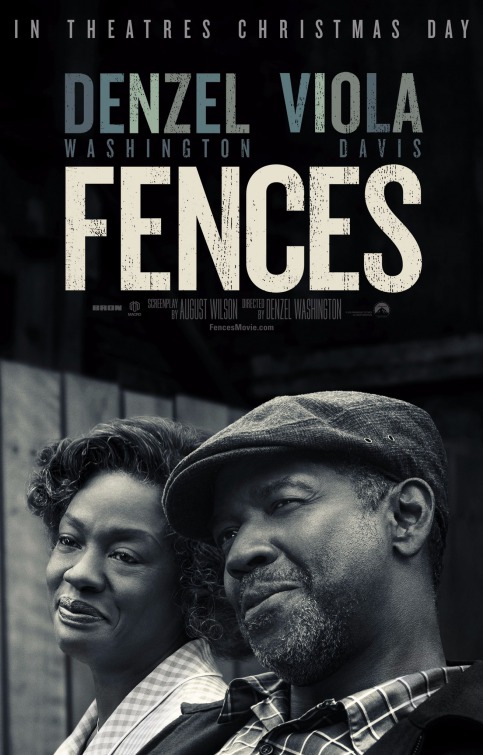
Fences

Since Gene Hackman, my favorite actor , retired a dozen years ago, he has been replaced in my esteem by another American actor who embodies the potential of everyman in dramatic situations. I first saw Denzel Washington in a comedy with George Segal as his father, back in the very early 1980s. The movie was “Carbon Copy” and it was not very good but Denzel was. Since then, he has won two Academy Awards and starred in a string of box office successes that would please any acting career. Earlier this year he appeared in a remake of “The Magnificent Seven”, which was solid if not spectacular. He has now directed himself in his third film as a director, the screen version of the August Wilson play, “Fences”.

As a director,  Denzel has stuck closely to the boundaries of a stage play. There are one or two moments that move the scenes beyond where most of the play is set, but the vast majority of the film still is located  in the kitchen and the backyard of his character Troy Maxson. The play addresses issues of black life in the first half of the last century. Troy is a man who has turned himself around from a thug in his teen years to a responsible adult in middle age, but he has deep resentments against the society that restricted his potential because of the color of his skin, and like all of us, he has difficulty escaping the shadow of his own family. As a consequence, we see that he is a stern father while being a loving husband. His views of family are solid but he also has some strong views on masculinity that threaten the peaceful life he has found and they undermine the progress that he has made.

The script is by the playwright himself, so it is no surprise that the dialogue sounds like the words of a play. Even though the dialect and slang are of a particular culture and time, the words sometimes sound so complete in their sentences, that you might wonder who the characters are cribbing from. What plays on the stage often works because we are so willing to suspend our disbelief due to the context. In a film, I think audiences expect things to play out a little more naturalistically. Characteres talk over one another in films, actions take place in the background, visuals drive our interest in the story. A play requires turn taking to be able to follow what is being said, the scenes are set in locations that are not likely to have wild visuals that draw our eye because the focus is supposed to be on the characters. There is nothing wrong with the story here, and the performances are top notch, but the film never moves or feels like real life, it feels like a play.


The dialogue however is a joy to listen to when it is being delivered by consummate professionals like Denzel and his co-star Viola Davis.  The two leads are convincing as a long married couple at odds over the life of their teenage son, and the crisis that raises it’s head in the second act. Mr. Washington has the right degree of belligerence and resignation in his voice. When events are against him, he gets his dander up and spouts off like a man certain of his position. When faced with his own failings however, he becomes truculent and the warmth that he often displayed along with a good deal of humor becomes sullenness that is not very appealing. Viola Davis is the most supportive partner a man could have, and at times she seems to be the most powerful force in her husbands life. When Rose is confronted with Troy’s weakness, she is defiant herself, but ustimately becomes a passive force for good. Davis meets both challenges directly and she will probably win the award she deserved back in 2011 for “The Help”.


Steven Henderson, who had a small one scene role in “Manchester by the Sea”, a film I saw earlier this week, has a much more substantial part here. As Troy’s oldest friend, he provides wise counsel that largely gets ignored. He is the voice of the audience, yelling for Troy to try to think about an issue in another way, but who ultimately understands the intransigence of his friend. Having played the part on Broadway, he seems to have the relationship mastered. Mykelti Williamson has played a variety of roles over the years. He was memorable as the stony Elliston Limehouse in the TV series “Justified”.   As Troy’s combat injured brother with reduced mental capacity, he seems to be repeating his most famous role as Bubba Blue in “Forrest Gump”. Denzel the director must be aware of the similarity of the characters, and while Williamson does a good job, the comparison is going to linger over the performance and that seems to be a shame.

I don’t want to sound down on the film. I thought it was well made and there were a couple of nice things the director added to the mix. The golden gate that Saint Peter is manning was nicely visualized, and the use of old murals in the city buildings added some texture to the story. This is a film worthy for the performances and the dialogue. If you are unlikely to ever see the play that the movie is based on, by all means check this out. If you are a theater person, expect a very familiar and comfortable experience. As a film, it is a little talky and workmanlike in it’s visualizations.

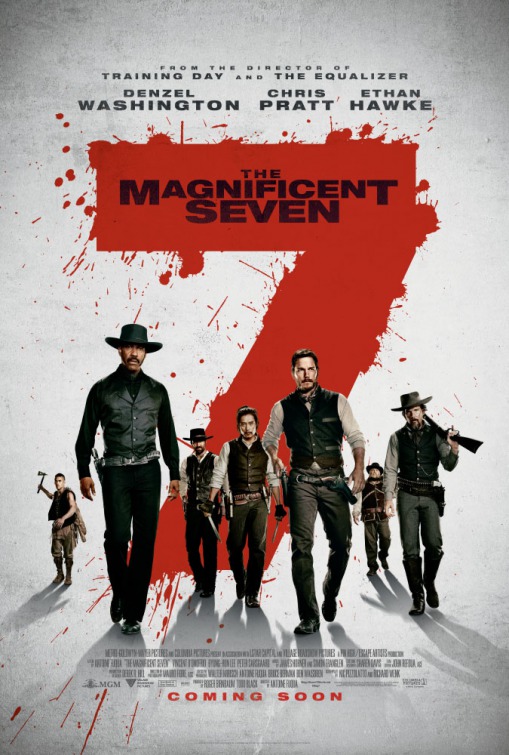
The Magnificent Seven (2016)

Remakes inevitably suffer from comparison to their predecessors. This version of the Magnificent Seven will not be an exception. It has star power, and entertainment value, but it seems to be short in stature because of the times in which it is made and the demands of contemporary audiences. We need our action to be spectacular and the visualization to be inventive. The problem is, with such a traditional setting, it sometimes feels a bit anachronistic. Characters playing out the events of the story in 1879, sound like they might have been born in 1979. The touches of humor and the self referential moments left me a little less impressed, despite some excellent tweaks to the well known story.

Let’s begin with the stuff that works and helps this movie cross the line as a winner. Denzel Washington is the closest thing we have to a movie star working today. His presence in a film can still bring out an audience and his acting chops are top notch. The only film star comparable would be Tom Cruise, and I think Mr. Cruise is more limited in what an audience is willing to see him in these days. Of course Mr. Washington is also playing in the action field now more than any other genre also. Cast as the lead cowboy in this band of mercenaries, he is completely believable in spit of  question of his heritage. You never once think that he is not exactly who he says he is and there is no question that the people he encounters grant him the respect he clearly communicate to all that he deserves. It is a credit to the makers of the film that they don’t exploit what might have been a distracting non-issue and instead focus on the story at hand.


Ethan Hawke’s character is also a plus in the film. We get a little more back story than we ever got with Robert Vaughn in the 1960 version, and it makes most of his actions seem more reasonable. As a deadly sniper who survived the  Civil War, his struggle with PTSD seems understandable even if it is only partially fleshed out. His friendship with an Asian assassin in the old west is a little more difficult to swallow, although it offers a nice relationship and provides quite a bit of entertainment. Also worthy are the characters played by Vincent D’Onofrio, Manuel Garcia-Rulfo and Martin Sensmeier. They make up a worthy second tier trio of mercenaries. I liked Byung-hun Lee perfectly well in the film but as I said, his character is one of two that draws attention to the fact that we are watching a story made by people trying to entertain us any way they can.

The second character that sticks out a bit like a sore thumb is Chris Pratt’s gambling cowboy. Don’t get me wrong, I’m glad he is in the film and I enjoyed his performance just fine. The trouble is that the character is so overdone in an effort to make the film a little more hip that the story loses much of it’s organic nature. It screams for attention and the manner in which the character talks is more in keeping with the Space Opera Pratt is noted for than the Horse Opera we are watching. His story is written more for the audience than for the events in the film.

There are moments in the reworking of the story that I thought fit well. The events that propel the character of Emma Cullen to reach out for help from such dangerous men was well set up and executed. She develops as a character only so far however and in the end her role becomes a plot device rather than someone we can care about and relate to. I will say however that the audience I saw this with was enthusiastic about her piece of action at the climax of the film. Peter Sarsgaard as the villain of the piece is suitably despicable, although the capricious manner in which he treats his employees would make most people think twice about taking a job from him.

I could have lived without the backstory for Denzel’s Chisolm, I think he would be more interesting as a cypher but it does provide a bit more logical reason for him to take on the task that he himself describes as impossible. The planning components of the final battle are reminiscent of some of the same things that were found in “Seven Samurai”, the film that was remade as the first “Magnificent Seven”. That battle sequence does go on quite a while and it is one of the places that the action sometimes feels over the top. I did not count the number killed but it would certainly approach two hundred. I can say however that the deaths that occur in the group seem relevant and well earned.


This is the final score of the late James Horner, who died last year far too young but with a set of films on his vita that would make anybody proud. Two nights ago, in preparation for an upcoming podcast, I watched “Battle Beyond the Stars”, a Roger Corman cheapy Star Wars wannabe that uses the plot of The Magnificent Seven as it’s source. One of the gems in that otherwise minor film is the score, by a young James Horner. His career is thus somewhat bookended by this story. This score is not as iconic as either of those other two films but it does convey some seriousness and in a couple of places, the grandeur of the west. There is a continuing echo of the classic Elmer Bernstein theme in several spots, but that tune is not fully utilized until the end of the film.

I’m a sucker for a western, so my opinion on this was likely to be pretty high to begin with. It is a solid entertainment and a reasonable facsimile of a traditional western, but it has a few elements that make it feel more manufactured than it ought to be. I look forward to discussing it with my fellow bloggers next week, but for mow I will say you should definitely see it. There are not likely to be a lot of westerns in Denzel’s future career, and that is a shame because he fits in the saddle really well.