So on my birthday 2 weeks ago I got a chance to revisit a film from 2000. It was very entertaining but was largely ignored at the time it was released. A little over a year ago I had a chance to attend a screening that was largely a party at the Paramount Theater celebrating Josie and the Pussycats. As it is, I was just celebrating my birthday with the Pussycats this time.
I’ve said it before, this film was way too clever for its own good. People misread it as a simple teen comedy, which it is to some degree, but it is also a sharp satire on the music industry, the media, and even the movie industry and its obsession with product placement. It is witty and sharp and full of jokes that will pass you by if you’re not paying close attention. The opening of the film is loaded with shots at the commercialization of filmmaking because everything is branded.
The deeper pleasure in Josie and the Pussycats however is the music. The songs by this faux band are so upbeat, clever and tuneful that it’s hard for me to understand how they weren’t all hits, much less how they were ignored at the Academy Awards that year for best song which they were certainly more deserving of than what really won.
I posted on this movie before and you can read about that here. and here. I just want to celebrate one more time the fact that this movie exists, and that it evokes good memories from 25 years ago. I went to see it with my daughter and she was just a tween when we saw it the first time. She’s now a grown woman and she made the effort to secure tickets for us so that we had something special to do on my birthday, thanks hon.
Apparently not everybody treasures Spinal Tap the way I do. “Spinal Tap 2:The End Continues” should have had a nice moderate run at the box office and been beloved by fans of the band. Instead it’s a neglected pebble on the beach, kicked out of the way by people who should be embracing it and ignored by the people who created it except for the four main stars, who are doing their best to try and sell the film in the face of public indifference.
Spinal Tap is a fictional band, but the music is real and the performances are live. Famously the structure of these movies is the framework that existed before the movie started but most of the material that fills it in is improvised by the stars themselves. Harry Shearer, Michael McKean and Christopher Guest are joined by Rob Reiner returning as his fictional director Marty de Bergey. They all improvise and kibitz their way through a reunion concert that is filled with intrigue, and the usual antics of narcissistic rock artists.
The 41 years that have passed since the original film, have seen changes in the music industry, and the way films are made and marketed. Those changes must have been significant enough to render this film impotent in the face of the new World Order. I say that because I completely enjoyed this movie, and I laughed a lot. The only thing that I thought was missing were new original songs that might match up to the brilliance of the original soundtrack album. To compensate we get Cameo appearances by some big rock stars who sing some of the Spinal Tap Originals. Paul McCartney comes in during rehearsals and with his quiet respectful comments, he manages to antagonize David St, Hubbins. A perfect example of Rockstar megalomania gone to the extreme.
A much longer insertion into the story is Elton John, who not only appears in the rehearsal stages but shows up for the performance of the climactic song of Spinal Taps reunion concert, “Stonehenge”. Fans of the original will be anticipating disaster and they won’t be disappointed, although it’s an exact reversal of what happened in the first film. In between these appearances we had a series of drummers who rejected the idea of joining Tap for a one-off performance, which is understandable given the history of Spinal Tap drummers.
I talked about this movie a couple of weeks ago with some of the other Lambs on the LAMBcast, one of whom enjoyed it almost as much as I did, and the other found a few things to be entertained by but he was not as nostalgic as we were for the return of Tap. I guess his attitude reflects the modern world more than my own. It’s a complete shame to me that this movie managed to have such a minuscule box office weekend, and some other crap is going to pull in more simply because it fits into a genre that is popular in September. Oh well it’s a fine line between clever and stupid, the stars and director of this film fall on the clever side of the line, the audience falls on the other.
A rare Wednesday double feature at the Paramount this week with a screening of “Legally Blonde” and “Clueless”. Both films have elements of female empowerment in them, and both of them have completely silly components, which keep them firmly in the comedy category and diminish any social commentary. Not that that’s a bad thing.What both films have going for them are charming leads, and comic scenarios that get resolved with happy endings. In other words they are audience fantasies that deliver what people want from their entertainment.
LEGALLY BLONDE
Legally Blonde was the Breakthrough movie for Reese Witherspoon, and it’s success catapulted her to the ranks of Highly sought after actresses in the first decade of the century. Playing a high school senior who is pursuing her boyfriend to Harvard Law School, Witherspoon plays Elle Woods, a fashion merchandising 4. 0 student who manages to excel on the LSAT after cramming very hard. The fact that she’s a cute blonde in a bikini in her video essay doesn’t with the admissions committee either. So when the film makes a point about the importance of female accomplishments over appearance, that is going to be undermined by this plot point. Okay that’s the last serious thing I’m going to say about Legally Blonde.
What I will say is that it is delightfully droll, Witherspoon is a blast playing a perky Fish Out of Water in an elitist cultural niche which judges you by your family in source of wealth more than your character or even income. Harvard I’m sure appreciates being portrayed as an exclusive Miley sought after admission, but the movie shows us some of the most stereotypical intellectual snobs that you can imagine, as being the sort of students that Elle will have to compete with.
The courtroom antics are fine, but you will actually get a better sense of legal procedure by watching My Cousin Vinny. Legally Blonde resorts to an old Perry Mason trick to finish off this Underdog Story. But no one will care because Elle Wood is a good person who wins out in the end, and all of the other good guys win as well. Cue the Applause from the overwhelmingly female audience that attended Wednesday’s performance.
CLUELESS
Cher, the heroine in this reimagined version of Emma, is played by Alicia Silverstone. This was another one of those films that established young actors as the Bedrock of ’90s and early 2000 films. In fact we’re still getting Paul Rudd, who looks pretty much like he did back in 1995, starring in movies. Silverstone is the quintessential spoiled dumb blonde of classic film. Although she sees herself as the authority in the story, the rest of us recognize quite early on that she is the one who is out of Step.
I can’t tell you how authentic the relationships between teen girls in Beverly Hills are represented by this film. It is however easy to imagine Petty jealousies and misunderstandings creating broken friendships or lost romantic opportunities. The themes in Clueless are actually a little bit more serious than the legal drama of Legally Blonde. Everybody engages in some kind of manipulation, sometimes we have the best of intentions when doing so, but in the long run we should really reassess the choices we make. Like Jane Austen’s Emma, Cher is manipulating others in what she sees is an altruistic attempt to help them out. The problem is she puts her own vision ahead of what is best when it comes to her friends.
Once again it all works out, and there are serious laughs to be had throughout the film. I’ve always liked Dan Hedaya who plays Cher’s dad, and even in the small role that he has here he puts his grumpy but sympathetic persona to good use. Wallace Shawn shows up as the stern but naive debate coach, and I see too much of myself in this role, fortunately I can laugh at myself.
About a third of the audience left after Legally Blonde, but those who remained embraced Clueless almost as enthusiastically and we all shared a laugh as we left later in the night than we usually do during the week.
It’s nice sometimes when your expectations are overcome by actual accomplishments. When I saw the trailer for the new Naked Gun film I did not have a lot of Hope. I did think the casting of Liam Neeson was probably the right move, but the way they played him up as disguising himself is a 8 year old girl seemed inconsistent with the form of humor that I was expecting from a Naked Gun movie. And truth that scene is out of character for the most part, although there is one other sequence that mimics the same silliness. By the way I have nothing against silliness, I just think it works best if it is consistent.
I will most certainly return to the Naked Gun because I’m sure I missed a lot of the books in the background. I probably missed a number of jokes in the dialogue as well, because I laughed a lot and as a result lost some Focus. I can’t say that it was as consistently funny as the original films were, but I can say I laughed a lot and I was surprised at how much satisfaction I took at the attempt to mimic the Zucker Abraham Zucker touch.
Pamela Anderson appears in the film as the female protagonist, and she plays at age appropriate and it seems fitting that she and Neeson are matched on film. She can play the straight to the funny as well as he can. Kudos should also go to Danny Huston, who seems to make a career out of playing villains lately. In this film is sinisterly funny, and the final gag was one of my favorite moments in the movie. So in addition to a bit with the dog, a film also benefits from a bit with a jetpack.
You can listen to us talk about this on the lamb cast, where we try to avoid simply repeating all of the jokes, but fail to some degree. But we all do agree that the movie is funny.
If ever there was a movie that I could make people watch, and hopefully love, it is “The Adventures of Buckaroo Banzai Across the 8th Dimension”. You are completely safe to watch the trailer, there are no spoilers there. In fact, there is no real information in the trailer at all. It tells you what kind of movie this is with just it’s tone. There are only two lines of dialogue and they are a flippant response to starting World War III. The main hero is not shown doing anything more challenging than walking down a sloped concrete flood channel, and he is doing so while wearing a suit and a bow tie. This movie is confounding to people from the very start, after all, the very title is offputtingly odd. The short trailer just uses the weird theme and shots of a variety of strange people joining the lead character on his walk. Then you get a couple of brief shots of who knows what, and finish with the hysterical exchange about destroying Russia. No wonder the film never caught on in 1984.
Of course it caught on with me, because I was a film weirdo and tried to see as many movies as I could that year, and this Science Fiction concept had been hyped a little in “Starlog” magazine, and that was enough to get me into theaters to see it opening weekend. Apparently, I was the only person in the San Gabriel Valley who read “Starlog” because I was mostly alone in that first screening. However, I have not been alone for 40 years, thousands have become fans of this cult experience and like me, now consider themselves Blue Blazer Irregulars. The Alamo Drafthouse has been screening films from 1984 during their time capsule series this year, and I got another chance to see this on a theater screen, I think this may be the fourth time. The theater was not packed, but there was a reasonable smattering of Irregulars in the auditorium, and you could tell by their reactions during the film and their comments afterwards that they were as pleased to be there as I was.
The title hero, Buckaroo Banzai, is not just a physicist, he is also a neurosurgeon, test pilot, and rock star. Neil DeGrasse Tyson and Stephen Hawkings would be jealous of his expertise but like everyone else, they would be charmed by his down to earth manner and sardonic humor. The Zen like statements that he uses to reassure his team, also suggest he is an Eastern Philosopher. Yet at no time is he condescending to the political dolts around him, the non-scientists that he works with, or the public at large. Peter Weller will always be “Robocop” in his biography/obituary, but I will also always think of him as Dr. Banzai. Weller’s low key demeanor, and willingness to let the crazies around him have the spotlight, make this a subtle performance. Oh, by the way, I should refer to him as Dr. Peter Weller, since he did not get a PhD in art history and literature, just to be referred to as Mr. .
“Buckaroo Banzai” is an 80s science fiction film that makes up with creativity and humor, what it lacks in budget. The locations are filled with conduit pipes, heat vent tubes and what might be some form of foam rubber molding. The humorous self awareness of the film can be observed in the scene where the cast members look at a holographic message through goggles that are made of bubble wrap. There are deliberate attempts to show us that this story is both a salute to and a parody of those kinds of pulp heroes that have come before. “Why is there a watermelon there?”, is not a question you will get a straight answer to. I also don’t know why lithium is no longer available on credit. That’s because I am a monkey boy who does not have the insight of a red lectroid like Lord John Whorfin.
John Lithgow had been nominated for a supporting actor Oscar in both of the two previous years. His take on the character of Dr. Emilio Lizardo, should have made it three in a row. Lizardo, is a scientist who in a failed attempt to break the dimension barrier in the 1930s, allowed the evil Dictator John Whorfin to possess his mind and plot a return to power while in a mental hospital for thirty years. The cross pollination of Italian accented scientist with megalomaniacal Red Lectroid, results in one of the most demented and delightful performances to ever be committed to film. Lithgow runs wild with bulging eyes, slathering monologues, and accents that would befuddle any linguist, regardless of their credentials. His obtuse interactions with his underlings is a great contrast to his opponent, Buckaroo.
Another reason that the film may have been overlooked at the time is that the supporting cast, which is filled with great performers, was in the early part of their careers, and audiences had not yet recognized their potential. Clancy Brown was not yet Kurgan from the Highlander film, Dan Hedaya was still waiting for the Coen Brothers to make Blood Simple. Christopher Lloyd was a well established oddball character actor, but he was not an above the titles name. Neither were Vincent Schiavelli, Matt Clark or Ellen Barkin. The only supporting player with some potential drawing power was Jeff Goldblum, and he was also at his nascent point in his career. Goldblum, as fellow brain surgeon and sidekick, is a complete joy to watch as he trapses through the movie in one of the most ridiculous cowboy getups since Hopalong Cassidy.
The action scenes aren’t great, but they are adequate. What you need to know however, is that they are merely a frame to hang the wry dialogue and arch attitude on. The film skewers and salutes these kinds of movies simultaneously. This is smart film making that looks like cheap, dumb sci-fi filler, but is one of the greatest treasures in a year that was filled with great films. Jump in your jet car and find an Alamo that is playing this, NOW. You will thank me, and if you miss it, you will hate yourself.
It’s always a joy seeing animation on the big screen but when it’s combined with live action as effectively as is done in “Who Framed Roger Rabbit?”, it’s an even greater pleasure. This was a groundbreaking film from director Robert Zemeckis who must have twisted some arms, kissed some butt, and prayed to the movie gods to be able to have access to all of the classic cartoon characters that appear at some point or other in the film. It seems almost impossible to believe that Mickey Mouse and Bugs Bunny would share a scene together. But they do and it’s hysterical.
The story builds on a well-known fantasy that there was a deliberate effort by car companies and the oil industry to get rid of the public transportation in Los Angeles. The rate at which the city was growing and the space that it was taking up was never going to be accommodated by the old red line, but the world is full of conspiracy theorists, and this plot takes its cue from that Old Chestnut. The most fantastic conceit in the film is that the characters are film stars who are animated and live in the real world. That means that humans and hippopotamuses are going to bump into one another. It means that that old joke where Bugs Bunny paints a line on the road to move the pursuers into crashing into a wall, can actually happen. And in this film it does.
Bob Hoskins needs more credit for the work that he did in this film. As the human private detective Eddie Valiant, Hoskins has to be handcuffed to animated Rodger Rabbit, have his hair stroked by an animated Jessica Rabbit, shake hands with a variety of cartoon characters that we will recognize from our childhood, and be the butt of some of the gags that we all knew from Saturday morning. He’s terrific in this movie. So many people deserve credit for making the film work but let’s not forget to mention animation director Richard Williams who managed to get animated critters to interact with human beings in a believable way.
There’s so many things to admire about the movie, but I want to start with the opening cartoon which is done in a text Avery Style with characters that feel familiar but are completely original. Baby Herman and Rodger Rabbit dashing through the kitchen avoiding tragedy with every movement, and the toon ending up being targeted by just about every item in the kitchen drawers is just funny. When it breaks at the end because Roger can’t come up with stars to show his concussion, rather than tweeting birds, it’s a Hollywood Insider’s dream.
Everyone should remember that Christopher Lloyd is not just a character actor but was an important star in the 1980s. Of course “Back to the Future”, but also “Star Trek 3″,” The Adventures of Buckaroo Banzai across the 8th Dimension”, and this film, where he plays Judge Doom, a cartoon masquerading as a human. His maniacal eyes, somber expression, and creepy voice almost give him away. And when the secret is out, believe me text Avery is applauding somewhere.
The film was playing at the State Theater next door to the Paramount because there was a concert being set up at the bigger venue. We had arranged to meet a couple of friends of ours from the neighborhood in front of the theater, but they were running a little late from some appointments they had on Sunday morning. Ultimately they got into their seats about 20 seconds before the film rolled. It was nice to get a chance to do something with people that we know from the neighborhood. We had a nice lunch afterwards, and Sunday afternoon is a great time for a cartoon and something to fill your belly.
When I wrote about this movie 10 years ago, I suggested in my post that the songs from this movie should have filled all the categories for best song at the Academy Awards. I stand by that statement because these songs do what a music piece in a film is supposed to do, advance the story, illustrate a problem faced by the characters, or tell us more about the characters themselves. All of the songs played by the band Spinal Tap in this movie do those things. I was reminded of this as I watched the film last night, and found myself tapping my toes and mouthing the words while simultaneously laughing.
This Is Spinal Tap is a documentary/ Mockumentary that tells the tale of a band that went from 60s pop to 80s heavy metal and suffered ups and downs like all musical groups do as the fads that they ride go in and out of fashion. Rob Reiner, Christopher Guest, Michael McKean, and Harry Shearer accomplish the task of making characters that we can laugh at and simultaneously identify with, at least to a point. Everyone has felt stupid doing something that others applaud, at the same time we love doing stupid things because we get to get away with it. Rockstars is a notorious for doing exactly this.
When this film came out we were at the height of hair metal popularity, and aging bands playing the nostalgia circuit. Spinal Tap may not have been a real band before this, but after this movie came out the actors who are also the songwriters discovered that their characters had an exterior life, and they have done subsequent tours and special events, and there’s even a sequel in the works. Frankly this movie produces more laughs per minute than most other films are able to accomplish in 90 minutes. The only other movies that I’ve ever felt comparable to the laugh ratio are Mel Brooks films, Monty Python films, and a few early seventies gems. I sure hope that Tap can sustain the laughter in a new entry.
Once again I was at the beautiful Paramount Theater in downtown Austin enjoying a classic movie on a summer evening with several hundred like-minded folks. The audience at last night’s screening laughed continuously and they all seem to get the joke. I could tell that several people in the audience were seeing this for the first time because their laughter was simply too spontaneous to reflect any memory. The movie is a brisk 90 minutes, with several performance set pieces that will leave you chuckling. If the shenanigans that take place during the Stonehenge number don’t make you laugh, you probably have no sense of humor.
Let’s be happy that metal music still exists, that rock bands from the 70s still make the rounds, and that fans of that genre can laugh at themselves when watching a film Like This Is Spinal Tap. Let’s face it, if you can’t enjoy someone else’s amusement at your own foibles, then you were too stuck up to really be a rock fan. Let’s tap into the next great song.
50 years ago was the start of a wonderful relationship for me. This was the year that I discovered Mel Brooks. Both “Blazing Saddles” and “Young Frankenstein” came out this year, and I saw them with my high school friends who all laughed as loud as I did. We knew we were in the presence of somebody who knew how to be funny, especially to high school boys. “Blazing Saddles” was the first of these two films to be released in 74, and it’s raucous, irreverent, and some times down right offensive. It was also a western, which I have a deep abiding Love for.
In spite of my admiration for “Blazing Saddles”, I’ve always felt that it was the second best Mel Brooks film of 1974. “Young Frankenstein” goes beyond silly parody, to be a genuine tribute to and echo of the classic Universal horror movies. Of course it is hysterical, there was little doubt that with the input of Brooks and co-screenwriter Gene Wilder, that this is going to be incredibly funny. It turns out that it is also incredibly sweet, with a soft spot for all of the characters in the film, even some of those loathsome villagers who think it’s time for a riot. There is something to laugh at and embrace in just about every scene.
To start off with, they made the film in black and white. In 1974 that was not very typical. Sure there were a few other films at the time that used black and white to suggest the past. Films like “The Last Picture Show”, “Paper Moon”, “Lenny” and a few more, They all use black and white to draw attention to themselves in a way that made them stand out in the crowded ’70s field. But in the field of comedy, you don’t get a lot of black and white films that are contemporary, until Woody Allen gets going a few years later. The truth is, this movie wouldn’t have worked in color, because our collective memory of the Universal films is black and white. Boris Karloff may have had green face makeup when the original Frankenstein was created, but we only saw the black and white and that’s what we remember. It would have been disturbing to have Peter Boyle on screen as the monster with a green face. Besides, all those great sets that were being used to make the movie wouldn’t look nearly as Gothic and creepy if they were in color. The villagers walking through the forest with fog rising from the ground in black and white just makes sense.
It would be pretty hard to go wrong with a cast that includes Gene Wilder, Marty Feldman, Madeline Kahn, Teri Garr, and Kenneth Mars, but when you add a surprise guest performance by my favorite actor in a completely unexpected role, I’m just going to have to say this film approaches perfection. Let’s face it Gene Hackman, as an avuncular blind man stumbling his way through making a new friend, may be the funniest 5 minutes in the whole movie, and that saying something.
The John Morris score is also something pretty special. It recalls Frankenstein with its limited score, Dracula with its borrowed themes, and classical source music. The little horn section gets its own joke when Marty Feldman as Igor, plays his little horn to accompany Inga on the violin. It’s guaranteed to get a chuckle for you. Next to the sequence with Gene Hackman, the dance routine with Gene Wilder and Peter Boyle to “Puttin’ on the Ritz” maybe one of the most bizarre, ridiculous, and ultimately perfect realizations of the absurdity of this story. Super duper.
As family-friendly as Young Frankenstein is, there are a couple of raunchy jokes built into the movie, especially at the end. Most of these will sail over the heads of kids, but teens and adults will smile at the sexual innuendo that is never explicitly stated. The film is certainly not as ribald as Blazing Saddles, but it’s not G-rated for a reason. We are reminded once again how sadly we miss Gene Wilder on screen, his performance is one for the ages. The moment of his frustration when he can’t get his two assistants to understand what he’s asking for as he’s being strangled by the monster, is both pantomime perfect, and then when he gets his voice back vocally hysterical. I have no patience for anybody who doesn’t think this film is funny. It’s so funny that I was amused by the slot machine that was based on it and was ubiquitous in Vegas two decades ago. Too bad you can’t find those slots now, I’m really in the mood for dropping some coin and hoping to get a bonus.
Hitman is a Nifty little Neo Noir from director Richard Linklater and his star Glenn Powell. It is based on the case histories of an actual informant in Houston Texas. The movie is based on an article written in the Texas monthly, which chronicled the numerous incidents in which a college instructor impersonated supposed Killers for hire in order to arrest those trying to hire someone to murder another person.
Incredibly they were over 187 cases where this police informant managed to interact with potential customers sufficiently to incriminate them adequately to have them arrested. Most of the arrests resulted in convictions. The problem with this fantastic true story, is that it is basically a series of incidents where our protagonist portrays himself in multiple different ways so as to convince the contracting client that he really was a hired killer. Now, the movie contends that outside of cartel or Mafia connections, The hired hitman is a myth. So most of these people bought into a fantasy that they could solve their problems by finding someone who is willing to kill for money. As interesting as that might be, it’s not a narrative that would sustain a movie. What’s happened here is that Powell and Linklater have created a Noir to go along with these real incidents.
The film is primarily a comedy but it does go into some traditional Noir territory when it introduces a femme fatale who gets involved with our main character. This results in comedies traditional structure of one person trying to hide something from another person and going through desperate measures to do so. The conceit in this film is that the character that our informant creates in order to draw in this woman, becomes a persona that he inhabits a little too comfortably, and with comic consequences. The film is actually quite funny with several ironic components to it. The jealous police officer who has been replaced in these kinds of sting operations by this previously milk toast college professor, is turned into a dangerous rival with an agenda straight out of a 1940s film. Of course it also has a comedic element to it that is quite amusing.
I’m not sure if you can call it a Neo Noir if the result of the story turns out to have a happy ending. That doesn’t really fit with the traditional dark themes of that classic format. But because this is a comedy take on the form, it doesn’t really feel disingenuous to go in the direction that it does. The characters that we encounter are for the most part very likable, and it would seem unjust for them to end up in the negative for the experiences that they’ve gone through. Powell and his co-star Adria Arjona, have good chemistry together and they make us care about the outcome. When we meet her husband, the man that she originally wanted to hire someone to kill, we kind of understand that she is not the bad person that we might have assumed simply because she wanted to hire a hitman.
The early part of the film drives most of its comedy from Powell’s disguises, characters, and the potential clients who are is inept, venal, and delusional as you might expect. The second half of the film the comedy derives from Powell’s attempts to keep his true identity secret, and to hide the romance that has grown between him and the woman that he is steered away from committing a felony. The final third of the film does take a darker turn, but not so dark as to diminish the romantic comedy that has been growing up inside of this movie.
I found this movie to be completely delightful, cleverly acted and very intricately plotted so that it is engaging throughout. It may not be to everybody’s taste but it’s certainly fit mine, and as far as I’m concerned it is one of the critical hits of the year. This is a Netflix film that is getting a limited theatrical release, which is the reason that it got covered on this site. The screening that I went to was actually the premiere in theaters, and included a live broadcast to other theaters around the country, featuring the tars Glenn Powell, Adria Arjona, and director Richard Linklater. It was a lot of fun to be in the theater with the creators of this film and listen to their stories about how the movie was put together. Hopefully you’ll get a chance to see this in a theater, but if you don’t go ahead and take advantage of its availability on Netflix, it’s better than hiring a hitman.
GG (Feb) chosen by Richard of Kirkham A Movie A Day! GG (Genre Grandeur) is a series Rob started a few years back where each month a different blogger chooses a genre for everyone to write a review of their favorite film (s) of the particular genre. (There is no limit or restrictions on the number of reviews)
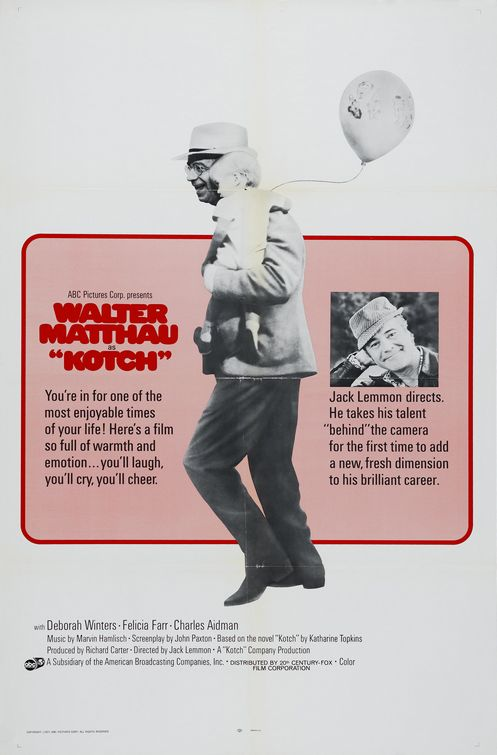
A 1971 picture that contains a nomination for best actor, by one of the big stars of the sixties and seventies, that has largely been forgotten, despite the fact that is the lone directorial effort of another oscar-winning actor. Kotch features a sentimental story about an aged man, coping with the complications of being a burden to his family, while he is still relatively active, cogent, and financially independent. It also contains a sweet story about an unwed mother who’s only 15 and is trying to navigate her pregnancy.
I saw this movie when it came out in 1971, and I remembered it slightly. The details of the story are hard to hold on to because nothing too dramatic happens in the course of events. This is really a character piece and that’s the thing that’s easy to remember here because Walter Matthau is a character in every role he plays but in particular in this one, where he is cast 30 years senior to his actual age. In fact he was only 5 years older than the actor who was portraying his son. Mathau had been in three successful sex comedies in the preceding 3 years, and was probably thought of as a comedian with the leading man’s charisma if not looks. 20 years down the road he would be playing this same part at his own age and making a big success of that as well. If you want to you can kind of think of this as a prequel to “Grumpy Old Men”.
Joe Kotcher is a 73 year old man currently living with his son Gerald, daughter-in-law Wilma, and their toddler child Duncan,in a nice suburban house in Southern California. Kotch does not have dementia, there is no disease on the horizon, and he does not pose a threat to anyone except those who jump to the worst kinds of conclusions about what an old man is doing at a park. However, anyone who has lived with a person, who has personality quirks that may be bothersome, knows that it can be stressful. His daughter-in-law, is maybe wound a little too tight, but of course Joe Kotcher is an avuncular guy who is free with information, opinions, and advice. Those things may not always be welcome and sometimes seem like a bombardment of information that’s unnecessary. Imagine a child who is telling you about their day, and tells you the name of every child that they sat with at lunch, and what they had to eat. It’s not a bad thing but it’s an unnecessary thing for the listener, it seems to be a needed function for the old man, he has to talk,and Kotch is a talker. He keeps a running commentary on all sorts of things, he has a vast knowledge of arcane information he’s happy to drop into every conversation. That’s the kind of thing that is driving a wedge into this family. Walter Matthau plays Kotch as a genial old man not as a curmudgeon, but sometimes you can just be too genial.
The son Gerald, is played by veteran television actor Charles Aidman, who anybody who has seen 70s television, will recognize from some program that they have watched. Aidman is great casting because he has the same hangdog face as his costar. Gerald is a sympathetic son and he is a little bit dominated by his wife who is struggling under the pressure of having her father-in-law live with them. At one point they have the delicate moment when the father and the son have to confront the possibility that Joe is going to relocate to a retirement community. The daughter-in-law is not a monster, she sees how tough this is for her husband and his father. She is the one in fact who sheds tears at the thought that this has become necessary by the way, she is played by the director’s wife). But like “Harry and Tonto”, which will arrive in a couple of years, old people can be a lot more resilient than their children want to think. Kotch has no intention of giving up living the life that he wants just to make his children feel secure.
At one point the old man feels a little bit like an informer because he has to share with his son the fact that the babysitter, while not being negligent, was distracted by having sex on the living room couch during an evening supposedly taking care of the grandson. When he shares this information we think he might simply be acting out of the feeling that he is being nudged out of his child care responsibilities by this young interloper. There’s a nice moment done in a flashback, which reveals that Joe and his late wife Vera, faced some of the same issues that the babysitter did. The location for their assignations was An old Hudson, instead of his parents’ living room couch. Erica, the babysitter, subsequently becomes an important character in the story. After Kotch has spent a little time away from his family traveling, he returns home to discover that the babysitter has been pushed out of school, sent to San Bernardino, because she became pregnant. We learned that her much older brother is her guardian, and there is a brief moment of sadness when we discover the story behind her orphan status. Koch is not going to take this lying down, he feels that he might have betrayed the girl and pushed her on this path because he told his son that the babysitter had misbehaved. He decides that he’s going to help her as best he can.
The film meanders along, giving us a few incidents about how these two, the pregnant teen and the slightly distracted older man, form a dependent relationship and care for each other over the course of her pregnancy. Nothing too dramatic happens, they go out to eat, or they fix meals at home, where they spend time sitting in the living room working on some hobbies that are a little strange but charming. As the end of her term comes, she is faced with some important decisions about her future. And without telling her what to do, Kotch has a huge impact on the decisions that she makes.
This is the only film that Academy award-winning actor Jack Lemmon directed. He got an Oscar nominated performance out of his close friend and frequent co-star Walter Matthau, and efficiently tells the story without an excessive amount of sentimentality, but with just the right amount of humor to keep us going. This time period looks grand in the film, and you might think that Palm Springs would be a reasonable place to move to. Maybe the one big flaw in the story is the location, because even in 1971, Palm Springs was overpriced and maybe not a wise choice for a retiree and an unemployed pregnant girl.
The film received three other Academy Award nominations, so it was widely respected and even though it didn’t win any of those Awards it seems to have gathered enough Goodwill to make it a multiple nominee. I bet if you ask anybody who the nominees for best actor were in 1971 people would only be able to name the winner, Gene Hackman, and maybe one other nominee and not this one. This for the most part is a forgotten film. Kotch is largely done in a style that is not typical anymore. It’s not fast paced, it doesn’t have surprise plot twists, and the characters are all generally good people without there being a villain in the scene. It’s a nice story, about the struggles of a couple of nice people, who find a way to make the world work for them. That seems enough to recommend it.


 Kirkham A Movie A Day