After having spent 2 hours in the presence of Cary Grant and Grace Kelly, one may wonder how any stars in another film could compete for our attention. The second film in our Sunday double feature answers the question in the most obvious way, multiplying the number of stars. Magnificent Seven gives us a half dozen great actors in a meaty part in a western. That’s the way you follow up with star power.
Yul Brynner and Steve McQueen may not match Kelly and Grant straight up, but that’s okay because they’re also supported by James Coburn, Charles Bronson, Robert Vaughn, and Eli Wallach. There are also a few secondary level Stars that make the movie worthwhile as well, and Elmer Bernstein score is a star in its own right.
You probably already know that this is a remake of Seven Samurai but set in the West. It works really well as a band of mercenaries help a local Village fight off marauding Bandidos for 2 hours. There are several clever moments in the film, but there is one glaring plot problem. Eli Wallach’s character grants the seven their weapons back after having caught them by surprise through the betrayal of one of the villagers. This was a mistake on a massive scale by the supposed brains of the marauding bandits. The only justification for it, is to allow Our Heroes to come back and claim victory. It’s a head scratching plot point.
Regardless of that fault, leads in this film provide plenty of fireworks for the movie. This film actually made Steve McQueen a star, but James Coburn was not too far behind him. Most people who think that Charles Bronson was merely a tough guy face on the screen, should pay attention to his character Ark in this film. He gives a pretty good speech to the kids who have attached themselves to his character.
The assembly of the band of Heroes that takes place in the first part of the film is more interesting than the conflicts in the village. In the long run most of the characters get a chance to reflect their reason for being included in the band. A lot of people might think that the Italian westerns of Sergio Leone were the start of the anti-western, but the depressing circumstances of Our Heroes here, very well could have been a precursor to those themes. It just doesn’t seem that being a gunfighter paid very well, or provided a comfortable lifestyle. Everybody in this film, from the villagers to the bandits to The Mercenaries seems depressingly miserable.
Regardless of their misery however, we get some pretty good gun fights, some clever twists, and maybe not A Fistful of Dollars but A Fistful of Stars. This film is never going to be as perfect as Seven Samurai, but it is pretty damn good.
One of the reasons I took the approach I have for this blog, was so I can do exactly what I am doing now, writing about a film I love, because I saw it in a theater. I have watched “The Great Escape” dozens of times, I own it on Laserdisc, DVD, and Blu-ray, but I have never seen it in a theater on the big screen, what a magnificent film! The story of the biggest prisoner escape during WWII is told in a straight forward narrative with plenty of suspense and great characters along the way.
Take a look at this cast, it is very impressive. There are a ton of British actors that you will recognize, even if you don’t know their names, and the American cast is stacked with legendary stars like Steve McQueen and James Garner. The film is nearly three hours long but never feels too long because all the pieces are put together so well. The plan is laid out for us, we know who everyone is and what their responsibilities are. There are great character points and a bit of humor here and there, but no one simply exists as comic relief. The one plot line that suggests it was designed to amuse us with humor, ends tragically and sets one of the characters on a different trajectory.
Donald Pleasance, who had made dozens of things before this, first appeared on my radar as Blythe in this film. His fish out of water forger was sympathetic and ultimately tragic, which I think made him stand out for me for the rest of his career. He was Blofeld in “You Onley Live Twice”, he was in “Fantastic Planet”, “THX1138”, a terrific TV Movie version of “The Count of Monte Cristo” and he is Dr. Loomis in the “Halloween” series. Heck, I even liked his parody of Robert Stigwood in “Sgt. Pepper’s Lonely Hearts Club Band”. The relationship he and James Garner develop in the film is one that will resonate well with people who come together under trying circumstances. Garner is great as a scrounger, he basically played the same character the next year in “The Americanization of Emily”. Garner’s aw shucks flim flam style will sustain him through a dozen future feature films and the television show “The Rockford Files”.
For a decade, was was sure that Charles Bronson was once an Academy Award Nominee for supporting actor for this picture. It wasn’t until sometime in the 1990s, when I looked it up on line, that I discovered I was mistaken. Watching his performance however, I can easily see why I thought it was true. His character, Danny, The Tunnel King”, is a man of strength who has a weakness that he faces repeatedly, but has finally reached a tipping point. His temporary abandonment of the tunnel as the escape route has some great moments of close up and voice performance. He is so solid in this part, and he mostly is stoic for the rest of his career, I see so much more that did not get played out as it could have in lesser films in his future.
I don’t know if anyone has ever talked about “The Great Escape” without mentioning Steve McQueen, and if they have, how could they do it and Why? McQueen is the top billed star in this film, but it is an ensemble picture, and he is not in it any more than many of the other actors. The reason everyone remembers him in the movie is because he is magnetic. His character is a defiant iconoclast, who never the less fits into the military structure very effectively. His casual interplay with Richard Attenborough and Gordon Jackson contrasts nicely with the defiant reminder to the German Commandant, that he is Captain Hilts. That was a moment of charisma so important, that it is reimagined for “Once Upon a Time in Hollywood”. Of course the biggest moment for him in the film is the motorcycle escape. My wife and I used to joke that if we watched the film one more time, this time he will make it over that second fence.
Director John Sturges had a way with masculine adventure stories that seemed to peak in the 1960s. In addition to this film, he made “The Magnificent Seven” (also with Steve McQueen, James Coburn and Charles Bronson) and “Ice Station Zebra” the baby boomers gateway drug to submarine movies. Sturges often used Elmer Bernstein to score his films and in addition the his theme for The Magnificent Seven”, his iconic score for this film is well loved. I read somewhere, probably on IMDB, that soccer fans hum it during games. (I would have thought whistling Colonel Bogey’s March would make more sense).
The fact that this is based on a true story and the techniques used by the prisoners were pretty closely followed in the film, give rise to even greater respect fore the fighting men of the Allied forces in WWII. The film makers do what must always be done in creating an entertainment, they romanticize some things, ignore the inconvenient, and have to change characters around. Still the film feels very honest, in part by the fact that there are no speaking roles for women in a P.O.W. camp. Hogan’s Heroes would fix that later. This is one of those thousand films you must see before you die. so I have several lifetimes worth of viewing it to my credit.
[The above trailer is not the original but it is very effective at conveying a sense of what the film is so I chose it for this post.]
You could call this an action film, after all there is a motorcycle chase, a car chase, a bunch of shootouts and fistfights. The problem with that label however is that this is a 70s style action film, where more time and energy is spent building up the characters and the plot and less time is spent trying to show the sixteen different ways you can kick a guy in the face or twirl a handgun in the air and catch it and shoot it accurately. Charles Bronson laid the groundwork for the action stars to follow, but he did so by acting as a character, not just a puppet in a special effects shot.
All you have to do to see the difference between films from this period and those made now a days is watch the opening fifteen minutes of the movie. Without any dialogue, without knowing exactly what is going on, we learn all the essentials about the character Bronson plays, Arthur Bishop. First we can see that he is meticulous. Bishop walks through the scenes deliberately, he sets up a camera carefully, he takes dozens of photographs to examine at his leisure. Once he is home, he thinks, he plans and when he executes it is again with deliberation. Bishop is not a “cowboy” shooting his prey dead in the streets for a bounty, Bishop is an artist. His executions are designed to look like accidents and there will not be any way he will be connected to the death. This is terrific story telling but it doesn’t provide an adrenaline rush. This is tension tat builds from anticipation. As the plan is playing out, we get to see exactly how patient Bishop is, we also know that he has discipline as he continuously strengthens his gnarly hands by repeatedly squeezing a ball of wax that he carries to pass the wait time this way.
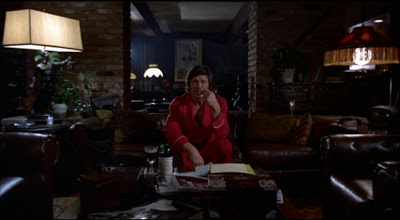
The plot of the movie starts after this opening sequence. Bishop gets a call from an old family friend who has crossed a line with the criminal organization that Bishop’s father once worked for. “Big Harry” (Keenan Wynn) wants Arthur to intervene on his behalf, even though he believes Arthur is not in the organization. It turns out that Harry has been given to Bishop as his next target. Bishop lives in a house off Mulholland Drive in Los Angeles. It is a unique home with a large two story atrium filled with exotic plants. There is a swimming pool that is half in the house and half on the patio. There is also a wall of weapons on display with a cork board behind it on which he plans his jobs. He drinks fine wine, smokes a pipe and lounges in red silk pajamas. Arthur Bishop is a sensualist without any real human connections and that’s what draws him to the spine of the story.
When he encounters a young man, much like himself, alienated from others with a strange sense of what is invigorating, he believes he has found an apprentice. Jan-Michael Vincent, a legitimate contender for stardom gone wrong status, plays the son of “Big Harry”. He ingratiates himself with Bishop because he senses that there is something going on behind the man’s stoic demeanor. Again, there is a long stretch of time without any action but the two characters are feeling each other out. We get more information about how isolated Bishop really is when he visits the now defunct and vanished “Marineland” and has an anxiety attack that mimics a coronary. His only human contact other than “Steve” the kid he is thinking about taking on, is a prostitute who has to invent elaborate romantic stories to satisfy him. I did especially like that Jill Ireland playing the girl has her apartment walls lined with old movie posters for films from the thirties, forties and fifties.
Now the story is full steam ahead. The two twisted men, who have been feeling each other out, go into an association that will have them working together. This is where there will be a variety of plot twists and complications that will cause the audience to wonder who really is in control of the situation. Bishop has always been cautious and thorough and he is passing these same skills onto a man who shares his value. It’s not about the money, “It has to do with standing outside of it all, on your own.”
I mentioned that there is a motorcycle chase. This happens out in the Newhall area of Southern California. This is the start of the last section of the film which does contain a lot more action. The nice thing about all the action is that you can follow it. There is a car chase on a highway on a mountainside in Italy, it looks like it could be the same road for the opening car scene in “Quantum of Solace”. The difference is we always know which car we are following, where they are relative to one another and we can see the physical actions required to get the explosions, sharp turns and gunshots off.
This has always been my favorite Bronson starring vehicle. His performance is stronger in “Hard Times” but the character here is so very intriguing. The conflict that exists at the end of the film was more shocking than most twists in a standard action film, and that opening sequence just hooks you in. Bronson’s shaggy hair, Fu Manchu mustache and craggy face are so unlike the looks of most film stars that you could never mistake a Charles Bronson film for one made by any of his contemporaries. Steve McQueen and Paul Newman were too pretty, Burt Lancaster and Kirk Douglas were too long in the tooth at the time. Bronson was unique and his individuality shows itself best in this film.
I don’t know what I did, but the completed post for “Death Wish” disappeared this morning. I was trying to copy it over to the other site and BOOM it was gone. So now I have to do the best i can to recreate my original comments on this iconic Charles Bronson Film.
Charles Bronson had starred in some of the biggest action movies of the 1960s, including the “Magnificent Seven”, “the Great Escape” and “The Dirty Dozen”. He was an international box office star at the turn of the decade, but he had not reached those heights in the United States. His name may appear above the title, but he was not necessarily a draw…until this movie happened. His fourth film with Director Michael Winner, turned out to be the biggest hit of both their careers. While a blessing in some ways, it was also the start of a path that would narrow Bronson’s options as an actor down the road. There were four sequels to this project, all of them ultimately made money but none of them had the impact of the original “Death Wish”.
The movie was successful not simply because it was an effective exploitation film. It tapped into zeitgeist of the 1970s, crime in the big city. NYC was the poster child for violent criminals gone wild. Just a few years before, Clint Eastwood and company were accused of facism and advocating vigilantism because of similar themes. While “Dirty Harry” is a classic of the era, when it comes to touching off controversy, it was nothing compared to this movie. Here is the last line of the New York Times Review from 1974 (Vincent Canby) “it’s a despicable movie, one that raises complex questions in order to offer bigoted, frivolous, oversimplified answers.” The Variety said “Poisonous incitement to do-it-yourself law enforcement is the vulgar exploitation hook on which Death Wish is awkwardly hung.” It returned seven times it’s budget in the U.S. alone however. Clearly the public saw something here that stirred them. The answer was pretty straightforward, Charles Bronson was dealing out the justice that was so frequently denied to victims of crime in those days. They identified with Paul Kersey, a peaceful man who had actually been a conscientious objector in his war service, who had the most horrifying thing happen to his family and the cops were unable to do anything about it.
In an attempt to recover some sense of sanity, Kersey takes a contract over from his architecture firm for a development in Arizona. The developer wants a design that is maybe less space effective but that preserves the sense of space a family might like to have. Stuart Margolin had appeared with Bronson in an earlier Micheal Winner Film, “The Stone Killer”, there he was an mercenary working as a gangland assassin, but in this film he is an avuncular traditionalist who gives Kersey an opportunity to feel empowered.
In Arizona they do some target shooting, but when he gets back to NY, Kersey discovers that the gift his new friend has sent back with him is a gun.The story however does not immediately turn Bronson into a stone cold killer. First he gets a taste of simple justice by defending himself with nothing more than a sock with a couple of rolls of quarters in it. When he fends off a mugger successfully, he gleefully swings his weapon around his apartment with enthusiasm. It is this first rush of control that pushes him toward carrying his new six shooter around at night. Kersey is not hunting the hoods who attacked his family, he is fighting back for all of us and it created an uproar in the film story as well as the real world.
The consequence of swift justice, in spite of it’s illegal nature, is that muggers begin to second guess themselves. This has always been one of the arguments gun rights advocates have made, if everyone is disarmed, we are all potential victims, if anyone could be armed the criminal is more likely to be the victim. In one of the few moments of humor in the film, a grandmother type tells a TV news crew how she was inspired by the vigilante and used a hatpin to fight off her attackers. It will amuse us but it frightens the police who see random acts of violence as likely to result in the name of just such vigilance.
One of the things that makes the story feel necessary to the audience is the fact that an average person is unlikely to get justice, after all the investigation of the crimes against Kersey’s wife and daughter is going nowhere. The police though, turn a dogged detective loose on the vigilante, and the procedural in looking for that criminal seems very effective. Vincent Gardenia, in the same year that he was nominated for supporting actor in “Band the Drum Slowly”, tackles the part of a cop who is given conflicting orders. He must find the vigilante but should do nothing that would harm the downward trend of violence that the vigilante has left in his wake.
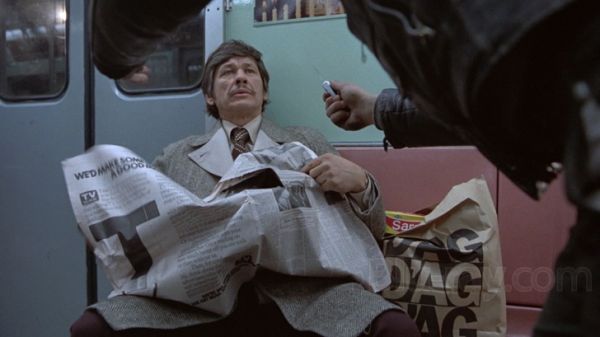
Ochoa tumbles onto Kersey and plays a cat and mouse game with him as Kersy continues to rid the city of as much vermin as he can find. The violence quotient in the film is high and Bronson’s character goes out of his way several times to find criminals that he can eliminate. In a scene on a New York Subway, that anticipates Bernie Goetz by 10 years, Kersey rides alone in a subway car, baiting three thugs to attack him but he turns the tables on them dramatically.
This is one of those lines the film asks us to consider, if we deliberately make ourselves a target, are we justified in our actions. Of course the film’s answer to this is a resounding “YES!” The audience knows who the bad guys are. The likelihood is that, today, the film would also be targeted as racist because the actors cast as thugs are primarily from the usual ethic groups that get blamed for crime. In the 70s though, audience were less concerned about being culturally sensitive and were instead freaking out that the violent crime rate had tripled. They needed a character they could identify with to help them feel empowered if only for an hour and a half.This movie fit the bill and Bronson’s performance helps us make that identification. He reacts to his own violence the first time the way many of us would, by puking. Kersey is an early sufferer of PTSD and his way of coping is to act, even if it is not against the specific criminals responsible for his trauma.
Director Winner moves the action effectively and stages the final conflict between Kersy and the last set of thugs as if an old west shootout were in the offing. Some might get the feeling from the look of the movie that this was a cheap exploitation film, but if you compare the lighting, sets and atmosphere, you could easily confuse it with one of Sidney Lumet’s urban thrillers of the era. NYC is gritty and dangerous, there are places where you would not want to be on your own, and the movie conveys this very well. The dialogue exchange between Ocha and Kersey recalls an ultimatum given by a sheriff in the old west, another deliberate choice that works well and provides a little humor.
Jeff Goldbloom and Christopher Guest both have small roles in the film, very early in their careers. Charles Bronson would have his biggest success in America with this film and almost all of his obituaries probably started with a reference to this icon of 1970s cinema. Intellectually, there are valid reasons to question the ethics the film sets forth, but most people living in fear of just walking out the front door did not want an intellectual debate on law and order. They wanted to feel safer. For the run time of this film, Charles Bronson made them feel that way.
When the Italians refer to you as “The Ugly One” and the French call you “The Holy Monster”, you know you are not going to be cast as the romantic lead very often. Charles Bronson had a face that looked like a catchers mitt that was left out in the sun for a long time. His skin was tough, his mouth was small and his eyes narrow. As he got older the features deepened and gave him real character. Still he managed to be an effective love interest in several films with his wife actress Jill Ireland. In fact, she appears in four of the five films we are covering for this little festival. The romance was almost always a secondary part of the main story and that is the only slightly different with this movie.
This was the first movie directed by Walter Hill. He had screenplay credits for a number of films before he began directing, including the neo noir “Hickey and Boggs” and the Steve McQueen/Ali Macgraw thriller, “The Getaway”. He would later go on to direct “The Warriors”, “48 Hours” and “Streets of Fire” which was recently featured as the Movie of the Month on the Lambcast. This was a project that seemed destined to bring these two together. I read an interview with the great Strother Martin, where he complained a bit about how the movie was cut. Both his part and James Coburn’s parts were trimmed by several sequences and he felt that the movie seemed like a program filler rather than something special. I don’t know if the studio interfered, but Hill was one of the writers and as director he called the shots. In retrospect the movie is a excellent example of spare story telling and interesting characters. The side plots might have been worthy, but the focus always needed to be on Bronson’s Chaney.
The title says it all, it’s the depression, jobs are hard to come by and everyone is looking to make a buck. Bronson drops into town, a beautifully shot New Orleans, off a freight train with nothing more than six bucks in his pocket. It’s been commented on in the notes on the DVD and on the IMDB page that Bronson has barely 500 words of dialogue in the film. If you watch the first five minutes you will know why. He simply does not need more. The character is laconic because he has little interest in other people or events. He is a loner and can indicate a lot of emotions with that punching bag face. Just watch the way he works the toothpick in his mouth while sitting at the counter of the diner. It moves along with his level of attention to different subjects.I’ve seen plenty of actors use props like cigarettes or food to make a point, Charlie just needs the tiny stick. In the bare-knuckled fights, the opponents usually are the ones with the big talk, Chaney let’s his fists do the talking. There are two scenes where other characters come right out and ask if that’s all he has to say about a subject, he doesn’t even give them a one word answer.
Another reason that it is a good thing that Bronson has few lines is that Coburn has so many. His character is nick named “Speed” and it sounds like that is based on his conversation skills. “Speed” is the loser character of the piece. He is a small time operator who dreams of the big time but almost always blows it on bad choices, especially saying a few words too many. His collaboration with Chaney would seem to be a nice symmetrical match. This is the third film the two stars made together, they previously appeared in “The Magnificent Seven” and “The Great Escape” together. Coburn had moved to the front ranks of film stardom but was slipping a but by this time, Bronson was peaking. This was their last film together.
Strother Martin probably had a bit more right to be irked with some of the trims. There are no scenes in the film where he is doing the work that he is contracted for. Everything he does is in assessing Chaney before a fight, not treating cuts or bruises. In spite of that, he steals the movie in every scene he is in. His dialogue is the best in the script. He plays an opium addict, with a poetic streak a mile wide.
Chaney: Two years doesn’t make a doctor.
Poe: Well, in my third year of studies a small black cloud appeared on campus; I left under it. Some are born to fail, others have it thrust upon them.
At the final fight, when Chaney has been manipulated into fighting, Martin picks up a wrench and throws it through the second story window of an office to announce that they are ready to begin.
Actor Robert Tessier specialized in playing menacing tough guys on TV and in the movies in the 70s and 80s. He was an early example of a bald head being used as a symbol of intimidation in the movies. He was a dangerous convict in “The Longest Yard“, a tough guardian angel in “The Deep” and he was the villain with his voice dubbed in “Breakheart Pass“. He is Chaney’s first real test as a fighter and their fight is one of the big action pieces of the film. It is shown from above, and then the crowds are shown at an angle looking up. It is a clever way to add to the staged fisticuffs that are going on in an abandoned factory. His role gives Bronson another chance to show how small acting touches can be so effective. Tessier smiles manically a couple of time during the fight, he even tries to intimidate with a backhanded compliment. Bronson remains mostly impassive, with only the mildest of smiles when he gets the upper hand. The absence of open emotion is the stronger personality in these scenes.
Another actor who works well as cast is Bruce Glover, maybe better known as the father of Crispin Glover these days. His face and voice convey a sadistic streak as the enforcer for a loan shark that “Speed” turns to for a bankroll. His Mr. Wint in the James Bond film, “Diamonds are Forever” would be the closest character I have seen him play with this type of vigor.
Just as Bronson cuts off conversation with two other characters after they ask if that’s all he has to say, he also initiates conversation with both of them the same way. He simply helps himself to a seat at their dining table. His come on to her in the diner is quiet and non-threatening. It is a little unusual for a guy who is supposed to be taking charge, but it is his confidence not his bluster that gets them connected. This is another great contrast with “Speed” who has to try to get in the last word every time and ends up looking like a fool.
There is a scene where he tries to impose a financial arrangement on Chaney but gets put in his place pretty quickly by Chaney simply standing up to leave. Another example in the script of less is more. “Speed ” is all easy charm and smiles but it can’t get him what he wants, Chaney is coiled silent tension, but even when he strikes it is in a non-flamboyant manner.
On top of the great script and the interesting characters in the movie, the film benefits from it’s look. Depression era New Orleans must have been a bit of catnip to film makers. Bourbon Street has a classic look and many of the older buildings have not changed since the era. Steve McQueen starred in “The Cincinnati Kid” a poker movie set in the same period and the landmarks and factories sell the authenticity of the film. I watched it on a Twilight Time Blu Ray disc and the transfer is stunning. The opening scene where Bronson just jumps off of an arriving train looks beautiful and the rest of the movie follows.
If you are unfamiliar with Charles Bronson, and want to see the kind of actor he could be, outside of the vigilante films he ended up being ghettoized in, than “Hard Times” is a great place to start. The characters make the movie and the acting elevates it. It may not be my favorite Bronson film, but it is my favorite Bronson performance.







 Kirkham A Movie A Day