Dead Man’s Wire (2026)

We got an early peek the other night at one of the films that will certainly be a highlight of the first quarter of 2026. This movie features two stellar performances, and a very efficient reenactment of a real life event from 1977. I was in college in 1977, but I’d been doing quite a bit of traveling with the debate team, and at the time that this news event took place I was only vaguely aware of it. I’m glad that I didn’t have a complete memory of what happened, so although there was an actual historical antecedent I was surprised by the turnout of the events.

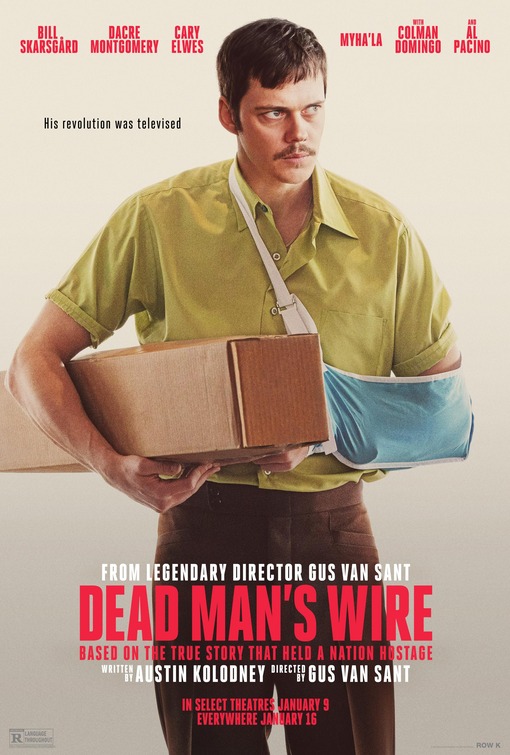
“Dead Man’s Wire” tells the story of a man frustrated by his inability to overcome economic forces that were crushing him. If you took the hostage drama of “Dog Day Afternoon” and combined it with the injustices that drive the characters in “Hell or High Water”, you would have a pretty good template for this movie. Tony Kiritsis takes a man hostage by looping a wire around the man’s head connected to a sawed-off shotgun with another wire connected to Tony. His goal is to recover economically from the dirty deed that a mortgage company has done to him, or at least that’s how he sees it. There’s been a long-standing dispute between Tony and the company over his mortgage on a piece of property that he hoped to develop in which he claims the mortgage company interfered with in order to force him into liquidation. It’s not merely the money however it bothers him. Tony is on a righteous crusade to get an apology from the president of the mortgage company who was his original target, but instead he is forced to take the vice president, who is the son of the president, as his hostage.

The real life incident took place in Indianapolis, and the filmmakers do a good job replicating the feel of 1977. The film stock seems to be from that era, with a good clear image, but a patina of shading it seems authentic to the time. Indianapolis is not a big city like New York, they didn’t necessarily have a hostage negotiator available, or a specialized SWAT team trained in all kinds of responses. Frankly the authorities are befuddled as to how to proceed. The suspense derives from the fact that any assault on Tony would result in the immediate death of his victim Richard.

Tony is played with gusto by the versatile Bill Skarsgård, who has become an obsession of my daughter. I think I saw three films starring Skarsgård last year. I can say however that this is his best performance without being under a pile of makeup. Tony has a righteous indignation, but he is not particularly cruel or vindictive to Richard. That helps keep him a sympathetic character which is exactly what the real Tony Kiritsis became to the public back in the day. He feels like a crusading Robin Hood trying to right a wrong that everybody else could identify as a thing they could easily have fallen prey to. The little guy against the system is the main theme of the film. Although the movie is very serious, like “Dog Day Afternoon”, there are moments of levity that occur because of the quirks of the characters.

Richard is played by actor Dacre Montgomery, best known for his portrayal of Billy in the show “Stranger Things”. He looks completely different in this role, and unlike the muscle bound preening Billy of the TV show, here he comes across as a bit of a nebish with a stoop and an awkward way of being polite that puts him at odds with Tony. These two actors account for most of the screen time but there is some other activity that’s worth mentioning. Richard’s father, the real villain of the piece, is played by Al Pacino with a little too much of that Foghorn Leghorn articulation that he’s developed over the years. If there is a weak link in the film, it’s from the most experienced of the actors. The father is equally self-righteous that he has done nothing wrong, to the point where he abuses his son Richard almost as much as Tony did.

The collection of local officials, some of whom knew Tony, as a local businessman, bar buddy, and occasional public nuisance. The undercover police officer who first arrives at the scene of the original kidnapping, is an acquaintance of Tony from a local bar. No one can believe that Tony is attempting this audacious Act of Justice, which violates the law and decency in an attempt to be treated decently. The cop is played by an unrecognizable Cary Elwes, and he is also terrific in the part. Even more impressive, once again, is Colman Domingo, who plays a local DJ, Fred Temple, who takes Tony’s call and helps mediate the crisis while trying to keep things cool.
There’s also a huge amount of social commentary in the way the news business handles this event. In the days before 24 hour cable news, local stations provided updates but not the continuous coverage that we would see today. The local news gets picked up for National presentation, so the two and a half days that this incident covers was closely watched by a nation that was not used to seeing crimes carried out live on TV.

As an audience, our sympathies are with both men, Tony for the Injustice done to him and Richard for the threat that’s being placed on his life. Neither man deserves what is happening. The police, and ultimately the FBI, arrange a deal with Tony, that you hope is going to resolve things. I won’t spoil the resolution for you, but I will say that it is a real world illustration of how the justice system can get something right even though they do so in the wrong way.

This movie deserves your attention, and it will command your interest through the performances of the two leads in the improbable but real life story. It’s hard to believe that it took 50 years to turn this into a movie, but first time screenwriter Austin Kolodney has done a nice job taking the unusual aspects of the real life story and turning it into a compelling narrative with an interesting theme. The movie is seamlessly directed by veteran Gus Van Zant. This may be the most accessible film he’s made since “Good Will Hunting”. Hopefully it’ll enjoy a good deal of success and bring attention to the actors who deserve credit for making us care.

The Princess Bride: An Inconceivable Evening with Cary Elwes

It’s rare that you find a perfect movie. A few years ago I had a post up about three films that I thought fit that category. When I say perfect I don’t mean that it’s the best film of all time, or that it’s essential for everyone to see it, although I could never understand why somebody wouldn’t want to go and see a perfect film. What I mean by perfect, is that it could not be improved by any changes made to it. The parts that are there, have been assembled in the correct way, they all fit together, and they work exactly as they are supposed to. “The Princess Bride” certainly belongs on the shelf with any film that could be described as perfect.

Once again I had the opportunity to see this perfection on the big screen with a receptive audience. On top of that, it was screening at my new favorite theater, The Paramount in Austin Texas. And just to add frosting to the cake, the star of the film Cary  Elwes, who wrote a book about the making of the film a decade ago, was there to share some stories after the film was finished. What can I say about “The Princess Bride” that hasn’t been said by hundreds of people before me? This movie is funny and dramatic, full of the swashbuckling kind of adventure that I have loved since I was a child. It also has a heart to it that beats and moves us like no other film I can think of. When I was asked by my daughter what my favorite moment in the film was, I had to admit it’s the last line when the grandfather, played by the great Peter Falk, says to his grandson, when asked to return and read the book again to him tomorrow,” As you wish.”

That moment gets me every time, because I think of my own children and my parents and grandparents and everybody who cared for those who came before them or after them. This is a story for everyone. And it’s a story about true love, the rarest thing in all the world. And I’m not just talking about Wesley and Buttercup. We all get a chance to feel embraced by and loved by this film. It makes a Giant feel like a human being that we would want to be friends with, it makes us cheer when the bad guys get their  comeuppance, and we’re all willing to sit through the kissing parts in order to get to the good stuff.

I saw this film originally when it was released in 1987, after my parents had gone to a screening at the studio. They enjoyed it but we’re not overly impressed by it. My father’s half sister Cherry Ann worked for Norman Lear, and she had arranged for my parents to go to the early screening. My wife and I were really jealous because we had looked forward to the film. In spite of my parents’ lack of enthusiasm, we rushed to see the film as soon as it came out. And like those who have come after us, who scratched their heads and wondered why this wasn’t a bigger hit, we could not understand why the movie was not being embraced by audiences everywhere. Frankly we loved it from the moment we saw it.

This was the middle screening of three showings of the film with guest Cary Elwes at the Paramount Theater this month. Of course we had bought our tickets when the first show went on sale, and then two shows were added, one in front of and one behind the screening that we were going to go to. A decade ago we went to a fantastic screening, also with the star of the film, when he was doing a signing of his newly released book,” As You Wish”. It was one of the best outings I had with my wife in the last decade of her life. You can read the story of that event here.

Mr Elwes, I’m sure, has told the stories that he shared with us many times before. However, as with all good storytellers, he enthralled us with details, spoke with voices that recalled the people he was talking about, and was thoroughly enthusiastic about the moment. There was nothing artificial at all about his conversation, even if it is something he’s done a thousand times before. He recalled the story of his injuries on the set, and took full blame, even when others may have contributed a little bit to his on-site mishaps. He recalled with great fondness everyone’s friendship with Andre the Giant, and he does a great impression of both Andre and director Rob Reiner. It feels a little bit after having listened to him, as if we were on the set as well and went through the adventures with him. Which is exactly how you want to feel in an event like this, with a movie that’s perfect.

One of the great things about seeing a movie that you have already seen dozens and dozens of times, is experiencing it with others who feel the same way about it as you do. Last night a capacity house, laughed and cried and cheered as “The Princess Bride” took us on the adventure that we all know so well. We were all a little incredulous when we heard that Mr Elwes had only watched the movie three times. After all, collectively among the people in this audience there may have been a million views of the film. It’s doubtful that any of the 1,000 or so people there had seen the film only a single time. Okay so maybe a million is a little hyperbole, but you get the idea, this audience knows the movie.

Like many of the films of this era, the special effects, production design, and cinematography make the film feel so much richer than it would be if it had been produced in the era of CGI. The Cliffs of Insanity and the Fire Swamp, looks so real yet it’s clear that it is artifice. And we the audience are swept up by the fervor of those Charming effects, and the spectacular, beautiful, cinematography. Watching The Man in Black chase Fezzick, Vincini, Inago Montoya, and Buttercup up the cliffside, is thrilling. It’s also funny, and filled with some of the lines that people have memorized over the years. It was easy for me to foresee that this film would have long-term legs, I once judged at a speech tournament where one round of the impromptu speeches were all quotes from this movie, and that must have been in 1989.

The sound of laughter was also highlighted by regular applause when our heroes were introduced and our villains taken down. The occasional lone applause clap when Mr. Elwes was telling a story would be amusing because sometimes it was for something completely incongruent. For instance one member of the audience happened to have lived in the area where the movie was filmed. Mr. Elwes laughed at the single clap, and was gracious in acknowledging the beauty of the area. When questions were submitted by the audience ahead of time, they were read out loud by the interviewer, and Cary answered enthusiastically. The host called out one question in particular as his favorite, and asked where the little girl was who had submitted the question. Her family was quick to wave their hands, and Cary, left the stage and went over to talk to her personally to answer her question. But she was young, maybe eight or nine and the thought that a thousand people would be looking at her made her even more shy, Mr. Elwes did his best to minimize her discomfort, and draw attention away from her and back to the question. It was a moment of warmth from the star who was being considerate both in trying to see the girl personally and in withdrawing from her because of her shyness. It was a moment of complete sweetness, in keeping with the whole evening.