
Little Women (2019) Revisit

A general rule of thumb is that remakes are never as good as the original film. That is certainly true of a great number of films, for instance as much as I love the 1978 and 2005 versions of King Kong, They don’t really hold a candle to the original 1933 film. Of course there is always the exception which proves the rule. “Little Women” seems to be that consistent exception. Although Katherine Hepburn may have been the perfect Jo, the two most recent versions of the film from 1994 and from 2019, film makers have found ways to make this story better and better told than the earliest editions.

In fact I’m of the opinion that the most recent version from Greta Gerwig in 2019 is the best version of Little Women. Saoirse Ronan is Practically Perfect as Jo, and Florence Pugh as Amy is just as good. This version of the film  pays particular attention to the relationship between Amy and Jo, and the characters are much more vivid and real as a result. Like real sisters, these two fight, make up, fight some more and still love each other deeply. The few moments of regret that Jo feels late in the film for rejecting Laurie,  are made all the deeper by our knowledge that Amy has replaced her affections.

Jo’s time in New York is one of the things that distinguishes this version from earlier editions. The gritty City in the middle of the 19th century is brought to life by great production design, and by the attitudes of the men around her as Jo tries to launch a career as a writer. The future love interest for Jo, is not so much a dashing foreigner as he is an honest critic and solid companion. Her initial rejection of him comes from a vanity that she herself would be mortified to discover exists. The reconcilliation that occurs is more believable because of the way that Gerwig has time shifted the story around. She is emphasizing emotional points rather than chronological points. The only criticism I have is that it is sometimes dependant on out observation of Jo’s hair, to be able to place the sequence of events in an order that works. 
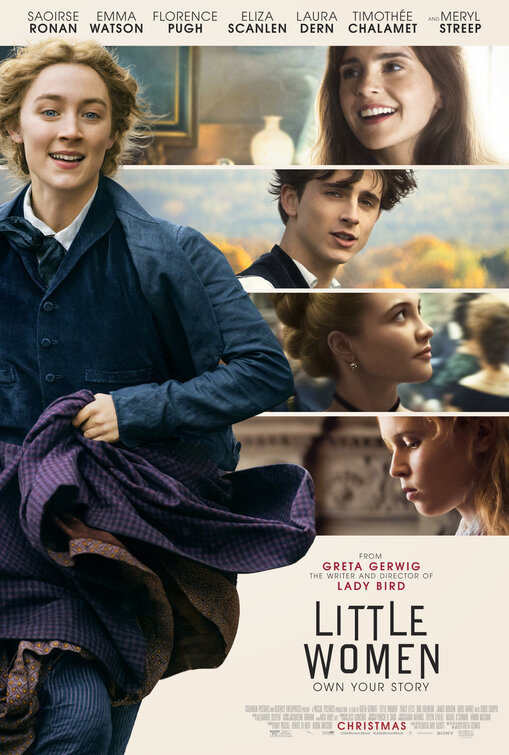
This film was featured as part of the Paramount Holiday Movie Season, and although it is not strictly a Christmas film, it passes the smell test the same way that “Meet Me in St. Louis” does. There is a key Christmas segment and the family connections all seem to be reflective of the spirit of the holiday, regardless of the season. There is gift giving throughout the year, and warm memories are present in the nostalgia of the sun as well as the snow covered lands around the March house.

I suppose every generation deserves a chance to make a story their own.  Maybe years from now, another screenwriter/director will imagine a way to tell this story in a way that is meaningful to children just being born now or in the near future. The foundations have been laid by the original story, I’m just glad when the contractor knows when to make some design changes. 

Pride and Prejudice (2005) Movie Party Revisit

The Glorious version of Pride and Prejudice from director Joe Wright celebrates its 20th anniversary this year. There have been many screenings and the film well a success in its original release, has become quite a cult phenomena with a strong following and a very strong reputation. We last saw it on the big screen 3 years ago had an Alamo brunch screening. We didn’t have the foresight those 3 years ago to include the brunch as part of our activity, an oversight that I regret to these days. This year’s screening was also at the Alamo, and it was a movie watch party. The fans of the film came out in large numbers, there was not an empty seat in the house.

One of the things that happens at the movie watch parties is that there are props provided as we go in. We were given a handkerchief with an embroidered patch for Alamo, so that we could drop it in front of the troops as they marched by, and hopefully one of the handsome soldiers would pick it up and return it to us. We also had a small stuffed object in the form of a potato, with a face, and the phrase what excellent boiled potatoes embroidered on it. It was good for a laugh but not very practical. As I said everybody at the screening was just in a mood to share the experience and enjoy the romance.

When I wrote about this film last time I do think I focused on the creative direction of Joe Wright. The camera follows the actions of the characters in a way that is both organic and interesting, without drawing attention to itself. That is particularly notable in the dance scenes, but as I watch the film this time it was clear that this creativity was followed throughout the film and it certainly made the story flow very smoothly. Elizabeth and Mr. Darcy do dance throughout the film in very different ways. Lizzy is at first enthusiastic and forceful, and then demure and indifferent. Mr. Darcy, is imperious and condescending, but he also eyes her at different times suggesting potential intimacy that he would never reveal in more obvious manner. The main characters are well serviced by the story.

I thought this time I would spend a little bit more energy on the supporting characters of the story. Mr. Bingham, played by Simon Wood,  the original object of affection by the Bennett sisters, is at times doe eyed, and oblivious. His delightful awkwardness is accentuated by the actor’s facial expressions and vocal cadence, which frequently ends up in a series of malaprops, stutters, and apologies. His friend Mr. Darcy must have been incredibly embarrassed by his befuddlement. The butt of most of the humor in the film, is the obtuse Mr. Collins, Tom Hollander, who while seeking a wife amongst the Bennett sisters, comes off as an officious prude, in spite of his attempts at being socially adept. It is clear that he is a climber of the social strata’s, and the way he drops the name of his benefactor, makes him feel even more clumsy. He is a sincere man, with generally good intentions, but he is in over his head and never seems to notice. That he ends up married to Lizzie’s close friend Charlotte, might be seen as a tragedy by some, but the actress playing Charlotte, Claudie Blakley, conveys a resolute cheerfulness about her new circumstances, and never once comes across as regretful. The two actors playing these parts were perfectly cast and performed.

I believe I may have said before, I think Donald Sutherland is the hero of the story as Elizabeth’s father. He takes her side against her mother in Sutherlands delivery of the eloquent line where he says you will lose the affection of one of your parents if you decide either not to marry Mr. Collins or to marry Mr. Collins. Sutherlands final scenes as Mr. Bennett discussing with Lizzie the potential marriage to Mr. Darcy is warm and embracing, characteristics that have not usually been attributed to Donald Sutherland in other roles that here, he enthusiastically embodies a doting father, regretting the loss of his daughters to husbands. Brenda Blethyn as Mrs. Bennett, provides the other comic relief in the film , as her conniving plotting to bring her oldest daughter and Mr. Bingham together plays out. Blevins is both sly and obvious and the balance between those is the credit she deserves for her performance.

Judy Dench comes in in the last Acts as Mr. Collins benefactor, Lady Catherine de Bourg, and she does her customary job of excellently portraying a cold impersonal harridan. She certainly stands out as a character, but it is not much of a stretch from some of the other parts that she has played.

We will continue to return to this delightful version of Pride and Prejudice whenever we get the opportunity. It is an incredibly well directed film, with perfect casting, and excellent performance is by the leads. We are also incredibly lucky to get the terrific secondary cast, to fill out the parts that make this a more complete world. Oh and by the way, the boiled potatoes were excellent.