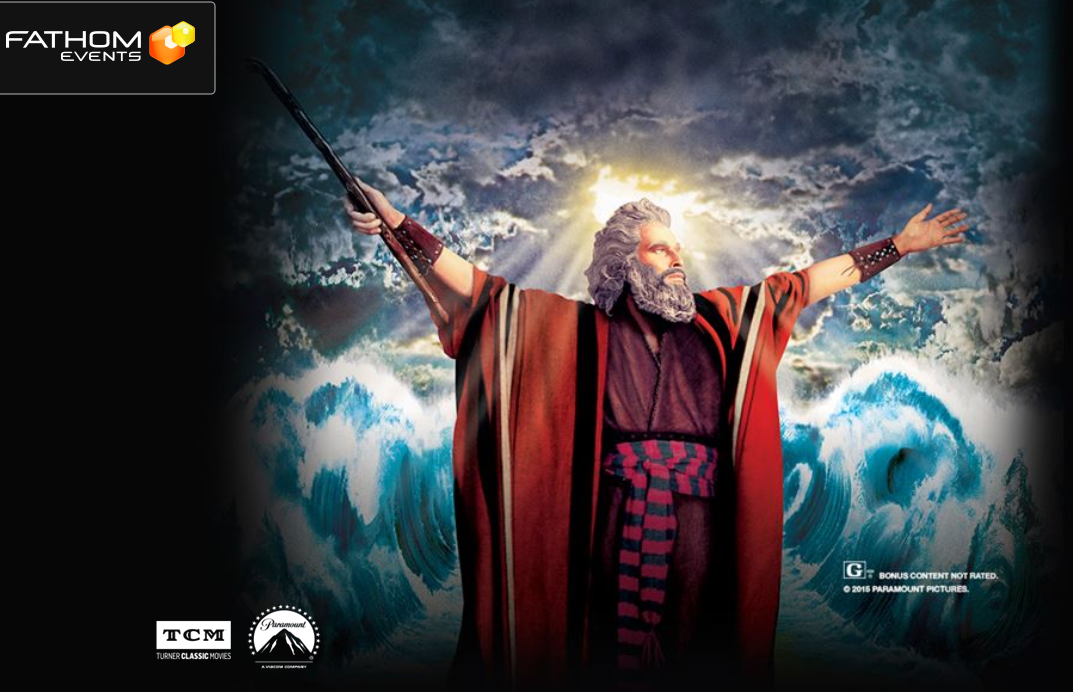
TCM Ten Commandments Fathom Event

It was just two years ago that I went to a screening of “The Ten Commandments” at this same theater. That showing was not a Fathom event but rather part of a series AMC Theaters did that year running a whole variety of older movies. It was not particularly well attended in part I’m sure because of a lack of promotion. Today, I returned to the Red Sea with Charlton Heston and because the screening was a Fathom Event in conjunction with TCM, the theater was quite full. It was not a sell out but it was impressive for a Sunday afternoon screening of a sixty year old film.

Once again the film was spectacular, and although the special effects are six decades behind today’s digital technology, it still feels more than impressive. TCM Host Ben Mankiewicz pointed out that much of the exterior work was shot in Egypt and that there were enormous sets to complement the camera trickery that makes the city of Goshen appear so impressive and of course the parting of the Red Sea so notable. The photographic effect of the final plague on Egypt looked like God’s green fingers were coming from the sky and that the fog which clung to the ground was his breath, turning Ramses edict on itself and slaying the first born of Egypt while passing over the Israelites who marked their thresholds with lambs blood.
The style of the dialogue sometimes provoked a bit of laughter from the audience. Let’s face it, half of the time anyone says the name of Moses, they repeat it a second time in the script. The things that are most believable in the filming are the impressive use of the extras, especially in the Exodus scene itself. The geese, and goats and camels and cattle all interact in a very realistic way with the impressive cast of thousands.  Still none of it would matter if Mr. Heston and Mr. Bryner were not convincing in their parts. While much more theatrical in nature than most of us are used to in acting today, both the leads are effective with their faces, body movements and voices. Both of them make large public pronouncements that would sound silly coming from today’s leaders but are sincere in the context of this film.

So many character actors are in the film that it is a wonder that they could keep them for as long as it took to shoot the film. I’ve heard it said that Edward G. Robinson was miscast in the movie but his slight NY accent did not seem to be a distraction to me. Vincent Price was suitably slimy and  hearing John Carradine’s sonorous voice backing up Heston was a delight. The only performer who seemed slightly awkward at times was Anne Baxter, but her scenes near the end of the movie were far more effective than the love scenes in the first hour.

It’s Easter season so this film is a perennial and it made sense for TCM to schedule it during the Holy Week. If you are looking for some easy way to commemorate the Holiday, the nearly four hour investment in this movie is probably worth your time. It is also playing again this Wednesday, so play hooky and go, you will be glad you did.

Butch Cassidy and the Sundance Kid: Fathom Events/TCM Series

In preparation for this Fathom Event, I went back to an excellent post written my my friend Michael for his own blog three years ago. “An Appreciation: Butch Cassidy and the Sundance Kid” is well worth your time. There are nuances that I found really interesting and anybody who loves Butch and Sundance should love it. I also know that sitting somewhere on the other side of town, Michael was enjoying the same experience I was because there is no way he would miss an opportunity to see this wonderful film on the big screen.

I myself wrote about this film for the final post I did for “Fogs Movie Reviews“, a site that I contributed to for several months before its ultimate retirement. That post was about the three great Westerns of 1969. Today I am going to focus exclusively on the George Roy Hill film. As Ben Mankiewicz said in his intro to the film today, it was the biggest film of 1969.That was an understatement, it made over a hundred million dollars and that was more than twice as much as any other film made that year. I first saw the movie with my friend Don Hayes when his family took me with them to a drive-in theater to see the flick, that was probably late 1969 or early 1970.

The secret of the films success is so easy to identify after watching the movie again, that it surprises me. There are three essential ingredients that make this movie sing. First is the star pairing of Paul Newman and Robert Redford. In old Hollywood, they say you could feel the chemistry of stars in a film. Bogart and Bacall, Tracy and Hepburn, Flynn and DeHavilland all had charisma together that made their films fly. Here is a match between same gendered co-stars that had the same effect. Their only other outing together is the Academy Award winning “The Sting“. That’s a pretty good track record for casting. From the opening sequence, the two of them showed perfect comic timing, playing off of one another’s facial expressions and body language. In the long sequence of the film where they are fleeing the pursuing super posse, they sweat and squirm and kibbutz with a real relationship that seems built on years together as outlaws. Mankiewicz mentioned some of the original choices for the film cast and I can’t imagine Jack Lemmon as Butch but I could see Steve McQueen as Sundance. Lucky for us that we had to wait for that Newman/McQueen flick until 1974.

The direction of George Roy Hill is another piece to the success of the film. Hill has managed a number of films with a nostalgic feel, including “The Sting” and “The Great Waldo Pepper”. He may not have been as stylish as other film directors but he had an eye and an ear that would let the past come to light and I think his creative use of music cues, sepia tones and timing of comic scenes accouts for a lot of the reasons that people can love this movie. The first five or ten minutes of the movie look like the nickelodeon feature that plays behind the titles. When the three main characters head off to Bolivia, they make a stop in NYC near the turn of the 20th century and the photo montage delivers enough information that we don’t need the extended film sequence that had to be condensed for reasons of studio politics. The lighting choices for most of the night scenes feel very distinctive from other films at the time. Of curse he was aided by Conrad Hall’s cinematography.

Finally, the most important ingredient in the whole concoction is the script by William Goldman. He had done extensive research, and for the spine of the story, the opening tag that declares “Most of What Follows is True” is mostly correct. Long time fans of “The Princess Bride” will be able to recognize the attitude of some of these characters. They are non-conformists with a wicked sense of humor and a streak of fatalism about them, for instance when Sundance turns his back on Butch as he kids that he is stealing Etta from him, he mutters “Take her”.  That sounded like the Man in Black and Prince Humperdink all at once. Percy Garris mocking the two bandits turned payroll guards as Morons, is just priceless. Sheriff Bledsoe, played by Jeff Corey, speaks wisdom without the humor when he points out that times have changed and that the two outlaws have outlived their minor legend. Sundance complains about where they have landed in Bolivia, “this might be the garden spot of the whole country.” The gallows humor is abundant and it is one of the most wonderful things that Goldman contributed to the story. Goldman wrote in one of his books that this was one of two real life stories that he thought were instantly compelling and cinematic. Somehow they managed to neuter “The Ghost and the Darkness” but thank heavens this story was brought to life by the right set of artists.

The movie will be playing two more times this coming Wednesday, I can’t think of anything you might be doing that would be more enjoyable for two hours than taking in this film. Get thee to a TCM/Fathom participating theater and set yourself down for the best time to be had in 1969 and so far, 2016.