The Dog Stars (2026)

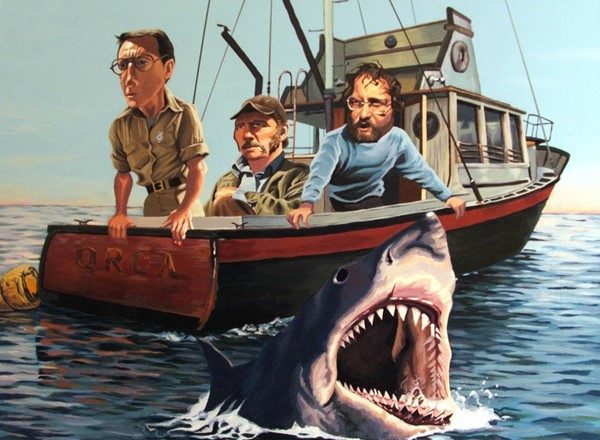
I’m not sure why a Ridley Scott film, featuring some terrific action sequences, isn’t hitting with audiences or why it’s being released in late August. Theatrical presentation is a little uncertain these days, which is too bad because I think this film hits on most of the points that it’s trying to make and many people would find it entertaining if they took the time to seek it out instead of seeing Spider-Man for the fourth or fifth time.

Maybe the reason the film isn’t working for audiences is that it is repeating a dystopian future that seems less likely now than it did a few years ago. The world is still a screwed up place, but it doesn’t seem as likely that we’re going to get wiped out by a plague or nuclear war or chemical accident, which for all kinds of reasons seemed possible a decade ago.

Jacob Elordi is the star of this film and he’s good at quiet and mournful, he still manages to to convey a sense of decency in spite of his PTSD. I am going to warn you right now Jasper, his canine companion, does not make it out of the First Act. That’s probably a spoiler but it’s a spoiler that people who are sensitive to these things probably should be aware of. Although I’m never a fan of seeing an animal being sacrificed in a story like this, it is better that it comes early in the film, so that the dread does not hang over the entire Enterprise.

Anybody unfamiliar with the three act structure that is often found in films is not going to have any trouble picking it out in this particular movie. The location literally changes twice, giving us a series of events in three different locations with occasional flashbacks to our original launching point. Josh Brolin is the co-star in the first third, and he basically plays the grumpy Josh Brolin version of himself, which seemed completely acceptable to me. Guy Pearce is in the second act along with Margaret Qualley, as a father and daughter trying to survive on their own in a completely different environment. Elordi’s ability to move from place to place because he has a plane and is a pilot, is what makes this dystopian movie a little more unique.

The third section of the film reminded me a lot of the second half of “A Boy and his Dog” from 1975. As usual the point of the movie here is to show the different ways that people try to cope with disaster. Some become predators, some become isolates, and others try to remain as normal as possible. I thought there was enough creativity in the story to justify one more of these dystopian nightmares. It looks however from the reviews and box office returns that I am one of the isolates.

There are two or three very exciting sequences in the movie, and a couple of very satisfying outcomes to conflicts. There is however some sacrifice that comes along with this, which is only natural in a movie of this type. I did think there was a little bit of a cheat at one point, but in the long run I felt better about that and if it had played out the way I expected it to. This movie is not going to win any awards, and it won’t take a place on the top shelf of all these kinds of films, but it’s at least as good a movie as the Will Smith version of “I Am Legend”. If you wait to see it at home it won’t destroy the experience for you, but I kind of like the idea of extending summer with a movie like this.
The Girl on the Train

Certain types of films seem to grow in different eras. The fact that many of those films originated as books, written in those time frames will explain some of that congregation. I believe the culture influences much of those trends. In the 1980s, with the U.S. resurgent in world affairs under a new Presidential administration, action heroes flourished and Stallone and Schwarzenegger were the big stars. In the 1990s, as HIV and AIDS were frightening Americans, we got sexual thrillers starring the likes of Michael Douglas and Ashley Judd. Murder mysteries have always been a staple of theaters so it is no surprise that they continue to draw in audiences, but the tone has changed. No longer are women stalked by strangers and voyeurs,  they are active participants in the crimes. Not simply as victims or femme fatales but as curious witnesses or antagonists with non-sexual agendas. The complexity of modern thrillers is in the psychology of the women involved in the crimes. Forget “Silence of the Lambs” gothic horror trappings, the modern American nightmare is suburbia. The big cities prowled by Sharon Stone have become bedroom communities haunted by wounded women.


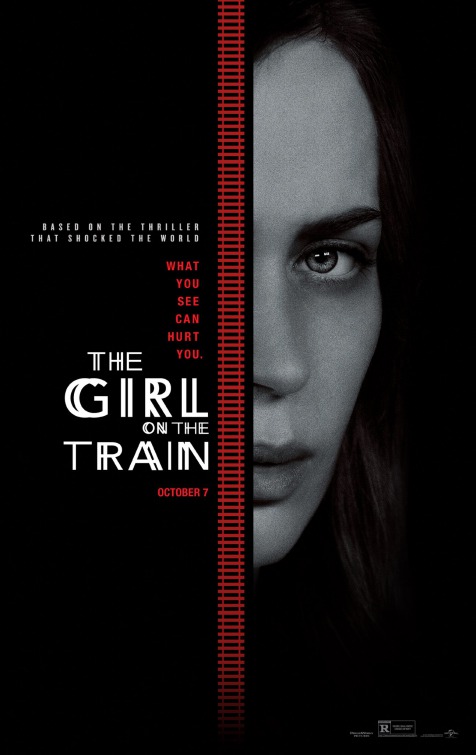
“The Girl on the Train” deserves some obvious comparisons to “Gone Girl” from two years ago. Both films are set primarily in quiet neighborhoods where soccer moms are raising their children in lavish surroundings. There is comfort, space, and a family unit that is supposed to provide support. Yet when those spaces are violated and the support disappears, there are some ugly truths under the surface.  Three women are tied together in a mystery. All of them are victims of some sort, the question is whether they can find the strength to discover the truth. Emily Blunt is Rachel, a psychologically unbalanced woman who has sought solace in her inability to conceive by drowning herself in alcohol. The inebriation allows her to indulge in elaborate fantasies concern a couple she sees every day from the train that she takes to the city. The couple live in the neighborhood she used to be a part of. Just a few doors down from where her ex-husband and his new wife and baby now live. While her intoxication may fuel her imagination, it also blanks out her memory and the complex relationship between her imagination and reality is tangled.

Very much like Rosamund Pike dominated “Gone Girl”, Blunt is the main force in the film. The big difference is that in “Gone Girl” we are waiting to see what will happen, in this film, we are trying to discover what did happen. Our sympathies for Rachel will rise and fall as memories flood back into her head. Memory is a tricky master however and the damaged Rachel is challenged to interpret the events of her own life from a alcoholic haze. Anna, the woman who has replaced her in real life, is an indifferent and needy woman, who loves being a mother but is not really strong enough to be one on her own. Megan is the young married neighbor who serves as Nanny in Anna’s house. While there are three male characters that serve as suspects, red herrings and psychological motivation, the story is really about the lives of the three women. Rebecca Ferguson, so great in Mission Impossible: Rogue Nation, does not get as much to do as she should, playing the former mistress and new wife to Rachel’s ex.

Blunt however, has a meaty role that she pulls off without the ferocity of Rosamund Pike but with equal skill. She is a lost soul finding meaning in empty bottles, but she forces her way back into a real life in a particularly twisted narrative. Haley Bennett is the Jennifer Lawrence look alike that nearly steals the movie. She is an unsatisfied women that we at first might dislike because of what seems to be her selfish nature. As the story unfold in flashbacks arranged in chronological order, we will change our perceptions of her as much as we do those of Rachel. Bennett was just in the Magnificent Seven Remake, and except for the last line of that movie she was quite credible there. In this film she is completely convincing as the sexual plaything of oppressive men. She has a juicy scene with the therapist she comes to for comfort by bearing to him an unbearable secret. Both Blunt and Bennett could be contenders for awards consideration if the movie is accepted for it’s emotional script rather than the lurid nature of the plot.

You have to pay close attention to the time sequence and a large number of characters. It would be easy to get lost in the events if you stepped out to go to the bathroom for a couple of minutes. Allison Janey plays a no nonsense police detective investigating the disappearance of one of the characters. She is usually used to lighten the tone of a film but not in this case. She is brutal in the honesty with which she confronts Rachel with the truths that she sees. Despite being insightful, her character is not going to be the one who solves the mystery. There is a lot of intrigue but not much action in the film. Those places where violence occurs are infrequent but startling. The downward spiral that Rachel falls into is depressing as heck and when all is said and done, although things look up, they don’t look up much. Don’t expect a vicarious sense of relief at the outcome, but consider how much your sense of self can hurt not just you but everyone you love.