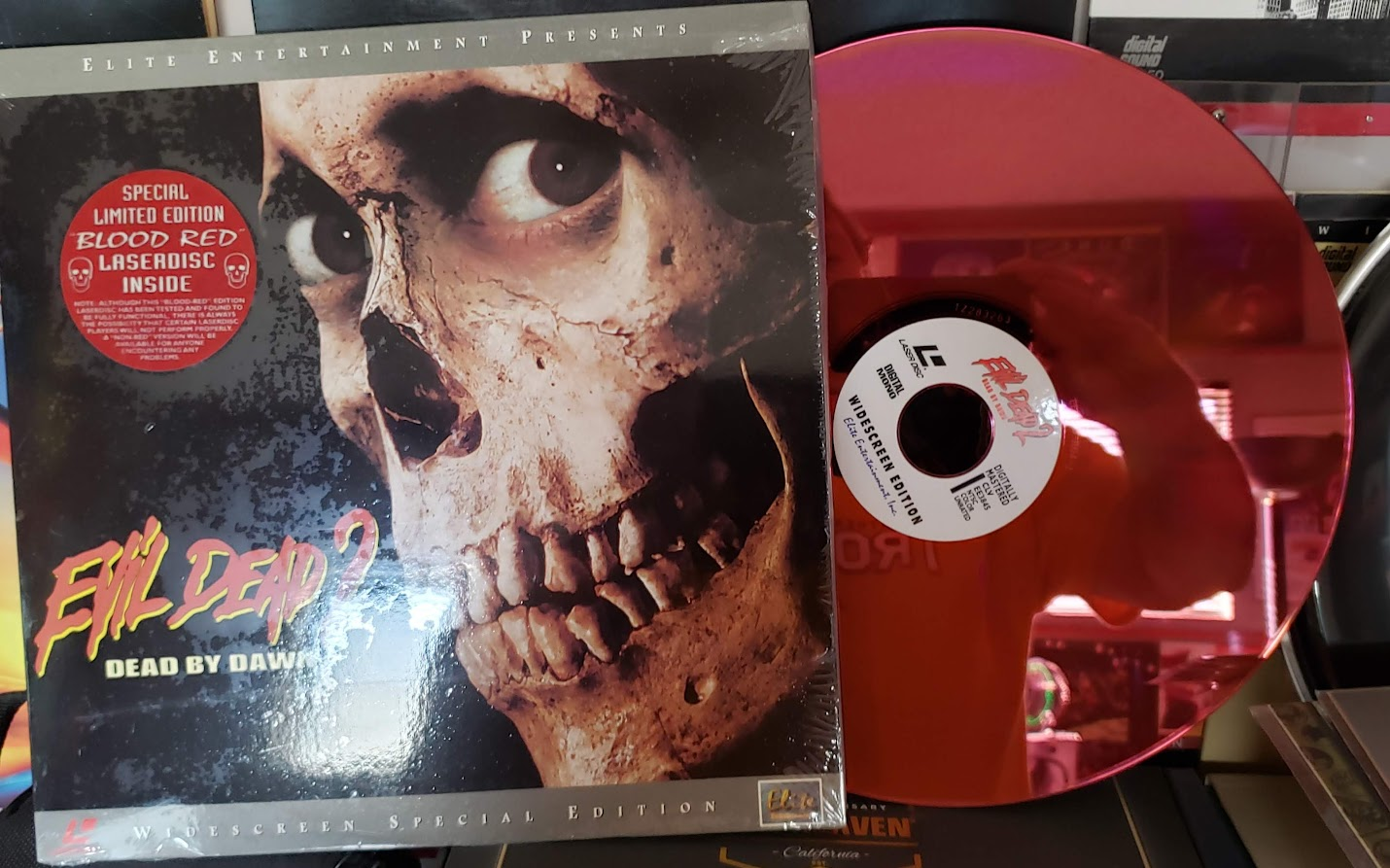
This film was my gateway drug into the “Evil Dead” Franchise. I saw it originally on a VHS copy, but ultimately added the laserdisc to my collection of films.
Who would not want this blood red beauty in among all the other film flotsam that makes up your collection? I have subsequently seen it on the big screen a couple of times, but it has been a long while and when Alamo Drafthouse decides to throw a watch party, you know I am not going to turn down an invitation.
“Dead by Dawn”, which is the subtitle, is such an odd sequel because it is basically a reboot of the story, not a continuation. With more money and a chance to add some humor, Sam Rami took his horror masterpiece and turned it into his horror/comedy masterpiece. There is still the requisite gore but it is matched by irony, slapstick and farce with this entry. Bruce Campbell is not only the hero, he is the chump. Tossed about like a rag doll, muttering to himself, and screaming at his own hand.
The movie is loaded with clever shots of the interior and exterior of the isolated cabin in the woods. This is in fact the franchise that basically invented the cabin in the woods horror trope. Maybe “Night of the Living Dead” featured an isolated cabin first, but “The Evil Dead” made it the origin point of the horror rather than the last stand . Evil Dead 2, begins the long history of horror films where attractive young people end up in an isolated spot and have to battle evil. The supernatural kind of evil.
In addition to the wild camera style of the director, there is an audio ambiance about the film that is also fairly distinctive. The deadites in the woods make noises like sick car engines as they converge upon the structure. The walls of the cabin creak and groan, like another character in the story. Inanimate objects that suddenly seem to be alive also make themselves known through sound. Once the chainsaw starts and the shotgun comes out, there is an assault on your audio senses that really adds to the discomfort and horror we are watching.
While there are jump cut scares, they are usually accompanied by a great makeup or lighting effect, so they are not just getting a scare out of our surprise. When Ed gets possessed, his sudden transformation is startlingly revealed, but the jump is as much due to the face appliances as his sudden appearance in the frame. We know some views from the cabin looking out are going to be suddenly filled with evil Ash, but we still respond as our minds and our bodies command.
As a “watch party”, the audience was given greater freedom than is usually available at an Alamo Screening. Shouting out lines in unison with the characters was encouraged, and we came equipped with foam hand chainsaws, a mini necronomicom and a gummy eyeball to pop in our mouths at the right moment. The theater was packed on a Monday night for this forty year old horror classic. We all thought it was
One of the things I remember vividly from growing up in the 1970s were the record labels of my favorite artists. In the 60s, Capitol Records or Motown would have been the most important to me, but in the 70s, was was enthralled by two bands, each of which was on a rebel, independent label, and both of those labels were lead by bigger than life characters.
Robert Stigwood led the RSO Label and parodied himself in the movie he backed with his biggest band, “The Bee Gees” in Sgt. Peppers Lonely Hearts Club Band.
Real fans got the joke because we paid attention to the labels. Casablanca Records was also a player, taking big risks, like releasing four Kiss Solo Albums at once, and sticking with artists that were taking a while to break. “Spinning Gold” is a biographical film of Casablanca’s creator, Neil Bogart. His story is as outrageous as any of the biopics of artists that you may have seen in the last few years, but as an executive, he had different reponsibilites and different opportunities to screw it up or hit it out of the park. He did both on a regular basis, in the cocaine fueled music industry located in New York and Hollywood.
The film comes from a son, Timothy Scott Bogart, who wrote the screenplay and directed this movie about his father’s career. There are still warts in the story that get told, but the movie has a quality to it that treats the subject with kid gloves anyway. Neil Bogart as played by Broadway star Jeremy Jordan, warns us that the story is all true, at least from the perspective of the person narrating it. This attempts to give license to some big claims about his contribution to the creatives and not just the business part of their successes. Of course there is also a basis for the ability to make those claims because Bogart was not just an executive, he was a musician, performer, producer as well.
From the opening of the film, the stage based musical styling of the storytelling is apparent. This will probably work as a Broadway Jukebox Musical, more effectively than as a drama for the screen. There are well over a dozen musical sequences, some of which are complete presentations of the work done by artists like Donna Summer, The Isley Brothers, Bill Withers and Kiss. The actors portraying these artists seem to have been chosen for their musical ability rather than their resemblance to the singers and bands. This allows the film to have some credibility as an entertainment but it leaves the drama to the same tropes that you will find in a dozen other films of this ilk.
Although littered with flashbacks and flash forward segments, the story is still narratively a rags to riches to ruin and then redemption arc. I did like every time the stakes were rising that we got a talley of the debt the label was accumulating. As a Kiss fan, I think the story shifts the rescue of the label a little more to Donna Summer’s single than the breakthrough that the band finally achieved with it’s live album. Still there are legitimate moments in the film story that come from reality. Kiss did have a financial standoff with Bogart at a critical juncture in the labels history. Bogart did back them, but the relationship was not always a positive one, although in the long run everybody made up, because success solves a lot of wounds.
The film is also a nice historical look at the music trends of the era. 70’s soul, disco and hard rock are all evolving and this movie attempts to depict some important moments in those movements. Regardless of the accuracy of the story, and it is mostly on target. the craziness in the film never works the way it should. The drama feels manufactured and the staging is inconsistent. Sometimes we get a great musical moment but it is followed by a flat musical sequence or a dramatic moment that is overplayed by the script.
Overall I can recommend this to fans of the music and the label, but regular movie goers are likely to yawn with a been there, done that attitude. You can enjoy the music, and the label history, but the clips of the real Neil Bogart in the credits talking to Merv Griffin or being interviewed by some other show business program, suggest he was a much more interesting character than was created in this film. There is a Kiss Biopic coming from Netflix down the road, It will be interesting to compare the version of Bogart that they come up with to the one in this film.
Keep your popcorn full and your soda handy, this will be the Saturday Matinee pleaser that you have been looking for. If Ray Harryhausen were to make a movie based on the game “Dungeons and Dragons”, this might have been it. As it is, we are forty years past his prime and the technology has changed, but the sense of adventure and fun is pretty much the same. In terms of style the only real difference is the snarky commentary offered by the characters as they go through the adventure, otherwise, this could be “Sinbad and the Eye of the Tiger” or “Jason and the Argonauts”.
From a family perspective, there is little reason to worry about taking your kids to this. It is fantasy scary, but not gory or violent like so many contemporary adventure films. Chris Pine is a noble scoundrel who fits in the mold of Han Solo or Jack Sparrow. He may not always have the right reason for doing the right thing, but it usually balances out in the end. Michelle Rodriguez is the badass warrior that you expect her to be, she is fast and furious in dispatching the soldiers that stand in her way, and you know she will have a heart of gold in the end. Once upon a time Hugh Grant might have had the Chris Pine role, but now, in his maturity, he is regularly playing villains and having a blast doing so. The only thing that parents might be concerned about is that the word “S#@t gets dropped three times. That’s it as far as vulgarity. Otherwise I can’t account for the PG-13 rating rather than simply PG, except I am sure the producers don’t want to position this as a kids film, but it is family friendly.
If you played the game, maybe you will be in on some of the references and understand the magic items that come into the story. There are also multiple cultures referred to and creatures of all sorts that are both dangerous and friendly. I never played once, but I could follow everything that was going on. Maybe a gamer would be more satisfied, but I doubt it. I also appreciated the humorous references to elves, dwarves and what could be hobbits in the film. Those may be part of the game, or maybe they are quick parody references to LOTR tropes, but they were fun and welcome whenever they popped in.
Chloe Colman is a young actress who has appeared in three movies I’ve seen in the last three months. In addition to this film, she is one of the Avatar Children, she travels to ancient Earth in “65“, so she has been busy. Justin Smith transplants the same character he played in the last two Jurassic Park movies, into a struggling wizard in this story. Ineffectual characters that over achieve is a recurring theme in this movie. Of course they are balanced out by characters like Rodriguez’ Holga and Regé-Jean Page’s Xenk, an amalgam of Aragon/Legolas and Gandalf, dolled up as a dreamy warrior.
This movie is full of ironic escapes, dashing confrontations and conventional conflicts. It is all put together in a fast paced fantasy that should keep you entertained for an afternoon or evening. There is a lot of humor, both in story points and in character development. The effects look good enough for the film, and there are plenty of turns in the story to keep you engaged in spite of the well worn game structure of obstacle, solution, complication, completion and then new obstacle. Does any of it mean anything? No. Does it need to? No, It just needs to keep us entertained for 2 hours and it does so quite well.
Throwback Thursday on the KAMAD site will be a regular occurrence in the next year. As a motivational project, to make sure I am working on something, even in a week where I don’t see a new film in a theater, I am going to post on movies from 1975. Along with 1984, this is one of my favorite years for movies and it is full of bittersweet memories as well. 1975 was my Senior Year in High School and my Freshman Year in College. The greatest film of the last 60 years came out in 1975, as well as dozens of great and not so great cinematic endeavors. Most of the films in this weekly series will have been seen in a theater in 1975, but there are several that I only caught up with later. I hope you all enjoy.
The Great Waldo Pepper
It was almost impossible for me to believe, but it turns out I have not written about this film before. I could have sworn that I’d done a post on it for the original project in 2010. As I looked back and could not find it, I realized that the movie opened in March of that year, which was outside of the parameters’ of that original summer project. My vivid memory of seeing the film is something I will discuss at the end of this post, but the movie itself deserves quite a bit of attention.
This film comes from Writer, Producer, Director, George Roy Hill. His previous film was “The Sting” for which he won the Academy Award. He co-wrote the screenplay with William Goldman, who wrote the screenplay for Hill’s earlier film, “Butch Cassidy and the Sundance Kid”. Both of those films also featured actor Robert Redford as the star. At this point, Hill was a successful film maker, but critics suggested that he did not have much style. “The Great Waldo Pepper” represents an opportunity to do a film based on a subject he was completely fluent in, flying. Hill was a fan of barnstorming pilots from the 1930s and got his own license to fly when he was sixteen. We was also a flying veteran of both WWII and Korea. The story idea for this film came from him, and he frequently was flying the planes in the show as he was directing the flying sequences in this movie.
Waldo Pepper is a charismatic pilot, making a living as a barnstorming flyer. He lands his plane in a farm field in Nebraska, and for five dollars, gives local a chance to experience flying themselves. Set in 1926, it is a different world than the one we live in. Aviation is barely twenty years old, WWI is less than a decade in the past, and commercial aviation is on the horizon. Pepper is a combination of Charles Lindbergh and P.T. Barnum, being both a good pilot and a good storyteller. The fact that some of his best stories are not his own comes out pretty early, but it does not undermine the investment that we make in him as a character. In the first part of the film, he bests, gets outed by and partners up with another flyer played by Bo Svenson. This was a break for Svenson who would go on to star in several movies and tv shows after this. He was replacing Paul Newman, who declined Hill’s offer to star in this picture along side Redford once more. For the rest of the story Axel Olsson and Waldo Pepper, trade off which of them is going to be most injured.
As good natured as the relationship between the two pilots becomes, there is some serious tragedy in the story as well. Death is a real possibility for the stunt flyers and it comes with legal consequences and survivor’s guilt. It may be that the reason the film was not more successful, is that it has an aura of sadness that hangs over it, including the conclusion of the film. Hill was able to pull this off with “Butch Cassidy and the Sundance Kid”, but it does not quite work here. The tone is elegiac with the era of bi-planes coming to a close and air travel becoming a shared experience. The opening of the film suggests that this will be the way the film ends as well, with a nostalgic and sad look at the chapter we are closing.
I was hooked from the very beginning of the movie, as the huckstering Waldo Pepper, gets a young boy to be his gas runner on the promise of a free ride. There is a teasing moment when it comes time to pay up, and that shows Waldo can be a bit of a cad but will come through in the end. I love the fact that the kid not only gets the ride, but that he brings his dog with him, that’s the kind of childhood most of us would love to remember, even if we did not live through the depression. The following scene, when Waldo enthralls the kids family over dinner with a war story of aerial combat was hypnotically told, with the kind of details that seem like they must have come from first hand experience. We later learn that it wasn’t Waldo’s own story, but it should have been.
There is a cute sequence where Waldo picks up a girl at a movie by adopting the perspective of the screen character they are watching, and suggesting his actions before they come up on screen. Either Waldo is a hero like the Valentino-like character, or he has seen the movie before and he is exploiting the naivete of the girl. She is played by Susan Sarandon who is making her second appearance on the Throwback Thursday 1975 project, after having starred in “The Rocky Horror Picture Show“. I’ve admitted it before, in my post on “Bull Durham“, I have a little crush on Susan Sarandon. She has beautiful big eyes and a voice that a hummingbird could gather nectar from. She is an innocent who gets caught up in the idea of the fame of the aerial act the partners are planning for the flying circus that they join. You can certainly understand how the owner of the circus would encourage her to bring a little sex to the show. On of the reasons that this film may have under performed on it’s initial release could very well be Sarandon’s character’s story arc.
If there is one very strong element to the film, it is the authenticity of the flying sequences. The actors are really in the planes as they are flying. The stunts are being performed for the camera, they are not special effects. As far as I could see, there was only one process shot used in the flying sequences, it was very brief, and it was to show how the propeller of a plane was eating the tail of another plane. Everything else is authentic. There were not a lot of quick cuts and frantic editing, most of the scenes were shot complete with very little cutting except between perspectives.
A surprise about the film, and probably not a good one, was the relative lack of music on the score. There are some piano themes, that reflect the era, provided by the great Henry Mancini, but their presence in the film is sparse. George Roy Hill was a music lover who preferred Bach and understood music well. It is puzzling that the emotional beats of the film lack a musical track to set them off. Maybe the goal was to let the flight stunts speak for themselves, but audiences react to music and I think some opportunities are missed. It is puzzling since “The Sting” used the music cues so well and his later film “Slap Shot” is filled with contemporary music prompts.
Redford is great in the film. He has a natural likability that seems to fit with that era. He worked perfectly for movies set in that time period, including “The Natural” and “The Sting“. In fact, it looks to me like Redford liked the era so well because he looks good in the newsboy style hats that were part of his costume. Edward Hermann had appeared in a film with Redford, right before this one, “The Great Gatsby” and here he is an old friend who understands aeronautics but even better, has a sister that is Waldo’s sometime lover, played by Margo Kidder, pre Superman. Marking his third appearance in the Thursday Throwback 1975 series is actor Geoffrey Lewis, who has been in “Lucky Lady” and “Smile” so far. This will not be his last film on the project either. He plays Waldo’s old Platoon commander and the Civil Aviation Authority official who is forced to crack down on the antics of his old friend.
I said at the beginning, that I had a memory to share. Let me give you a little trigger warning, it is a tough memory connected to a tragedy in my life.
In April of 1975, my older brother, Chris, died at the age of 24. My parents were of course devastated. My Mother went into a period of almost agoraphobic mourning. She was unwilling to leave the house and she stopped working with my Father in the magic act they had been doing since before they were married. We were all in a pretty fragile state when my father decided we all needed to get out together as a family. “The Great Waldo Pepper” was playing at the Garfield Theater, about a half mile down the street from where we lived. We all went to see it, probably in late May or Early June. My younger brother, Mom , Dad and I all sat together in the dark and did a little healing by spending some time together out of the house. We went across the street to The Pizza Pub, and had a late dinner after the movie. My Mom was not cured, and we did not stop mourning, but we all drew a collective breath that evening, and we knew we could get on with life. A film can have a powerful effect on people for reasons that may have nothing to do with it’s qualities. That is one reason I love the movies and a reason that I remember this film fondly.
I joined my friend Todd Liebenow for a discussion of this film on his podcast the Forgotten Filmcast.
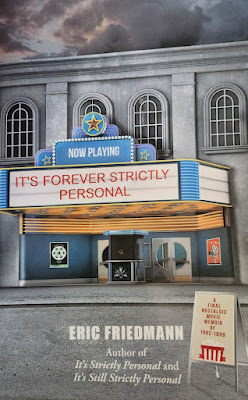
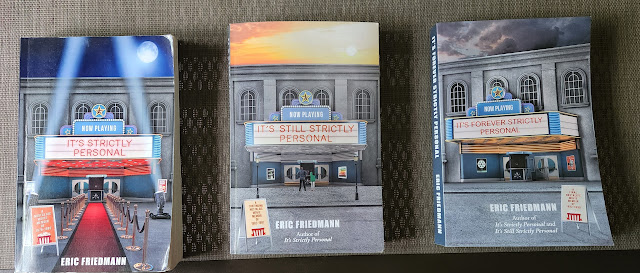
Well it has happened, my fellow film blogger Eric Friedman has completed a trilogy of books that discuss both movies and his life. You might ask yourself why you should be interested in an autobiography of someone you have never heard of . That is an understandable question, and there are times in the current volume when frankly, it might be a question that you would answer negatively. This seems to me to be the most personal chapter in Eric’s life, and unless you were a close friend you might believe it is a bit voyeuristic to look in on his life. There is a continuing vein of personal pain in some of the stories he writes. A broken heart does not mend easily, and some of the phases that you might go through are not pleasant and may not reflect well on you. The reality is that the author is being honest about his life and when the movies reveal part of his sense of abandonment or clinginess, he does not hesitate to show us the warts and all picture.
This entry in his series of “Strictly Personal” books, focuses on the films of the 1990s, particularly 92 to 99. In his personal biography, this is the era right after he has finished college and is searching for a job in a field that sounds like it is his fallback career. Eric Friedman has the ambition that a lot of film fans do, of actually being part of the industry, and in his case, doing so by screenwriting. In his entry on “The Player” from 1992, he strongly identifies with the frustrated writer who has been told once too often, “I’ll get back to you”, never to hear from the person again. This seems like the right film to connect to this frustration because the writer dies, the executive gets away with murder, and the story in the film gets swallowed up by the production machine and does not resemble what was written in the first place. These are the kinds of stories that you will find throughout the book. There are parallels to the author’s life in the films that he is writing about. If there is one thing that could have enhanced these chapters when they come up, it would be some details about the pitches Eric made when he had the chance, or maybe some pages from one of the screenplays that he wrote. Those would give us a greater sense of how his career aspirations connected with the industry elements he encountered.
Just as often however, the focus of Eric’s movie stories is not on a potential screenwriting career, but on those personal demons we all face. Sometimes we indulge in a little schadenfreude, when someone who disappoints us, gets disappointed in return. He freely admits that he has carried a torch for someone, long after the relationship was over. It feels at times that he is writing his own version of a Woody Allen screenplay when he repeatedly makes an effort to keep that relationship going, frequently by connecting through a movie. At times he recognizes that the object of affection does not relate to the film the same way he does, but he only sees the red flags later. Twenty-five plus years after some of these events, this journey of self discovery is likely to be more honest and accurate than if it had been written at the time. I did enjoy reading about those moments when a film was an escape from his own thoughts. Richard Kimble, searching for a one armed man becomes a block on his internal monologue, at least for two hours, and I’m sure film fans can relate to that.
The book is organized around the films of an individual year, and the discussion of the films he has chosen to write about, is often connected to an event in his life. In his previous volume “It’s Still Strictly Personal“, the dominating life subject was the on again off again marriage of his parents. In this edition of his life, the issues hang on his employment, heartbreak, and especially his love affair with a house at the beach. When his home was essentially denied to him by a coastal erosion problem, he sought an alternative that led to some great summers but not a meaningful relationship. He uses the Kenneth Branagh version of “Hamlet” as a reference point to the turmoil in his life, and the satisfaction of returning to the beach house is punctuated by his adoration of the film. Ironically, a completely different issue intrudes on his happiness, and it gets compounded by betrayal inside of his own family. Damn that Shakespeare was a good writer.
Like many books that reflect on film, and like way too many reviews I read on line, a large amount of energy is expended on recapping the story for us. Sometimes this is necessary because a film may be esoteric or unfamiliar to the reader. I can get behind a two page reworking of “Lost Highway”, a film I saw once and it was strange to begin with. I don’t know that as many people will need the recap of “The Matrix” or “Goldeneye”. Of the seventy or so films he writes about, I’d seen all except a dozen or so. When the plot or the performances is relevant to a point that he is making about his life, the recaps feel useful. It’s probably the fact that some of the films are so familiar to me that makes the occasional long summary feel unnecessary. Of course your mileage may vary, so it won’t be an issue for you.
Be warned that the titles of his book series is honest and upfront disclosure. These are his opinions and he does not hold back. While acknowledging that different people may experience films through their own perspective, his expression of his own opinion is often hyperbolic. I myself find his dismissal of Cuba Gooding Jr. in “Jerry Maguire” to be a bit flip and a bit egocentric on his own opinion, but that’s me. I would probably take him to task for his defense of “The Phantom Menace”, but not with the venom that he sometimes releases on a poor film that was just sitting there. It is part of his style to go big, and in the right context, that feels appropriate. Readers who have experienced the films he is writing about and have had a different opinion, the climate for an understanding disagreement is not always favorable.
There are plenty of reasons to self disclose in an interpersonal relationship. You want to gain the trust of your partner, you want to influence them in a decision they are making, or maybe you are simply reciprocating a disclosure they have made. When writing a book, which could be read by people with whom you have no existing relationship, the reasons are going to be different. I think Eric gains a bit of catharsis by sharing a movie experience and how that played out in his life, especially his romantic life. Get the Carens out of your psyche and move on. Writing a book like this can also be an invitation to build on a relationship. So, if Eric wants people to continue to read his blog or other books, screenplays or essays that he generates, having shared his life with us will help us appreciate his other material. Revealing the personal is usually done in a proper time and sequence. Although the films in this book stand alone from the previous decades of his life, the personal stories are more interdependent. As such I would suggest reading “It’s Strictly Personal” first, as a way of working up to the intimacy of this volume. The second book is a deeper dive into the personal, so “It’s Still Strictly Personal” would be a proper next step. If you start with this third biographical enterprise, be prepared for some frank personal details that might be awkward out of context. I’ve been reading Erics blog page for years and both of the earlier books went down smoothly. I was happy to have this third volume, but being prepared probably helped me react to it more positively.
Eric Friedmann can be proud of his accomplishment with this book. He has faced some of his weaknesses and overcome them with the help of a good movie. He generates some interesting thoughts on favorite directors like Woody Allen, David Lynch and Stanley Kubrick. Without hesitation he speaks his mind on the films and the people in his life. It may not always be comfortable, but it is always interesting, and of course, it is always Personal.
Eric was a Guest on the Lambcast Two Years ago, and you can hear our conversation at the link below. I hope to talk to him about his third book in the not too distant future.
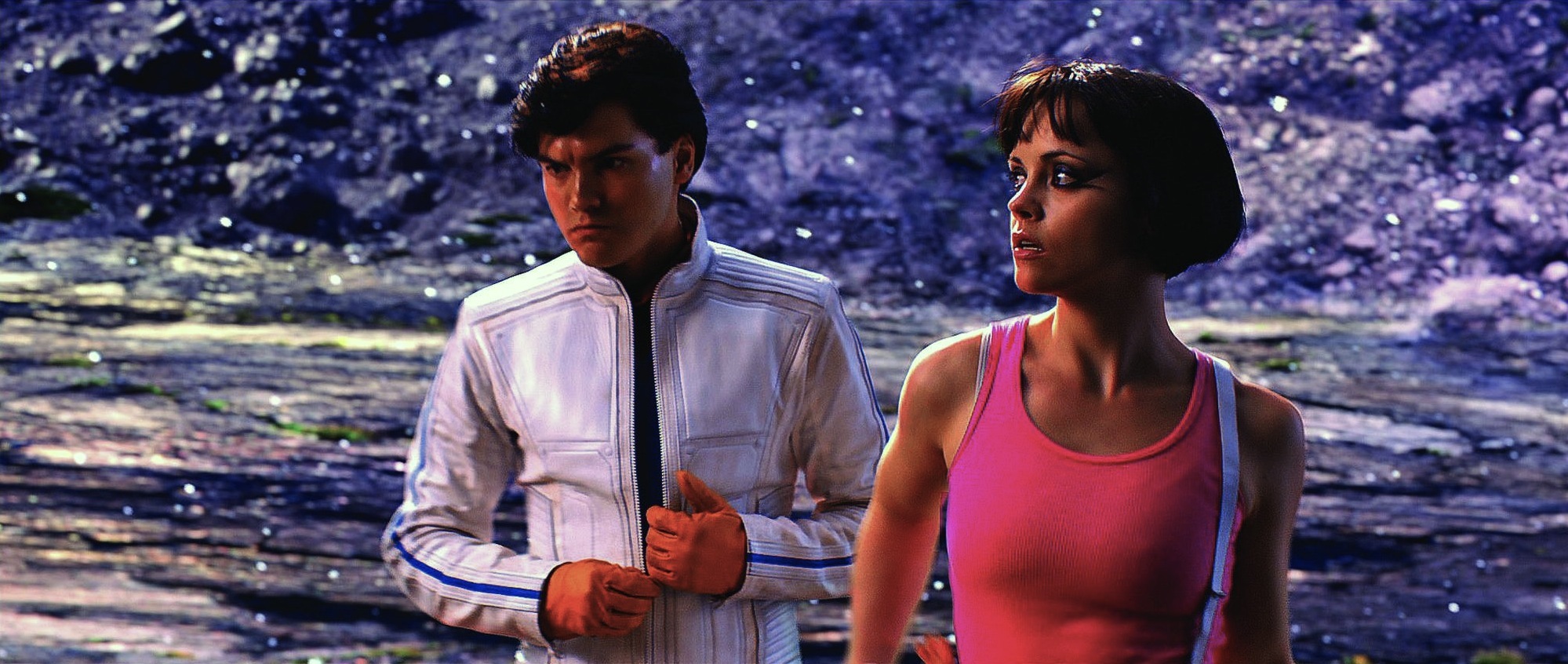
If ever the phrase “eye candy” was appropriate, this would be the movie to apply it to. This is a cotton candy, lollypop version of a cartoon, that assaults you with color and and motion. There are visual gags in every frame and it would be easy to be overwhelmed by the images. If you have seen those notifications about flashing lights and rapid images before some streaming show or movie, none of them compare with the bombardment that you will experience here.
When this movie arrived in theaters in May of 2008, it should have been a big hit. It came from the Wachowski Brothers, who had made the visually stunning “The Matrix” just a decade before, and it featured state of the art photography with special cameras to create clear images at multiple depths in the frame. There is an innovative style that is clever and very funny, and the film is based on a well known anime that spans decades of fans from the 1960s up to the Cartoon Network of the day. Instead, it tanked at the box office and was critically dismissed as being incoherent and headache inducing.
The film has however been embraced by the gamers, anime fanboys and computer nerds of the world. It seems to have gained cult status and I would say that it’s original style and sense of humor was misunderstood and it has become clear that people are catching on. The camera is in constant motion in the races, which look like they are filmed as a video game with real people in the place of gaming avatars. The cartoon nature of the film is exaggerated as the colors pop off the screen and the acting of the characters gets more and more outrageous. In addition to the racing sequences, there are fight scenes that feature kung fu, WWF style wrestling and machine guns. Oh Yea, there is a kid with a chimp as a companion, inserting himself in situations that are comic book ridiculous and also a lot of fun.
The look of the movie could be seen as an evolutionary step in film design. With computers, the early special effects of “Tron” and “The Last Starfighter” have given way to something much more complicated and reflective of imagination rather than replicating real world environments. The color palate of the film feels like a step taken from Warren Beatty’s 1990 Dick Tracy, with singular colors contrasted with darker or more complex backgrounds.
The costumes accentuate those contrasts and make the characters stand out. Also, the images of the characters, especially the villain, scroll across other scenes as they speak, suggesting constant activity, there is rarely a static moment in the film. The layering of scenes on top of one another makes the artifice even more noticeable. Of course gravity, physics and common sense are not part of the movie, it is a cartoon presented as live action, and it looks cartoony.
There are a bucketload of familiar faces in the film, John Goodman, Christina Ricci, Susan Sarandon, Matthew Fox, and Hirouki Sanada, who I just saw in John Wick 4 and Bullet Train in the last year. Emile Hirsh stars as Speed and he has the right look and a little bit of charm to carry it off. In the late 2010s he was the next big thing. He still works and is in several movies I have blogged about, but he is not as prominent as he once was. Maybe this film’s failure to launch cooled off his career a bit. That would be too bad because he was the right fit and the movie deserves to be re-evaluated.
We went to see this at an Alamo Drafthouse screening, and it would be easy to tell who the audience was that made this film a cult object of affection. Sorry for the stereotypes, but if you get an image in your head of gamers and anime fans, in their 30s, that is probably accurate. Our screening was packed, and 80% of those in attendance looked like they had just put down their controllers and Mountain Dew, for a few minutes to enjoy this film. Everyone was laughing and clapping at the film, we all had a wonderfull time, the eye strain was completely worth it.
Much like the title character, the film of John Wick 4 is bulletproof. No one is going to care that the physics in this film are nearly as wack as those in the “Fast and Furious” franchise. No one is going to care that hundreds of people dancing at a club will ignore multiple murders among them on the dance floor and keep dancing, until it is time for the lead character to make his escape. No one is going to wonder why every law enforcement agency in the world is ignoring the greatest serial killer on a spree in history. We want to see the damage that John Wick can do with a gun, a sword, hell even nunchucks. Let the mayhem commence and pass the popcorn.
The original John Wick was a revenge story, centered around the theft of a car and the murder of a puppy. It had the advantages of being fresh, bloody and reminding us why we enjoyed Keanu Reeves in the first place. John Wick Chapter Two is a Universe building, action sequel that indulges our fetishes’ for cars and guns and lots of hand to hand death. John Wick Chapter Three Parabellum does the best job of taking characters and giving them something to do, and giving us interesting characters, who are both opposed to Wick and allied with him. John Wick 4 extends the choregraphed mayhem effectively, but falls flat on creating new characters, with one major exception. In my ranking, this would be the weakest entry of the films, but that does not mean it is unworthy, it simply means that you need to keep a little perspective.
Of the things that this film has going for it, the first would be the incredible stunt team. There are four or five sequences, where the technical level of excellence just keeps climbing. I thought that they had peaked with the scene at the Arc de Triomphe roundabout. The cars move in a ballet of collision and surprise. [Once again, the fact that anyone, much less our lead who has multiple hits, survives one of these moments is irrelevant]. Yet right behind that fantastic sequence is the best fight sequence of the film, and maybe the second best in the series. The stairs at the Sacré-Cœur’s church are many and high, and John has to get by dozens of assailants, at least twice. Sure there is going to be plenty of CGI enhancement, but it looks so much more like a practical shoot than some other moments in the film, and that sells it even more.
There are three significant new characters introduced in the film. The Marquis played by Bill Skarsgård, is an effete antagonist who is never very interesting and never feels threatening. Donnie Yen, a martial arts film legend, is on the other hand, compelling in almost every scene he is in, even when he is simply having something to eat while everyone else is getting their asses handed to the. Shamier Anderson is a character called a tracker, but he refers to himself as nobody. “Nobody” as a character idea is ok, but there is so much ambiguity about him that we never care that much about the resolution of his story, his dog on the other hand is awesome.
The late Lance Reddick gets a nice tribute slide before the film plays, and his character is only in the movie for a brief amount of time. Lawrence Fishburne is in the movie because his character was in two previous movies and that’s about it. Hiroyuki Sanada, another martial arts star, plays a part very similar to his character in “Bullet Train“. I am always happy to see Clancy Brown in a movie, “Rawhide” is a welcome sight to this Blue Blaze Irregular. If the characters had gotten half the detail that is given to imagined culture of “The Table”, the nearly three hours that this film takes up might be a little more reasonable. We have to go down a rabbit hole of crime families, rituals, rivals, and “ancient ways”, just to get to the third act. And still most of this is rushed by so there can be another action sequence. John Wick 4 sometimes feels like a better version of “Shoot ‘Em Up”. It is better, but after a modestly paced openings few minutes, everyone can see the roller coaster highs and drops that are coming.
I know this sounds like I am down on the film. This is a terrific action piece that will satisfy fans of the series, and I think the story arc is sufficiently closed for us. Keanu continues to generate good will with these movies, it just doesn’t feel fresh to me, and after having had three previous servings of the main course, it might have been nice to have a different entrée, rather than just putting a better sauce of the one we have already had.
You always have to make some hard choices at a festival, because you can’t see everything. Amanda has a different agenda than me on Friday Morning, but otherwise, we will see most of these together. House of Wax may fall by the wayside if Allison can come down to the hotel on Friday night for late dinner. You will get plenty of updates here when the Festival begins.
Throwback Thursday on the KAMAD site will be a regular occurrence in the next year. As a motivational project, to make sure I am working on something, even in a week where I don’t see a new film in a theater, I am going to post on movies from 1975. Along with 1984, this is one of my favorite years for movies and it is full of bittersweet memories as well. 1975 was my Senior Year in High School and my Freshman Year in College. The greatest film of the last 60 years came out in 1975, as well as dozens of great and not so great cinematic endeavors. Most of the films in this weekly series will have been seen in a theater in 1975, but there are several that I only caught up with later. I hope you all enjoy.
Rollerball
This was one of the films from my original project back in 2010. I was writing about films from the summers of the 1970s, my formative years, and this movie came out the same week that “Jaws” hit the marketplace. In spite of mixed reviews, I suspect it would have been a big hit except that it was overshadowed by the competition. I chose the film this week because it was referenced in a television series I am currently streaming. “Daisy Jones and the Six” is a fictional look at a 70s era band, along the lines of Fleetwood Mac. Two of the band members are obsessed with “Rollerball”, actually calling it brilliant, and they are on their way to see it for the eighth time. That fictional enthusiasm was enough for me to go back and watch the film again for Throwback Thursday.
When I went back to my original post, I was happy to see that it expressed my feelings about the film almost exactly as I was experiencing them this week. You should read that post here. The strength of the film is in the design of the game the movie is based on. The combination of roller derby, soccer and football plus the acceptance of violence that goes well beyond that in hockey and rugby, is a great show that will hypnotize the masses. The production design of the film starts off with a bang by showing off the track, the ball, the teams with their motorcycles and some futuristic fonts that seem to be realistic from the perspective of time.
The color schemes of the teams are the only distinguishing element. I guess a logo might imply more choice than the proles are entitled to. The combination of the high tech track and the traditional fugue music sets an ominous tone that we will feel every time the game commences. I thought the teams individual struts on the track as they were entering also sets a martial tone and a sense of inevitable clash.
Houston, the team that Johnathan E (James Caan) plays for, has the simple Houston stride, an in-line synchronized march that is direct, elegant and feels very determined. Other teams seem to have been more artistic, for example the Tokyo team has an arrow wedge that looks fearsome, and as they break out of the formation, they drop down to the center of the rink in a kamikaze style flourish. The film comes to life the most in the three matches that we see. Of course as the rules are being changed to force Johnathan out of the game, the clashes become more elaborate, violent and ultimately deadly.
Obviously, the script and the director were trying to say something about the dangers of corporate control over the world. Unfortunately, there are few places other than the game and Johnathan’s personal life, that we see the stilting effect of corporate decision making. There is a sequence where Johnathan attempts to discover how corporate decisions are made. His wife had been taken away from him in what he sees as an arbitrary action. He wants to know why.
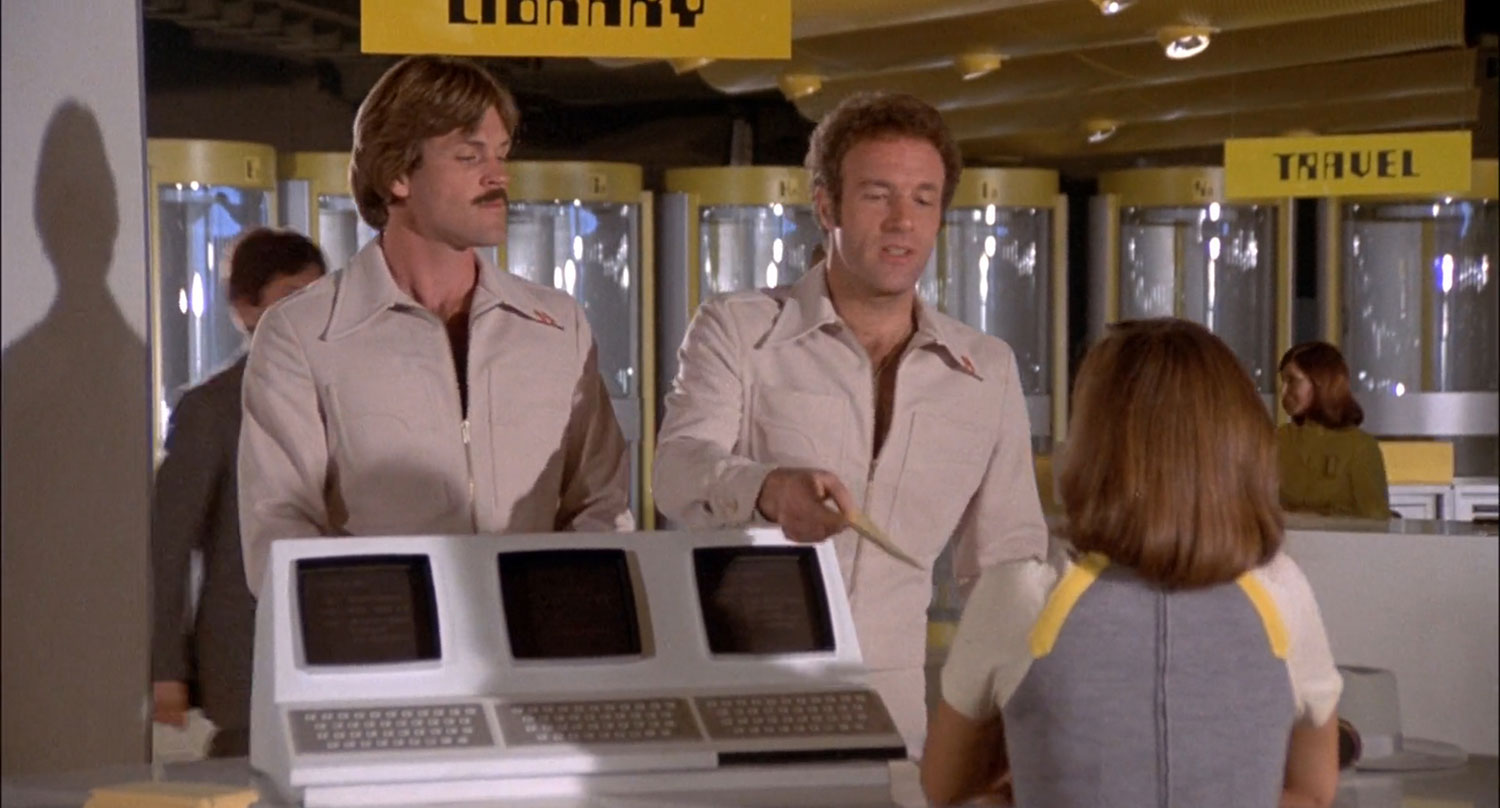
The computer system that has replaced all the books, is limited in access and intelligence. There are not really librarians, just clerks who try to direct people but have no ability to find information on their own. It’s as if Wikipedia had to be accessed through a human, who did not have any understanding of the information they control access to. Later in the film, Johnathan goes to Geneva, to the main data storage facility. If the director had spent less time at the idyllic party of drug addled executives, there might have been an opportunity to do some interesting exposition with the main computer “Zero”. A video of the corporate wars or a quick summary of the current social conditions might have made Johnathan’s individualism seem mor meaningful. Instead, there is a mildly amusing Ralph Richardson, playing word games with an A.I. that has a defective memory. It is a lost opportunity to do the thing the film purports to do.
Early on there was a moment that I thought could be contrasted to the world of today in an interesting way. As the corporate anthem is being played before the first game, all the players are lined up obediently standing at attention, but Johnathan is clenching his fist and lightly pounding it against his leg. It is certainly not the act of defiance that kneeling on the sidelines or staying in the locker room for the anthem would have been. It sems the smallest act of individuality that could exist in the corporate world.
Throughout the film, Director Norman Jewison uses classical music to set the mood, in a way that seems to deliberately invite comparison to “Clockwork Orange.” The use of some interesting architecture in West Germany (at the time), which is modernistic in the way a futurist might have suggested does the same thing.
As I said earlier, my original post expresses my feelings about this film perfectly, but I hope that the few extra note here made your visit worthwhile.
Frankly, they would have had to screw this up really badly for me to lose my enthusiasm for the character as created by the first film in the series. Fortunately, they not only failed to screw it up, they found a very reasonable approach to extending the story and then they cast some new characters that just tell you, the film is going to work. I can’t say it is perfection, but I can say I had a great time, and enjoyed the movie almost as much as the first film. “Fury of the Gods” turns out to be a blast and a worthy successor to Shazam!.
In the original film, our young hero is struggling to find a family that he lost. The gut punch of his Mother’s brush off was one of the darker moments in an otherwise sunny story about a kid who gets superpowers. Billy this time is having a different crisis with family, he is struggling to hold on to the newly acquired group that has become his family, and to paraphrase Princess Leia, ” The more you tighten your grip… the more that will slip through your fingers.” A family of heroes working together is great, but each foster brother and sister needs to be their own person, and Billy gets frustrated as he tries to keep everyone together and antagonizes Freddy, his foster brother and best friend, and alienates Mary, who earned admission to Cal Tech but has sacrificed a dream for the core group of heroes. There is still fun to be had as we are learning of these troubles. The opening rescue on the bridge is only halfway successful and the Lair in the Rock of Eternity gets explored with some funny moments. Eugene’s quest to map all the doors that lead to and from the rock give us plenty to laugh at. One of the best reminders that we are dealing with children in the form of adult heroes, is the utilization of “Steve”, the magic pen that records their words on parchment, but does so literally and as a result we get to be reminded that these are kids. When Helen Mirren’s character, Hespera, reads the note out loud, it is a moment to relish.
Mirren and Lucy Liu as Kalypso, are the daughters of Atlas, one of the gods whose powers, the kids have been imbued with. Their desire to reclaim the powers and inflict punishment on the human race for taking the powers in the first place, becomes the driving force of the plot. It does get a bit convoluted when n additional McGuffin, “The Seed of Life” is introduced. It is relatively easy to follow the plot, but there are many permutations that result from this device. For example, the city of Philadelphia, gets encased in an impenetrable dome, and a plethora of monsters from mythology get released on the town. One of the things I liked is that the production design between the two films remains consistent when the monsters are a part of the story. Yes, it is a CGI sellout in the last part of the film, but at least it is interesting. Oh, and Unicorns are terrifying not cute. The biggest laugh I had in the film comes when a product placement slogan gets used in a non-PG form by youngest sister Darla.
For the most part, the film is family friendly. The bad guys are easy to identify, the monsters are scary but the violence is not particularly explicit, and there are some fun family themes that run through the movie. When the foster parents get in on the action, there are also some heartwarming moments, including one that addresses Billy’s big fear about his new family, that he will lose them when he ages out of the system. However, there are some dark moments that might caution families a little bit to make sure their kids are prepared for some bad things that happen. A new character, who is supportive, friendly and easy for us to like by the way he connects with Freddy, is dispatched in an unpleasant manner and the tone seems at odds with the rest of the film. The climax of the film has a few moments of remorse and sadness, that you will find in a lot of films. We have an apparent loss that ultimately gets repaired, but for a few moments it feels more real than some of those Disney fake outs.
Zach Levi is terrific as Shazam!, the hero at the center of the story. Asher Angel, who plays Billy, the kid version of the main hero, is appropriately angsty, but as he has gotten older, his immaturity will be a harder sell. Jack Dylan Green, who is Freddy, has to carry a pretty big emotional load for the film and he is clearly capable of doing so. I also thought that Rachel Zegler as Anne, was pretty effective as a love interest and as a fulcrum in the fight with Hespera and Kalypso. Djimon Hounsou returns as the wizard who gave the powers to Billy in the first place, and his interactions with Freddy during their time imprisoned by the sisters, was a lot of fun. To be honest, everyone here seems to know what this movie is and how to play their parts. The director David Sandberg, and the writing team, stick to the goal of the first film, let’s have fun with this and worry about how it all fits in with the DC Universe, some other time. We do get a couple of references to the world of heroes and meta humans, but they are mostly just for fun rather than trying to build a bigger story.
I think superhero/comic book burnout is a real thing. There is a point at which, the audience will stop caring about the overarching end of the world scenarios that keep coming up. If comic book movies are going to get through this period, it will be because of films like this and “Guardians of the Galaxy”, where the fun and laughter are at least as important as the plot, and are more important that the latest villain. I was happy to see a range of people in the audience for the show I went to. There were teens, families and older couples. A film that can cross a lot of sub groups and bring them together for two hours of fun in the dark, together, has got to have something going for it.






 Kirkham A Movie A Day
