Throwback Thursday on the KAMAD site will be a regular occurrence in the next year. As a motivational project, to make sure I am working on something, even in a week where I don’t see a new film in a theater, I am going to post on movies from 1975. Along with 1984, this is one of my favorite years for movies and it is full of bittersweet memories as well. 1975 was my Senior Year in High School and my Freshman Year in College. The greatest film of the last 60 years came out in 1975, as well as dozens of great and not so great cinematic endeavors. Most of the films in this weekly series will have been seen in a theater in 1975, but there are several that I only caught up with later. I hope you all enjoy.
Return to Macon County
On my original project, I did a post on “Macon County Line“, an semi-exploitation film that I remembered pretty well and it was surprisingly good. This is a second film with a similar premise, but it is not a sequel and no one from the first film appears in this film. The main connection between the films is that it was written and directed by the same man who co wrote and directed the first film, Richard Compton. Compton was primarily a tv director who did shows like “The Equalizer”, “Miami Vice, and “Babylon 5”. He was also Married to actress Veronica Cartwright for over 25 years, she of “Alien” and “The Right Stuff” fame.
The original ” Macon County Line”was a big success and it lead to a lot of drive-in material about the dangers of traveling while young in the South. It probably is a descendant of a movie like “Easy Rider”, but with a simpler story that is more nostalgic than anything else. Instead of two anti-heros giving the bird to the man, both “Macon County Line and Return to Macon County feature attractive young me, traveling in by car, who acquire an attractive girl for their road trip, and then complications ensue.
“Return to Macon County” features the debut film appearance of actor Nick Nolte and a second 1975 film from Don Johnson [“A Boy and His Dog” will be featured later this year on KAMAD TBT]. Both of these guys would go on to substantial fame and fortune and they continue to work today. Robin Mattson, the waitress they take with them on the road is played by Robin Mattson, who did a lot of television in the following years and has been feature on numerous soap operas.
Mattson’s character Junel, is a wild card girl, who impulsively joins them on the road and turns out to be a love interest for Nolte, but also the source of the plot complications. She comes equipped with a gun, and she feels compelled to recklessly brandish and discharge it in a number of situations, that make everything worse for the characters. Let’s just say it becomes a chase film, with a few car crashes and clever escapes along the way.
The three of them are pursued by a local gang of toughs who lost a race, welched on a bet and beat up Johnson’s character. There is a local sheriff, from Macon County of course, who also gets bested by the hod rod driving fugitives, and disobeys orders to give up the chase and he pursues them across state lines. The movie meanders from incident to incident, with some romantic clutches along the way, including a rendezvous that Johnson has with a woman at a motel. There is a brief moment of nudity in that scene, and it only gets a PG rating in 1975.
It would be expected that the resolution of the story would be tragic ala “Easy Rider” and “Dirty Mary, Crazy Larry”. In fact there is a confrontation and a death, and lives ruined at the end, but it goes in a direction that is unexpected and lets us have a happy ending to some degree. It is not nearly as good as “Macon County Line” was, but it is an innocuous way to spend ninety minutes. In 1975, getting out of the house, going to a drive in with a romantic partner, and watching an undemanding movie, was everyone’s idea of a good night out.
LEAD Technologies Inc. V1.01 Sized3000
The movie is on You Tube, I don’t know if it is pirated or not, but below is a link if you want to tale a look.
Writer/Director James Gunn has had an off the wall sensibility throughout his career. He originally made films for Troma, so that makes sense. When he took on the task of making “Guardians of the Galaxy” into an entity that would fit into the MCU, that was going to be a stretch, but he managed it very well. He is now taking over the DC Universe, and with any luck, he will get that portfolio of characters into shape. The thing that I find a little surprising is that despite his off kilter sense of humor and story telling, his films in this series have largely succeeded because they have an emotional heart at the center, not just some twisted sense of humor. In the original Guardians Volume, the disparate characters come together to form a team. The sacrifice of one of the team members to save the others, and then the follow-up of standing together to hold an Infinity Stone, was heart warming. In Volume 2, Quill finally reaches Gamora, and even more importantly, discovers that your Daddy may not be your father. Once again, the loss of a character drives the emotional conclusion of the film. Yondu may not be practically perfect, but we want to remember him as Mary Poppins anyway.
Why then should anyone be surprised that Volume 3 would be the biggest emotional touchstone in the series? This is the climax of the storyline of the original Guardians, and there were clearly going to be some tears somewhere. Well, they start early and keep on coming. The biggest sobs will be had over the backstory of the most hardened of the Guardians, Rocket. The opening of the film features a sad and morose Rocket, singing along with the sad and morose song from Radiohead, Creep. WE then go to a flashback to see when Rocket became transformed from what we know as a raccoon, to something more. This becomes the structure for most of the film. Every few scenes we come back to Rocket’s origin story and it becomes sadder as we go along. Years ago, it was suggested that Andy Serkis deserved some Oscar attention for his motion capture performance as Gollum in the “Lord of the Rings” films. I know that Rocket is not a motion capture of actor Bradley Cooper, but is instead a digital animation, but Cooper gives an equally great non-screen performance as the tortured hero. His anger issues and insecurity are as much conveyed by the vocal work her as any of the visual cues. These are the kinds of moments that elevate these movies past the realm of being mere cartoons, to being something we can care deeply about and become a character we can embrace.
As central to the story as Rocket’s history is, we also get a post mortem tale of a love lost. Peter Quill and Gamora both still exist, but because Gamora is a character from a different time line, the love that existed between the two no longer exists. Peter is in love with the memory of Gamora, and the current version is a ghost that haunts him with loss and feeds him with false hope. The story does not resolve itself in the way that one might hope, in spite of the potential. This is another step in the closure of the original Guardians story. All of the Guardians get some kind of closure to their current story arc, which is exactly the kind of thing you want in a capstone film like this. Drax, Nebula and Mantis have new paths to follow, and they make sense, although the time devoted to those stories is not as great as the two main points. The script also sets up some future storylines with some of the characters, and some of the tangential characters that are suddenly a part of the team.
The traditional plot points involve two villains, Adam Warlock and the High Evolutionary. Adam is the creation of “The Sovereign”, the elitist culture the Guardians crossed paths with in Volume 2. If you were not paying attention at the end of the previous film, you may have missed the rise of this potential threat. The High Evolutionary is the main villain however, and he is gleefully played by Shakespearean actor Chukwudi Iwuji. By the end of the film, his character has become one of the most reprehensible foes in the whole MCU. Iwuji plays him with a light touch at first, but as circumstances become more complicated, the character becomes even more insufferable, prompting cheers when in a penultimate moment, Rocket gets to face him, or maybe I should say, deface him. If you think that Michael Vick got off lightly for his abuse of dogs, you will be happy to know that this character, the Joseph Stalin of animal genocide, gets treated exactly as he should be.
Some of the things that work well in this chapter include the amusing insertion of Nathan Fillion as a security officer in a strange uniform, but with the same problems that every supervisor has. The sections of the film featuring Rocket are frequently shot from what would be his eye level, so we are even more immersed in his story. The sequence where the Guardians penetrate the headquarters of the corporation that the High Evolutionary controls, and it’s living tissue structure, is filled with amusing moments as well as tension. Star-Lord plants the seeds of his always lucky exit strategies and we cheer them on. The most spectacular sequence is a hallway fight (which seems to be almost a cliché these days) where the Guardians take on a throng of opponents in a low gravity environment. It is shot for 3D, and I saw it in both 2D and 3D formats. It looks spectacular in each, and even if you see the traditional two dimensional version, it still looks like a 3D experience.
There are a couple of reservations that I have about the movie. The needle drop songs that were so perfect is the first two films, are just not as engaging in this one. Many of the song choices are from the 90s rather than the earlier decades that Peter knew from his time on earth. I don’t think we feel much attachment to them, and frankly, as an older fan, I don’t have the same appreciation for those tunes as I did for the choices in Volume 1 and 2. There is no “Brandy”, “Come and Get Your Love” or “The Chain” moment that stands out. The closest I came to feeling those vibes was when the Beasty Boys “No Sleep Till Brooklyn” gets deployed. Maybe the song choices will grow on me as I extend my relationship with the film. The other reservation I have is the utilization of a herd of children at the climax of the story. In some ways it feels like Drax is being dropped into “Mad Max Beyond Thunderdome”. In the end it turns out okay, but if there is emotional manipulation that is not earned in the movie, this is where it is located.
Of all the Marvel films focused on specific characters, the Guardians films have been the most consistent in tone. Volume 3 delivers the humor we want with spectacular space based action. There are weird creatures and amazing technology that is visualized in a production design that should not only appeal to the audience, but should get some artistic recognition as well. The Orgoscope headquarters is imaginative as heck, and the idea of Knowhere operating as a vehicle and not just a destination is fun, and it allows us to see more of the design of a giant Celestial skull as a city in space. I love the character of Kraglin, as a fledgling Guardian and the interactions with Cosmos, the Soviet Space dog are frankly just up my alley. This movie certainly satisfied me. It brought a tear or two to my eye, and I felt emotionally fulfilled as opposed to emotionally manipulated. There is lots to see here, so I have no doubt I will be seeing it a lot.
Throwback Thursday on the KAMAD site will be a regular occurrence in the next year. As a motivational project, to make sure I am working on something, even in a week where I don’t see a new film in a theater, I am going to post on movies. This week only, we are taking a break from 1975 and jumping ahead almost a decade. This is the fourth day of May, and as many Star Wars fans refer to it, “May the 4th be with You”. I happened to have seen a Star wars film in the theater this week, and so in honor of May the 4th falling on a Thursday this year, I decided to post about it today.
Return of the Jedi
Since this is a #TBT post, there will be a lot of nostalgic story telling as well as an assessment of the film as it stands in 2023. I first saw “Return of the Jedi” in it’s opening engagement at the Egyptian Theater in Hollywood California.
It opened on May 25th, 1983 and there was a midnight show for everyone who wanted to get the jump on seeing it. My best friend Art Franz and I got in line at two in the afternoon the day before. The line went around the block and we sat on the sidewalk behind the theater for the day. Sometime after five pm, we were joined by our spouses who were equally excited to see the movie. Tickets did not go on sale until an hour before the show was supposed to start. Sometime around 11 pm, the rest of a local fraternity showed up and met with the one pledge they had sent to stand in line. Needless to say, there were a lot of people who were unhappy, and folks who had been there for ten hours already were being bumped from the first show. That included us. However, for the first weekend, the Egyptian was running the film on a 24 hour cycle. So we missed getting into the Midnight show, but there was a 3am screening and we all made it in for that. You would think we would all be fighting to stay awake from three to five in the morning, but the adrenaline was high for us, we had waited three years to see what was coming. We were all quite stoked when the film was over, and we made arrangements to see Art and his wife Kathy, later that day to see the film again, out where they lived. Dolores and I walked out of the Egyptian, just after five thirty, and saw that the line for the six am show had already gone in, and the box office was open, so we bought tickets, walked in and saw a back to back screening of the film. When we got home at around 10 am, we collapsed for a few hours, and then headed to West Covina, to meet up with our friends for what was out third screening of the film in the first 24 hours.
Six months earlier, I had gone Christmas shopping for a traditional gift at our house, movie posters. At the shop in Hollywood that I usually went to [Hollywood Book and Poster] I scored a copy of the poster for the upcoming third Star Wars film, “Revenge of the Jedi”. I paid a nominal price and went home happy with my purchase. Days later it was announced that the title had changed to “Return of the Jedi” and I now had a collectors item that people were paying a premium for. In 2014, I was able to have my item signed by artist Drew Struzan, the man who painted the famous image.
Drew signing my poster while I chat.
Enough now with the history, let’s talk about the movie. This last week, “Return of the Jedi” has been playing on 475 screens in honor of the 40th anniversary of the film. It ranked number four at the box office as a forty year old film. I think I can tell you why. My screening was a four pm show on a Tuesday, there were maybe twenty people there. Three families with kids, a handful of thirty year old geeks, and three or four of us oldsters. This is a chance for the next generation to see the movies from a franchise they love, in their natural habitat.
Unfortunately, the version of the film that is playing is the 1997 “Special Edition” which is where George Lucas tinkered with a few elements to tweak the film. I don’t think all of the changes are terrible, but I prefer the original version of a film like this, everytime. The two scenes that are most irritating in their revisionism include a music/vocal performance in Jabba’s palace, and a beaklike mouth extruding from the sarlacc pit. There is also one final change at the end of the film that makes no sense except for marketing the prequel films. In the 2004 video release, the actor playing Anakin Skywalker was replaced in his “spirit” form by Hayden Christenson, who played Vader at a younger age. It’s counter intuitive even if it is ridiculous in the first place.
“Return of the Jedi” is sometimes ranked as the least of the Star Wars films, at least by people who have never seen any of the prequel films. It is criticized for some clunky dialogue and performances that are not always as strong as they could be. Most people object to the Ewoks, as if they were a marketing tool for toys, rather than a twist in the story line. I can’t say that the dialogue issues are not there, they are. Han and Lando stumble through some exchanges that just sound awkward. Luke has to skip over exposition to keep the plot driving forward. Carrie Fisher does the best she can with some of the moments that she is given, but her character arc is a little light in exposition during the film. On the other hand, I will defend the Ewoks, the idea of a primitive culture, fighting against a technologically advanced culture is intriguing. The reason it is distracting is because the Ewoks themselves are just so darn cute, they look like teddy bears in most of the sequences. That appearance is part of the deception, and it also allows us to invest in characters that are not speaking a language we understand. When some of them go down in battle in the final act, we have to feel that loss and the way they look is a shortcut to those emotional points.
Regardless of the dialogue or the Ewoks, the film is technically amazing. The battle around the second Death star is complex with some spectacular moments. The three tiered battle conflict was managed very well, although the timing on the attack run on the reactor has to be forgiven for taking as long as it does. Meanwhile, there is a fun and effective ground battle sequence that has some clever moments, some comedy moments and a couple of moments to tug on our heartstrings. The best of all however, is the fight between Vader and Luke with the Emperor in the Death Star Throne room. Mark Hamill gets to do his best work in the series in this sequence, tipping between the light and the dark side of the force and finally finding the will to choose and sealing his destiny and creating a redemption moment for Darth Vader. John Williams score here is fantastic, with an ominous undercurrent and a chorus like refrain. The moment that Vader takes to choose between Luke and the Emperor is played out with great patience and a couple of cuts that magnify the choice, even in the climax of the film.
The opening sequence of the movie, with the rescue of Han from the clutches of Jabba the Hut is iconic. Han as wall art, Leia passing herself off as a bounty hunter was great, but of course later as a slave in a gold bikini, it is priceless. All of our favorite characters get a moment to shine in this section. The aliens from a thousand worlds are good background and make nice fodder for Luke and his Light saber. Although I watched the Boba Fett streaming series, I’m just going to believe that he is still being digested inside the sarlacc. The sail barge was so much fun and it has the swashbuckling elements that make these films catnip for me.
I can see the seams and imperfections more clearly now, after forty years of reflection, but the story arc is not a problem, and the characters followed the paths that seem most satisfying. The film looks great, and it does not need those “improvements” that have been added over time. I continue to hope that someday, Disney will find a way to restore the original films and release them on home media, but until then, I still have my Laserdiscs which contain the films in their original form.
Director Guy Ritchie is an accomplished film maker with more than a dozen features on his filmography, but this is the first one to put his name in the title. The usual reason is given for why that has occurred, another film project has a claim to the title and the studio is trying to avoid confusion. That has happened before, e.g. “Lee Daniel’s The Butler” and “Guillermo del Toro’s Pinocchio”. I am going to suggest a better reason, this is Ritchie’s best film and one that he should be most proud of. Like John Hancock signing the Declaration of Independence in a large flourish, Ritchie signifies a personal statement with his name in the title.
I made his film “The Gentlemen” my favorite of the Covid limited movie year 2020. I have enjoyed and admired most of the English gangster film he has produced. I consider him a reliable director when it comes to comedic action and silly violence. I can now say that his skills in regard to action are not limited to the light adventure styles we have been accustomed to/ “The Covenant” is a serious war film with hard action sequences that are played realistically without the cinematic stylings that are so frequent in today’s films. Just a few weeks ago, he released a film “Operation Fortune: Ruse de guerre“, that I thought was a bit of a let down from his previous output. My guess is, he was more focused on this project than the piece of action entertainment that came to us earlier this year. The reality of this picture makes the suspense work so much better than the artifice of those earlier pictures.
“The Covenant” is a fictional story about a non-fictional war, and it is focused on characters we know to exist in reality in some form or another. Actor Jake Gyllenhaal plays Army Sgt. John Kinley, a soldier tasked with locating Taliban Weapons in Afghanistan. His unit is assigned a new interpreter, Ahmed, played by Iraqi born actor Dar Salim. For the first act of the film, the men form a tentative professional relationship in which Ahmed repeatedly demonstrates his worth not only for his language skills but for his understanding of the culture and physical environment the conflict is located in. There are plenty of tense moments in this section, as the treats from the Taliban are everywhere, frequently buried in the everyday life of the people of Afghanistan, who seem to despair of both the U.S. presence and that of the radical Muslim movement. Ahmed sometimes takes the initiative, when he is really expected to defer to the Americans, but Sgt. Kinley recognizes, slowly, that his interpreter is a valuable part of their team.
A frighteningly realistic combat sequence makes the transition between the first and second acts, and it is tough to imagine because it does not go well for the American unit, several of whom we have met and listened to in conversations that are fraternal in nature with one another. Kinley and Ahmed find themselves fleeing from a vast force of Taliban fighters, while they are more than 70 miles from the base of operations. This act is where Gyllenhaal and Salim earn their acting stripes, as the two men fight their way through the mountainous terrain, trying to avoid capture that would surely lead to torture and death. I have no military training myself, but I was convinced that the two actors were operating very much in the manner that real soldiers would. They are cautious when necessary and forceful when required to be. The overwhelming odds make it inevitable that something bad is going to trip them up at some point. When the inevitable happens, they still manage to forge on, and the heroic cleverness of Ahmed, plus his familiarity with the people and terrain, allow them to dance around capture on their journey. Salim takes the lead role for much of this portion of the film, and although he is a savior figure, his character never comes across as a condescending stereotype.
It is the third act of the film that should shame the U.S. and it carries the real weight of the movie. The people of Afghanistan have suffered under the Taliban, but imagine what it must be like for those people who cooperated with U.S. forces. They live under a shroud of doom, and Ahmed is simply a symbol of the larger issue of U.S. obligation to it’s partners in this enterprise. Bureaucracy, indifference, and logistics probably have accounted for hundreds of deaths since the U.S. left the arena. This story may be fictional, but the scenarios are real, and they are haunting. Ritchie’s film strips off the veil and shows us how damaging our failures to these allies is. Without taking a political position, the film still makes a valid point about our moral shortcomings in this conflict. The third act concludes with a suspense filled action sequence, which is thrilling, but the epilogue to the story should depress anyone with a sense of right and wrong.
Personally, I was moved by the story and outraged by the reality. The film is suspenseful from beginning to end. The tension that I felt in my stomach during the whole story, never seemed to let up, and that sort of engagement is what I treasure in a film. So when you take the two lead performances, and put them together with the realistically staged action sequences, and then layer a dollop of moral outrage on top of it, I think you get one of the best films of the year. If I were not opposed to totalitarianism, I’d say it should be required viewing for everyone who cares about what this country does in the rest of the world. I don’t know that there is a solution to the issues in Afghanistan that will satisfy all the relevant parties, but I do know that what we have done in getting out of that part of the world, did not work in a way that anyone should be proud of.
Somewhere along the path of film history, we crossed a line. What was once horrifying to us became familiar. The things we might have dreaded to see became the things we longed to see. Images that once made us cringe became images capable of sparking laughter. I’m not sure it is a bad thing that this evolution has taken place, but I can say that I have evolved with the rest of the film community, to the point where I can take delight in the gruesome mayhem that takes place in a film like “SISU”. This is a movie that revels in the brutality it shows on screen. We root for the Nazis to get the treatment they so richly deserve in the films set up. The hero has to say nothing, and we are still on his side.
When I was ten years old, my big brother took me to see “Bullitt” with Steve McQueen. Everybody remembers the car chase, including me, but at the time, the scene that most impacted my young psyche was the murder of the witness using a shotgun, close up. The body slamming the wall and then slipping down with blood stains on the wall was my first exposure to real screen violence that was not the old western shoot’em up with guys clutching their stomachs and falling to the ground. This was real, and it was traumatic. Even though “The Wild Bunch” came out the next year, I did not see it until 1971, and the violence there was balletic, terrifying and in slow motion. A few years later, I saw an Italian Western called “Cutthroats Nine” and the violence there was also over the top and disturbing. Between 1975 and and the end of the century, we started accepting extreme violence as being humorous. Horror movies may have started that trend, I know that “Evil Dead II” made light of chainsawing people in a way that was vastly different than that scene in “Scarface” in the bathroom. As video games became more widely played and the visuals became more extreme, it seems that we started accepting dismemberment as equally funny as a Three Stooges poke in the eye. The over the top nature of the violence makes it more palpable. When a bad pun or a smart ass comment from the hero goes along with the visual, it is easy to laugh off. “Sisu” features violence that when similar images appeared in “Saving Private Ryan”, they provoked gasps and weeping, here they provoke guffaws.
I suppose what I am trying to do is justify my glee at the movie I saw last night. When body parts explode across the screen, and people are disemboweled, why am I laughing? The answer must be that I have gotten use to some of it, and the film makers have found a tone in depicting it that says it is safe to do so. A landmine blowing someone to pieces should not be funny, but when it is Nazis, who are war criminals, and the soldiers who get exploded were being used as human mine sweepers, our expectations are different. Then, on top of that, add a stylized moment like a foot, spinning through the air and landing at the feet of the next soldier, suddenly things are not grim, they are amusing. All of this is in way of saying, I was immensely amused by “Sisu”. The hero, Aatami, has no dialogue except for the very last lines of the film. He is stoically determined to achieve his objective, which is sort of what the title of the film is based on. The IMDB summary puts it this way: “what sisu means: a white-knuckled form of courage and unimaginable determination in the face of overwhelming odds.” You have a sense of what is coming.
The stylized violence of the John Wick films, is similar to what you get here, but there are important differences. John Wick is mostly efficient and detached, his martial arts style of killing is almost like watching dancing. Aatami, is not as graceful but he is just as efficient. His killing is brutal but not poetic at all. When he is stabbing someone, it is forceful, repeated and draws a lot of blood which covers him as he continues to fight for what is right. The pickaxe that he carries is like an emblem of the kind of brutality we are going to see. This is not Keanu in a bullet proof suit using elegant handguns, this is a commando, weathered by the climate and years of war, pushing himself past human limits. Of course some moments are not particularly believable, but that will not diminish the satisfaction we get as he presses on.
“Sisu” is set in Finland, and the actors are all from that region. Jorma Tommila plays the lead, and the only thing I saw him in before this was “Rare Exports”. I know there was at least one other cast member from that film as well. Be assured, most of those characters not played by Tommila, will not be back for a sequel. The pieces of the soldiers that screwed with Aatami, are strewn all over the tundra of Lapland. The music score is just as bruising and powerful as the film’s hero is. I was intimidated just hearing the notes. I saw this in a Dolby Theater, and the sound design was terrific. The director, Jalmari Helander, was also responsible for “Rare Exports”, a film that does have some of the same tone as this.
So following in the long line of “Evil Dead Bruce Campbell Versions”, most of the films of Guy Ritchie and Matthew Vaughn, and Quentin Tarantino’s list of bloody revenge films, “Sisui” delivers the violent, brutal humor, that we have been conditioning ourselves to accept. I’m certainly glad I did accept it, although I may still worry a bit about humanity in general.
Throwback Thursday on the KAMAD site will be a regular occurrence in the next year. As a motivational project, to make sure I am working on something, even in a week where I don’t see a new film in a theater, I am going to post on movies from 1975. Along with 1984, this is one of my favorite years for movies and it is full of bittersweet memories as well. 1975 was my Senior Year in High School and my Freshman Year in College. The greatest film of the last 60 years came out in 1975, as well as dozens of great and not so great cinematic endeavors. Most of the films in this weekly series will have been seen in a theater in 1975, but there are several that I only caught up with later. I hope you all enjoy.
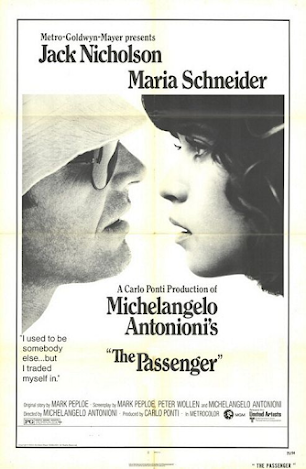
The Passenger
This film is one of my blind spots from 1975. I badly wanted to see it, but it played in limited engagements on the other side of town and I never made it over there to see it. I remember as a 17 year old kid, looking at the Calendar Section of the L.A. Times, wanting to catch up with this highly praised arthouse film, featuring Jack Nicolson. This came out the same year as “One Flew Over the Cuckoo’s Nest”, even though it had been filmed two years before the release.
I always thought it was some kind of thriller, but it turns out to be very different in tone than I was expecting. There is almost no violence in the film, except for two brief moments. One of those moments, disturbingly, is not a fictional killing, but was a filmed execution of a bank robber in the African country of Chad. It is shown as part of a documentary that Nicholson’s character is supposed to be working on. The other moment of violence involves a single karate style kick to the head of a minor character in the film. There are two pivotal deaths in the story but both occur off screen, and they are not designed to create suspense and tension, that isn’t really what the film is about.
As I was watching the first half hour of the movie, I was worried about the pace of the film and the ambiguity of the events being shown. Eventually, most of the uncertainty about characters and their actions gets explained more clearly as the film moves on. The pace also starts to pick up when there is more dialogue. Nicholson plays a journalist, working on a story about conflict and civil war in Africa. In the 1970s, that seems to have been a constant problem, and it doesn’t look like the world has changed that much in the intervening years. His character is David Locke, and he is struggling to connect with the fighters in the conflict, but does not seem to be getting anywhere. The metaphor of spinning your wheels is also visualized literally when his Land Rover gets stuck in the sand. Later, in some flashbacks, we see that his homelife is similarly stuck in the mud, and we get a sense that maybe he is looking for a new life. When a fellow resident at his hotel dies, Locke takes over his identity, a man named David Robertson. This changes his life, but maybe not for the better.
Audiences will have to fill in the blanks and suspend a great deal of disbelief, to accept that Nicholson is able to follow through on some of his new identity’s plans. As I was watching, it seemed strange that the man who was so feckless in Africa, was able to bluff his way through with some dangerous types early in the film. It also turns out that his wife, who thinks he is dead, is a lot more determined than he imagined she would ever be. Without credit cards, or cell phone GPS data, she is able to track down Robertson across Europe. Spain must be a small country because they practically trip over one another in the lobby of a hotel, completely by accident.
Jack plays a disaffected man, seeking a new life, but he is still playing at someone else’s life, and getting close to being burned by doing so. I suppose it is karma that brings him together with a similarly disaffected architecture student played by Maria Schneider. They don’t quite fully commit to each other, but at times, their mutual presence gives each of them a few moments of pleasure in life that they are seemingly missing the rest of the time. Languid conversations in the car, hotel restaurant, or wherever they happen to be, make up the majority of the story in the second half of the film. There are a few chase scenes, but they are not shot like a thriller, so much as they just move us to the next obstacle.
All of the film is a set up for a seven minute shot at the end of the movie, where events play out in front of us and behind where we can see. Almost everyone is in a long shot, and it looks to have been done as a single continuous take. One of the things that is very noticeable in the film making, is the absence of a music score. All the events take place in a vert real world environment, that is not accentuated by movie techniques. Michelangelo Antonioni is the director, the only other film of his that I know I have seen is “Blow Up” and I think that movie does the same sort of thing.
One of the reasons that I had not caught up with the film was that for a number of years it was out of circulation. Nicholson himself acquired the home exhibition rights, and it was not until 2005, that the film became available, except for a very limited VHS release in the 80s. Antonioni was unhappy with several of the cuts he was required to make to bring the film in at a reasonable runtime. The leisurely pace of that opening section might have been a place to trim, and then maybe he could have kept scenes he thought were worthy later in the picture.
I would have preferred to have this film as physical media, but one of the reasons that it is this week’s entry on the Throwback Thursday project is that I wanted to include it in my Lambcast Show this coming weekend, and the out of print discs that I could buy, could not be here in time for that show. So this is the first film that I have purchased, rather than simply renting, on a streaming platform. I hope it does not disappear when whoever now controls the video rights, decides to alter the arrangement. I don’t know how much I might have appreciated the film in 1975. Probably I would have admired it, but not completely understood it. That is not too dissimilar from my current reaction, but I do think I can make a little more sense of it now that I am older.
A couple of weeks ago, I went to a screening of Evil Dead 2. I of course had a blast, seeing this original gateway drug for me into this franchise. Ever since I immersed myself in this world back in the early 90s, I have been a fan of every iteration. I went back and saw the original film, I have practically memorized “Army of Darkness“, and frankly, I loved the reboot from 2012, which is apparently not a popular opinion among the deadites around the world. Too bad, I stand by my opinion that “Evil Dead 2013” was a terrific horror film. So I was not too worried about this film, even though I was not overly impressed by the trailer.
My hopes were frankly buoyed by the fact that the screenings on Friday were largely sold out. This bodes well for the box office and future visits with the deadites. I can safely say the film is not a disaster, and there is much horror to enjoy here, but I will caution that it does feel a bit lesser than the movies that came before it. There is no humor in the film, so it will not compare to “ED2” or “Army”. “Evil Dead Rise” fits in the pocket with the original film and the reboot. Pretty much this is a straight horror film. The main conceit of the story is to take the film to an urban environment rather than keeping us in the woods. I don’t think that is a spoiler, in spite of the fake out we are given at the start of this movie.
As it is a horror film, we must concede that there will be some well worn tropes trotted out to make the movie work. The first of these is the location. The apartment complex shown is supposed to be in Southern California, but it is not one that was built in the last 90 years. There is no sunny open air courtyard, the stairs are located inside of the building’s walls rather than in the open. The garage is enclosed rather than being a carport style with ventilation to the out of doors. It feels like a building from NYC or Chicago, that has been planted in SoCal for no particular reason. It is 13 stories high, and oh yea, it is condemned to be taken down in a month. This dilapidated structure is also serviced by an elevator that most of us would not get into on a bet. You can expect a lot of mysterious horror in an elevator like that, and it shows up.
The second trope is that an innocent will launch the threat of the Dead, by ignoring every warning, becoming fascinated by the “Book of the Dead”. Somehow, a recording will be played and the forbidden words will release the evil contained within. That’s right, someone in a horror film behaves stupidly as a way to get the plot going. If you are a fan of these films, you will also be expecting chainsaws and shotguns. Do not despair, they will show up and they will be used. There is also a lot of blood, a lot. Most of it appears to be a practical effect rather than CGI, but there are shots in the film where in spite of Director Lee Cronin’s word, CGI does take over. The make up effects are sound for the most part, but the eyes have to have been done with CGI and that may remind you of too many episodes of “Supernatural”.
The cast is game, and I liked the testy relationship of the family members before all hell breaks loose. They are played by Australian actors doing good American accents for the most part. The opening sequence consists of call backs to the original Evil Dead, and then when we get to the climax, there are a whole bunch of references to “ED2: Dead by Dawn” (and a pretty obvious one to “the Shining”.). There is a clever moment of name dropping when you see the pizza joint label on the boxes of pizza the kids bring home, but I’m not sure that it will make up for the absence of the Delta 88.
“Evil Dead Rise” deserves to be seen in a theater, the sound mix is awesome, some of the set pieces just need the space, and it is a wham bang momentum builder that slowly revs up and then launches into fast mode. The idea that this would be a streamer was a terrible one, and with it’s success with moviegoers as opposed to movie watchers, there is a good chance we will get to be frightened again down the road.
The best thing that “Renfield” has going for it, is the demented, ham fisted performance by Nicolas Cage as Dracula. He is the antagonist in the story and is mostly a secondary lead to Nicholas Hoult as the titular character. Hoult is great too, but it is the make-up heavy visage of the Count that you will remember if you see this film. From the very beginning, when Cage and Hoult are digitally inserted into the original 1931 version of the film, I was hooked into the story, regardless of where it ultimately was going.
This is decidedly a comedy rather than a horror film. There is not really a sense of dread so much as an expectation of violence. So it is also an action film, although one with an unconventional premise. Renfield has decided to break his codependency with the count, and try to make up for a lot of horrible things that he has done. Making amends is complicated when you are for the most part, a contributor to the longest murder spree in history. The conflicted servant seems like a decent guy, despite enabling a monster for almost a century. That we can relate to the character is the gift of Hoult, who manages to convey a puppy dog like sincerity, even when dragging dead bodies across the floor to his master.
In trying to flesh out the story, the film makers have borrowed a subplot from the long forgotten, “Innocent Blood” from 1992. That story mixed vampires with mobsters and “Renfield” does the same thing to create more confrontations for Hoult’s character and a threat for Dracula to expand on. It also justifies the addition of Awkwafina to the cast, as a smart mouthed cop who both backs up Renfield and pursues him as a suspect. There is also a romantic element to her presence, which is mostly discrete but makes the film more conventional than it needs to be.
Cage gets a mouthful of fangs to emote through, and that is fun to watch. Dracula in the story has been repeatedly stopped by good guys and it doesn’t end with his death so much as a fall in fortunes that takes a while to recover from. This feels like it is borrowed from “Interview with the Vampire”, as Lestat had to lay in a hole in the ground for a long time before being revived. The decrepit make up effects here are stellar and the incremental improvements are faithful to the story. So the technical elements of the film are top notch.
The action sequences are reminiscent of a thousand recent films in which the fights are staged with wire work, CGI and physics defying visual movements. There are also copious amounts of CGi blood and dismembered body parts. That is the stuff that is used for the extreme humor that a movie such as this is designed to take advantage of. The use of a persons limbs as projectiles that another person will be impaled on is both disturbing and amusing. I suspect that if you are inclined to see this film, those will be the kinds of moments that you are looking for, congratulations, you will find plenty of them.
“Renfield” is not going to set the movie world on fire, but it does entertain in the lane that it is driving in. There are a lot of gruesome laughs to be had and a fun performance from Nic Cage. So I can’t think of a reason to skip it, even if in the long run it is not a substantial film. The idea for the concept is what makes this worthwhile, but it is not a very deep idea in the first place. Dwight Frye has nothing to worry about.
Well you know that you have something solid, when your immediate thought is, “This is the movie I will be comparing everything else to for the rest of the year”. It’s already April and we have a contender for the best film of 2023. It stars Matt Damon and was directed by Ben Affleck, yea, those guys. They did not write the movie but their presence certainly gives it the vibe of their collaboration from twenty-five years ago. This is a drama, set in 1984 and it focuses on the greatest basketball player of all time with him being a practically invisible character for the story. The plot focuses on a business deal and that hardly sounds like the subject that would make a movie compelling. Also, we know the outcome before the film even starts. So how does this end up working?
First of all, you have intrigue that most of us were unaware of. Getting Michael Jordon to commit to a shoe company that had negligible impact on basketball in the time was an arduous task. The competitors were better prepared and financially able to fulfill the athletes wishes, his agent was aggressively dismissive of Nike’s attempt to set up a meeting, and Michaels parents were naturally suspicious of everyone as he is making the leap to the pros. Phil Knight to founder of Nike was a successful shoe innovator but his athletic apparel di not have any cache with the basketball community at the time. What Nike did have was Sonny Vaccaro, a basketball scout for talent in the endorsement industry, who had a deeper understanding of the game than his rivals, and a better instinct about Jordan than anybody outside of his family.
Damon plays Sonny as a driven gambler with good instincts and a dogged personality. He is also not an athlete or user of Nike products. He is a middle aged guy working in a rapidly changing environment, but he is never put off by the obstacles in front of him. Damon gives him the conflicting auras of passion and hopelessness. Fortunately, he is also better able to articulate his vision than any one else. There are two great spots where he has to be persuasive, primarily on the spot. In a sequence where Sonny talks with his friend Basketball coach George Raveling, he learns that Martin Luther King Jr. extemporized the second half of the “I have a Dream Speech”, and learned the lessons that you have to read the audience. When we get to the pitch that he makes to the Jordans, he does basically what King did, listen to his audience and speak to their inspirations and aspirations.
Of course the characters in the film have to be interesting to hold our attention. Vaccaro is a gas, flippantly joking about Nike’s dismal reputation in the basketball field, while simultaneously projecting the conviction of his visions. Jason Bateman plays Rob Strasser, the marketing executive at Nike who wants Vaccaro to succeed but doubts his gambler’s instincts. His realization that Springsteen’s “Born in the U.S.A.” is not quite the world affirming anthem he thought it was is very amusing. The two of them are great exchanging criticism, life lessons and gallows humor. Affleck plays The founder, Phil Knight, who has delusions of eastern insight, moderating his business sense. Chris Tucker is another executive with a story to tell and a personality to match Sonny when it comes to speaking enthusiastically. Once again, Viola Davis shows off her thespian chops as the gracious but steel minded mother of Michael Jordon. The phone call she has with Sonny, trying to close the deal with a set of unprecedented demands, is another standout sequence in the film.
Those of us who remember those days will recognize the production design and soundtrack of the era. There is great fidelity to the times and the sense of the world. The story is a salute to the vibrancy of an entrepreneurial attitude and the power of capitalism, combined with the right vision and direction. Everting ultimately depended on Vaccaro being right about Jordon, and we know how that turned out. This movie almost does the same thing, we’ll see how it all comes out eventually.
Throwback Thursday on the KAMAD site will be a regular occurrence in the next year. As a motivational project, to make sure I am working on something, even in a week where I don’t see a new film in a theater, I am going to post on movies from 1975. Along with 1984, this is one of my favorite years for movies and it is full of bittersweet memories as well. 1975 was my Senior Year in High School and my Freshman Year in College. The greatest film of the last 60 years came out in 1975, as well as dozens of great and not so great cinematic endeavors. Most of the films in this weekly series will have been seen in a theater in 1975, but there are several that I only caught up with later. I hope you all enjoy.
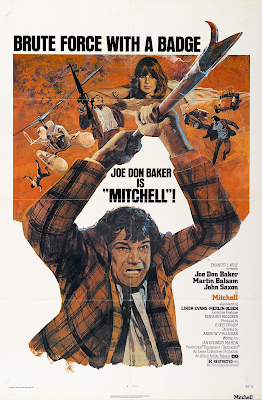
Mitchell
It’s going to happen a few times more this year, you will get a Throwback Thursday 1975 post on a film that I have never seen before. In addition to revisiting the films of my youth, this project will plug a few holes in the watchlist I have of 1975 films. I don’t remember hearing about this film back when it came out, but over the last few years there have been occasional references to it that encouraged me to toss it on the pile. That is an appropriate euphemism because this movie has thew lowest rating on IMDB for any film I have ever written about myself, a 2.7 out of 10. There are a lot of people who don’t like this movie very much.
The low rating is probably a result of the film being the subject of a Mystery Science Theater 3000 episode back in 1993. The star of Mitchell, Joe Don Baker, took exception to the treatment given to the film by the writers and threatened to “kick their ass”. I suspect that fans of this show followed up after another Baker film was mauled by the parody show, by visiting IMDB to kick Baker’s ass. The movie is not very good, but it is certainly not deserving of this dismal score. Having never watched MST3K, I am going to stay out of this particular fight and just talk about the movie I watched. That may still be influenced by the TV show because the version of the movie that is available for streaming, seems to be the one edited for the show without the riff track.
“Mitchell” is a very typical cop movie from the era. A loner detective is doggedly pursing criminals that he refuses to ignore. This cop has integrity but he is also a bit of a slob and definitely not cooperative with his higher ups. There are two crimes being investigated here, one is a self defense killing that Detective Mitchell believes was actually a murder, and then there is the drug case he has been assigned to that no one wants because it involves other agencies and politically connected mafioso types. John Saxon is the sly businessman who used a burglary as cover for shooting a guy for kicks. Martin Balsam is the mid-level crime syndicate guy who doesn’t want to cooperate with the family on a drug heist, but also doesn’t want Mitchell to nail him.
If there is a mystery here, it is in how these two cases get connected to one another. I did not think that was clear at all. Eventually it seems that Balsam and Saxon have some business arrangement but it never becomes clear what that is. Their connection does lead to the one cool action sequence in the film, where dune buggy racers are being used to hunt down the cop and try to kill him. It is not a perfect scene but it is believable, unlike the later action scene where Mitchell uses a helicopter, dangling a large compressed gas tank, to attack a yacht and then repel down to the boat for the final confrontation. This must have been the scene that inspired the movie to be selected by the MST3K team, because it is preposterous, despite being a lot of fun.
Linda Evans plays a high priced hooker who shows up at Mitchell’s door and takes him to bed, without telling him who is paying her. Their relationship never seems straight, but we are supposed to get the impression that she actually starts to go for him. Baker is not exactly matinee idol material, and his character sleeps on a fold up couch in a crummy apartment, so where the attraction comes from is never credible. She gets paid a lot of money and he will never have any. It is a little amusing that he does bust her over some minor drug possession charges and she keeps showing up anyway.
Like a lot of 70s films, there are more car chases than needed. The cop also kills a lot of people and there is never a lot of follow up, so it does sometimes feel like we are watching a TV movie rather than a feature, but remember, it is a low budget, drive-n feature, so don’t expect much and don’t ask too many questions. The one element of the show that has some verisimilitude, is the physical threat from Balsam’s character’s henchmen. Joe Don Baker is a big dude, so how could someone be intimidating and a real threat to him? By casting Rams Defensive back Merlin Olsen, who was 6’5″. Olsen had made three films before this and this was his last feature before he transitioned to television both as commentator and actor. He may not have been much of a thespian, but he looked like he could take Baker, and that’s about all that was expected of him.
Joe Don Baker is one of my favorite character actors of the 1970s. He was in “Junior Bonner”, “Walking Tall”, “Charlie Varrick”, “The Outfit” and “Golden Needles, all right before this film. He continued to work but never had a streak like that again. “Mitchell” seems to be the period at the end of those hard scrabble character parts that I loved so much in that era. There is another 1975 film that he made, “Framed”, that I have not seen, so maybe I will catch up with that one later this year as well.


.jpg)


 Kirkham A Movie A Day
