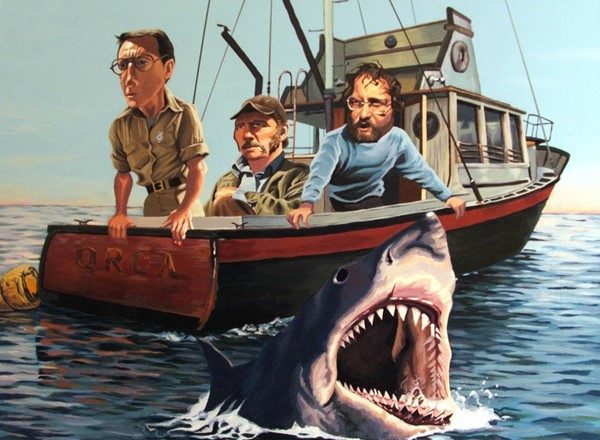
Not scary, not tense, not funny, not good.
Category Archives: Uncategorized
It Follows: Panic! At the Paramount
Panic! at the Paramount
The Paramount Theater here in Austin, wrapped up it’s annual Halloween selection of movies, Panic! at the Paramount, with this atmospheric contagion movie. Director David Robert Mitchell (he of the three first names) delivers plenty of fright with this film that features a curse, passed on by sexual contact. So there is a provocative concept, layered in guilt which results in a fear induced sense of paranoia for our main character.
The movie “Smile” from last year, basically stole the plot of this film and just changed the nature of the contagion and the way characters react to it. The thing that makes it most clear that the two films come from the same DNA is the manner in which those infected must try to rid themselves of the curse. It comes from forcing it on someone else. Also, the pursuing malicious force can take on the countenance of someone the victim knows. That is the climax of both films, and it is a pretty effective fright tool when deployed.
When I saw this movie originally, I was most interested in the horror dynamics, but there are other elements that make the film work. Jay, the main character, is a college student who has a new boyfriend that she has sex with in his car. Afterward, in an idyllic mood with a very hopeful and sunny disposition, she is suddenly subdued and tied up by the boyfriend. This is the first instance of a negative result from an early in the relationship sexual encounter, but it is not the worst. The boyfriend tries to explain the curse to her and it seems that the entity that pursues, can be diverted by passing on the curse through sex. So now, promiscuity becomes a temporary safety valve, because once the next person dies, the evil will come to the previous possessor of the curse. Will there ever be enough layers between you and the cursed entity for you to sleep well at night?

Outrunning the entity seems to be a good start, but we never quite know the dynamics at play here. The curse is a slow walker, so you would think that a four hour car ride would give you weeks of safety. It doesn’t work that way exactly, but the real idea here is that you cannot run away from the consequences of your action. Although only the person with the contagion can see the entity, otherers can interact with it, much like an invisible man, but it can’t be simply killed, as Jay’s friends discover. Jay has two friends that she ends up relying on in addition to her sister. Greg, a high school boyfriend and former lover, and Paul, a childhood friend who has always longed after Jay. Both are willing to take on the curse to try to free Jay, and that introduces more moral indecision into the film. She is not really interested in a sexual relationship with either of the young men, but she is at her wit’s end as to how to escape. The first choice she makes is guided by convenience. That decision ends in disaster, another commentary on the sexual revolution and it’s failures.
In what is a very straight horror film sequence, the friends form a plot to go after the entity and try to destroy it. It is a tense sequence and we see something that Jay sees, without quite knowing what is so fear inducing about the image. The plot backfires but there may be some hope that they have diffused the risk. Even so, to be sure, Jay makes another decision, and the plot finishes off with a horrifying implication. There may be a different kind of pandemic ahead.
Killers of the Flower Moon
Normally, I get my comments about a movie up the same day or a day later.. This may be the longest interval between when I saw a movie in a theater and when I wrote about it, at least on this site. My delay is largely due to my life rather than any shade being thrown on the film. Retirement has lead me to be busy, in ways that I had hardly imagined. Lots to see and do, and you sometimes have to prioritize. I did have a podcast episode up discussing this movie, we recorded on Sunday, so my comments here will reflect some of those thoughts with a little extra time layered in for editing.
“Killers of the Flower Moon”, is a standard Martin Scorsese film. Maybe that phrase will provoke you, but hear me out. It is a long, detailed examination of a criminal enterprise, which is based on violence and murder. The two main characters are played by Robert DeNiro and Leonardo DiCaprio, and the comeuppance of the villains seems insufficient to the scope of their crimes. So does that sound like “Goodfellas”, “Casino”, “The Departed”, “The Wolf of Wall Street” or “The Irishman”? It sure checked a lot of those boxes for me. This is a very good movie, but the only innovative thing about it is that it is a Western Gangster film, and Scorsese has made this movie before.
Visually, it would be hard to fault the director or his cinematographer, Rodrigo Prieto, the movie looks great. The streets of the town featured in the film, look authentically un paved and ready to soak up the blood that will be spilled on them. The vistas of oil wells, plains, and lonely ranch houses are capable of being displayed artfully on the wall. Prieto also manages to capture the faces of the era on the countenance of actors working a century after the events depicted here. The production design is top notch as well, with cars of the era, tools of the time, and houses that look as if they were lived in during the 1920s.

If there are weaknesses, they come in three places from my point of view. Thelma Schoonmaker, the award winning editor of most of Scorsese’s films, has apparently been overridden by her director’s demands. This movie does not need to be three and a half hours long to tell the story, but someone seems to have insisted that many lovely shots or long sequences not be trimmed for time, even though doing so is not just commercially desirable but artistically legitimate. Scorsese and his co-screenwriter Eric Roth, have explained the plot, and then elaborated on it, and then added some characters, and then found some additional story, so that it all seems more complex than it really is. DeNiro and DiCaprio are too old for the parts that they are playing the parts that they are cast in. Their method styles of acting seem jarring next to the naturalist performance by the Native American cast and the lowlife co-conspirators that make up their cabal of henchmen. DiCaprio seemed to me to be holding his breath, stuffing his cheeks and generally scowling through the whole movie. The marvelous secondary roles by Lily Gladstone and Cara Jade Myers are the real sparkplugs that give the movie the life it needs.
In spite of my reservations, I still found the film compelling enough to recommend to people. This is a true story about one of the most proliferate murder conspiracies in American History. The authentic way that it is told, the location work, and the technical details are all things that give credence to the film. In the last act, there are more traditional courtroom scenes and procedural plot points, and they just feel like a different movie. It is certainly better than the overrated “Wolf of Wall Street“, but it is unfortunately on a par with the average “The Irishman“. Scorsese would do well to step out of the comfort zone for creativity, but he is still a master film maker and this will be essential for all of his acolytes.
Texas Chainsaw Massacre (1974): Panic! at the Paramount
I looked for a record of the review I saw of “Texas Chainsaw Massacre” on KABC Eyewitness news. This was before Gary Franklin was the resident critic, I can’t remember the name of the guy who covered movies there in 1974, but I do remember he had nothing good to say about it. He showed a clip of Sally being chased in the dark by Leatherface and he mocked the repetitive nature of the sequence. It took me years to overcome a prejudice against the film, formed by that childish review on the TV news. When I finally did see the film years later I enjoyed it immensely. However, it was not until relatively recently, that I decided it was in fact a masterpiece of the horror genre, and an incredibly well put together film. Tobe Hooper deserved to be remembered for this above all others of his filmography.
Like many horror films of the 1970s, this is a slow burn that sets up bizarre characters in the background and waits to unleash them fully in the later parts of the story. Listening to Kirk, Pam, Sally, Jerry and especially Franklin, yammer while on their road trip might be a little annoying at first, except, there is a set up about grave robbing that is part of what brought them out on the road trip together in the first place. When the radio is playing in the background of their drive, the news is all bad. Wars, natural disasters and a variety of tragedies are obliquely referred to. The news stories about grave desecration come up regularly and provide great foreshadowing of what is to come.
Horror films of the 70s especially, tended to have disorienting moments or circumstances. When the kids in the van pick up a hitchhiker, things get weird very quickly. The young people are clearly good hearts because it is the oppressive heat and location that motivates them to offer the lone stranger a ride in the first place. Once in the vehicle, they try to play it cool as the new passenger reveals himself to be somewhat deranged and certainly lacking in social skills. After some crazy moments, he is ejected from the vehicle and the trip continues, but we know it is not going to be an everyday excursion into the world. Of course we know that from the opening titles as well, but it is this sequence in the film that establishes the crazy tone for the violence to come.
As our group of kids encounter a variety of problems, like peeing on the side of the road, meeting with the sheriff at the graveyard, or running low on gas, we learn that these kids are just not that lucky. Every contemporary horror fan might yell at the screen for some of the choices being made, but in 1974, you had not had a hundred earlier films with people making the same mistakes, these were among the first to make those mistakes. Pam and Kirk wander off and they enter a house when no one answers the door. Later Jerry makes the same mistake. Also, someone needs to keep track of the car keys. It was innovative to have one of the group be in a wheelchair, and to have him be a bit of a whiner. We simultaneously understand his frustration but also find him frustrating. When he and his sister get into a tug of war over a flashlight, you would think it was the last piece of food in the world, or the most precious jewel ever. Character humor is sometimes subtle in the film, but as often as not, it is also way over the top.
Hooper has designed some pretty terrific shots to establish mood for the film. A dead armadillo on a baking Texas road, the sun bearing down as seen through a turning windmill, and the establishing shots of the house where most of the bad things happen are all examples of a thoughtful film maker, not someone who is just interested in cranking up the gore factor. When you add in the production design, which was done on the cheap but was clearly thought out, you can appreciate Hooper even more. Once the mayhem breaks out, he gets even better in his directing choices. The first “kill” happens so quickly and with such brutal efficiency, it is over before you have time to process that it happened. The second death is not stylized, but rather it is brutal with an establishing shot of a meat hook that increases our anticipated revulsion.

This film may be the harbinger of the “final Girl” trope, and if so, they have a great model to follow. Marilyn Burns character goes through hell. The nightmarish chase that seems to end with sanctuary at the gas station, is only a precursor for the the horrors ahead. If you have ever dreaded sitting down with odd relatives for a meal at the holidays, take a gander at what Sally is up against, you will see your reservations as minor in contrast to her plight. There is nothing artificial about the brutality or craziness that takes place in the last twenty minutes of the movie. Sally’s desperation and fear are real, as you will notice from her screams but especially the extreme progressive close ups on her eyes. Those lovely green eyes are so freaking wide and popping out that you might think she was being tortured rather than acting. Her character is so committed to living, that she makes not one but two death defying leaps through glass windows to escape the depravity she is faced with.
Almost every horror movie has jump scares, but Hooper keeps them to a minimum. The two best are in the house of horrors and and the trail in the dark. It’s hard to call the first moment a jump scare because we can see it coming, there is auditory prompt to set it up, but it works anyway. A chainsaw is not a silent weapon, but when it comes out of nowhere, you won’t be thinking about the question of how Leatherface managed to sneak up on someone, you will be happy that the effects budget did not allow for a close examination of what happens when chainsaw meets flesh.
I would not say it is a happy ending, but it is satisfying. Sure you might wish for something more horrible to happen to two vile characters, but the one gruesome karma moment is pretty damn great. That whole scene is played out so realistically, it surprises me. The truck driver acts like a real person might when suddenly confronted by the insanity we have had half an hour to get used to. To quote a later horror film, “Go. Stay on the road.” Sally responds to her actual moment of security with the kind of laughter we sometimes give during a horror film, relief and uncontrolled insanity.
KAMAD Throwback Thursdays 1975: Tommy
Throwback Thursday #TBT
Throwback Thursday on the KAMAD site will be a regular occurrence in the next year. As a motivational project, to make sure I am working on something, even in a week where I don’t see a new film in a theater, I am going to post on movies from 1975. Along with 1984, this is one of my favorite years for movies and it is full of bittersweet memories as well. 1975 was my Senior Year in High School and my Freshman Year in College. The greatest film of the last 60 years came out in 1975, as well as dozens of great and not so great cinematic endeavors. Most of the films in this weekly series will have been seen in a theater in 1975, but there are several that I only caught up with later. I hope you all enjoy.
Tommy
Reading comments on-line, people either love this movie or hate it. The work of collaborators Peter Townsend and Ken Russell has turned The Who’s Rock Opera, “Tommy” into a motion picture and it does not lack for audacity or bombast. This is an in-your-face collection of 1970s excess from a director who was known for his excesses and a producer who would later give us another even more hated Rock Opera based on Beatles songs. Robert Stigwood was a record mogul who became a movie producer and is responsible for some of the biggest hits and flops in musical films of the 70s and 80s. Director Russel might have been willing to live with lesser artists, but Stigwood encouraged the excess by holding out for Elton John and Jack Nicolson to join the cast of this film. This was a confluence of egos that created a visual assault on the audience that can still be felt 48 years later.
Oh, count me in the loves the movie category.
A parable about family secrets creating a cult of personality, “Tommy” is a social satire par excellence. Avariciousness, idolatry, drug use, sexual mores and more, all come in for some bashing with humor and style. Is it excessive at times? Yes, but it is also imaginative, invigorating and fun. Roger Daltry plays Tommy, the boy who has a psychosomatic condition that cause him to be blind deaf and unable to speak. Daltry must have performed the opera hundreds of times as a member of The Who and now he he gets to act as well as sing the part. I personally prefer the sound of the album version of the music, but the soundtrack here is quite good, adding as it does, a variety of other artists to interpret the songs, including some who are not noted for their singing.
The sequence with Eric Clapton as the Preacher, at a temple that worships Marylin Monroe as a deity, capable of performing miracles, is one of the most disturbing conflations of ideas about pop culture that I have ever seen. The dancers who trudge down the aisles wearing a ceramic version of the face they worship is creepy as all heck. Clapton’s low key vocals are hypnotic as the rhythms entice the faithful to kiss the feet and peek up the skirts of an effigy to their object of adoration. This is like a tent show healer without the fire and brimstone but rather the soothing melody of hypnosis as a solution to your problems.
Every few minutes in the film is a set piece highlighting the work of another guest star. Tina Turner dazzles as the Acid Queen and Russell has visualized an Iron Maiden of hypodermic needles to hive us nightmares. Add to that a mirrored split screen and some psychedelic lighting effects and the influence of the director’s madness is evident. The show stopper tune however, is the “Pinball Wizard” contest, pitting blind, deaf and dumb kid Daltry, against a rock icon of the era, never noted for subtlety, Elton John. The audience in the scene is equally frantic and when the Pinball Wizard falls, and is carried out by his oversized boots, you should be getting a great laugh.
Oliver Reed and Jack Nicolson both sang their own parts, although they are not singers. Reed is mostly bullying himself through the process with a gruff voice pushed to short bursts of trying to stay in tune. Nicolson would not be putting out a Christmas album, but he acquits himself very nicely in a short scene where his eyebrows interact with Ann-Margret most effectively. Speaking of Ann-Margaret, she was nominated for Best Actress for this part and I have seen a number of people question that nomination. I think it was perfectly justified, she does all the heavy lifting of the songs that have to hold the narrative together. Her character also has almost as elaborate a story arc as Tommy himself. If you pay attention, you will see that it is not only the scene with the beans, bubbles an chocolate that she throws herself into. She is energetic as all get out in a number of other moments and she is also very poignant at times. It’s best that she did not win, but being in the mix was certainly reasonable.

If you are looking for additional Ken Russell moments, watch the “I’m Free” number, where Daltry swims, runs, tumbles and flies in a kinetic montage while singing one of the best loved songs from the work. Also, the reverse climax of the film which returns us to the long overture segment of the movie is really quite clever. This film is bursting in inventiveness but it is not always tasteful or coherent, which may account for why some people hate the film. It was a huge success when it was released in the spring of 1975, and that is when I first saw it. My memory is that I saw it at the Academy Theater in Pasadena. Today I watched it on a DVD that I burned from my Laserdisc years ago.
The cast, the music and the costumes, and scenery make this a perfect snapshot of 1975.
A Girl Walks Home Alone at Night and [•REC] A Twofer during Panic! at the Paramount
A Girl Walks Home Alone at Night
Two more films during the “Panic! at the Paramount” Halloween Screenings, although technically, this should be “Panic! at the State”. since they played next door at the State Theater. This was anot a double feature, but two separate shows, although I suspect many in attendance had done what we did, just plan on going to both.
“A Girl Walks Home Alone at Night” is a vampire film, set in Iran but filmed in Southern California. Directed by Ana Lily Amirpour, it tells the story of a dying town that is being drained of life by drugs and a vampire. In this case it is a lonely vampire woman. She seems to be able to be selective about her victims and chooses criminals, drug users and homeless people to feed on. All the while she is intrigued by the others she sees living in the area. She lives in an apartment filled with pop culture refernces on the walls and she listens to music that she has taken from some of her victims as she dwells on her life, alone in the dingy surroundings of the flat and her neighborhood. The idea that we might sympathize with a vampire who kills people is not new, neither is the perceived loneliness of such a life. That perspective was cover pretty well by Tony Scott’s “The Hunger”.
Before we even meet the vampire however, we encounter Arash, a young man who seems to start the film by stealing a cat, and then proceeds to become more sympathetic in spite of his light fingered tendencies. Some of what motivates him is that he is caring for his father, a heroin addict incapable of doing anything other than remembering the past and shooting up his next dose of medicine. Deeply in debt to his pusher, a pimp who styles himself after the chic Eurotrash he wants to live like, Arash’s father allows his son to shoulder the responsibility and the pimp takes his prized possession, his car. The car becomes a keystone in the story, later bringing together an aging prostitute, the vampire and Arash himself.

The film does seem to meander a bit, but most of that is establishing the environment and circumstances of the characters. The horror elements are very limited, with the creepy apparition of the Girl, appearing in the background and sometimes following other characters in the story. The Girl wears a Chador over more Western dress, so that when she is seen in public she simply seems to be a compliant woman, but when we see her in her apartment and at the party later, she is anything but that. Maybe there is some commentary implied about the rules that people live under in Iran, although it appears that there is plenty of privilege for those with means.
Stylishly shot in Black and White, the film creates a foreboding atmosphere without ever provoking fear, just some anxiety. Lighting and shadow effects are used well to draw attention to some emotional points, and the sadness that permeates “Bad City”, the town they occupy. My favorite scene in the movie occurs when Arash, dressed as Dracula for a party, drunkenly encounters the girl and the start of their relationship is funny as well as disconcerting. I’d seen this film before, but this was the first theatrical screening for me and I think, as usual, that the theater environment enhances the film in every way.
[•REC]
This is a Spanish horror film that was remade in the U.S. as Quarantine. I never saw the remake and this was a first time watch for me. In essence this is a found footage film, since all of the content is recorded on a video camera by an operator we know as Pablo but who we never really see. The film starts out as an episode of a television program, that looks at everyday experiences. Ángela, is a reporter for this lifestyle news program and she is following a Fire Department crew on their nightly routine. Of course the experience turns out to be anything but routine.
Made up of edits and segments that would normally be culled down to a minimal running time, the realistic nature of the film technique enhances the excitement in the movie and it brings up the terror factor very effectively. We are only seeing what Ángela and her cameraman are able to record, hence the title of the film. She is committed to getting the truth out when dangerous things start happening in an apartment building that the fire crew has been called to. A Mysterious aliment seems to have befallen an elderly woman living on the top floor of the building, but anyone who has seen a zombie movie before, has a good idea of what is coming.
As the stakes get higher, outside authorities have closed off and sealed the building, refusing to let the occupants, the news team or the firefighters and cops inside to exit. Life threating injuries are being neglected and Ángela wants to document that neglect and find out the reasons. So often in movies, the reporters are annoying obstacles that are used for exposition and then treated as humor or fodder for the rest of the story. This film treats the press a little more fairly, although we do see that the two person team is deliberately ignoring the directions of the police during the events.

The action scenes are quick but the after effects are shown in gruesome detail to make the film more horrifying. Towards the end of the film, we switch to a night vision viewpoint on the video camera because the power seems to have gone off in the building and at that point people are sequestering themselves inside the already sequestered building. There is a strange explanation of what might have originated the contagion causing people to become hyper aggressive monsters, but by the time those explanations arrive, they are irrelevant, except to set up a final sequence.
[•REC] is an excellent example of both the found footage style of film making, but also the modern version of a zombies story. Actress Manuela Velasco has to carry much of the weight of the film as the on screen reporter who is essentially directing the movie by pointing her camera operator in the right directions. She does a great job of selling the character as a woman who knows the limits of her job, until push comes to shove and she levels up. This was a real discovery for me and highly [rec]ommended.
Pearl and X Double Feature Panic! at the Paramount
These were my two favorite films last year. I treat them a bit like I do the Lord of the Rings films, they are a piece and should always be connected to one another. Getting a chance to see both of them on the bog screen again was fantastic, and delightfully, they are shown as the story chronologically, not in how they reached the audience the first time around. I am not the only one with high praise for the films, the Paramount’s main programmer Stephen Jannise, said as much when he introduced the program on Saturday night.
The audience was packed and it was a great surprise to see that more than half of the people attending indicated that this was going to be a first time watch for them. Listening to the laughter and the sound of breath being held, the audience got the picture. It sure sounded like they were responding appropriately. Having just reviewed these films last year, I will skip most of the critical analysis and direct you to those two reviews. “X” was the first to be released. It is the one set in 1979 and it owes everything to the Drive-In exploitation films of the era. Later this week we will be seeing the “Texas Chainsaw Massacre” and it would be a good companion piece to watch if you want a sense of the tone of films from this period.
“Pearl” is the prequel that came after the star and director created such an elaborate backstory for the character in X, that they had basically created another movie. More ambitious in story than “X”, and although she does not get to play two roles in the film like she did in “X”, Mia Goth simply takes your breathe away with the strength of her performance. If you want to be disturbed by a character, you could just skip to the credits at the end of this movie watch her smile for four or five minutes straight. It is as eerie as anything in that other horror film from the same month “Smile“.

Watching the films in chronological order is not essential, but it does make the events of “X” a lot more understandable. Howard as a character is the one who seems to have changed the most in the sixty years between the events. If there is ever going to be a spinoff series, his story arc would probably be the place to start. Of course we are all anticipating the third film in the “X” universe. Maxxxine is currently in post production, for a release sometime next year. Naturally, I’d hoped somehow that we would get the first drop of the trailer for that film, sadly it was not to be. There was an odd performance by a local drag celebrity prior to the first film, it seems to have been inspired by “Pearl” even if it was not particularly organic.
The Paramount did a nice job setting up some photo ops for fans. We of course took advantage and here are a few of the pictures.


Here is the teaser trailer for Maxxxine that ran at the end of “Pearl” in it’s original release, but not last Saturday at the Panic! at the Paramount .

Taylor Swift: The Eras Tour Concert Film
I am not a Swiftie by any stretch of the imagination. I enjoyed several of her early recordings in a casual way but I have never listened to a whole album except in the car when being played by my daughter who is a big fan. She actually attended two of the L.A. Concerts that this movie was made from, and I suspect seeing this film is a way to reconnect with that experience as well as putting more money into Taylor Swift’s bank account. The idea of five shows at a sold out SoFi Stadium is impressive, that’s well over a quarter of a million people seeing this in the one venue. I remember when Led Zeppelin did six shows at the nearby Forum back in the seventies and that seemed like an impressive number. The experience though has to be extremely different.
The idea of covering different periods of her musical journey is a good one, I was a little surprised that it was not chronological, but there may be a reason for that. Of the ten albums that she features in the show, the strongest songs are from the middle and early years, although I did appreciate a few bits that take place in the final album, I think the songs work much more effectively in a live show than they did in the car. When listening to her while driving, the latest period of her music sounds faceless, tuneless and lacking melody. On stage, with a dance troop, visual effects, and a lot more personality in the presentation, they came off pretty well.
Visually, the concert experience was incredibly ambitious, with an elaborate stage, proscenium and background sets, there was a lot to look at. The stage floor as well as the proscenium extending out on the field of the stadium, are integrated with video feeds that constantly change and reflect the songs or eras that are being performed. My favorite visual moment took place when she appears to dive right into the floor below her and can he seen moving as if under the surface of the water until she emerges, complete with costume change at the other end of the outcrop. Sections of the stage raise and lower depending on what is called for and they contain dance sequences, pantomimes and sets that make up what comes across as the world’s most elaborate cabaret act.
Maybe the filming of the concert draws attention to a mild weakness from my point of view. There are way too many dance sequences that consist of Taylor Swift, flanked by her primary dancers, walking in synchronized steps down toward the front of the proscenium. Often they have the detached facial expressions of models on a runway but in a more martial formation and maybe a little too ponderous. If it happened only seven or eight times I might not have cared, but by the middle of the film I had had my fill of this particular choreography. Had I been in the stadium, I doubt that this would have bothered me, but it seems like director Sam Wench is in love with that shot and uses it whenever there is nothing else to focus on.
Taylor Swift herself is working her butt off to make the show come alive. I don’t think she has a personality that is compelling enough to hold us by itself, but she does have the dance moves down, and she maximizes movement and vocal performance for the best effect possible. When she just addresses the crowd, I think she is sincere but not compelling and she is much better when she plays or sings. The band does appear in a couple of numbers, but for the most part they are sequestered to the side of the stage, hidden from view like the orchestra at a Broadway musical or an opera. For my money, her best moments were during the acoustical set when she is just playing the guitar and singing and is not trying out for a part in the latest Circe de solei extravaganza in Vegas. Some of the moments in the show reminded me of a skit being put on to a record in the background, but other set pieces worked really well. The dancers in the cubicals that descend to the stage, that was great. The dinner table song with a solo dancer acting out a break up dinner date seemed trite.
The show looks great and the high definition photography enhances all the sets and costumes. All of the dancers were excellent and I noticed that they often came in various sizes so that was a nice plus. The back up singers provide terrific support but ultimately it is Taylor Swift you have to love to love the movie. She has many moments where her voice does make an impact, but there were a lot of numbers, especially in the first half of this nearly three hour production, where she is letting the dancing do all the work. Taylor Swift fans will love the movie, movie fans will appreciate the technical aspects and sound quality.
By the way, I saw this with an audience full of Taylor Swift Fans. They were exchanging friendship bracelets, they were decked out in clubbing attire, and they stood up and danced in the movie theater during several moments in the film. So it really enhanced the “live” vibe of the movie. I don’t know if the film will play as well without the fan enthusiasm. If they can keep up that energy level for forty more days, maybe they can knock that “Barbie” monstrosity off the top perch of films for the year.

It probably won’t happen but it would make me feel better about the movie going public if it did.
KAMAD Throwback Thursdays 1975: The Day of the Locust
Throwback Thursday #TBT
Throwback Thursday on the KAMAD site will be a regular occurrence in the next year. As a motivational project, to make sure I am working on something, even in a week where I don’t see a new film in a theater, I am going to post on movies from 1975. Along with 1984, this is one of my favorite years for movies and it is full of bittersweet memories as well. 1975 was my Senior Year in High School and my Freshman Year in College. The greatest film of the last 60 years came out in 1975, as well as dozens of great and not so great cinematic endeavors. Most of the films in this weekly series will have been seen in a theater in 1975, but there are several that I only caught up with later. I hope you all enjoy.
The Day of the Locust
Well it turns out there was a reason I never rushed to see this film when it came out in 1975. “The Day of the Locust” is a dour, black hearted takedown of the Hollywood Dream and by association the American Dream. It is showered in technical excellence in performances, production design and cinematography, but it is also lathered up by the most vile version of failed movie people you are likely to see this side of “Babylon“. At least this film avoids the elephant shit.
One of the reasons I never followed up on the film is that I could never get a sense of what it was about. Maybe I missed the trailers because the one above is pretty direct in saying it is the underside of Hollywood that we are going to see. Look, I know that there was a dark side to the Golden Age, there are always flip sides to any story. It’s just there there is almost no one that you care about in the story, so whatever tragic outcome shows up will probably be met with indifference. Donald Sutherland is listed as the first lead in the movie and he does not appear for three quarters of an hour into what we see on screen. Meanwhile, we are introduced to a strange relationship that never takes on the quality it needs to make us want to know more about the two figures who are really at the center of the picture. William Atherton may have the most sympathetic role of his career here. He is notoriously the obnoxious prick in 80s comedies and action films. Maybe he is more sympathetic as a terrorist on the Hindenburg than here, because his character literally tries to rape a woman, and then apologize for it. So Drunken Rapist or murderer against the Nazi Airship, which one is the most appealing character? This was probably his biggest role and he is very good in it, but again, it is hard to feel sorry for people who are so obliviously self destructive.
Karen Black, is the star of the film, playing Faye Greener, an aspiring actress who is struggling to get extra work, and lives with her aging vaudeville performer father played by Burgess Meredith. Faye is a character who seems like she could be appealing to start with, but she rapidly is revealed as a potential gold-digger, and she certainly is aware of the effect she has on the men around her. She is self centered and leads Atherton’s character as well as Sutherland and Bo Hopkins and Pepe Serna on for most of the movie. She is mercurial and insecure and thoughtless to the men in her life. You almost sympathize with Atherton’s Tod when he does assault her. Maybe we could have more sympathy when she is forced to resort to prostitution, except she is such a bitch to everyone around her that it seems like maybe she has found her real niche.
Fecklessness thy name is Homer Simpson. Not the cartoon character, but the Sutherland role in the film. As a lonely man, maybe a cloistered homosexual, he has difficulty relating to others and when Faye latches on to him, it’s like watching a cat play with a mouse. The incongruity of their relationship and her continued connection to Tod is simply befuddling. No one is getting what they want from any of the connections they are forming. Everyone feels like an object of pity. Little Person actor Billy Barty is aggressively confrontational in what is likely to be the biggest role of his career, and Burgess Meredith pushes the pity button but also is cloyingly cliched.

Director John Schlesinger has mounted a admirable visualization of old Hollywood, finding the homes in the hills to shoot scenes at, constructing moments of behind the camera elements for the work being done at a studio, and working with Cinematographer Conrad Hall, to produce a soft focus view of the corruption we are seeing on the screen. The work earned him a well deserved Academy Award nomination. Schlesinger’s collaborator on previous films, Editor Jim Clark, probably needed to find a way to make the story flow a little faster, although his work on the two best scenes in the film is excellent.
Those scenes that will remain with me, as the highlights of this movie, include an on set disaster during the making of a Napoleonic War film, and the extremely disturbing climax of the picture. Novelist Nathaniel West, on whose book this movie is based, clearly was down on the American dream and his nightmarish vision of the culture is embodied in the climax of the film where a character murders a child, is subsequently murdered by a mob, all of this taking place at the site of the most lavish of images from the 1930 depression era, a Hollywood Movie Premiere. The satire and cynicism in the two scenes is not subtle, but both sequences are staged very effectively and I think would justify a viewing of this film, if you can put up with the dark side of the Golden Age of Hollywood.
[I watched this on a cropped laserdisc version, not the ideal aspect ratio]
KAMAD Throwback Thursdays 1975: One Flew Over the Cuckoo’s Nest
Throwback Thursday #TBT
Throwback Thursday on the KAMAD site will be a regular occurrence in the next year. As a motivational project, to make sure I am working on something, even in a week where I don’t see a new film in a theater, I am going to post on movies from 1975. Along with 1984, this is one of my favorite years for movies and it is full of bittersweet memories as well. 1975 was my Senior Year in High School and my Freshman Year in College. The greatest film of the last 60 years came out in 1975, as well as dozens of great and not so great cinematic endeavors. Most of the films in this weekly series will have been seen in a theater in 1975, but there are several that I only caught up with later. I hope you all enjoy.
One Flew Over the Cuckoo’s Nest
Obviously we were going to get to some of the prestige pictures of the year 1975. In addition to “Jaws”, “Dog Day Afternoon”, which I have talked about on this project, the other Oscar Nominees for Best Picture are “Nashville”, “Barry Lyndon” and the ultimate winner “One Flew Over the Cuckoo’s Nest”. Famously “Cuckoo’s Nest” won the top five prizes at the awards that year, tying a record with “It Happened One Night” and later repeated by “Silence of the Lambs”. This was the fifth nomination for Jack Nicolson and the first time he won. As you watch the film it is evident why this was going to be the outcome. Maybe Ken Kersey thought Nicolson was wrong for McMurphy, but for a cinematic experience he is the perfect fit.
The part of McMurphy is that of a joker in a situation that is grim, an outsider in the ultimate inside game, and the reluctant hero to a group of reluctant fans. He gets to indulge some of his wild mannerisms and facial expressions, but there are also a number of equally quiet and serious moments. The tension between McMurphy, the prisoner faking mental illness and the head nurse, Miss Ratched, is evident in their looks at one another and their voices express a barely suppressed distain. McMurphy of course, is much more open in his aggressive manner of interacting, Louise Fletcher has to hold her emotions back in the passive aggressive pattern that the nurse uses with all of the patients. Her deliberately calm demeanor may be meant to create a safe space for all of the group, but it comes off as condescending at times and she exerts her power with an icy stare rather than a raised voice. This is a film with two fantastic parts and both actors are completely up to the task of bringing them to life.
Maybe this is about the machine and how it grinds everybody down, or maybe it is a film about individuality and the importance of fighting to keep your unique identity. I always think it is about the banality of evil. Miss Ratched seems on the surface to care about her patients, and she probably thinks she is doing right by them, but at every step of the process, her manner sends the signal that they all need to conform and submit to her power. Authoritarians always think they are right and acting in the greater good, regardless of who’s necks they have to stand on and what the cost is. She is the embodiment of the Covid Crusaders who wanted everyone to do as they were told, regardless of what the consequences might have been to someone else’s life. Ratched acts more aggressively when her power is threatened. What happens to Billy Babbit is a result of her turning the passive control she has exerted over him, into a cudgel, and his betrayal of McMurphy and the self consciousness about being with a woman and the way it will impact his mother are a recipe for disaster, and Nurse Ratched is the one who puts it on the stove to cook.
In an institution filled with troubled souls, you would have a hard time differentiating the patients from the actors. Vincent Schiavelli, Danny DeVito and Christopher Lloyd are three actors early in their careers and their looks were not typical. When you throw in horror icon Michael Berryman in the background, the group seems very much a set of misfits. Sydney Lassick and William Redfield are both very good in parts that have a greater degree of dialogue. Cheswick will make you take pity on a lost soul and everyone will be frustrated with the obtuse Harding, but they are still essential to the group. The other two performances that need to be singled out are key characters in the plot. The “Chief” was played by non-actor Will Sampson. a large man of native American Indian ethnicity, and he makes a great impression in a nearly wordless performance. The moment he does utter a single word, is a transcendent one in the film. Brad Dourif as Billy Babbit makes us root for him and wonder at the world that has produced this sensitive kid that can hardly express himself. Dourif got the nomination that would have gone to the entire supporting cast if the SAG awards Ensemble category had existed in 1975.

Verisimilitude in the film is one of the things that makes the story work. The therapy group sessions are forced, like a true psych experience might be. The patients are all resistant to participating or saying anything that could have a negative consequence. The fact that they shot in a real, active mental institution means that the sets never feel like they are cardboard fronts but caged windows, communal tubs, and a near dormitory existence. The ECT treatment that McMurphy gets looks real and by all accounts represents an accurate portrayal of the procedure. The patients lining up for their medication also seems too real.
The two best sequences in the film are of course the ones that give Jack the biggest opportunities to play to his strengths. When McMurphy breaks out to take the group on the fishing expedition, he plays with all of the other characters and gets a lot out of what is going on. It is a collective moment that he inspires. However, the greatest moment is his improvised calling of a World Series Game that isn’t on the TV. Although all of the supporting cast backs him up, it is really his moments and it feels perfect.
I make no secret of my preference for another film this year, but if “Jaws” is not going home with the stupid trophy, I’m glad that this film did.

