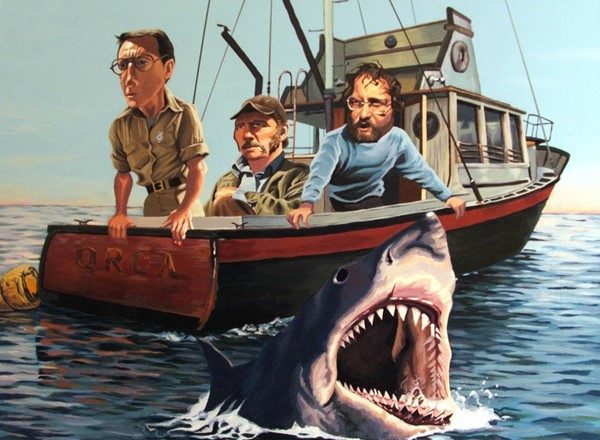
The Shark is Broken (Broadway Play)

The film world is full of movies based on plays. Nowadays, there are plenty of plays, usually musicals, that are based on films (See Disney, Back to the Future, Almost Famous and The Producers). This is a play based not on a film, but on the behind the scenes moments of the making of a film, the transcendent and incredibly hard to film “Jaws”. If you are visiting this site for the first time, take a look around, you will see that “Jaws” is revered above all other films (with maybe one exception) by the author of these pages. It is a film that I know I have seen well over a hundred times. It will then come as no surprise to longtime visitors to KAMAD, that a play about the making of the film would draw my attention. Last weekend, we made a special expedition to NYC for the purpose of seeing this particular work. 

“The Shark is Broken” was written by Ian Shaw and Joseph Nixon. Ian Shaw is the son of actor Robert Shaw, who portrayed “Quint” in the film and was notoriously cantankerous on the set in addition to being well lubricated during his time on the film. Robert Shaw was said to have bullied his co-star Richard Dreyfuss mercilessly and that the two even had some physical set-tos. Dreyfuss has always contended that it was a difficult relationship in shooting but that ultimately he had immense respect for Shaw and they were friends. Ian Shaw was inspired in part by a drinking diary his father had kept, and he knew the film is a key part of his father’s legacy, so he started writing. I believe there is a great deal of honesty in the play but that it is also an entertainment first rather than a documentary, so obvious license will be taken in telling the story.

While it might seem strange to start my discussion of the play with the stagecraft rather than the story or the acting, it is not a surprise at all. The set is open from the moment we entered the theater. The only other Broadway style productions that I have seen recently were “Hamilton” and “Harry Potter and the Cursed Child 1/2” and as I recall, there is no curtain raised in either of those experiences either. So the set is right there for as long as you are in the theater before the play begins, and it is hard not to start noticing things and feeling right about commenting on them. The physical set is a cutout of the Orca, Quint’s ship, which is the setting for the last half of the movie. There are some props in the hull of the ship but for the most part the action takes place in the small cabin around the table that you see in the film. It looks appropriately claustrophobic and intimate for the three actors to operate in. 

Most of the passage of time and change in setting is determined by the lighting and by the screen scenes on the large background screen that contains images of the ocean that the film was shot on. The play actually starts when we see the image of a shark fin in the background, and then a cloud of smoke and steam erupts from the location as the image sinks below the surface. It is the first of many laughs that will fill the auditorium for the next hour and a half. The lighting indicates time of day, sometimes the golden hour, and occasionally the choppy seas the actors were enduring. This simple tech solution to the environment probably keeps costs down but it also encourages us to keep our focus on the actors.

Ian Shaw trained as an actor and has appeared in multiple plays, films and television shows, but it is his resemblance to his father that is the most striking feature when the story gets going. Obviously, he did not have to train for that, just a little hairdressing and makeup to fit the part. His voice, while not a perfect echo of his fathers stentorian voice, it is authoritative and familiar to all of the fans of the film. He gets several inflection moments just right, but he does not seem to be merely mimicking the clips of Robert Shaw from the film, it is an acting performance not a replication. The story does start off lightly but it does go to some dark places along the way, so even though the play is largely comic, Shaw adds plenty of drama to some of the passages. He honestly portrays his father as a driven creative alcoholic with a very competitive nature. His nature was not always easy to accept and that is part of the plot as the three actors are trapped in unpleasant conditions with one another for weeks in this confined space.

Robert Shaw was a veteran screen actor when he took the role of Quint. Richard Dreyfuss had worked in films but was just moving up to featured status and he was just of insecurities and anxiety. It was in large part his belief that he had whiffed his performance in “The Adventures of Duddy Kravitz”, that lead him to accepting the part of Hooper, the smart aleck college grad who would butt heads with Quint on the shark hunt. In a way, it was the contrasting personalities of the two actors that helped create the dynamic that makes the film such a great character piece. Alex Brightman is the actor who gets to play Dreyfuss in this production, and he knocks it out of the park. His energy and staccato delivery of lines, matches the tone that Dreyfuss had in the film. Brightman has to do a lot of the heavy lifting when it comes to the comedy, because he is the most physically active character in the play, in spite of the sub-plot about him being physically overwhelmed on the shoot. He has all many of the big punch lines to the humorous script and just like Dreyfuss himself, he is not afraid to mug a little for the audience. 

The part of peacemaker seems to have fallen to Roy Scheider on the Jaws set, and here actor Colin Donell does a solid job as the voice of reason on the set. His appearance as Chief Brody is visually well cast, and he has the moderate voice range that is characteristic of the actor he is playing, particularly between the two more outlandish characters he plays against. I think it is the lines that he has, that sometimes draw attention to the theatrical nature of his part. He is a part time narrator, part time mediator, and often is the wall between the tension of the other two. As a result, he sometimes feels like he fades into the background and when he does get a chance to shine, it feels a little more obvious that he is now speaking, rather than having a natural transition to his lines. Donell does get to shine in one regard for sure, he strips down to a swimsuit as Scheider to sunbath on the deck and he is chiseled, unlike Dreyfuss/Brightman, and his physique drew a few awes and in-takes of  gulped air from appreciative audience members.  

Story structure starts the play in the eighth week of shooting on the water, when nerves are beginning to fray, but at least there is a sense of gallows humor about the logistics of what Spielberg was attempting. The characters are killing time by telling stories and making jokes, and in Shaw’s case, drinking obsessively. By the tenth week, they are playing made up bar games when no deck of cards is handy, and the talk gets to be more serious, although there is usually some levity to be found. When Dreyfuss tosses Shaw’s bottle overboard, the unpleasant physical confrontation brings a whole lot of matters to the surface. The name calling seems a lot less just guys kibbitzing and more in line with real tensions. Everyone tells a little bit of their character’s back story and the writing seems a little more self conscious in these moments. It is well known that the Indianapolis Speech was critical but also trouble from the start. Shaw ties to wrestle it into a coherent shape but his intoxicated performance destroys the impact of the scene, and this is the dramatic climax of the three characters on the boat. The audacity of featuring the greatest scene in the movie as a failure is remedied in the coda of the story as Ian Shaw does a credible job of performing as his father when he gets a second chance to do it right. No curtain needs to drop, the lights just go down and the memory of the film, combined with the live performance, provides the chill on the back of the neck that punctuates the whole enterprise. 

The screen fills with production shots from the 1974 shoot and the actors take a well deserved bow.  The play is entertaining as anything you might hope to see. Sometimes the play is a little obvious in the laughs it goes for, but those laughs still come and a real fan of the movie will enjoy every moment of it. The three actors are superb in their parts and although Shaw is the real focus of the story, Brightman walks away with some of the best moments. I flew 1700 miles, just to see this play. We did do a couple of other things on the trip, like eating at a couple of great spots, but even if we had not, for this fan of the Movie “Jaws”, the trip was worth it.  

The Music while the audience is being seated is all from 1974 radio.

The Dark Knight

This movie came out before I had started the blog and this is the first time I am getting to write about the film. I said it last night when I posted an update on Facebook, this is the jewel  in the crown of Christopher Nolan’s Batman Trilogy. Both “Batman Begins” and “The Dark Knight Rises” are excellent films, but the middle film is the finest second act in a superhero trilogy you are likely to encounter. We are past the origin story and Batman is a looming presence over Gotham. The crime lords are beginning to chaff under the attention they are getting from the District Attorney, and things seem to be turning around for the city, just as Bruce Wayne wanted. Enter the Joker, a figure of chaos, who at first seems like an enemy and then a potential ally to the underworld kingpins, but looks are deceiving, as we will be reminded on a regular basis. 

The opening set piece with the daytime heist of mob money from one of the banks secretly controlled by the criminal elements of the city, is a terrific starting point. The crime is filled with audacity in execution and violent subterfuge by the man who planned it. When the last clown standing takes off his clown mask and reveals the clown make-up he is sporting, we know that we are in the company of a deranged criminal who does not follow any rules or patterns. This will undermine both the criminals and the cops for the rest of the story. This is the performance from the late Heath Ledger that won him a posthumous Academy Award, and it was richly earned. Ledger gives the Joker mannerisms that suggest he is bat shit crazy in every scene, but he also has a voice that commands respect because of the level of intelligence behind it. In the scene at the fund raiser, when he takes notice of Rachel Dawes, he pushes his sweaty  hair back behind his ear, with a knife in his hand, like he is primping for a meet cute, while armed and dangerous. When he gets caught and is baiting the officer who is standing watch over him, he manages to smirk in an antagonistic way, in spite of the fact that he is still covered in his trademark make-up. Ledger underplays so many scenes despite being the most flamboyant character in the story. 

One of the things that makes this film work well is that Bruce Wayne gets to be part of the plot in addition to being Batman. His love triangle with Rachel, his planning of the extraction of the accountant from Hong Kong, and the series of moments when he seems set to reveal himself, are all more engaged in the story than the billionaire usually gets. When he manages to safe the life of the man who is going to reveal his identity, it is in his best detached and clueless rich guy persona, a part he plays regularly in the film. Christian Bale has to do most of his acting in these scenes since the costume does so much in the Batman moments. One of the jokes that people sometimes make about Nolan’s Batman concerns the gravelly voice that the Batman uses to cover who he is. I think too many people believe it is just an attempt to intimidate criminals (which it is) but they ignore that he is also avoiding being identified. 

Director Christopher Nolan has put together a great series of action sequences which are mostly justified by the plot, even if logically they can’t all come out the way they are supposed to. I have already mentioned the opening heist, but Batman has a heist of his own when extraditing Lau from Hong Kong. The spectacular removal from the building is a moment from a 60s era James Bond film, but played as serious rather than comic. The stunned security men are befuddled at the smashed window and the pane flying into the upcoming day looks just brilliant. Both the Joker and Batman have an action scene that plays out their own plans simultaneously, as Harvey Dent, claiming to be Batman, is transferred across town, there are gun battles, crashes, the end of the Batmobile and the birth of the Batpod, and it climaxes with a tractor trailer cartwheeling front to back on the streets of Gotham.

Harvey Dent, played by Aaron Eckhart, is the White Knight of the city that Batman wants to step aside for, but of course the Joker has a different goal. Certainly Harvey has reason to feel embittered and resentful. The fact that he can be tipped over to the Dark Side has been hinted at a couple of times in the course of the film. I just think that the final Two Face challenge is such a reach that it is the only flaw in the carefully constructed plot. It works, but only barely, and I think you have to see the film several times to be convinced that it is not just a plot contrivance. 

The film is filled with actors who do a fine job in their parts. Most of the criminals get short shrift but the cops, many of whom are tainted, get a chance to show off a bit. Eric Roberts is slimy as hell,  Morgan Freeman is as cool as you would hope, but the heroic center of the film is Jim Gordon, played by Gary Oldman. Gordon is a cop who tries to play it by the book but knows that the Batman is the linchpin on pushing Gotham back from the brink. His part in the capture of the Joker is a fun twist and his distraught father in the last scenes are demonstrations of Oldman’s talents. 

The electronic and orchestral score makes a dramatic impact on the film, although the lack of melodies probably keep it from being memorable. Humming along to the strum and dang of the score is not really possible, but the score is effective time after time in evoking emotions and mood. The action scenes have the parts that are most like traditional tunes, and Hans Zimmer and James Newton Howard have divvied up the two antagonists to create wholly different personas for them musically.  It is a very distinct score from the Tim Burton Batman films and several elements from the first film are repeated here, in completely appropriate ways.

Even though the Joker succeeded at spoiling Harvey Dent as a hero, Batman and Jim Gordon snatch victory from the jaws of defeat by changing the narrative and turning Batman into the dark figure of the story. The combination of Batman’s faith in the citizens of Gotham on the ferry, and the sacrifice he makes to become a fugitive, give the story the bump it needs at the end to reach an emotional crescendo. The final narration from Gary Oldman makes the conclusion pay off with goosebumps.  

Spy Kids Armageddon

A few weeks ago, at the Paramount Summer Film Classic screening of “Clash of the Titans”, Director Robert Rodriguez previewed for us the above trailer. The film is set to premier on Netflix later this week, but we were inviter to the World Premier last night at the Paramount here in Austin. The audience was packed with kids and people who had worked on the film and the house was raucous. The film was shot in Austin and the main contributors are members of the Rodriguez family. 

The film is the fifth in the franchise and it does not stray far from the formulas that came before it. Two young kids get involved in a spy plot because their parents are spies. They accidentally release a video game virus that combines with a program partially developed by Dad that will allow the designer to control all electronic mechanisms. The become spies themselves and fight back using the tech that has been given to their parents by the spy agency they work for. 

One of the reasons that the audience at the “Clash of the Titans” was specifically invited is because the film is filled with Ray Harryhausen images, including sword wielding skeletons and crab like robots. This is a lot of fun and reinforces the fantasy elements as much as the gadgets do. The story is thin, like a kids film is likely to be, but it does have some values about family that are certainly admirable. It is clear this is a movie for families to enjoy together. The fact that parents were at the show last night, who had grown up watching the original films, and they were now bringing their own children to the series is part of the reason Rodriguez has returned to the stories.

We had a great time and the movie is light and breezy, so go ahead and stream it when it drops this week.

A Haunting in Venice

This is the Movie we covered on the Lambcast this week, and usually, by the time of the podcast recording, I will have posted my comments. That did not happen this week. We had a full slate of activities that kept me busy and then I did the show, edited and posted the podcast, edited and posted a You Tube Video of the podcast, and finally remembered I’d not put up my own thoughts on my own site. That is about to be rectified.

“A Haunting in Venice” is the new Hercule Poirot film from director Kenneth Branagh. I have long been a fan of the theatrical films featuring the Belgium sleuth, although I have never read any of the Agatha Christie books that he sprang from. This is the third in the series from Branagh and it is quite a bit different from the previous two. “Murder on the Orient Express”  was a serviceable remake of the 1974 version, but lacked the romance of that earlier film. “Death on the Nile“,  was delayed two years by the pandemic and only was released last year, which made this film feel like a very quick follow up. Nile was a lush film that compensated for the convoluted machinations of the plot by creating a setting that was exotic and looked inviting (even if at times it was just CGI magic). “Haunting” scales back on the landscapes but ups the directorial flourishes with Dutch angles and fisheye lenses around every corner. The plot contains a supernatural element that also allows for some horror tropes to creep in, jump scares and reflections especially are dominate. 

Michelle Yeoh and Tina Fey are the two biggest names in the cast, and after the star packed casts of the other films, this story could use the lower profile performers more convincingly. I did wonder whether Micelle Yeoh’s casting was a stunt, because there is not any background on the character, but after the movie gets going, you will probably not feel that way about her presence.   Tina Fey on the other hand was an interesting take on the character and her more modern persona fits better with the Post War aesthetic that the story focuses on. 

As is usual for these plots, there are several false trails and a couple of red herrings that keep things interesting. The supernatural elements all will be explained by Poirot at the end of the film, in a satisfactory way, and although the resolution feels a bit abrupt, it was not the sudden switch in suspects that so often occurs in TV mysteries.  Once again the cinematography was exemplary, Haris Zambarloukos has been working with Branagh for a long time and seems to understand the mood he is looking for in the spooky old house on the canal. Jude Hill the young actor from Branagh’s terrific “Belfast” joins the cast as well as a boy who is both creepy and sympathetic at the same time. 

My guess is that this film will close out the Poirot films for Branagh, three seems to be a magic number after all, but I enjoyed all the films enough to recommend them and I would be happy to see this one again. If you are looking for an adult Halloween film that does not involve maniacs dismembering the cast, this would be a solid pick for your evening.

Christine (40th Anniversary Fathom Event)

I would describe myself as a John Carpenter fan, but not necessarily an aficionado. Of the eighteen theatrical releases his films have had, I have seen fifteen. “Christine” from 1983, was one I had missed for years and only caught up with during the pandemic, catching it on one of the streaming services maybe a year or so ago. I enjoyed it, but it did not make a strong impression on me, at least until last night. Seeing “Christine” in a theater, in the dark, with an audience was a frank reminder of how differently a movie can play given the environment in which it is being experienced. There was no daylight streaming through the window. No dogs were demanding my attention, and sitting in a theater is much different from laying on the bed and watching TV.  The immersive atmosphere brings out the creepy and haunting elements of the film much more vividly.

The movie has a rock and roll attitude about it from the very beginning. The fact that the 1958 Plymouth Fury is being assembled in 1957, and that Rock music was just starting is not a coincidence. Carpenter’s selections of source music emphasize the time period of the cars date of manufacture, not the time of the story. “Bad to the Bone” may have been an 80s record, but it is based in a 50s style and sound, emphasized by the roots rock of George Thorogood and his band. The songs that play on Christine’s radio are by 50s artists like Buddy Holly and Little Richard. The transformation of Arnie, the kid who restores and loves Christine,  is largely an evolution to a greaser personality and style, even though the film is set in the late seventies. 

It is a slow burn after a suggestive opening scene during the manufacturing process. Arnie, a good natured kid who is a bit of a sad sack, is played by Keith Gordon. His buddy Dennis, played by future genre director John Stockwell, is a football player with a lot more popularity but a good heart and a loyal friend to Arnie. We get some good character points about the friends and we see the initial enthusiasm that Arnie has for the dilapidated Fury he catches a glimpse of on their way home from school. Arnie’s parents are not monsters but they don’t come off as nurturing, and it is a surprise when Arnie starts talking back the them. It is the change in Arnie’s personality, rather than the satanic car, which drives the opening half of the film. The killings don’t start until well past the mid way point of the story.

We know that the bullies are going to get theirs at some point. After we see what a douche the lead bad guy is, we will all be rooting for Christine to come to life and take him out. Christine however is a jealous lover and Dennis and new girl girlfriend to Arnie, Leigh, also run afoul of her. The early incidents are hints of what is to come but the real violence involves a car taking out the trash. The most visually frightening sequence has Christine aflame, chasing after Buddy, the alpha bully of the group. In a night time scene on a lonely road, she really does look like a car from hell on a mission.  All of the deaths will get more vivid renderings with a new version that has been announced. 

Practical effects are used for the car to restore itself after being heavily damaged in an act of vandalism but also after the murders of the bullies. It is visually as accomplished as any CGI work, but because it is done in camera it looks far more convincing and disturbing. The great Harry Dean Stanton shows up for a few scenes as a detective investigating the killings, but his part is under developed and we seem to be missing the section where he figures out that the car is possessing Arnie and is really responsible for what has happened. 

When I asked Amanda what she had thought of the film, she gushed enthusiastically, that it would be craking her top five list of John Carpenter films.  I don’t know that I will go that far, but I will say it played really well in the theater and I was sorry I missed it 40 years ago, but completely happy to be seeing it on the big screen. 

What’s Up Doc?-Paramount Classic Film Series Finale

The Summer Movie Series at the Paramount Theater finished off on Saturday with one of the most enjoyable movie experiences of the summer. Director and local hero Robert Rodriguez again hosted an event that he programmed. The idea that a Barbara  Streisand comedy from 1972 was his selection is intriguing, but it was easy to understand when he revealed why. This was a family favorite of his parents when he was young and they were big fans of the singer/avtress. After the film Rodrieguez shared some stories that I will share at the end of this post.

Director Peter Bogdanovich had an amazing trifecta of films to launch the decade of the 1970s. “The Last Picture Show”, “What’s Up Doc?” and “Paper Moon” were all critical smashes and financial successes. “What’s Up Doc?” may be the most unusal of the three films because it mines the classic screwball comedies of the 1930s for it’s material and sensibility. “Bringing Up Baby” and “Ball of Fire” are a couple of the films that this movie cribs from, and it does so quite effectively. Slapstick is an art that does not alwasys get much credit because some see it as easy humor, but ask anyone who has participated in a play or movie that is a slapstick and you will find that timing is the essential ingredient to make things work. The actors and plot points have to synchronize or else the result will be painful rather than joyous.

Fortunately, Bogdanovich found three essential actors to carry off this elaborate farce and make us laugh in delight. Ryan O’Neil has been criticized for years as a dull actor who got by on his looks and the huge success of “Love Story”. Well anyone seeing this film will know he was capable of being an hysterical straight man and counterpart to the crazed characters he was playing against. Barbara Streisand was a Broadway sensation in comedic roles and transitioned to movies smoothly, and with her fast paced delivery, you will be reminded of Rosalind Russel in “His Girl Friday”. She has to do most of the heavy lifting on the comedy, but carries it off with grace and perfect timing. Finally, in her first film role, Madaline Kahn, practically steals the move in the gender reversed Ralph Bellamy part. Kahn shines so much in this film that you just knew she was going to be a comedy star.

When Robert Rodriguez talked about the film after it was done playing, he outlined the fact that the comedy bits all centered around five particular scenes. The sequence in the drug store is all about the two leads and they completly own the scene with their by play and word games. The scene in Howard Bannister’s hotel room, that ends with it being completely destroyed is a master class in building mayhem. The scene though, that most people will remember is the elaborate chase sequence through San Francisco on a bicycle with taxis and town cars in pursuit. There is a wonderfully choregraphed piece with a large pane of glass that comes close to destruction by the vehicles and of course the payoff is that it gets done in by something else. 

The theater must have had six or seven hundred people filling the seats on Saturaday, but surveying the audience would tell you less about the capacity than listening would. The sound of laughter was loud and it was consistent. The audience was laughing at the jokes and stunts in the moments that were planned by the film makers, and the combination reminds me so much of why seeing a movie with an audience is the reason I love films so much. The shared experience and communal response is not something that gets replicated, even if you are having a watch party at home with your friends. Six hundred people, laughing together is a wonderful sound.

Our host came out after the movie and talked about how the film was a family favorite. He also told stories of becoming friends with Bogdanovich and a particularly delightful encounter he had, along with his parents, at the wedding of his friend Josh Brolin who is Barbara Streisand’s step son. The fact that his Mom got to meet Steisand and that the star convered with her like they were old friends is just heartwarming. I was most amused by the bit of information about a stunt early in the film. As Barabara’s character is being tracked by the camera as she approaches the hotel, she is nearly run over by a car in the street. That is followed up by a crash between two other vehicles. The budget was generous but they had to be careful about spending. Bogdanovich had the production crew rent two cars from an agencey and purchase the damage insurance that they always up sell customers with. They did the stunt and returned the cars the next day, and simply said there was an accident. That story got a big laugh out of all of us. 

We were fortunate to seel this movie back in 2017 at the TCM Film Festival, the late Peter Bogdonavich was there to be intervied about the film, so I have seen it twice with some expert commentary and incites, and both experiences have been worth savoring. This screening brought the Summer Classic Film Seroes to a close. This was the 49th year the Paramount Theater has done this film series, but it was my first. I made it to twenty-five screenings it the theater this summer, and I was able to attend four of the five films that Robert Rodriguez presented. It was a spectacular experienec and I look forward to the Halloween and Christmas Series as well. You can bet I will be back for year 50 of the terrific tradition. 

The Equalizer 3

As long as Keanu Reeves, Liam Neeson and Denzel Washington keep showing up in movies to dispense some violent justice on bad guys, I will be going to watch. This is the third “Equalizer” film, and it carries over some of the background we got in the second film. We always knew Robert McCall was a former C.I.A. wet operative, but his spy connections became the framework for the story in the second movie and they return here with just a slight twist. 

I never watched the original series and I have not seen the reboot with Queen Latifa, so I can’t say there is much overlap in the approach. The basic idea always seems to have been that McCall is assisting someone who has run out of options. In this film, it is a whole town that has run out of options. The evil doers are numerous and incredibly violent, but they discover that they barely know what violent means when they cross paths with McCall.

Denzel is low key in this film. His character has always been even keeled and a bit OCD, and that shows up in a number of ways in the movie. His polite demeanor when first talking with people he is going to kill, suggests a huge degree of confidence. Even when at one point he might be sacrificing himself for the good of others, he never raises his voice, looks at all concerned or hints that he is not ready to handle an unpleasant job. The closest we come to seeing him conflicted over the killings he has committed is a flashback to the events that open the movie. That moment does not feel like remorse however, it only feels like a memory. 

Director Antoine Fuqua has made a bunch of these action films, and he and Denzel know how to build up the anticipation of vengeance. You show how intolerable the bad guys are, and here they are truly insufferable. There are two brothers who head a mafia style family, and they act like untouchable apex predators to everyone, including the police. Their vile acts of violence and the threat they present to the local Southern Italian town that McCall has become invested in, but their actions have bigger ramifications and McCall’s former employers take an interest. The operative they send is played by Dakota Fanning, which is a nice touch since she was the little girl who needed violent rescue by Denzel in “Man on Fire” back in 2004. 

Does the plot get convoluted, yes, but it makes sense in the end. Are there enough action scenes, yes, but no chase scenes like you might usually see in these films. The violence is usually close up and personal, and when Robert has a bottle in his hand or a nearby poker or lanyard, you can be sure he will use it in a gruesome manner. Even an empty revolver becomes a penetrating weapon. This film is R rated for a reason, and it is the reason that we go to these movies. Justice dispensed without mercy in a violent manner on people we know deserve it. Pass the popcorn. 

2001: A Space Odyssey-Paramount Summer Classic Film Series

The Paramount Summer Classic Film Series, at the Paramount Theater in Austin Texas, has been one of the great discoveries of my arrival in the area. When I saw the schedule for this summer, I joked with my daughter that I should just get an apartment downtown for the season, since I will be at the theater so often. I will do a more complete wrap up of the Series in a another post, but in commenting on this particular film, it seemed right to take note of a particular fact. Four of my ten favorite films played during the series, Jaws, Lawrence of Arabia, Amadeus, and 2001: A Space Odyssey. Some might find that a sign that my tastes are not particularly daring, I on the other hand, find it proof that these films have merit because they deserved to be included in the series. 

“2001: A Space Odyssey” is the first of the films that make up my list of the ten best, for me to see in a theater as a child. This movie came out when I was ten, and I saw it with my family at one of the movie palaces on Hollywood Blvd. It made a big impression on me and it has continued to stimulate my mind, overwhelm my senses and make me deeply grateful for fifty plus years. As I watched it last night on the Big Screen in another old movie palace, I was in awe immediately by the title sequence of the film. It was a combination of shots of the Earth, Moon, and the Sun lining up and the music cue is fantastic. When the title is listed, I was sooo ready to go on this ultimate trip once again. 

The Dawn of Man Sequence befuddled people early on but the symbolism is not subtle and when you pay attention, you will understand the jump of a million years of evolution immediately. The space sequences in the second act are all about showing our technical advancement, and repeat the flight, landing pattern three times back to back. I have seen this movie dozens of times but it was not until last night that a new piece of information dawned on me. The two sections of the flight to the moon where the crew and passengers are weightless are impressively created with practical effects, but I had not noted before how the costumes were also part of that effect. The Flight attendants wear uniforms that are a little odd. I’m not talking about their grip shoes, I am referring to their headgear. Suddenly it hit me like a thunderbolt why they wear those turban like get ups.

Ok, so it only took me fifty years to figure it out, but that’s because everything Stanley Kubrick did in making this movie was meticulous. 

The screening included the Intermission break, which has almost disappeared from modern films, even the ones that probably need a break. “Gandhi” was the most recent film with an intermission scheduled for all it’s screenings. “The Hateful Eight” had an intermission built into it’s 70mm engagements. This year’s “Asteroid City” has an optional intermission that I have not heard of anyone using. The break in 2001 is at a particularly portentous moment and it makes returning to the last part of the movie so much fun. 

I flew solo last night because my daughter had a social event planned, but to my major disappointment, she would have skipped the movie anyway. We went to a screening a few years ago in Hollywood, and I’m sad to say, she is not a fan. No matter, I am a fan and I got to enjoy this masterpiece one more time on the big screen. The psychedelic trip into the monolith near the end is not nearly as long as you think it is, and it still dazzles in spite of the fact that the optical technology seems quaint in comparison to some of the modern film techniques. 

This film will always have my full endorsement. See it in a theater and be awed. 

Slotherhouse

This is a film that is completely ridiculous and stupid to boot. The idea of a killer sloth is a funny premise from the get go, so it is not too hard to figure out that this is a comedy, disguised as a horror film. If you took all the clever parts of this year’s earlier film “Megan”, with its animatronic doll killer, and replaced them with a stuffed puppet of a sloth that is never convincing, you would get the joke immediately. The film makers here are having a lark and they know that there is nothing remotely legitimate about their film story. So they lean into the stupidity and have some fun, and that ends up working. 

“Slotherhouse” is a pun that gets a groan in the film, and it is the kind of joke you will see repeatedly if you catch this movie. “Alpha” the sloth, becomes an internet sensation at the sorority house where she ends up. There are parodies of all the social media tropes now present in the culture. They even laugh at the idea that an “influencer” gets paid for doing nothing but spouting off. That story line gets mixed with a sorority mean girls plot and thus you have the movie. There are nods to other horror films as well, so maybe you can see it an an homage. 

How this got rated PG-13 is not clear. There is no bad language, no nudity, virtually no blood, and all of the violence happens off screen except for the climax, which is no worse than most Saturday cartoon. It is not at all scary, although the director knows all the shots that need to be copied from a slasher film, but then uses the jump scares for laughs instead. In the end, it succeeded in entertaining me. I laughed a lot during the film. Most of the time I was laughing at how stupid everything happening is. I think the script and director know that and they just let the chips fall where they will. 

In all fairness, I enjoyed this movie much more than “Barbie” or “Cocaine Bear”, although both of those are far superior to it. This is one of those movies you laugh at, not with, but in this case the film makers know that this is going to be the result. How else can you explain a sloth that learns how to use social media to spread the word about it’s own murderous ways? When Alpha makes her way to the hospital, you know at that point that the story is completely designed like a sketch, this is an SNL moment that is better than most of the stuff on SNL itself.

I can’t recommend the film to you, it is not good. I will tell you however that if you do watch it, you will laugh a lot. So, you decide how to take that. It’s entertaining and funny, but at the expense of any story. #killerslth, #housesloth, #whatthehellgoseeit. 

Amadeus-Paramount Summer Classic Film Series

This film came out during one of the greatest years in film history. It won the Academy Award for Best Picture that year, and in my opinion, it is the best film of that decade. I have written about the film before on my retrospective blog “30 Years On“. It is doubtful that any of you reading this will be unfamiliar with the film, but if that is the case let me briefly sum the story up. Antonio Salieri the court composer, develops a degree of envy of Mozart that leads him to plot a complicated revenge. 

F. Murray Abraham was a character actor who was given the keys to a fantastic part, and he floors it all the way to a well deserved Academy Award for Best Actor. Salieri has charm, and guile and anger that he channels at all the right times. Abraham has a great range, and is the most duplicitous friend a great composer could have. Abraham makes us both pity and hate Salieri at the same time. The scenes that I find most effecting however, are not the plot driven moments, but the character points, especially the sequences where he waxes about the music. His own compositions are not worthy, as he discovers when comparing himself to Mozart. When he describes listening to Mozart’s Operas, he is carried away with envy and passion. 

The best moments of the film occur at the climax, fittingly soaking up the talent of his rival and grateful to be a participant in writing it down. The fact that Salieri plans to steal the Requiem that is emotionally draining Mozart, is almost irrelevant to the moments of intense joy he experiences in seeing how Mozart works and participating in just a little bit. Both Abraham and Tom Hulce, who played Mozart, were nominated for the acting honors and this scene earned them both a place in history. This past weekend, CBS Sunday Morning had a little piece on the actor who played Mozart’s alleged assassin. You can watch it here:

My only reservation about last night’s screening is that it was the so called “Director’s Cut”, which is a 2002 revision. I’d seen the material on a a Laserdisc Special Edition from 1995. There, Director Miloš Forman explained why the material was left out, it mostly had to do with time. Figuring with a DVD release, that time was not an issue, they went back to the original script. I don’t think it works as well in a theater. I think the right choice was made when the film originally came out in 1984. While there are a few moments that are enhancements (a longer version of the Opera Don Giovanni for instance), most of the time it feels like padding and the narrative is undermined a little. I’d still say it was better than any other film of the decade, except for the original version. 

What makes the film more memorable and powerful than the play is the way that music can be integrated into the story. We see segments of the Operas, we hear key pieces used for dramatic purpose in the score. The mix of aural and visual is simply superb in this film. The opportunity to see “Amadeus” on the big screen does not come up as frequently as those for “Lawrence of Arabia”, if it did, you would see far more entries on this site.