Robocop Revisit 2023

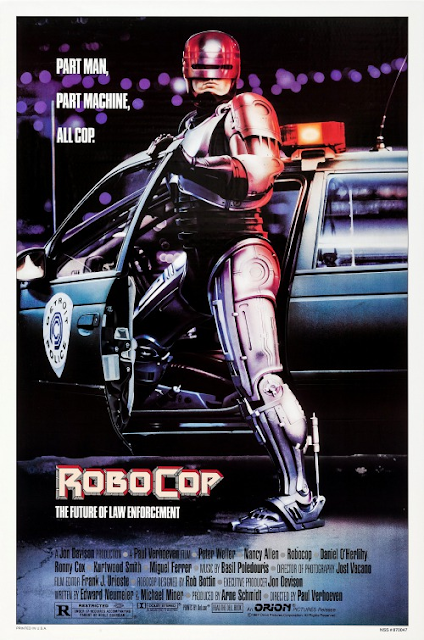
One of the great films from the 1980s, and my personal favorite from 1987, “Robocop” is a tough, violent, near dystopian satire on capitalism, the justice system, and technology, all in a package that is action filled and funny as hell. If for some reason you have never seen “Robocop”, stop reading, go watch it now. Every minute of your life without this film in it already, is a waste. 

The last time I wrote about this movie, it was based on a special presentation of the film in tribute to Miguel Ferrer who had passed just a few weeks before that screening. (Robocop: Miguel Ferrer Remembered With Dr. Peter Weller

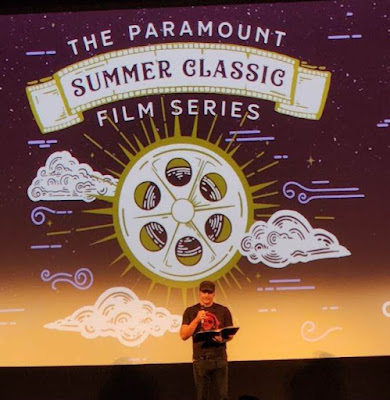
). That crowd was very enthusiastic as was the audience yesterday at the Paramount Theater in Austin. I will be going to a number of classic films this summer at the Paramount, and if you follow Social Media, you should be able to see the traditional photo I take each time in front of the marquee. I don’t have tee shirts for all of the films I will be seeing this summer, but for some of them, I have more choices than are really necessary.

I have spoken about the film multiple times on podcasts and in conversation. The first time I saw the film was in a sneak preview, and the audience reaction sounded like a freight train. The movie is assembled so much more artfully than anyone hearing the title is likely to expect. I am just going to mention a few things for this post, at some point I will include this on my Movies I Want Everyone to See list, and then I will do a real deep dive.

Kurtwood Smith, as Clarence Boddicker, is the kind of villain that every movie fan longs for. He has personality and is sometimes appealing, but in a repellant manner. We want him to keep acting in the outrageous manner he does, but we are also impatient for him to get what is coming to him because he is so loathsome. Smith smirks his bad guy smile through crimes, meetings, murders and everyday social moments. We know from looking at him that he is an asshat, but he is a fascinating one. Ronny Cox is the real big bad of the story, but I will save him for next time.

Dan O’Herlihy, as “The Old Man”, the chair of Omni Consumer Products, is not an evil character in this film. In fact, despite some callousness in the face of a demonstration mishap, he really seems concerned about doing something to restore Old Detroit. It was not until the sequel that his indifference is extended to evil subterfuge. His gravitas goes a long way in selling the corporate climate that director Paul Verhoeven  is shooting for. The script even gives him some warmth at the conclusion of the film, and that is the right choice for this particular story. 

I am a big fan of stop motion effects, and I think they look so much more interesting when used the right way, than some of the excessive CGI that you see in movies nowadays. It is strange that something that is so clearly artificial; can feel more real than the computer images that replicate the real world that actors surrounded by green screens are forced to exist in. The legendary Phil Tippet, working with designer Craig Hayes, created the ED 209 sequences in the film. Robocop fighting Ed 209 is the highlight of the technology in the film, but it is the battle with Boddicker’s gang that provides the emotional component of the film. 

I return to Robocop at least annually, and having just experienced it, I am ready to do it again. 
KAMAD Throwback Thursdays 1975: Love and Death

Throwback Thursday #TBT

Throwback Thursday on the KAMAD site will be a regular occurrence in the next year. As a motivational project, to make sure I am working on something, even in a week where I don’t see a new film in a theater, I am going to post on movies from 1975. Along with 1984, this is one of my favorite years for movies and it is full of bittersweet memories as well. 1975 was my Senior Year in High School and my Freshman Year in College. The greatest film of the last 60 years came out in 1975, as well as dozens of great and not so great cinematic endeavors. Most of the films in this weekly series will have been seen in a theater in 1975, but there are several that I only caught up with later. I hope you all enjoy. 

Love and Death

Years ago, I saw a trailer for a Woody Allen film, it might have been “Stardust Memories”, where the voice over complained, “remember when he used to make funny movies?”. As a matter of fact I do, and this was the last in his earlier films that were absurdist more than introspective. I have no problems with the later movies, many of them can proudly stand as some of the best films ever made, but there is a clear demarcation point where Woody stopped being a Mel Brooks sort of film maker, and tacked off in a different direction.

The film is sort of a take off on Russian Literature. Much like Mel Brooks did parodies of Westerns and Hitchcock, this film is sort of a parody of Russian novels, particularly those by Dostoyevsky and Tolstoy, such as The Brothers Karamazov, Crime and Punishment, and War and Peace. There are so many characters and they are intertwined in ways that requires a diagram to make sense of it. Here is a nice example of Allen mocking the absurd convolutions of some Russian Novels, this is a line of dialogue spoken by Jessica Harer late in the film:

“It’s a very complicated situation,cousin Sonja.         

I’m in love with Alexei. He loves Alicia. 

Alicia’s having an affair with Lev.

Lev loves Tatiana.

Tatiana loves Simkin.

Simkin loves me.

I love Simkin,

but in a different way than Alexei.

Alexei loves Tatiana like a sister.

Tatiana’s sister loves Trigorian

like a brother.

Trigorian’s brother

is having an affair with my sister, who he likes physically,

but not spiritually.

The exception here is that the names are not nearly as complicated and similar as you might find in some of that literature. That’s OK because Woody uses names for characters that are actually in the plot, which are : Anton Inbedkov, Leon Voskovec, Countess Alexandrovna, Boris Grushenko, Vladimir Maximovitch, Old Nehamkin and Young Nehamkin.

In addition to the Russian Literature, European films get a little tweak as well. Ingmar Bergman, one of Allen’s heroes, has his visage of Death from the “Seventh Seal”, played with well before Bill and Ted got ahold of it. There is alo a clever shot of Diane Keaton and Jessica Harper which replicates an image from persona.

In spite of the serious pretentions of those themes, the movie is closer to slapstick than satire. Allen engages in ridiculous wordplay with other characters, some of which sounds like it came right out of a Daffy Duck/Bugs Bunny cartoon. The training sequence when his character of Boris is being prepared to be in the army, fighting against Napoleon’s invasion of Russia, is a series of comic shots that use simple images as gags, like a rifle that falls apart or a bayonet that can’t be withdrawn from a practice dummy. This material could easily have come from “Blazing Saddles” or “History of the World Part 1”.

Woody gets only a little more serious when he does some verbal comic riffs on the metaphysics of existence and on morality. As a long time instructor in argumentation, I enjoyed his twisted version of the famous Aristotelian Syllogism:

murder… the most foul of all crimes. What would Socrates say? All those Greeks were homosexuals. Boy, they must have had some wild parties. I bet they all took a house together in Crete for the summer. A: Socrates is a man. B: All men are mortal. C: All men are Socrates. That means all men are homosexuals. Heh… I’m not a homosexual. Once, some cossacks whistled at me. I happen to have the kind of body that excites both persuasions. You know, some men are heterosexual and some men are bisexual and some men don’t think about sex at all, you know… they become lawyers.”

The story does not have to make much sense, it just has to give Allen and Diane Keaton a chance to go wild with the long winded quotes and the shocked double takes that break the fourth wall at times, but then this could easily have been one of Allen’s stand up routines from his early days. Add to those amusingly drol moments, the silly puns and visual jokes, like Boris’s fathers piece of pand, and you have a great example of someone making a movie to make us laugh rather than to make a point. This may have been the transition between the pointlessness of films like “Bananas” and Sleeper” and the later gems like “Annie Hall” and Hannah and Her Sisters”. Both types of films deserve our attention, but for different reasons.

Raiders of the Lost Ark (Fathom Events)

I just happened on this screening by looking at the app for one of the Cinema Chains that I have a membership to. I suppose this has been scheduled in anticipation of the upcoming “Indiana Jones and the Dial of Destiny”. In essence, we are paying for a commercial that lasts two hours for a movie that opens at the end of the month, frankly I’m OK with that, as was the nearly full auditorium of movie fans I saw this with. 

You can find previous posts on “Raiders of the Lost Ark” here

and here

, and also here

, and at least one more here

So I am not going to do a deep dive on this post, although there is always something more to see or talk about on a great movie. I just want to cover two quick things as an acknowledgement of my seeing the film again on the big screen.

First up, I want to address the notion, widely promulgated after an episode of  “The Big Bang Theory”, that Indiana Jones is really irrelevant to the plot in this, since the Nazis would have found the ark regardless and been destroyed by it, just like what happens in the film. People who believe this are ignoring two big points. First and perhaps most importantly, they would not have found the Ark without Dr. Jones. The whole opening sequence sets up the premise that Rene Belloq is a parasite who claims treasures after Indy find them. 

” Dr. Jones. Again we see there is nothing you can possess which I cannot take away.”

This has been a pattern that continues with the search for the Ark. They need Ravenwood’s headpiece but don’t know where he is and how to contact him. So what do they do? They follow Indiana, who has taken up the task himself. Toht follows Indy to Nepal, follows him to Marion’s place, and then follows up Indy’s offer to Marion with threats instead. It may not be the best influence on the plot, because he gives away the location of the prize, but it is certainly relevant. 

Second, we learn that the head piece the Nazi team is using is missing key information. Information that allows Indiana to find and take possession of the Ark. Belloq only gets his hands on it because Indy found it first. Repeating their pattern.

 “So once again, Jones, what was briefly yours is now mine.”

It is also true that without Indy, the Ark might have remained with the Nazi’s . We don’t see how it is accomplished but the famous last scene in the film shows the Ark being buried again, this time by the American Government, in a tomb of ephemera and flotsam, contained in nearly identical crates. That does not happen without Dr. Jones and Marion, even if we don’t get to see how it was done.

Now, as to a couple of different points, I’d like to give a shout out to a couple of the supporting actors. Ronald Lacey as the despicable Toht, Gestapo tool and torturer, is delightfully fiendish in his role. He oozes menace in Nepal, whines like a wounded animal when he handles the red hot head piece, and nicely plays the visual joke of the coat hanger that looks so menacing in Cairo. His scream in the climactic sequence is also frightfully deserving.

William Hootkins, who plays Major Eaton, from Army Intelligence, is the personification of the old joke that the phrase “Army Intelligence” is an oxymoron. In the first meeting with Jones he comes off as a clueless but inquisitive investigator. In the last segment, he is an officious bureaucrat, whose curt answer of “Top Men” as the team that will be investigating the Ark, is perfect. It is dismissive and condescending and exactly parodies the type of government incompetence that Dr. Jones has to deal with.   

KAMAD Throwback Thursdays 1975: The Drowning Pool

Throwback Thursday #TBT

Throwback Thursday on the KAMAD site will be a regular occurrence in the next year. As a motivational project, to make sure I am working on something, even in a week where I don’t see a new film in a theater, I am going to post on movies from 1975. Along with 1984, this is one of my favorite years for movies and it is full of bittersweet memories as well. 1975 was my Senior Year in High School and my Freshman Year in College. The greatest film of the last 60 years came out in 1975, as well as dozens of great and not so great cinematic endeavors. Most of the films in this weekly series will have been seen in a theater in 1975, but there are several that I only caught up with later. I hope you all enjoy. 

At one point, I was set to buy this on ebay, believing that Strother Martin was in the film for a second Harper Story. It would have been for my companion blog, “The Strother Martin Film Project”. When I looked closer at the credits, I realized that Strother does not appear in this film, so I skipped it and never ended up seeing it until this last weekend. In 1975, I could easily have skipped this simply because I had limited resources or availability. Although there were six screens within walking distance of where I lived, not everything played in my town.

This is a fish out of water story following Lew Harper, a private detective from California, who ends up in Louisiana, trying to help out a woman that he’d had an affair with several years earlier. The plot at first involves blackmail, but as things roll along, there is political corruption, bribery, kidnapping, murder and assorted other felonies that become part of the story. This is a sequel of sorts to “Harper” which did feature the same character that Paul Newman is playing and in which Strother did have a part. Since it was directed by Stuart Rosenberg, who had done “Cool Hand Luke” and “Pocket Money” with Newman and Martin in each, that’s why I was confused. 

Newman is a natural at playing an aw shucks, slightly disheveled, low key private investigator. Harper’s persona is not unlike that of Jim Rockford from the TV series, they are both wise guys, eager to talk their way out of trouble rather than fight their way out, but willing to sucker punch someone in the right circumstances. Newman is playing against his real life wife Joanne Woodward, as Iris, his ex-flame. Melanie Griffith is an ingenue in the film, and she is in the middle of a busy year here. In 1975 she was previously in “Smile”, and  she will appear in “Night Moves” which was released the same month as this. Character actors Richard Jaeckel, Andy Robinson and Paul Koslo also are in the movie, but the most important other character was played by a co-star in the most important film of the year, decade, era and maybe ever. 

Murray Hamilton plays the not very well disguised villain of the piece, J.H. Kilbourne, a wealthy oil baron, aching for the land that belongs to the family that Woodward’s character Iris is a member of. There is a secondary villain that you can probably figure out but is much better hidden for the eventual reveal at the end of the film. Hamilton is an oily, self centered kook, with a slightly Cajon accent. His performance is very distinctive from his role as the feckless mayor of Amity in “Jaws”. Hamilton worked primarily in television but had an important part in “The Graduate” and then his two biggest parts were the films that came out this year.

The movie is a diverting piece of slow burn southern mystery, that will not compel you to rewatch it but also will not irritate you for taking the time to check it off of your list. The sequence referred to in the title is actually pretty effective and it is all done in camera so it looks really good. Not an essential film from the era, but definitely has the vibe of all those other 70s films that you remember so well. 

Escape from New York-Presented By Robert Rodriguez

Apparently, I should have chosen 1981 for my Summer Movie Season debate claim from the Lambcast a couple of weeks ago. After all, 1981 had “An American Werewolf in London”, “Raiders of the Lost Ark”, “Superman II” and this film, the one that turned Kurt Russell from a Disney kid into an action star. I saw “Escape From New York” in the Summer of 1981 at the El Rey Theater on Main Street in my hometown of Alhambra California. I’d been married for a year and I had summer off between semesters, while my poor wife had to work, so I saw this at a matinee by myself. I had to take her to see it the next week, because I knew she would love it, and sure enough, she fell completely for Kurt Russell.

This was a low budget film that made the most of every dollar they had to spend. John Carpenter was a viable director after his success with “Halloween” and he had made a TV biopic about Elvis with Kurt Russell, so it feels a little inevitable that they would work together in a completely original project. The premise is a simple one, Manhattan has been turned into a maximum security prison, where the convicts are dumped to make out the best they can. In the middle of an international crisis, the President’s plane goes down in the area, and someone has to go in and recover him and the McGuffin he in possession of. Former military hero, now convict Snake Plissken, is given the job as a way of gaining his freedom.

Russell does his best Clint Eastwood impression throughout the film, and that makes sense because when Carpenter originally wrote the screenplay years earlier, he had envisioned Eastwood in the part. Snake is an anti-authoritarian, like John Carpenter himself, so the movie is full of middle fingers extended toward the government, convention, and anything else that was pissing off the director at the time. Russell plays Snake as a sullen outsider, who wisely trusts no one and is a lot more of a strategic thinker than he is given credit for.  He snarls and growls his way through the plot, remaining cool in the face of every obstacle he ends up against. 

The action scenes are not complicated but they are fun. As Snake tries to get away from a swarm of crazies at one point, he uses his weapon to improvise a door through a wall. It’s a terrific looking action piece and emblematic of the kinds of creative moments Carpenter brings to the film. I combat sequence in a boxing ring is brutal without getting as gory as it would be if this film were made today. The nihilism evinced by Snake is downright compelling, even if it runs contrary to the world’s best interest. He is so indifferent that he even puts off a moment of personal revenge because he is tired. His final FU to the whole affair is completely fitting with the character and the semi-dystopian world that all of the characters are operating in. 

Four years ago, we got to see the movie at the TCM Film Festival, with both Carpenter and Russel in attendance.

I’d been a fan of the TV critics Siskel and Ebert since I’d discovered their show on PBS a couple of years before this film came out. While putting this post together I came across their reviews for this film, and if you have a few minutes you can watch it here:

As much as I respected Roger Ebert, I usually found myself on the same side of the equation as Gene Siskel. This may have been the tipping point for me way back in 1981, and lasting until Siskel’s death in 1999. 

Last night’s screening was presented by Austin based film maker Robert Rodriguez. Before the movie screened he did a brief introduction and he surveyed the house on the number of people seeing the movie for the first time, for the first time on the big screen, and who had seen it in theaters in 1981. A couple people up front were given some nice gifts, one of which were some personal sketches done for the film and signed to Rodriguez by production designer Joe Alves (the production designer of Jaws also). He shared a bit about his personal relationship to the movie, and how he came to be acquainted with Carpenter and worked with Kurt Russell on “Grindhouse”. He promised a few stories after the film as well. 

The most amusing one involved Kurt Russell. Rodriguez was showing off his love of “Escape From New York” to Russell when they were together one time by showing that the wallpaper on his phone was an image of Snake Plissken. Russell responded by getting out his own i-phone, fumbling with it for a minute and then asking Suri “Who am I” , to which Suri replied, “You are Snake Plissken”. Kurt laughed and said, I’m the only one in the world who can do that. 

Jaws (2023 Entry #1)

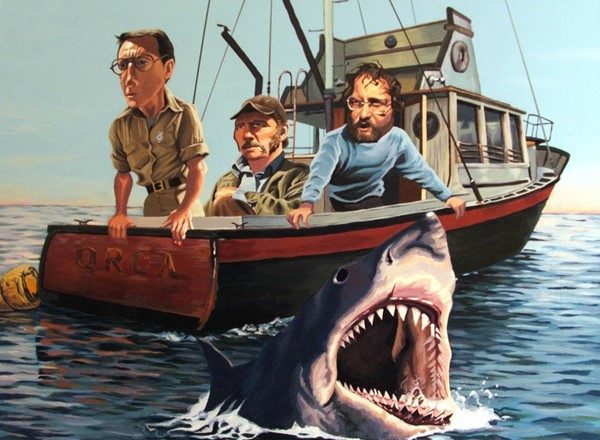
I’ve posted the trailer for Jaws a dozen times before, so I am changing it up a little for this post. Chief Brody is the character in the film with the most important story arc, and the sequence above explains that his instincts are really headed in the right direction. The fact that Mayor Vaughn talks him out of closing the beaches does not make him the bad guy. Martin Brody has a huge about of guilt poured on him when Alex Kitner is killed by the shark, but remember, his kids were on the beach, and he was trying to be cautious in pursuing his responsibilities as Chief of Police for this community. The fact that he gets bull rushed by the Mayor and Selectmen about closing the beaches a second time, shows that he is not the one ultimately responsible, but he shoulders that burden anyway. 

His wife Ellen, tells Hooper about Martin’s fear of the water and dislike of being on the ocean. It takes an act of courage, fueled by his own guilt, to get Brody onto the Orca and to join the fight to end the shark. Once on the boat, Brody is made a figure of ridicule by both Hooper and Quint. Their jabs are subtle, sometimes condescending, but all of them are attempts to assert dominance in the triumvirate that is on this odyssey. Martin is the realist, who believes they are outmatched when he sees the shark and utters the famous line from the film. Some might see it as cowardice, Quint certainly does, but it turns out he was entirely correct. The good man, who is not blinded by his fear from thirty years earlier, or by the intellectual superiority that Hooper assumes, is the one who had the best advice, and he was ignored because of the other two men’s assumptions. 

I have seen this film well over a hundred times, and every experience bring satisfaction. Sometimes it is for the inventiveness of the director, sometimes I am awed by an actor’s performance, occasionally I marvel at a technical achievement. This time, it is the spine of the script that I was noticing the most. Chief Brody is the glue that holds the film together. He is an average family man faced with extraordinary circumstances. We watch him get out of bed, struggle with mundane issues like feeding the dogs and chastising his kids, before he gets slapped in the face with the remains of Chrissie Watkins. He finds the fortitude to try to do what is right. he defers to authority when it is necessary, and defies authority when it is clear that someone else has to act. 

Roy Scheider’s Chief is the odd man out on the Orca. Both Quint and Hooper are experienced sailors. Maybe their experiences are different, but they are comfortable on the water. We know Brody is not. Quint is Ahab, chasing the White Whale. Hooper is an academic, determined to prove his superiority to the old fashioned ways of the senior fisherman. Brody just wants to kill the shark, however it can be done. It is his responsibility to take care of the extended family of the Amity Community. He is not trying to prove himself or impress anyone, he just wants to get her done. 

I have written about Scheider’s performance before. He is excellent in this film, but Dreyfuss gets the funny lines and Shaw has the mic drop moment in the film. Brody is the everyday hero that a family and a town need. 

Fast X (AKA Fast Ten Your Seatbelts)

I don’t know what to say about these movies that has not already been said by me and a thousand others. “The Fast and Furious” series has gotten bigger and more preposterous with each entry, and the connection to reality disappeared around the fifth one in the series. They are extremely well made, over the top action films, that you can enjoy the heck out of, as long as you are willing to give up any sense of reality. The physics are silly, the characters are cartoons, the stunts are Rube Goldberg sequences that will make you want to go back to your childhood and play “Mousetrap”. Every movie has the same tropes in it somewhere, there is a racing scene, shots of girls wiggling their hind ends to hip hop songs at the race scene, and then there are the character beats. Vin Diesel’s Dom gets serious and says he has to go it alone, the team mocks that idea, Letty defies the notion, and they all end up working together. There will be new characters introduced, usually with some family connections. A Secondary character will return to be sacrificed at some point in the story, and a dead character will be resurrected. There is also usually a double cross somewhere ion the story, and/or enemies come together for a common purpose. 

“Fast X” or “Fast Ten Your Seatbelts” as my friend Mark Hofmeyer would call it) has all of those moments. Like a Roger Moore 007 film, it checks off the essentials, tosses them together and then gets by on it’s stars. Michelle Rodriguez continues to glower at everyone who might be an opponent, and if there is a woman to be taken down, she will get the sequence that requires that ass whopping. Tyrese Gibson and Ludacris will do their Abbot and Costello routine, fall out for 30 seconds and then bond again. They are the comic relief most of the time, although there are other characters that do get to put some comedic spin on what they are doing. The characters of Han and Ramsey are along for the ride on this one, but they have almost nothing to do for most of the story. Charlize Theron likewise, is in the story, but the segment with her and Letty is mostly shoehorned in to give them something to do while the rest of the action is taking place. 

The best thing that the makers of this franchise have done, is introduce new characters on a regular basis. Those characters can come back and be part of the action in the next films. Dwayne Johnson, Jason Statham and Jon Cena all started out as antagonists to Dom’s team, and end up working with them in later films. Helen Mirren is not given a lot to do, but when she shows up, she classes up the film a bit. I try to avoid spoilers in my essays so be careful with this next bit, although anyone who has followed the series knows that it is true. Characters die in the films, but they all seem to come back somehow. We get a couple of those moments and the film itself is a bit of a tipoff because of how it ends.

Fresh faces keep things lively in the eleven films so far (which includes the Hobbs and Shaw spinoff). Jon Cena was the anti-Dom in the last film, and now he is back as a semi-autonomous surrogate father for several scenes. He seems to be having a great time and I enjoyed his sequences more than most of the others. However, it is clearly Jason Momoa who is having the most fun with this movie. His character is flamboyantly evil, and Momoa plays him with gusto and panache. The character is written as a stylized villain, and the actor embraces the character the same way that John Lithgow took on Lord John Whorfin in the Adventures of Buckaroo Banzai: Across the Eighth Dimension. His costumes, hair, eyebrows and voice all scream “I’m the Bad Guy!! Pay Attention to Me!”. It is exactly right, even the use of the extended arms in a crucified like position as a visual exclamation point that the character has a habit of posing in, feel like a comic book bad guy should be. The retcon sequence that brings Dante into the story is not as elaborate as the one that got Cena’s Jacob in the last film, but it was managed well and it works. 

The one new wrinkle this film gives us is that it ends on a cliffhanger moment. All of our heroes appear to be doomed and the bad guy has won. There are several strings that you can pull at to come up with more story. For example Brie Larson could find her Dad Kurt Russell and start a new hunt on the villain. Jason Statham is on his way to protect his Mama from the bad guy, so that can be a path to follow. And Letty’s new alliance with Theron’s Cipher has been set up with a twist that I saw coming three movies ago. Regardless of all that potential, I am confident that the dead will rise, the strings will be tied up, and if Dante, Momoa’s character is not sent to hell, he will become an anti-hero ally in entry number 12. I heard they were going to stop after the next one, but I also thought Han was dead. 

KAMAD Throwback Thursdays 1975: Return of the Pink Panther

Throwback Thursday #TBT

Throwback Thursday on the KAMAD site will be a regular occurrence in the next year. As a motivational project, to make sure I am working on something, even in a week where I don’t see a new film in a theater, I am going to post on movies from 1975. Along with 1984, this is one of my favorite years for movies and it is full of bittersweet memories as well. 1975 was my Senior Year in High School and my Freshman Year in College. The greatest film of the last 60 years came out in 1975, as well as dozens of great and not so great cinematic endeavors. Most of the films in this weekly series will have been seen in a theater in 1975, but there are several that I only caught up with later. I hope you all enjoy. 

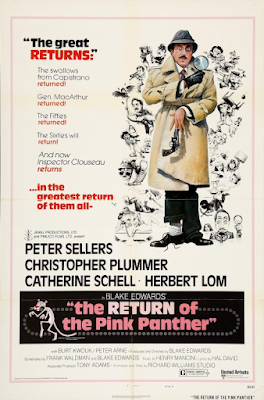
Return of the Pink Panther

One of the reasons I am pursuing this Throwback Thursday exercise, is that it allows me to wallow in the nostalgia of my own nostalgia sometimes. Today’s film is one of those occasions.  I covered “The Return of the Pink Panther” on my original project in 2010. You can read that post here

. My original memories of the film are catalogued there.

One thing that has changed in the past thirteen years is that there is now a trailer for the film available on YouTube, which like on most of my posts, you will find at the top of this essay. Back in 2010, the only thing I could find was the title sequence, and that link is now gone. If you watch the titles, you will get a delightful Pink Panther cartoon, one where the silent feline does impressions of movie characters, including Bogart, Groucho Marx and Charlie Chaplin. I don’t know what the inspiration for this theme was, but it feels completely fitting for a Blake Edwards film. 

At this point in the series, the movies became a vehicle for Peter Sellars to do physical comedy and verbal humor. The plot is not really important, which is why Christopher Plummer feels almost invisible in the movie, he is second billed but completely detached from most of the things that happen in the story. In fact, it is actress Catherine Schell who is most involved in the plot as Sellar’s Inspector Clouseau, searches for her character’s husband, played by Plummer, and also tries to find evidence of his involvement in the theft once again of the legendary titular diamond.  One of my favorite comedic beats comes from her as Lady Litton, running back into the bathroom where Clouseau and a bellboy are hiding in a sauna. The steam from the sauna has made the floor wet, and Sellars and the bellboy have already gotten some laughs with their feet slipping out from under them. When Schell comes back in, she slips as well, but grabs on to a column in the large bathroom, and does a perfect spin on it. The fact that she is in a bathrobe, almost makes it look like she is doing some pole dancing.

When I read my original article after watching the movie this morning, I noticed I had made mention of a joke about a telephone in the foyer of the Litton Family estate. Clouseau, masquerading ineffectively as a telephone repair person, is trying to get into the office to do some digging, and he has to come up with a reason why the phone right there in the foyer will not work for his repairs. It is a throw away minute that I was not paying attention to this morning. After I read my earlier comments, I went back and looked at the moment again, yep, there it was. A visual joke that Sellar’s pantomines through and gave me a huge laugh. Again I will not spoil it for you, but be alert if you get to that moment, don’t look away. 

“Return of the Pink Panther” was one of the films my fellow Lamb Dave Anderson used this last week on the Lambcast, when arguing that 1975 was the greatest movie summer. I might well have chosen it myself if I had been defending 1975, which as you can tell from this year long project, is pretty special to me. 

This is the iteration of the films where Clouseau’s boss, played by Herbert Lom, goes mad and becomes the antagonist for the next few entries of the series. Lom is very amusing as the frustrated Chief Inspector Dreyfus. His twitching eyebrows and maniacal looks let us know he is on the brink of losing it. In the opening section in his office, he is so flummoxed  by the ridiculous Clouseau, that he almost kills himself and his assistant by accident. So between the bellboy, Lom, Schell, and the continuingly reliable Burt Kwouk, it is clear that the slap stick was not just limited to Sellars, but that Blake Edwards had a lot to do with it as well.

Just as a side note, I saw the actor playing the Hotel Concierge, and kept asking myself where I’d seen him before. Victor Spinetti was not a familiar name, but it suddenly broke through to me that he was the frustrated T.V. director in the Beatles Film, “A Hard Days Night”. So if you are looking for a stream of consciousness recommendation for a film to put on today, you can’t do better than that. 

Phantom of the Paradise (1974) Revisit

I have loved this film since I saw it in December of 1974 at the UA Theater in Pasadena, with my friend Art Franz. We were both movie buffs and the rock score and theatrical aspects of the trailer and the poster, lured us in with ease. I have since watched it a dozen times at minimum, including a screening in Los Angeles at the Silent Movie Theater in 2012.  Paul Williams, the star and songwriter of the film, made an appearance at that show. I found a notice of that show on the website of “The Swan Archives“. 

You can read my own notes on this event here. It was a wonderful evening that reminded me of how much I love this film. So it is a pleasure to report that I had another great experience with Phantom, this time as a result of the Alamo Drafthouse here in Austin. 

The event on Monday night was billed as a special screening, but it was not clear what was going to be special about it. As far as I’m concerned, anytime you can see a movie you love in a theater, it is a special event, so I was just happy to get a ticket and attend. It turned out to be special for two great reasons. The screening was proceeded by a lecture from the Principal Archivist of the “Swan Archives”. The discussion focused on the need for a re-mastered version of the film to be released on home media. The Archivist, Ari Kahan, has devoted much personal time and energy to keeping Swan’s name alive., in particular by nurturing this film.

During the presentation, there were extensive demonstrations of changes that had to be made to the original release, due to an agreement by 20th Century Fox, and the representatives of Led Zeppelin. The band used the name “Swan Song” for their publishing rights, and to avoid a legal battle, some compromises were made to the film at the time of it’s release.  Those included extensive use of floating matts in the film, to cover up references to “Swan Song” that could be construed as copyright infringement.  Of course that was a ridiculous mistake, and the shaky matts were very noticeable in the power point presentation. Additional flaws have to do with color correction and saturation that undermine many of the scenes in the film.

Finally, there is the issue of the title, which at one point would have been simply “Phantom”, but someone was concerned with confusing the film with the comic book character (this was well before the Andrew Lloyd Webber musical). “of the Paradise” was an addition that referred to the theater that Swan had constructed to be his ultimate concert venue, much like the Fillmore East or West of the day. The original elements had to be recreated since the negative has the matts on it, and the editing had to be cleaned up as well. A remastered version has been created with the help of the original editor, Paul Hirsh, one of the crew who turned the original “Star Wars” into a success.  The films writer and director Brian DePalma, has been supportive of this restoration effort, and the current owners of the film rights would be willing to follow through, if the now defunct Led Zeppelin, would release the studio from their agreement. Even after a lengthy appeal, supported by a variety of film and music notables, the answer was no. So a remastered version of the film will not be coming to you anytime soon.

However, that doesn’t mean that remastered version will never be seen by anyone. It appears that the screening on Monday night had all of the corrections that had been discussed in the lecture. The copy screened for us was the version that Kahan, DePalma, Edgar Wright, Paul Williams and a variety of others would like us to have. It was well worth the effort. I did not get a chance to speak with the Archivist as we left, he was chatting with some others, but I did shout out a thank you and give him a thumbs up.  

The Film  

If you have never seen “The Phantom of the Paradise” let’s just say it is a version of Faust and Phantom of the Opera, set in the rock world of the early 1970s. Ambitious composer Winslow Leach, has his music stolen from him and in a series of complications, is disfigured and now hunts down his tormentors in the Rock and Roll Concert Palace called “The Paradise”. Winslow is played with heart breaking sincerity by  the late William Finley, probably most recognizable from DePalma’s film “Sisters”.  His antagonist is simply known as “Swan”, a musical producer who seems to have become a minion of evil, trading success for souls.

Swan is played by Paul Williams, who will be instantly recognizable to anyone over the age of fifty, but might be a new face to those millennials and Gen Z audience members, discovering the film for the first time. While Williams is terrific in the role, sufficiently  charming and repellant simultaneously,  it is his musical talent that makes the greatest impact on the film. He composed the score and the songs used in the film and they are well crafted, satirical, and very entertaining. The fictitious band “The Juicy Fruits” do “Goodbye Eddie” and “Upholstery” in do wop and surf styles, mining the then current nostalgia wave. Fans of the Broadway Musical that came later, will probably appreciate “Special to Me” and “Old Souls” performed by ingenue Phoenix, played and sung by Jessica Harper. Those moments foreshadow “Think of Me” and “I Remember” from the Broadway show. 

“The Juicy Fruits” and “The Undead” are two bands that are background characters in the story, the same actors portray both bands and they get to do some funny satire in the opening song, and a great deal of stage theatrics in the debut of “Faust” on the Paradise stage. One of whom, Peter Ebling billed as Harold Oblong, also did the choreography. The stage sequence and makeup for the song “Somebody Super Like You” is a blast, reminiscent of Alice Cooper and Kiss.  All of that gets shuttled aside when Beef makes his appearance. The Glam/Metal rocker is played by Gerrit Graham, and he practically steals the movie. He is supremely confident at times, and manically insecure and fearful at other moments. He has some of the best comic moments of the film and he gets maximum milege out of them.

I smiled with delight as the movie opened, and I nodded my approval at the altered titles which indicated that we were getting the remastered version of the films. I had to stop myself from singing along and humming the melodies, so as not to disturb the other members of the audience, but it was an emotionally satisfying 90 minutes and I am pleased to share what I can of it with you. 

KAMAD Throwback Thursdays 1975: Three Days of the Condor

 Throwback Thursday #TBT

Throwback Thursday on the KAMAD site will be a regular occurrence in the next year. As a motivational project, to make sure I am working on something, even in a week where I don’t see a new film in a theater, I am going to post on movies from 1975. Along with 1984, this is one of my favorite years for movies and it is full of bittersweet memories as well. 1975 was my Senior Year in High School and my Freshman Year in College. The greatest film of the last 60 years came out in 1975, as well as dozens of great and not so great cinematic endeavors. Most of the films in this weekly series will have been seen in a theater in 1975, but there are several that I only caught up with later. I hope you all enjoy. 

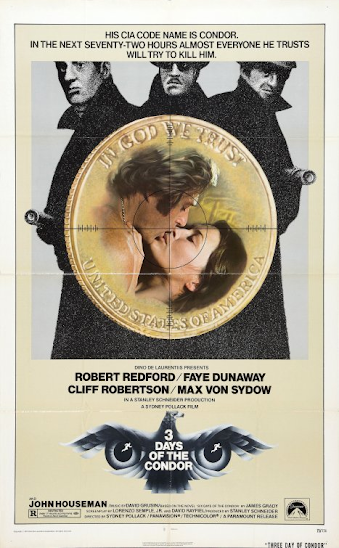
Three Days of the Condor

This week’s Throwback Thursday is a real treat, one of the great paranoia films from the 1970s Starring Robert Redford and Fay Dunaway. “Three Days of the Condor” is a spy film about a guy who is not really a spy, he just works with them. As an analyst , Redford as Joe Turner, codename Condor, trips over a secret plot by a covert group operating inside of the CIA. 

“Listen. I work for the CIA. I am not a spy. I just read books! We read everything that’s published in the world. And we… we feed the plots – dirty tricks, codes – into a computer, and the computer checks against actual CIA plans and operations. I look for leaks, I look for new ideas… We read adventures and novels and journals. I… I… Who’d invent a job like that?”

I like to think there is a job like that, it is something I might have liked doing. I may not quite have been ambitious enough about espionage to become James Bond, but I could probably do this. The opening few minutes of the film establish the mundane existence of most of the employees of the CIA. They file reports, process data, gather statistics and read a lot of things they may have no interest in. Condor is a bit of an iconoclast in his working group. He mocks the security measures that gatekeep the front door of his office, he rises a bicycle with a motor on it to work (and he is consistently late to the exasperation of his superior), and he by-passes the back door security when it rains. His diffident nature is what allows him to accidentally escape the fate that befalls his co-workers. The event that sets up the rest of the story is shown as a brutal, passionless, exercise by professionals to take out a leak, by murdering seven innocent worker bees. 

While Turner is not a field operative, he is still pretty smart and capable. Condor may be a little panicked about what has happened, but he is also now highly suspicious of everyone. That sense of paranoia infuses the film with the suspenseful atmosphere that director Sydney Pollack was certainly shooting for. It takes a while for we the audience to figure out what is going on, Turner is trying to do so while being hunted, and it is a complex plot. The elements of a procedural are there, as Condor ties to fit pieces of information together to understand what has happened. There is also a 007 trope of involving an outsider, as both a ally and a romantic partner, and that is where Dunaway comes in. She does not show up in the first half hour of the film, and the tense and fearful relationship she has with Condor is believable. That period of antagonism and disbelief makes it easier for us to swallow a romance between the two that might otherwise have seemed an illogical contrivance.

Operating on his own, Turner seeks more information about the command structure that might have taken something he wrote in a report as a threat. Once Dunaway is on board, he has a collaborator who allows him to try various means to identify who in the CIA is after him and why. For my money, the best part of the story is the contract agent Joubert, a tall taciturn European, who leads the hunt to wipe out the leaks, especially Condor. Joubert is played by the great Max Von Sydow, who seems to have done a similar role as an unreliable spy in a half dozen other films. There is a terrific shot right at the stary of the attack on Condor’s work group, where Von Sydow is crossing the street and we see his reflection in the uneven waters on the street and in the gutter, right after it had been raining. Along with the execution sequence, this is one of those moments when a professional like Pollack was the right choice to put the script on the screen. 

Joubert has two other strong moments in the film. In one, he is riding in an elevator with Condor and a group of unaffiliated people. He knows who Condor is, but Turner doesn’t know him, he only suspects the man who is polite in the elevator. It is a scene of tension and a little bit of humor as they play cat and mouse while the elevator descend to the lobby. At the end of the film, in an odd twist, Joubert becomes a different figure and he now does a little bit of talking and mentoring. Von Sydow played Blofeld in the 1983 James Bond offshoot, “Never Say Never Again” and it would have been fun to see him in that role in a series of Bond films. 

Also in the cast is John Houseman, who appeared in “Rollerball” a TBT film I wrote about earlier this year, shows up in another of those roles that would define his later career. After winning the award for Best Supporting Actor in 1973 as the imperious Harvard Law Professor Kingsfield, he was the go to choice for dry, humorless corporate mandarins. The CIA in this film is filled with unreliable types who act ruthlessly in order to achieve their objectives. Houseman is a senior to Cliff Robertson’s character, who at first is trying to help Condor, and then suspects Turner, and finally seems to turn into the same kind of man as the rest of the CIA has become. 

Along with “The Parallax View”, “The Conversation” and Redford’s next film “All the President’s Men”, “Three Days of the Condor” would lead you to believe that there is always a conspiracy, everyone is watching and listening, and the good guys don’t always win. That is definitely 1975 for you.