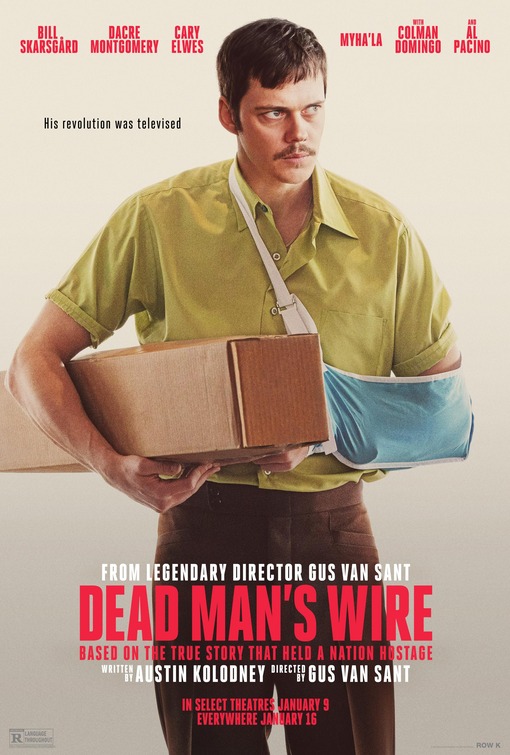
Dead Man’s Wire (2026)

We got an early peek the other night at one of the films that will certainly be a highlight of the first quarter of 2026. This movie features two stellar performances, and a very efficient reenactment of a real life event from 1977. I was in college in 1977, but I’d been doing quite a bit of traveling with the debate team, and at the time that this news event took place I was only vaguely aware of it. I’m glad that I didn’t have a complete memory of what happened, so although there was an actual historical antecedent I was surprised by the turnout of the events.

“Dead Man’s Wire” tells the story of a man frustrated by his inability to overcome economic forces that were crushing him. If you took the hostage drama of “Dog Day Afternoon” and combined it with the injustices that drive the characters in “Hell or High Water”, you would have a pretty good template for this movie. Tony Kiritsis takes a man hostage by looping a wire around the man’s head connected to a sawed-off shotgun with another wire connected to Tony. His goal is to recover economically from the dirty deed that a mortgage company has done to him, or at least that’s how he sees it. There’s been a long-standing dispute between Tony and the company over his mortgage on a piece of property that he hoped to develop in which he claims the mortgage company interfered with in order to force him into liquidation. It’s not merely the money however it bothers him. Tony is on a righteous crusade to get an apology from the president of the mortgage company who was his original target, but instead he is forced to take the vice president, who is the son of the president, as his hostage.

The real life incident took place in Indianapolis, and the filmmakers do a good job replicating the feel of 1977. The film stock seems to be from that era, with a good clear image, but a patina of shading it seems authentic to the time. Indianapolis is not a big city like New York, they didn’t necessarily have a hostage negotiator available, or a specialized SWAT team trained in all kinds of responses. Frankly the authorities are befuddled as to how to proceed. The suspense derives from the fact that any assault on Tony would result in the immediate death of his victim Richard.

Tony is played with gusto by the versatile Bill Skarsgård, who has become an obsession of my daughter. I think I saw three films starring Skarsgård last year. I can say however that this is his best performance without being under a pile of makeup. Tony has a righteous indignation, but he is not particularly cruel or vindictive to Richard. That helps keep him a sympathetic character which is exactly what the real Tony Kiritsis became to the public back in the day. He feels like a crusading Robin Hood trying to right a wrong that everybody else could identify as a thing they could easily have fallen prey to. The little guy against the system is the main theme of the film. Although the movie is very serious, like “Dog Day Afternoon”, there are moments of levity that occur because of the quirks of the characters.

Richard is played by actor Dacre Montgomery, best known for his portrayal of Billy in the show “Stranger Things”. He looks completely different in this role, and unlike the muscle bound preening Billy of the TV show, here he comes across as a bit of a nebish with a stoop and an awkward way of being polite that puts him at odds with Tony. These two actors account for most of the screen time but there is some other activity that’s worth mentioning. Richard’s father, the real villain of the piece, is played by Al Pacino with a little too much of that Foghorn Leghorn articulation that he’s developed over the years. If there is a weak link in the film, it’s from the most experienced of the actors. The father is equally self-righteous that he has done nothing wrong, to the point where he abuses his son Richard almost as much as Tony did.

The collection of local officials, some of whom knew Tony, as a local businessman, bar buddy, and occasional public nuisance. The undercover police officer who first arrives at the scene of the original kidnapping, is an acquaintance of Tony from a local bar. No one can believe that Tony is attempting this audacious Act of Justice, which violates the law and decency in an attempt to be treated decently. The cop is played by an unrecognizable Cary Elwes, and he is also terrific in the part. Even more impressive, once again, is Colman Domingo, who plays a local DJ, Fred Temple, who takes Tony’s call and helps mediate the crisis while trying to keep things cool.

There’s also a huge amount of social commentary in the way the news business handles this event. In the days before 24 hour cable news, local stations provided updates but not the continuous coverage that we would see today. The local news gets picked up for National presentation, so the two and a half days that this incident covers was closely watched by a nation that was not used to seeing crimes carried out live on TV.

As an audience, our sympathies are with both men, Tony for the Injustice done to him and Richard for the threat that’s being placed on his life. Neither man deserves what is happening. The police, and ultimately the FBI, arrange a deal with Tony, that you hope is going to resolve things. I won’t spoil the resolution for you, but I will say that it is a real world illustration of how the justice system can get something right even though they do so in the wrong way.

This movie deserves your attention, and it will command your interest through the performances of the two leads in the improbable but real life story. It’s hard to believe that it took 50 years to turn this into a movie, but first time screenwriter Austin Kolodney has done a nice job taking the unusual aspects of the real life story and turning it into a compelling narrative with an interesting theme. The movie is seamlessly directed by veteran Gus Van Zant. This may be the most accessible film he’s made since “Good Will Hunting”. Hopefully it’ll enjoy a good deal of success and bring attention to the actors who deserve credit for making us care.

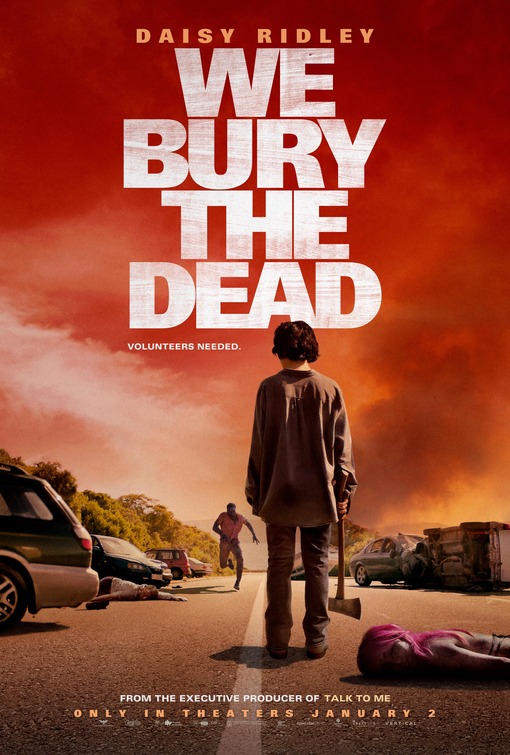
We Bury the Dead (2025)

An interesting little drama disguised as a horror film, “We Bury the Dead” stars Daisy Ridley as a woman who may in fact be a widow but it’s not sure yet. The fact that she is an American becomes an issue because of the potential threat her husband faced. It seems that the United States was testing an electronic weapon in the southern seas when an accident occurred and the entire population in part of Australia was wiped out. Although it may be that they were not wiped out entirely, because this is something of a zombie film.

As a way to get to the distant location where her husband was located deep in the disaster area, Ava volunteers to be part of the National Emergency Recovery team, which basically consists of volunteers to collect the dead and identify those who have been damaged into a zombified state. As she engages in this volunteer work, she is also plotting a way to get the few hundred miles south to the resort island where her husband is supposed to be.

In a way all zombie films are meditations on grief, and our unwillingness to let go of our loved ones even in the worst of circumstances. There are other characters in this story, who are volunteering for their own personal reasons as well, and Ava forms an alliance with one of them to make her way South with his assistance. So, it is also going to be a road trip movie. Although we know that there are living dead in the affected region, this rarely becomes the traditional kind of horror film that features zombies. It is really only one jump scare that makes this a horror film, as usual, the real monsters in these stories are the living who take advantage of the circumstances.

The story is told with a series of flashbacks to the time before she and her husband were separated by this trip. We learn over several of these mediations that while they were in love, they did have problems. So this is also a film about the discovery in your love relationship. There are complications on the road, and a sense of foreboding haunts us through most of the movie, but there are only two or three moments of real tension. Those moments however were staged very effectively. Ava is viewed suspiciously a few times during the film because of her nationality, but politics is not really on the minds of the filmmakers, they are worried about our emotional psyche.

I thought the film was pretty efficient at telling its story and keeping it interesting. Those people looking for a zombie film that is filled with double taps, infected bites, and standoffs against hundreds of the Living Dead, will be disappointed. There are a couple of interesting turns during the film, one of which has already been explored in last year’s “28 Years Later”,.so this film is second to that theme. There is also an interesting reveal about the personal problems between Ava star and her husband, which comes at the start of the third act.

This must have been a moderately budgeted film, but the director is getting the most out of the resources that they were given. And even though it is a zombie infested Wasteland, the Tasmanian locations are still going to be an inviting tourist spot for those who take in the film. Ridley is solid, operating in a zone between the stupor of grief and the mania of trying to get to her husband. There are two other major characters, and they provide opposite ends of a story continuum, in an outcome that is more hopeful that is realistic.