The above is not the trailer for the film, rather it is the YouTube version of the podcast that we did on the LAMBcast a month ago. I also wrote about the screening we went to last year, and you cna check that out HERE.
So there are no additional comments that I want to add at this time, but I will share a picture with you.
We have been recruited to defend the frontier against Xur and the Kodan Armada.
Every time I see this movie I am floored by the accomplishment of the technicians, craftsmen and especially the director of this film. I have written about the movie a couple of times before. You can read my comments from last year’s screening at the Paramount Theater here. I have a more extensive look at the film from a screening I took my daughter to at the Egyptian Theater in 2016. It still befuddles me how she can love movies, the way I do, but not love this film. As the programmer mentioned in his introduction, everyone will see something different in the movie, and probably different every time they see it.
This time around, I thought I might talk a bit about 2001 as a horror story. It may not be a slasher film in the traditional sense, and there is no monster per se in the film, except for the A.I. at the heart of the main part of the film. The HAL 9000 is the apex of computer technology in the era of the film. Referred to as “Hal”, it really feels like a crewman aboard the Discovery. Along with Dave Bowman and Frank Poole, Hal works and interacts with the team onboard like any other soul. In fact at times, his warm voice and cheerful demeanor in playing chess, doing his psyche profiles of the crew and diagnosing problems with the telecommunication array, Hal can feel less mechanical than the speech and appearance of his human compatriots. We realize however, in the first inkling of the horror to come, that Hal has his own agenda, when he eavesdrops on Frank and Dave when they isolate themselves in one of the pods. This perfect intermission pause lets us ponder the danger ahead.
Hal turns out to be a spree killer. There is something wrong with him despite the vaunted reputation of the 9000 series of computers. His protestations that he is only acting in the best interest of the mission by preventing Dave and Frank from shutting down his higher level capacities, is really just a cover for killing to protect his self image. He cannot accept the fact that he has made a mistake somewhere, and that it is not human error that accounts for that failure. He does not need to kill the three crewman in hibernation to prevent his shutdown, and they are an essential part of the mission. So his action is a reflex to being discovered as a fraud. The AI in Hal has become a little too human.
The dramatic sequence where Hal shuts down the life support for the sleeping crew is horrifying without any overt violence and no blood at all. The more direct murder of Frank Poole is more visually engaging and intellectually cruel, but the starkest element of the whole thing, which really turns this section into a horror film, at least for a moment, is when he is confronted by Dave in the excursion pod. Not yet realizing what Hal has done, Dave attempts to rescue Frank, and learns upon his return to the ship that Hal will no longer cooperate with him. By letting Dave remain stuck in the pod without any recourse, it is as if he has buried him alive and he is walking away without a second thought.
Hal once again tries to gain back some humanity, when Dave finds a way to defeat Hal’s attempted murder. Hal grovels and pleads for understanding. In essence he is begging for his life. Dave becomes a vindictive avenger, but it is only an act of self preservation. He won’t kill Hal without at least allowing him a human moment, like the one Hal tried to deny him. If this interpretation seems unreasonable to you, contrast this movie with Kubrick’s version of “The Shining”. Hal Kills more people than Jack Torrance does, and he is as evil in his banality as Jack was in his fever dreams.
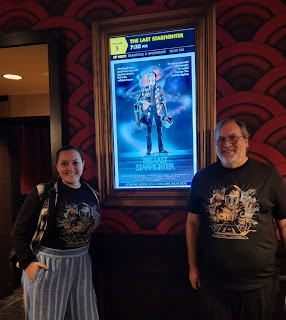
Like I said, there are a myriad of ways to see this film, I just thought I’d take a different journey for this screening. I had a marvelous time, in part because I received several comments from other audience members on my shirt. In fact, the compliment I received allowed me to engage in a nice conversation with Mark and his daughter Mari, who were seated right behind me. He asked if he could take a picture on my shirt and I asked him to take one for me. Mari had not seen the whole film before last night. Her previous attempt did not make it to the intermission and the home viewing experience according to her was marred by her own cell phone distraction. She seemed sufficiently satisfied at the end of the movie, so it’s likely Mark will get the pleasure of seeing this again with his daughter. I wish I could say the same about my own kid. Oh well, be your own person, but you are missing out on something here.
We missed “The Searchers” at the TCM Film Festival this year because it was opposite to “Chinatown”. I am so thankful that Steven Jannise and the Paramount Programmed it for their 70mm week, because that was the format we missed when we were in Los Angeles. This iconic western has one of the all time great John Wayne performances, and it is another of his many collaborations with the great John Ford.
Ethan Edwards (Wayne) is a returning Civil War vet, from the losing side, who reconnects with his brother’s family in Texas. Ethan is a hard case in regard to an adopted nephew, who has some of the Native American blood that ran through the veins of the Indians who killed Ethan’s parents. Marty, has been considered a brother and son to Aaron and Martha and their children. Marty is played by Jeffrey Hunter, who I knew best as Captain Christopher Pike in the pilot for Star Trek. His easy going manner and sincerity become a counterpoint to Ethan during the film. Ethan is wise and sly and plays his cards close to the vest. Like Sonny Corleone, Marty sometimes lets people outside of the family know what he is thinking, resulting in complications.
The thing they are searching for is the remaining sister of the family, everyone else having been slaughtered in an Indian raid while Ethan and Marty were with a posse pursuing a false lead. The young Debbie has been taken by a Chief they learn is named “Scar”, and for five years, they pursue rumors, stories and tips about the white girl and the Indian Chief who has taken her into his tribe. Wayne’s performance is frequently grim for several plot related reasons. It is strongly suggested that he carried a torch for his sister-in-law, and one of the reasons he was slow to return after the was was this unstated love. It also appears that he has been a bit of a tough guy on the trail, maybe benefiting from some less than savory means of making a living, although he does seem to have a code which would preclude anything we might thing of as unethical.
Most of the movie is filmed in Monument Valley and it looks spectacular in color. Ford seemed to really love that part of the country and made it the backdrop in several of his films. The hostility of the Indian tribes is not the only problem that Ethan and Marty face on the trail. In addition to inclement weather, they encounter bushwhacking merchants, overzealous Texas Rangers and domestic conflict at home. It seems that Mary and Laurie, from the neighboring homestead, have a less than well defined romantic relationship. Each of them finds themselves involved with a different partner that they truly don’t want. There is a lot of humor in the film, and most of it comes from their tempestuous long distance love affair.
Ethan and Marty are also at cross purposes in regard to Debbie. Both of them want to save her from captivity and sexual slavery as one of Scar’s wives, but they have completely different ideas about what that means. Ethan’s bitterness at the loss of his family drives hatred toward the Indians and their path. There are two or three action sequences where a fight between the Searchers and Indian warriors take place. Ethan is in his natural environment in those moments. He lets his hatred overcome him when plotting against Scar. Marty is the hopeful optimist who wants to reunite his sister with the homelife that he knows. The main conflict in the end is between he and Ethan and also Ethan’s inner selves. At the resolution, Ethan remains an outsider, in spite of the ultimate decision he makes. This is a deep thought western, not just a shoot’em up. So glad to see it on the big screen and in 70 mm.


 Kirkham A Movie A Day